

FIGURE 1.
Gazefinder movie samples and their areas-of-interest (AoIs). (A) Screenshot of the human face without mouth motion; AoI-1 and AoI-2 include the eye and mouth regions, respectively; (B) Screenshot of the human face with mouth motion; AoI-1 and AoI-2 include the eye and mouth regions, respectively; (C) Screenshot of biological motion; AoI-1 and AoI-2 are the upright and inverted images, respectively; (D) Screenshot of the preference paradigm; AoI-1 and AoI-2 are people and geometry, respectively; (E) Screenshot of finger pointing; AoI-1 and AoI-2 are social and geometry areas, respectively.
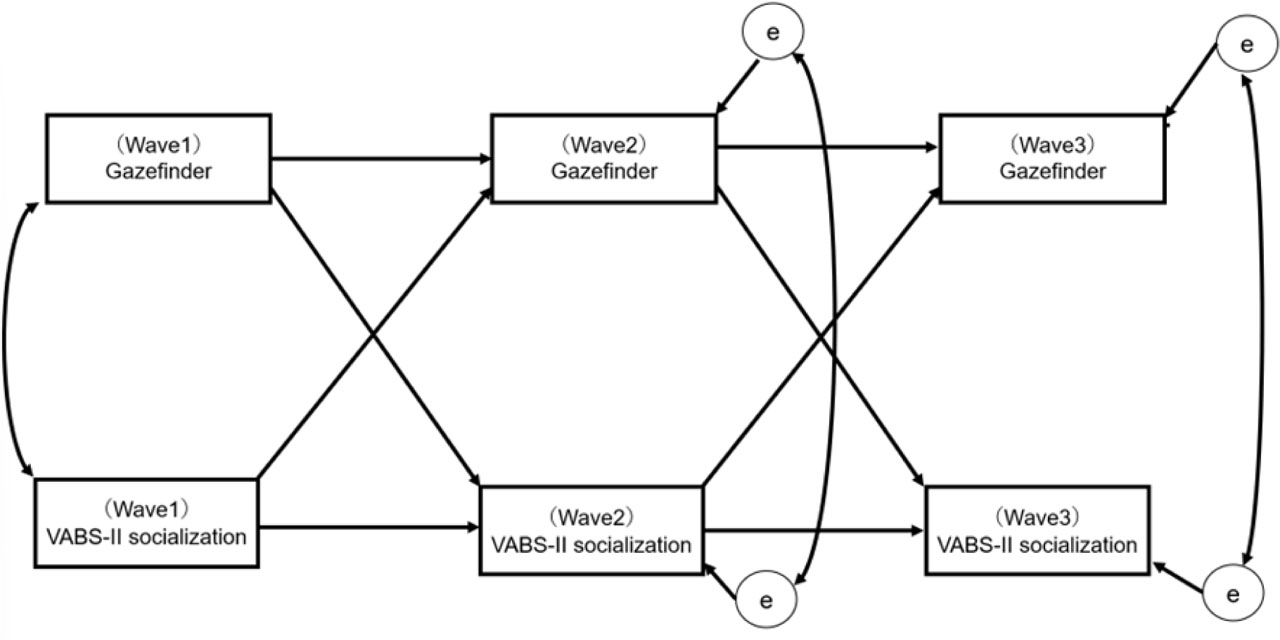
FIGURE 2.
Cross-lagged effects model of the scores of Gazefinder and VABS-II.
TABLE 1.
Descriptive statistics for each index at the three time points.
| Wave 1 | Wave 2 | Wave 3 | F | p | ηp2 | |
|---|---|---|---|---|---|---|
| Age (range) | 4.01 ± 0.84 (2.10–5.57) | 5.22 ± 0.66 (4.19–6.61) | 6.57 ± 0.63 (5.25–7.61) | 350.515 | < .001 | 0.938 |
| SRS (range) | 29.52 ± 9.46 (9–46) | 25.96 ± 10.74 (7–48) | 24.30 ± 12.83 (4–69) | 2.841 | .069 | 0.114 |
| WISC-IV FSIQ (range) | 104.82±12.63 (85–130) | |||||
| Gazefinder | ||||||
| Face without mouth motion | ||||||
| Eye region (%) | 46.3 ± 19.5 | 56.3 ± 12.4 | 53.0 ± 18.7 | 0.688 | .508 | 0.029 |
| Mouth region (%) | 18.1 ± 12.8 | 20.8 ± 10.9 | 20.7 ± 13.5 | 2.971 | .061 | 0.114 |
| Face with mouth motion | ||||||
| Eye region (%) | 25.3 ± 15.5 | 22.9 ± 16.5 | 26.4 ± 17.6 | 0.521 | .597 | 0.022 |
| Mouth region (%) | 44.9 ± 27.1 | 54.6 ± 18.8 | 52.5 ± 20.7 | 2.407 | .118 | 0.095 |
| Biological Motion (BM) | ||||||
| Upright (%) | 48.5 ± 18.6 | 53.2 ± 16.5 | 47.2 ± 20.1 | 0.735 | .485 | 0.031 |
| Preference Paradigm | ||||||
| People region (%) | 45.1 ± 18.9 | 44.5 ± 11.6 | 46.9 ± 12.3 | 0.267 | .708 | 0.011 |
| Finger Pointing | ||||||
| Social (%) | 39.7 ± 23.3 | 36.1 ± 11.7 | 41.9 ± 12.0 | 0.951 | .378 | 0.040 |
| VABS-II | ||||||
| Communication | 100.5 ± 10.5 | 99.0 ± 9.9 | 103.3 ± 8.8 | 1.949 | .154 | 0.078 |
| Socialization | 103.6 ± 6.6 | 100.7 ± 8.4 | 98.1 ± 10.3 | 3.147 | .052 | 0.120 |
| Daily living skills | 103.9 ± 11.3 | 103.5 ± 11.5 | 100.1 ± 12.7 | 1.224 | .304 | 0.051 |
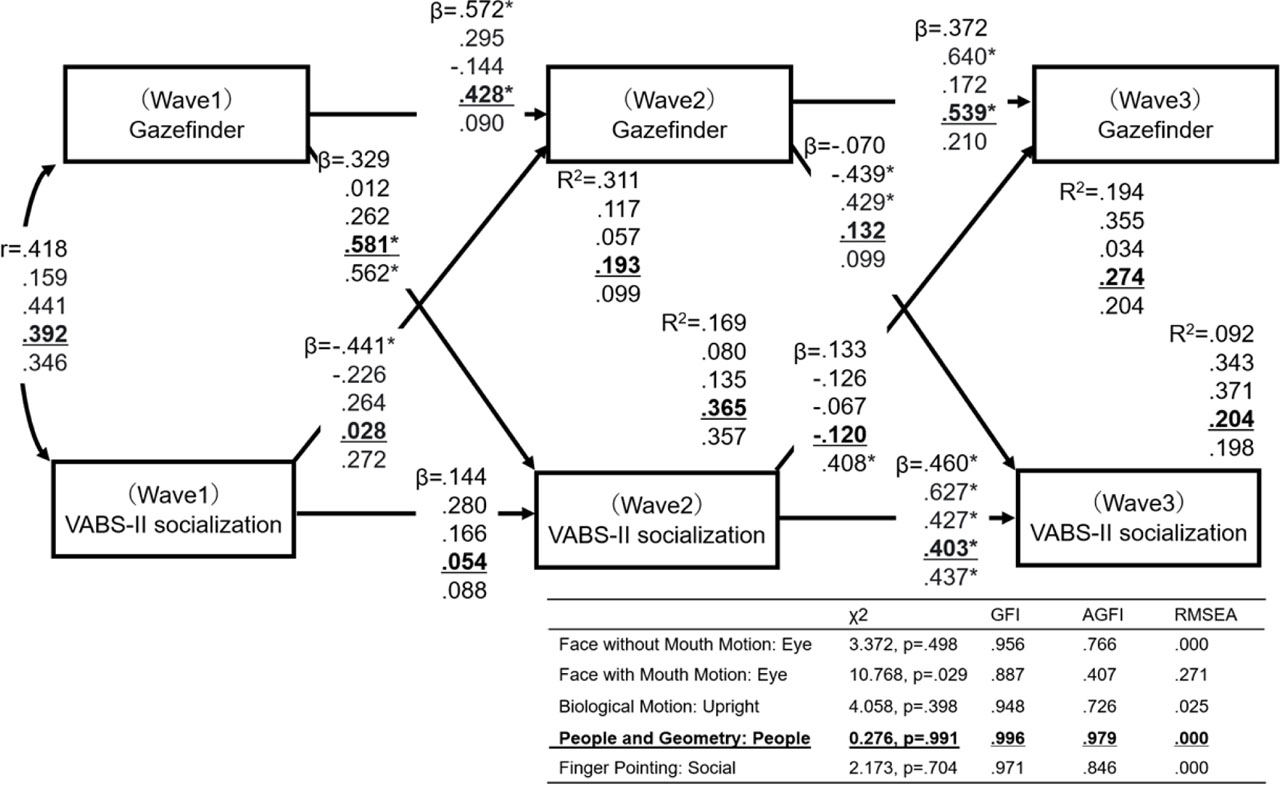
FIGURE 3.
Cross-lagged panel model of percentage fixation times for social information and socialization scores of VABSII. Note. *p < .05, **p < .01. The values on the path were for the standardized coefficient (β). The values from the top are for the human face without mouth motion, the human face with mouth motion, biological motion, preference paradigm, and finger-pointing. The results for (D), the preference paradigm that met all four model-fit criteria, are underlined in bold.