
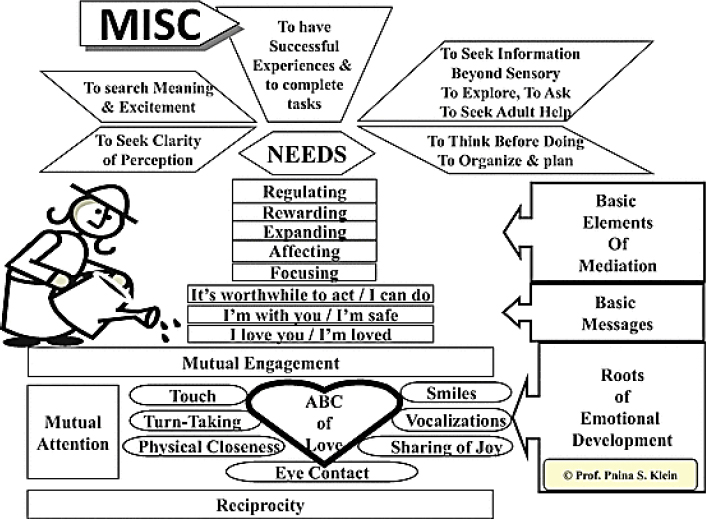
FIGURE 1.
The conceptual model guiding the Mediational Intervention for Sensitizing Caregivers (MISC).
TABLE 1.
OMI positive and negative cognitive components.
| Cognitive component | Description | Positive example | Negative example |
|---|---|---|---|
| Focusing | Statement/behavior that is intentionally directed toward affecting a child’s perception or behavior. | Pointing to conflict task instructions. | “Come on, (child name)…” *points to task |
| Child response: looks to instructions, begins reading | Tone: hostile Child response: looks down, slowly moves toward instructions | ||
| Affecting | Provision or request for meaning. Expresses significance of things. Must convey meaning, express excitement, or identify objects or people by name. | “Who else gets involved in the arguments?” | “That is not a good answer.” |
| Child response: “Usually Dad is there too” | Content: invalidating Tone: insensitive Child response: Looks down, sad affect | ||
| Expanding | Directed toward extending the child’s awareness beyond the immediate need or context that triggered the interaction. Must attempt to expand the child’s awareness beyond the immediate context of the interaction, attempt to connect present, past or future experiences, relate to a general, social or biological principal or process, or “tell” about things not seen or heard at the moment. | “What do you think was going through dad’s mind?” | “Why did you think that an okay thing to do? “ |
| Child response: “Maybe he was worried about me being safe” | Content: invalidating [based on context] Tone: hostile Child response: “I don’t know! I already said sorry!”, appears exasperated | ||
| Rewarding | Expresses satisfaction with a child’s behavior and identifies a specific component that contributes to success. | “You worked really hard on that math assignment. You’re doing a great job in school this year” | “You did that all wrong.” |
| Child response: smiling | Content: invalidating Tone: insensitive Child response: Looks away, does not respond | ||
| Regulating | Behaviors or statements that model, demonstrate, and/or verbally suggest to the child regulation of behavior. Raises the child’s awareness to the possibility of “thinking” before doing and of planning steps of behavior towards a goal. | “What will you do first when you get home from school to make sure you finish chores today?” | “Don’t say that, just calm down.” |
| Child response: “I’ll come check in with you first” | Content: controlling Tone: hostile Child response: Angry affect |
TABLE 2.
Sample characteristics (N = 56 mother – child dyads).
| Child | n or M | SD or % |
|---|---|---|
| Age | 12.29 | .83 |
| Gender (female) | 30 | 53.6% |
| Race\Ethnicity* | ||
| Black | 21 | 37.5% |
| White | 23 | 41.1% |
| Hispanic | 2 | 3.6% |
| Multiracial | 12 | 21.4% |
| CBCL psychopathology (borderline; clinical range, n=50) | ||
| Total problems | 12; 7 | 21.4%; 12% |
| Internalizing problems | 8; 8 | 14.3%; 14.3% |
| Externalizing problems | 15; 5 | 26.8%; 8.9% |
| K-SADS DSM-5 diagnoses | ||
| Attention deficit hyperactivity disorder | 35 | 62.5% |
| Oppositional defiant disorder | 26 | 46.4% |
| Major depressive disorder | 20 | 35.7% |
| Generalized anxiety disorder | 15 | 26.8% |
| Separation anxiety disorder | 13 | 23.3% |
| Conduct disorder | 12 | 21.4% |
| Disruptive mood dysregulation disorder | 4 | 7.1% |
| Social anxiety disorder | 6 | 10.7% |
| Post-traumatic stress disorder | 3 | 5.4% |
| Panic Disorder | 2 | 3.6% |
| Childhood Interview for Borderline Personality Disorder diagnosis | 18 | 32.1% |
| Mother | n or M | SD or % |
| Age | 40.30 | 7.28 |
| Race\Ethnicity* | ||
| Black | 19 | 33.9% |
| White | 33 | 58.9% |
| Hispanic | 2 | 3.6% |
| Multiracial | 3 | 5.4% |
| Marital status | ||
| Married/living as married | 20 | 37.5% |
| Never married | 20 | 37.5% |
| Divorced/separated | 14 | 25% |
| Highest level of education | ||
| < High school | 7 | 12.5% |
| High school/GED | 20 | 36.4% |
| Associate’s | 10 | 18.2% |
| Bachelor’s/graduate | 18 | 32.14% |
| Household income | .50 | |
| < $20,000 | 17 | 31.5% |
| $20,000 - $39,000 | 10 | 18.5% |
| $40,000 - $59,000 | 12 | 22.2% |
| > $60,000 | 15 | 27.8% |
TABLE 3.
Frequency of OMI components and Interrater Reliability.
| n with 1+ code | ICC | |
|---|---|---|
| Composite scores | ||
| 1 Emotional sum | NA | .76* |
| 2 Pos. composite | NA | .92** |
| 3 Neg. composite | NA | .94** |
| Pos. components | ||
| 4 Focusing | 13 | NA |
| 5 Affecting | 56 | .92** |
| 6 Expanding | 54 | .93** |
| 7 Rewarding | 6 | NA |
| 8 Regulating | 51 | .81* |
| Neg. components | ||
| 4 Focusing | 1 | NA |
| 5 Affecting | 46 | .92** |
| 6 Expanding | 20 | .63 |
| 7 Rewarding | 0 | NA |
| 8 Regulating | 27 | .98** |
TABLE 4.
Pearson’s correlations among OMI variables and construct validity variables.
| 1. | 2. | 3. | 4. | 5. | 6. | 7. | 8. | 9. | 10. | 11. | 12. | 13. | 14. | 15. | 16. | 17. | 18. | 19. | 20. | 21. | |||
|---|---|---|---|---|---|---|---|---|---|---|---|---|---|---|---|---|---|---|---|---|---|---|---|
| Composite scores | |||||||||||||||||||||||
| 1 Emotional sum | |||||||||||||||||||||||
| 2 Pos. composite | .50** | ||||||||||||||||||||||
| 3 Neg. composite | -.51** | -.44** | |||||||||||||||||||||
| Pos. components | |||||||||||||||||||||||
| 4 Focusing | -.01 | -.02 | .06 | ||||||||||||||||||||
| 5 Affecting | .49** | .94** | -.43** | .01 | |||||||||||||||||||
| 6 Expanding | .03 | .07 | -.12 | -.16 | -.16 | ||||||||||||||||||
| 7 Regulating | .16 | .48** | -.08 | .02 | .22 | .03 | |||||||||||||||||
| Neg. components | |||||||||||||||||||||||
| 8 Affecting | -.48** | -.41** | .97** | .04 | -.39** | -.12 | -.12 | ||||||||||||||||
| 9 Expanding | -.39** | -.31** | .55** | -.14 | -.34* | .09 | -.10 | .43** | |||||||||||||||
| 10 Regulating | -.25 | -.23 | .54** | .23 | -.26 | -.16 | .15 | .36** | .23 | ||||||||||||||
| SCIFF | |||||||||||||||||||||||
| 11 Cohesiveness | .59** | .34* | -.23 | -.27* | .36** | -.12 | .14 | -.20 | -.20 | -.17 | |||||||||||||
| 12 Focus of Problem | .28* | .22 | -.25 | -.10 | .27* | .02 | -.11 | -.23 | -.14 | -.18 | .51** | ||||||||||||
| 13 Positive Affect | .57** | .35** | -.20 | .20 | .39** | -.17 | .10 | -.20 | -.23 | -.04 | .58** | .36** | |||||||||||
| 14 Anger/Frustration | -.23 | -.05 | .49** | .39** | -.01 | -.15 | -.01 | .43** | .47** | .32 | -.40** | -.29** | -.15 | ||||||||||
| 15 Rejection/ Invalidation | -.24 | -.11 | .25 | .27* | -.13 | .08 | -.05 | .20 | .26 | .25 | -.57** | -.47** | -.29 | .58** | |||||||||
| 16 Withdrawal | -.42** | -.33* | -.03 | -.005 | -.25 | -.23 | -.19 | -.07 | -.001 | .12 | -.27** | -.18 | -.15 | -.006 | .06 | ||||||||
| 17 Coerciveness | -.08 | -.004 | .24 | .35** | .001 | -.07 | .04 | .21 | .09 | .25 | -.25 | -.26 | -.14 | .48** | .39** | .03 | |||||||
| 18 Emotional Support | .40** | .35** | -.36** | -.20 | .39** | -.06 | .04 | .35** | -.29* | -.13 | .38** | .55** | .44** | -.51** | .66** | -.22 | -.45** | ||||||
| 19 Respect for Autonomy | .48** | .39** | -.47** | -.09 | .44** | -.08 | .04 | -.46** | -.42** | -.13 | .53** | .48** | .37** | -.39** | -.54** | -.09 | -36** | .81** | |||||
| FACES-IV (n=43) | |||||||||||||||||||||||
| 20 Cohesion | .31* | .30* | -.59** | -.20 | .32* | .11 | -.01 | -.46** | -.53** | -.43** | .13 | .19 | .06 | -.51** | -.50** | -.08 | -.26 | .45** | .53** | ||||
| 21 Flexibility | .03 | .33* | -.40** | -.15 | .27 | .12 | .24 | -.29 | -.43** | -.33** | .05 | .05 | -.11 | -.43** | -.34* | -.11 | -.22 | .34* | .35* | .67** | |||
| 22 PSS°(n=5O) | -.03 | -.29 | -.10 | .11 | -.19 | -.16 | -.31* | -.08 | -.12 | -.09 | -.08 | .19 | -.06 | .03 | .25 | .07 | -.08 | -.15 | -.06 | -.07 | .19 | ||
TABLE 5.
Hierarchical Linear Regressions Testing Utility of Negative Composite over Positive Composite in Predicting Construct Validity Variables
| b | SE | β | t | p | Adj. R2 | ΔAdj. R2 | |
|---|---|---|---|---|---|---|---|
| DV = SCIFF Anger/frustration | |||||||
| Step 1a | -.016 | ||||||
| Pos. cognitive composite | -.003 | .01 | -.05 | -.36 | .72 | ||
| Step 2b | .246 | .262*** | |||||
| Pos. cognitive composite | .01 | .01 | .20 | 1.56 | .12 | ||
| Neg. cognitive composite | .06 | .01 | .58 | 4.44 | < .001 | ||
| DV = SCIFF Emotional support | |||||||
| Step 1c | .105 | ||||||
| Pos. cognitive composite | .02 | .01 | .35 | 2.70 | .008 | ||
| Step 2d | .146 | .041 | |||||
| Pos. cognitive composite | .01 | .01 | .24 | 1.70 | .096 | ||
| Neg. cognitive composite | -.03 | .02 | -.26 | -1.88 | .066 | ||
| DV = SCIFF Respect for autonomy | |||||||
| Step 1e | .137 | ||||||
| Pos. cognitive composite | .02 | .01 | .39 | 3.10 | .003 | ||
| Step 2f | .236 | .099** | |||||
| Pos. cognitive composite | .01 | .01 | .23 | 1.76 | .085 | ||
| Neg. cognitive composite | -.03 | .01 | -.37 | -2.82 | .007 | ||
| DV = FACES-IV Cohesion | |||||||
| Step 1g | .070 | ||||||
| Pos. cognitive composite | .21 | .10 | .30 | 2.0 | .048 | ||
| Step 2h | .333 | .263*** | |||||
| Pos. cognitive composite | .10 | .09 | .15 | 1.10 | .278 | ||
| Neg. cognitive composite | -.87 | .21 | -.55 | -4.14 | < .001 | ||
| DV = FACES-IV Flexibility | |||||||
| Step 1i | .088 | ||||||
| Pos. cognitive composite | .23 | .10 | .33 | 2.25 | .03 | ||
| Step 2j | .174 | 8.6* | |||||
| Pos. cognitive composite | .16 | .10 | .23 | 1.6 | .118 | ||
| Neg. cognitive composite | -.52 | .23 | -.34 | -2.3 | .028 | ||
TABLE 6.
Hierarchical Linear Regressions Testing the Effect of Baseline Affect.
| b | SE | β | t | p | Adj. R2 | ΔAdj. R2 | |
|---|---|---|---|---|---|---|---|
| DV = Mother’s post-discussion PA | |||||||
| Step 1a | .505 | ||||||
| Pre-discussion PA | .81 | .11 | .72 | 7.6 | < .001 | ||
| Step 2b | .519 | .014 | |||||
| Pre-discussion PA | .77 | .11 | .68 | 7.12 | < .001 | ||
| Pos. mediation composite | .04 | .02 | .15 | 1.58 | .120 | ||
| DV = Mother’s post-discussion PA | |||||||
| Step 1c | .505 | ||||||
| Pre-discussion PA | .81 | .11 | .72 | 7.6 | < .001 | ||
| Step 2d | .541 | .036* | |||||
| Pre-discussion PA | .74 | .11 | .65 | 6.8 | < .001 | ||
| Neg. mediation composite | -.10 | .04 | -.22 | -2.3 | .027 | ||