
Table 1
Types of pores present in cementitious mixtures [6].
| Name | Size | Origin |
|---|---|---|
| Air pores | >10 µm | Intentionally or unintentionally entrained air inclusions and porous aggregate material |
| Large capillary pores | 0.05–10 µm | Formed due to the evaporation of excess mixing water from the cement paste and typical porous structures in dense aggregates |
| Small capillary pores | 10–50 nm | Resulting from excess water in the paste and microcrack-like porous structures in the aggregate |
| Gel pores | <10 nm | Approximately 28% of the volume of hydrated cement consists of micropores (1.5–4 nm), small capillary pores, and pores in the interfacial transition zone |
Source: Based on [5].
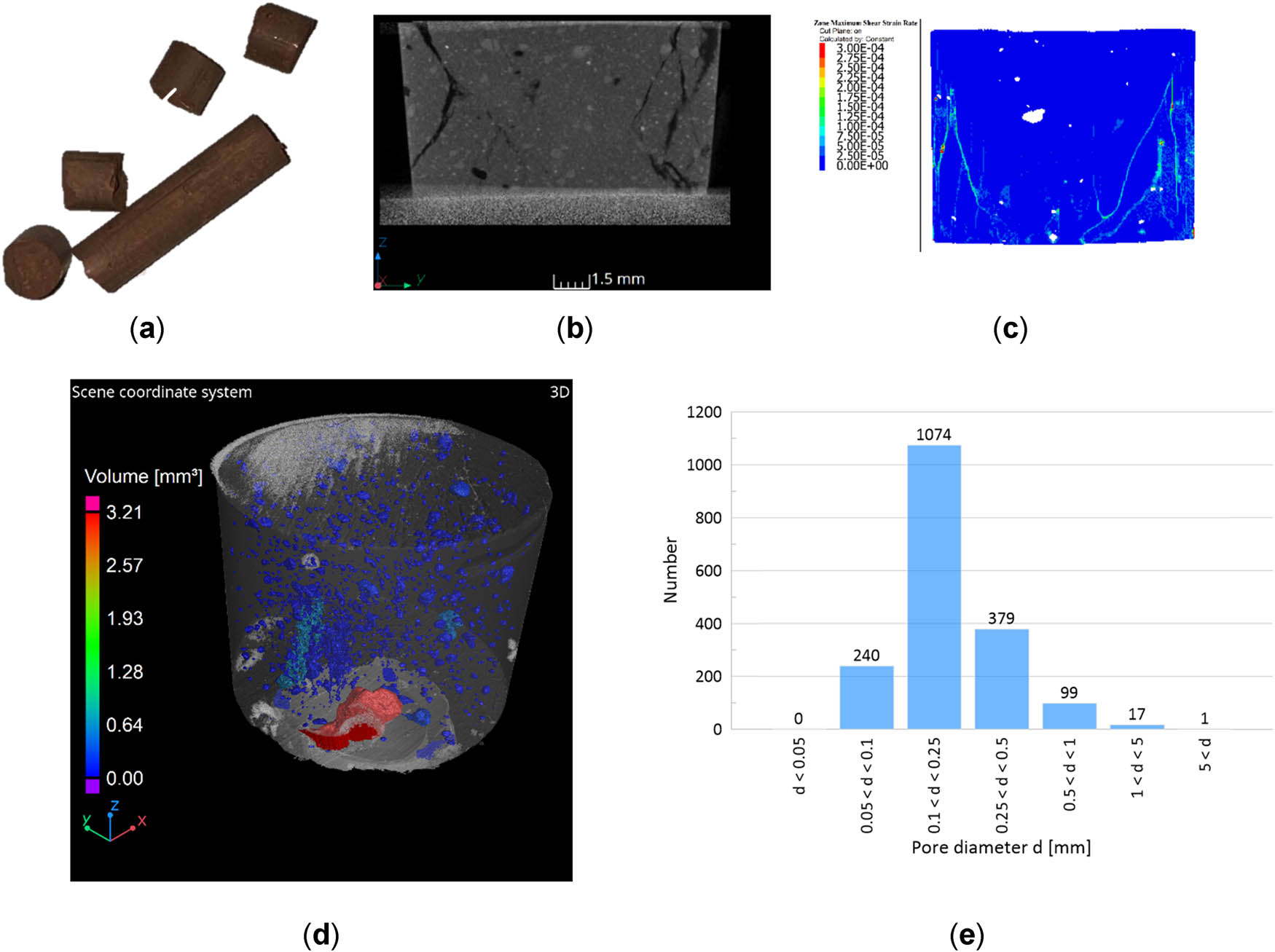
Figure 1
Material used in the study: (a) test specimen; (b) vertical CT cross-section of the failed specimen; (c) result of the calibrated numerical analysis; (d) isometric view; (e) distribution of pores.
Source: Author’s contribution.
Table 2
Numerical parameters for the material.
| E [GPa] | f c0 [MPa] | f cm [MPa] | G c [N/m] | f t0 [MPa] | f tm [MPa] | G t [N/m] |
|---|---|---|---|---|---|---|
| 0.32 | 18.2 | 30.4 | 35,600 | 3.7 | 3.7 | 202 |
Source: Author’s contribution.
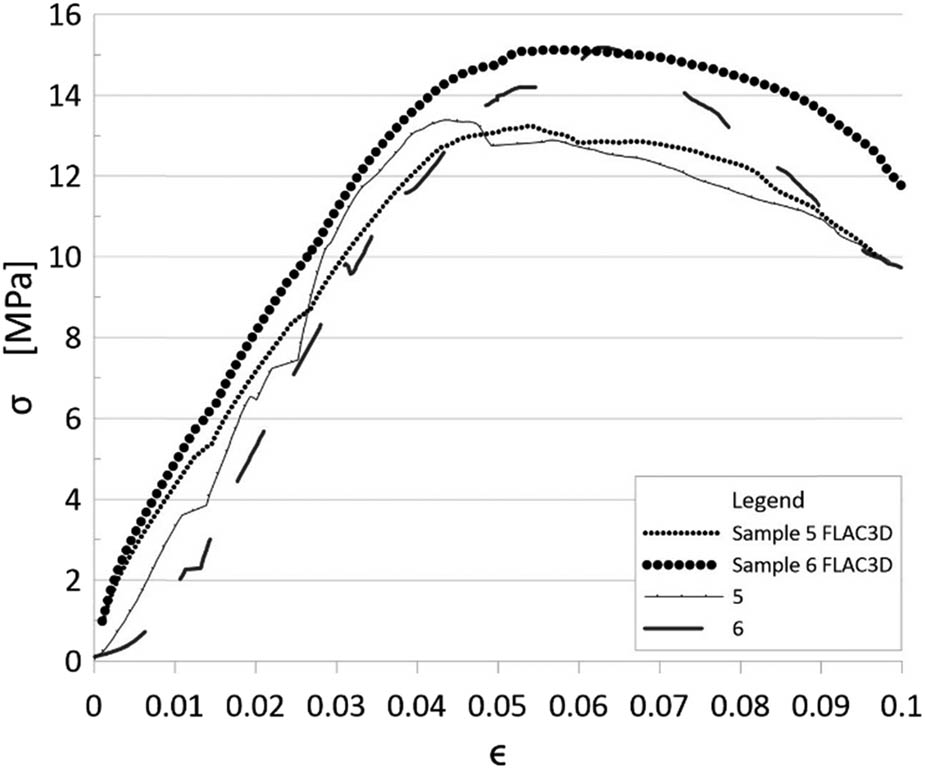
Figure 2
Uniaxial compression. Stress–strain σ(ε) curves for the tested samples and the corresponding simulation results.
Source: Author’s contribution.
Table 3
Description of numerical models.
| No | Base radius [mm] | Scale X | Scale Y | Scale Z | Sphericity | Porosity [%] | Position | Comment |
|---|---|---|---|---|---|---|---|---|
| 0 | 0 | — | — | — | — | 0 | — | Solid model without pores (reference) |
| 1 | 1 | 1 | 1 | 1 | 1 | 0.37 | A,B,C | Model containing spherical pores of varying size |
| 2 | 1.5 | 1 | 1 | 1 | 1 | 1.25 | A,B,C | |
| 3 | 2 | 1 | 1 | 1 | 1 | 2.97 | A,B,C | |
| 4 | 1 | 1.5 | 0.66 | 1 | 0.91 | 0.37 | C | Model with the smallest pores of varying sphericity, horizontally elongated |
| 5 | 1 | 2 | 0.5 | 1 | 0.79 | 0.37 | C | |
| 6 | 1.5 | 1.5 | 0.66 | 1 | 0.92 | 1.25 | C | Model with medium-sized pores of varying sphericity, horizontally elongated |
| 7 | 1.5 | 2 | 0.5 | 1 | 0.79 | 1.25 | C | |
| 8 | 2 | 1.5 | 0.66 | 1 | 0.91 | 2.97 | A,B,C | Model with the most prominent pores of varying sphericity, horizontally elongated |
| 9 | 2 | 2 | 0.5 | 1 | 0.79 | 2.97 | A,B,C |
Source: Author’s contribution.
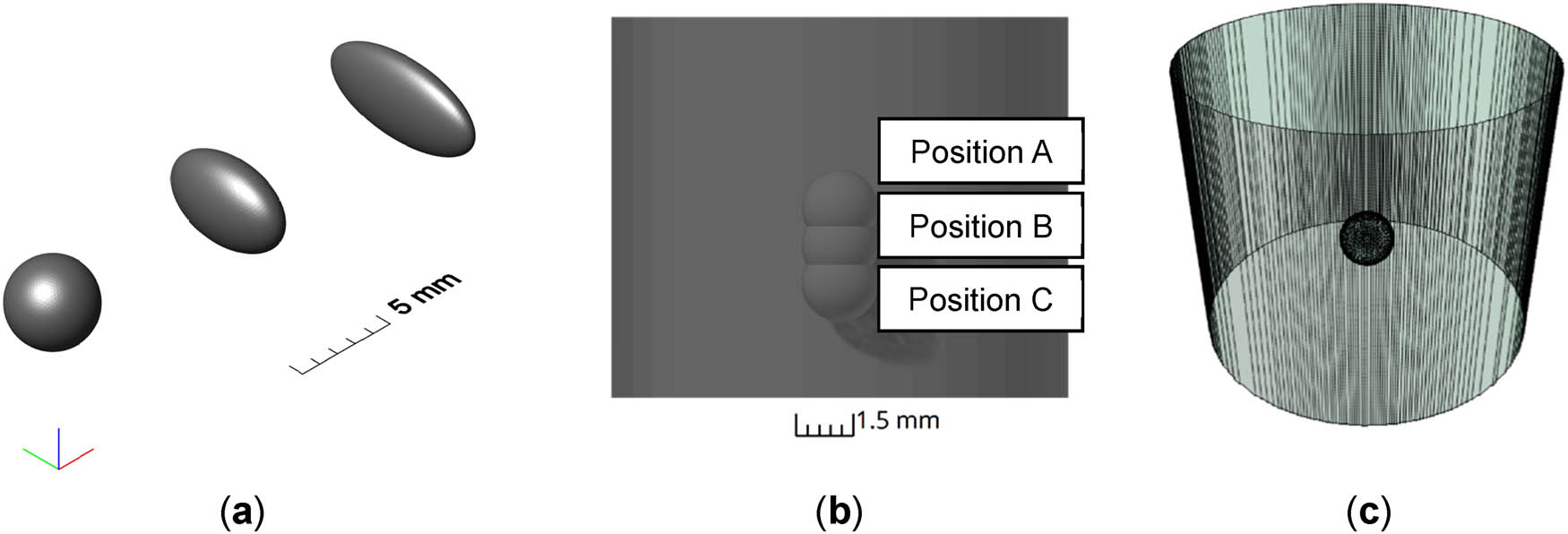
Figure 3
Numerical models: (a) pores with constant volume and varying sphericity, from left to right: 1.0, 0.91, 0.79 – isometric view; (b) three pores of identical diameter shown at positions A, B, and C; (c) model’s geometry view – pore no. 1, position C, FLAC3D.
Source: Author’s contribution.
Table 4
Results summary.
| Porosity [%] | Vertical coordinate of the pore centroid [mm] | Sphericity [−] | Peak compressive stress [MPa] | Axial strain at peak stress [%] | |
|---|---|---|---|---|---|
| 1A | 0.37 | 5 | 1 | 15.79 | 4.9 |
| 1B | 0.37 | 4 | 1 | 15.95 | 4.9 |
| 1C | 0.37 | 3 | 1 | 18.30 | 6.0 |
| 2A | 1.25 | 5 | 1 | 14.70 | 4.8 |
| 2B | 1.25 | 4 | 1 | 14.44 | 4.9 |
| 2C | 1.25 | 3 | 1 | 15.40 | 5.3 |
| 3A | 2.97 | 5 | 1 | 13.75 | 4.6 |
| 3B | 2.97 | 4 | 1 | 13.97 | 4.9 |
| 3C | 2.97 | 3 | 1 | 15.32 | 4.7 |
| 4C | 0.37 | 3 | 0.91 | 17.84 | 5.8 |
| 5C | 0.37 | 3 | 0.79 | 17.75 | 6.0 |
| 6C | 1.25 | 3 | 0.98 | 16.40 | 5.0 |
| 7C | 1.25 | 3 | 0.79 | 16.89 | 5.9 |
| 8A | 2.97 | 5 | 0.91 | 14.25 | 4.7 |
| 8B | 2.97 | 4 | 0.91 | 14.38 | 4.7 |
| 8C | 2.97 | 3 | 0.91 | 15.60 | 4.8 |
| 9A | 2.97 | 5 | 0.79 | 15.33 | 4.9 |
| 9B | 2.97 | 4 | 0.79 | 14.30 | 4.9 |
| 9C | 2.97 | 3 | 0.79 | 15.55 | 4.8 |
Source: Author’s contribution.
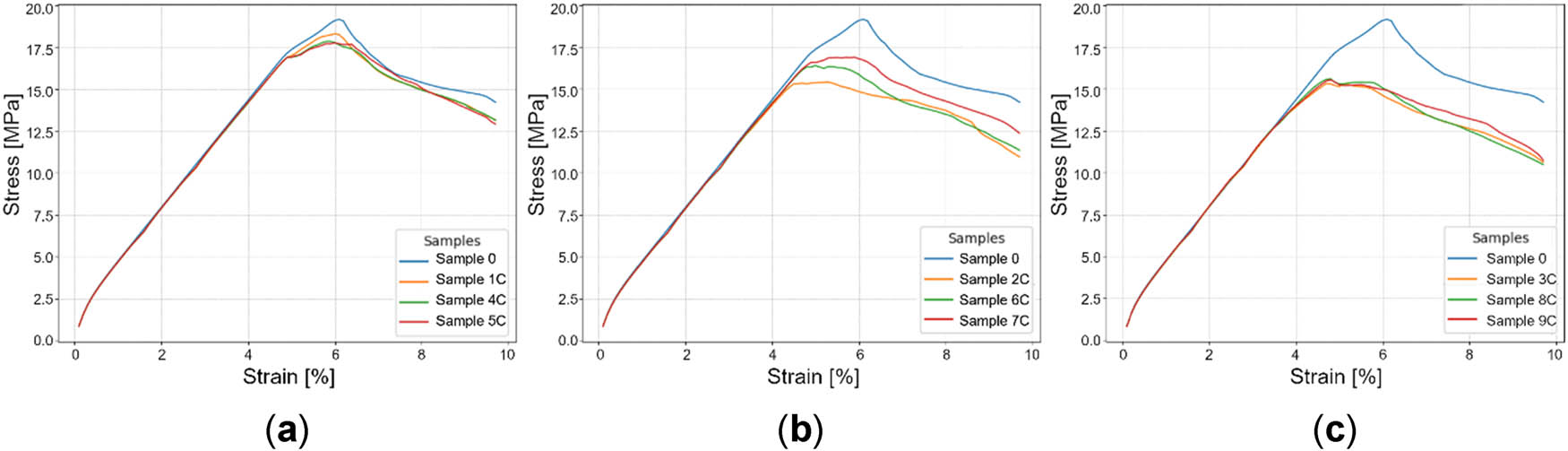
Figure 4
Stress–strain curves with varying sphericity (a) pore radius: 1 mm; (b) pore radius: 1.5 mm; and (c) pore radius: 2 mm.
Source: Author’s contribution.
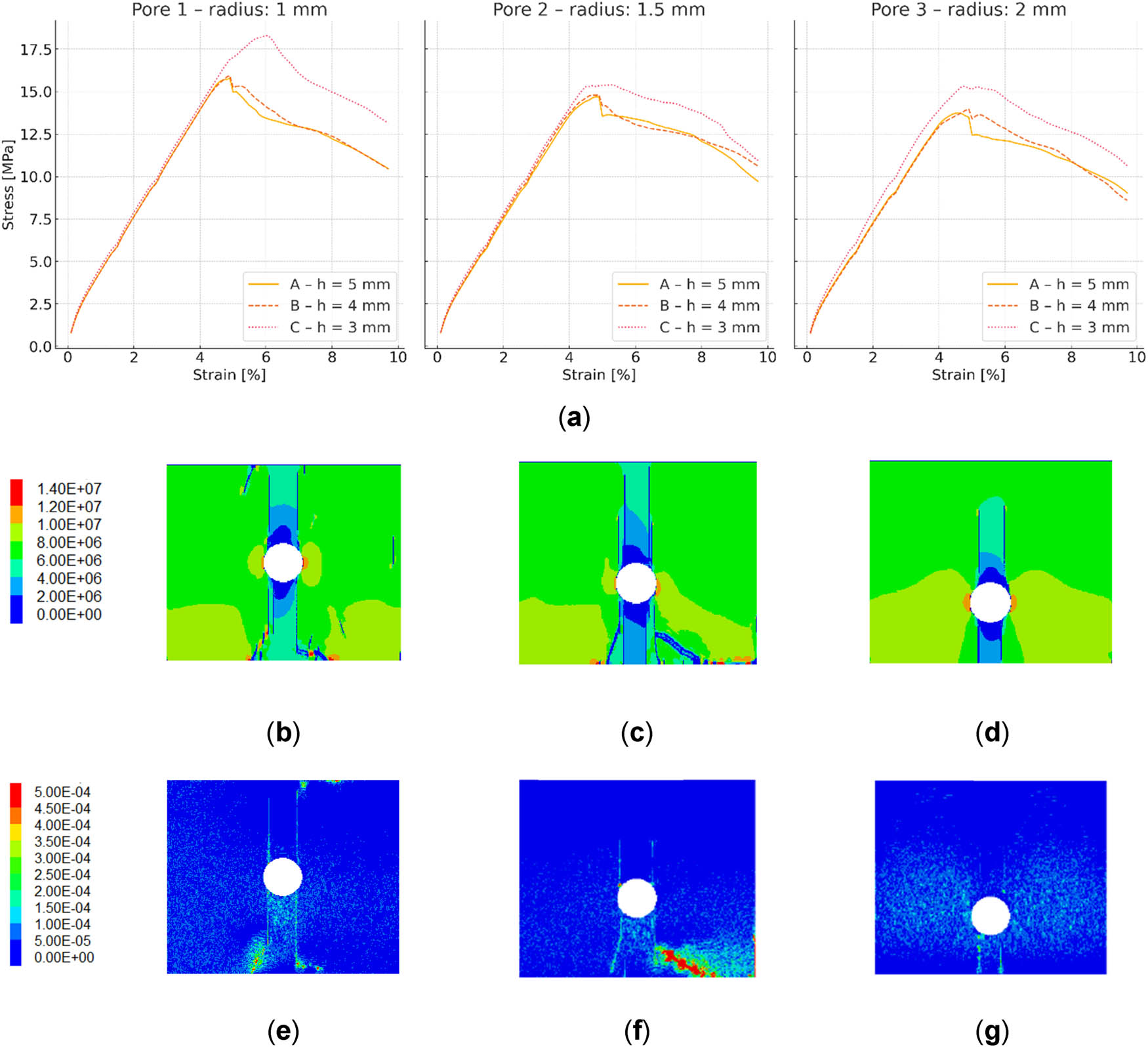
Figure 5
Results for the effect of pore position: (a) stress–strain curves for different pore locations; (b) vertical stress distribution map for position A; (c) vertical stress distribution map for position B; (d) vertical stress distribution map for position C; (e) shear strain distribution map for position A; (f) shear strain distribution map for position B; and (g) shear strain distribution map for position C.
Source: Author’s contribution.
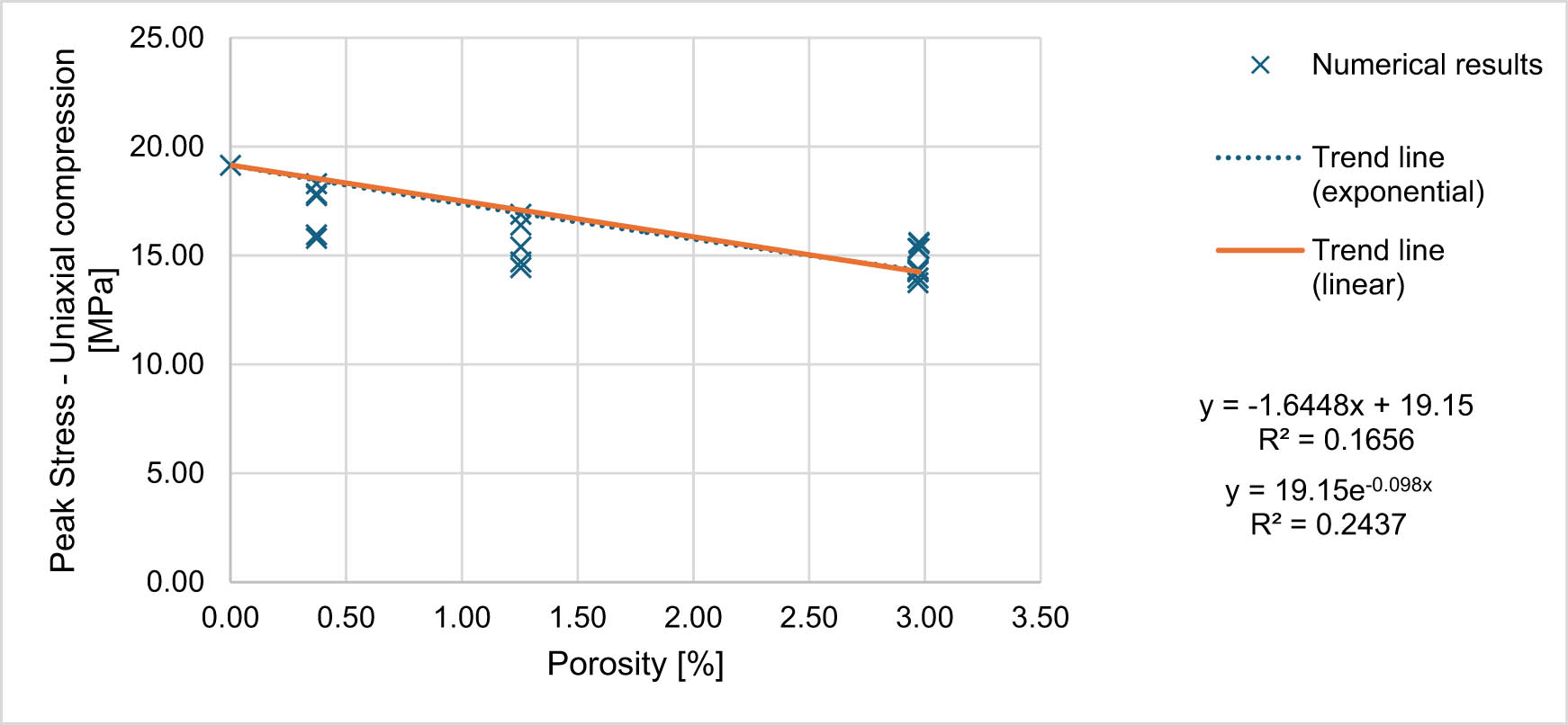
Figure 6
Relationship between uniaxial compressive strength and total porosity.
Source: Author’s contribution.
Table 5
Statistical parameters of the multiple linear regression model describing the mesoscale influence of pore geometry and position on compressive strength.
| Parameter | Regression coefficient β [MPa/unit] | Std. error | t-Value | p-Value | Standardised β* | Mechanical interpretation |
|---|---|---|---|---|---|---|
| Porosity | −0.803 | 0.143 | −5.61 | 5.0 × 10⁻5 | −0.69 | Dominant factor controlling strength. Increasing porosity strongly reduces compressive strength due to increased void volume and stress concentration |
| Pore sphericity | −4.228 | 1.816 | −2.33 | 0.034 | −0.28 | Statistically significant but weaker geometric effect. Horizontal elongation of pores modifies local stress redistribution and affects strength at the mesoscale |
| Pore position | −0.660 | 0.191 | −3.46 | 0.0035 | −0.42 | Second most influential parameter. Vertical relocation of a dominant pore may change strength by ∼1.3 MPa over two position units. Reflects interaction with specimen-scale stress field |
Source: Author’s contribution.