
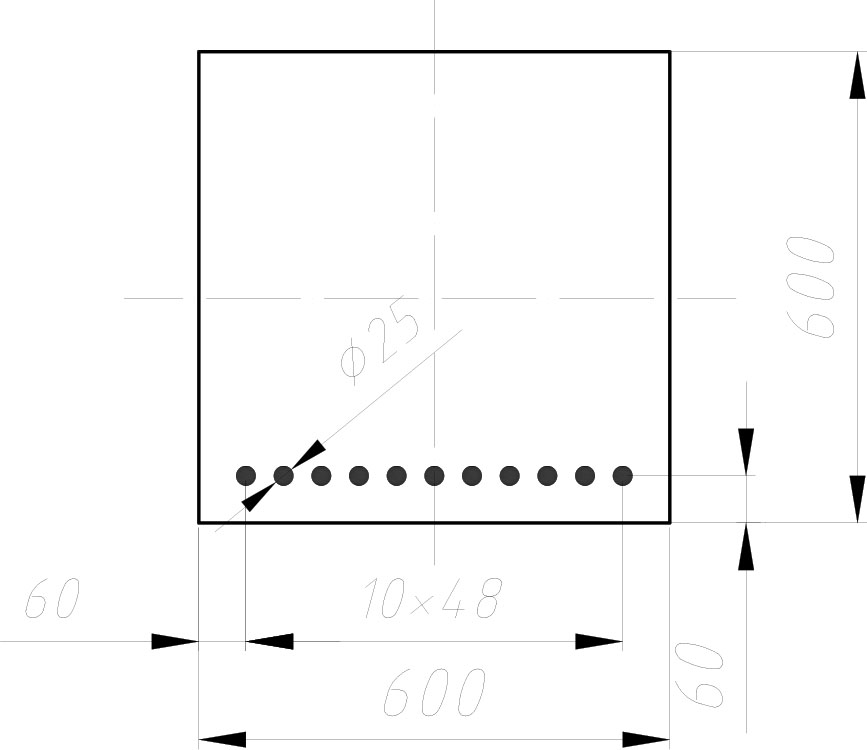
Figure 1:
Cross section of reinforced concrete beam with reinforcing bar arrangement, dimensions in millimetres.
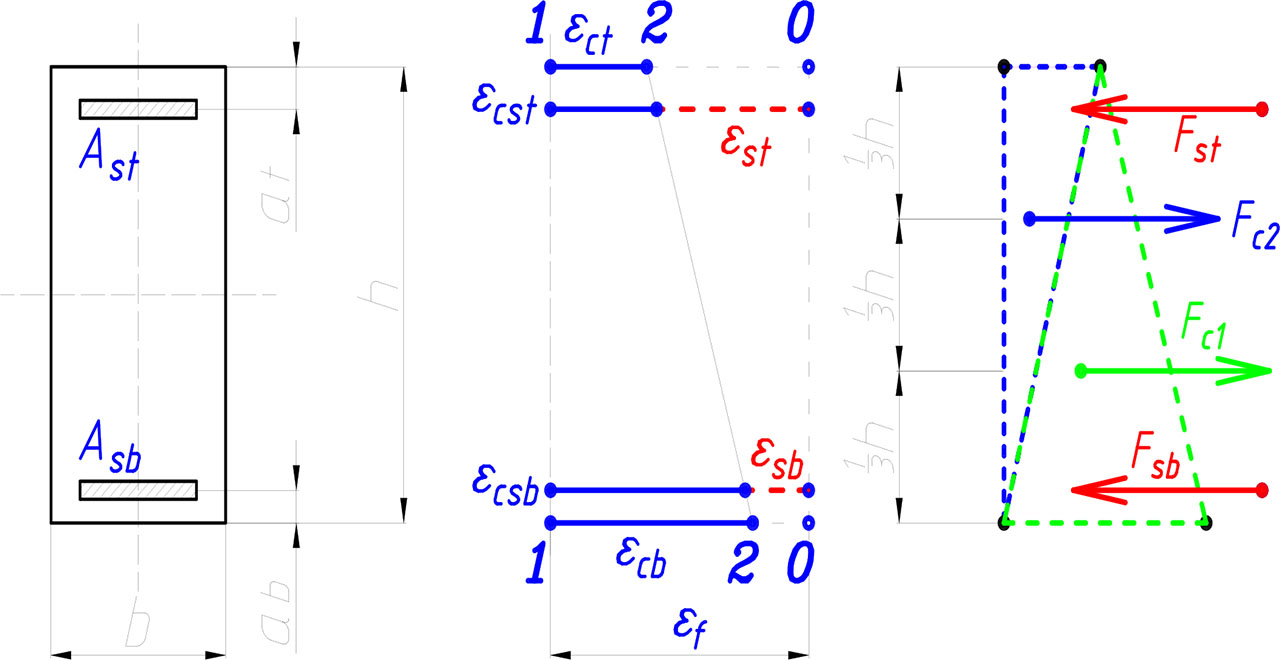
Figure 2:
The section under analysis, deformations of cross section, forces due to strain.
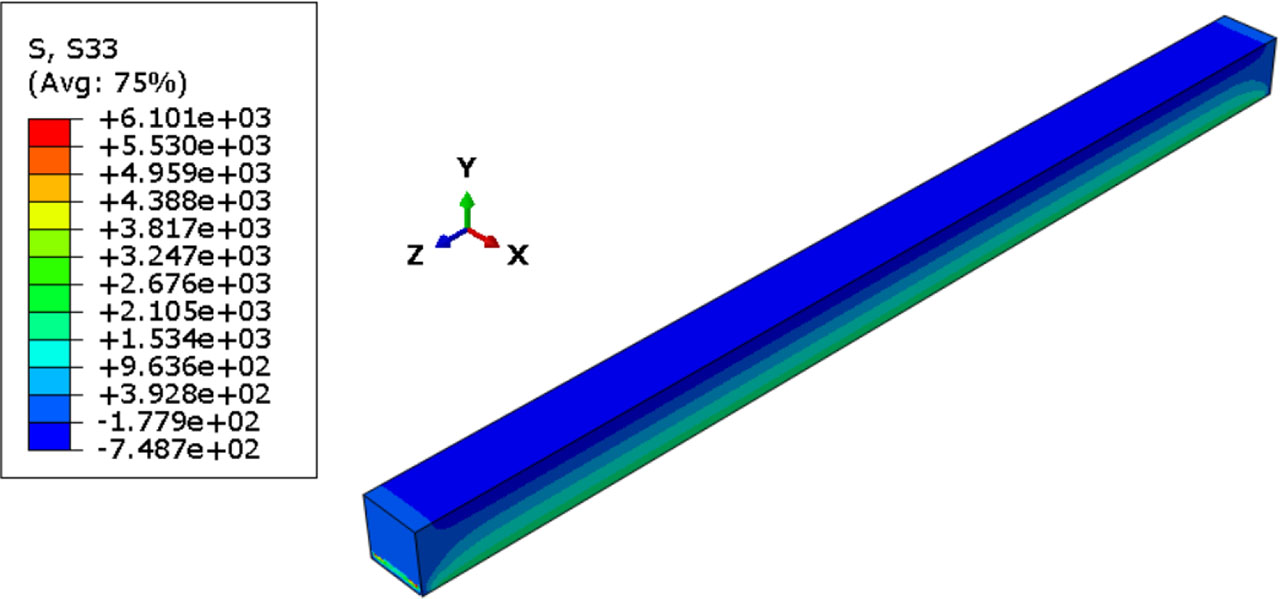
Figure 3:
Stress S33 = Szz (kPa) in the concrete beam.
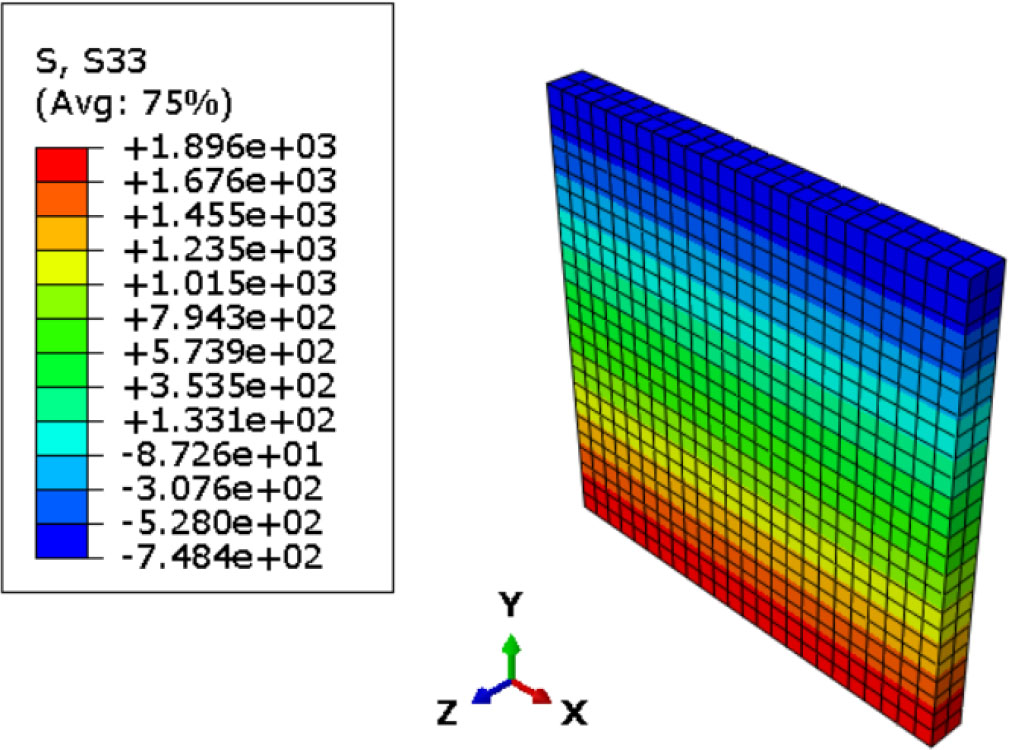
Figure 4:
Stresses S33 = Szz (kPa) in the cross section at the mid-span of a concrete beam.
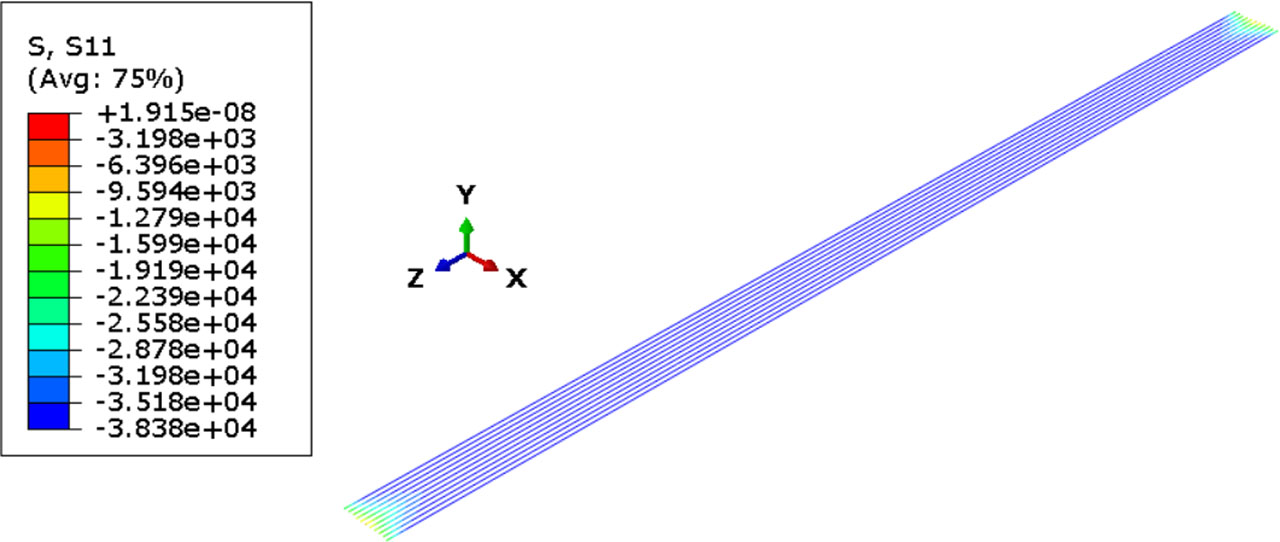
Figure 5:
Stress S11 = Szz (kPa) in the reinforcement.
Table 1:
Results from analytical and numerical FEM solution.
| Stresses (MPa) | ||||
|---|---|---|---|---|
| Analytical solution σA | Numerical solution (FEM) σF | Relative error Δσ (%) | Remarks | |
| Concrete, the lower edge of the section | 1.95 | 1.896 | 2.8% | Tension |
| Concrete, the upper edge of the section | −0.80 | −0.748 | 6.5% | Compression |
| Reinforcing steel bars | −38.30 | −38.38 | 0.2% | Compression |
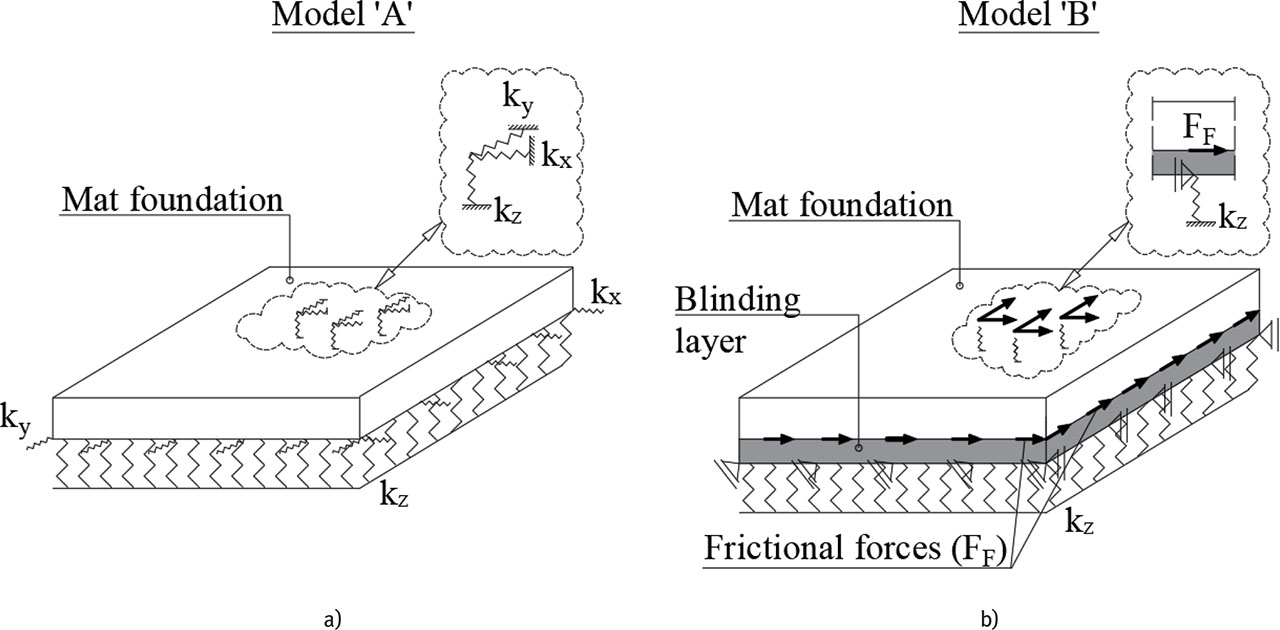
Figure 6:
Structure model diagrams adopted for numerical analyses.
Table 2
Range of modulus of subgrade reaction kz based on [13].
| Soil | kz (kN/m3) |
|---|---|
| Loose sand | 4800–16,000 |
| Medium dense sand | 9600–80,000 |
| Dense sand | 64,000–128,000 |
| Clayey medium dense sand | 32,000–80,000 |
| Silty medium dense sand | 24,000–48,000 |
| Clayey soil: | |
| qa < 200 kPa | 12,000–24,000 |
| 200 < qa < 800 kPa | 24,000–48,000 |
| qa > 800 kPa | >48,000 |
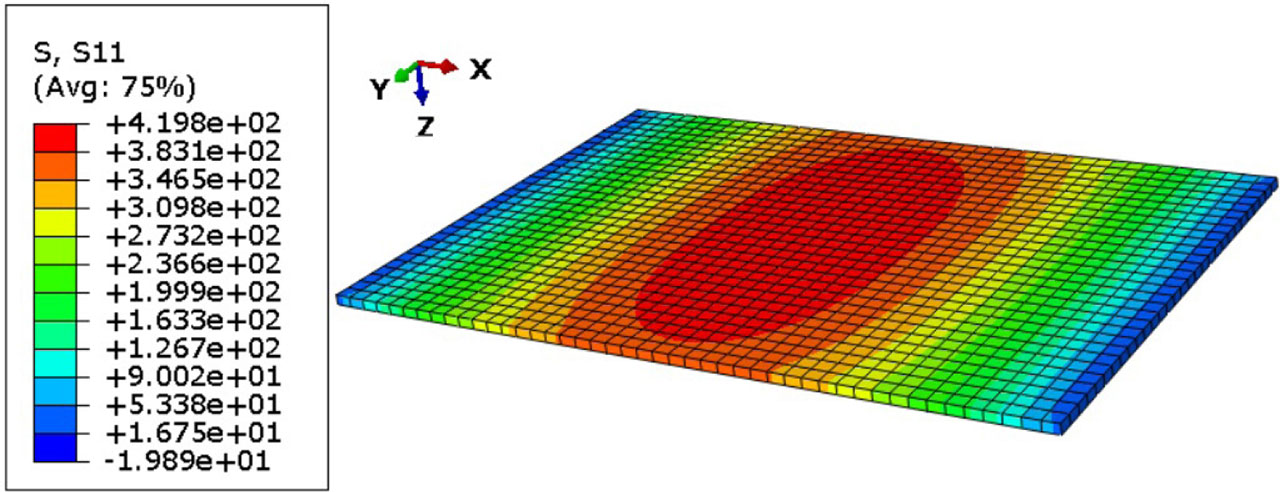
Figure 7:
Stress S11 = σx (kPa) in the concrete slab founded on soil (Winkler model: kz = 50,000 kN/m3, kx = ky = 4000 kN/m3).
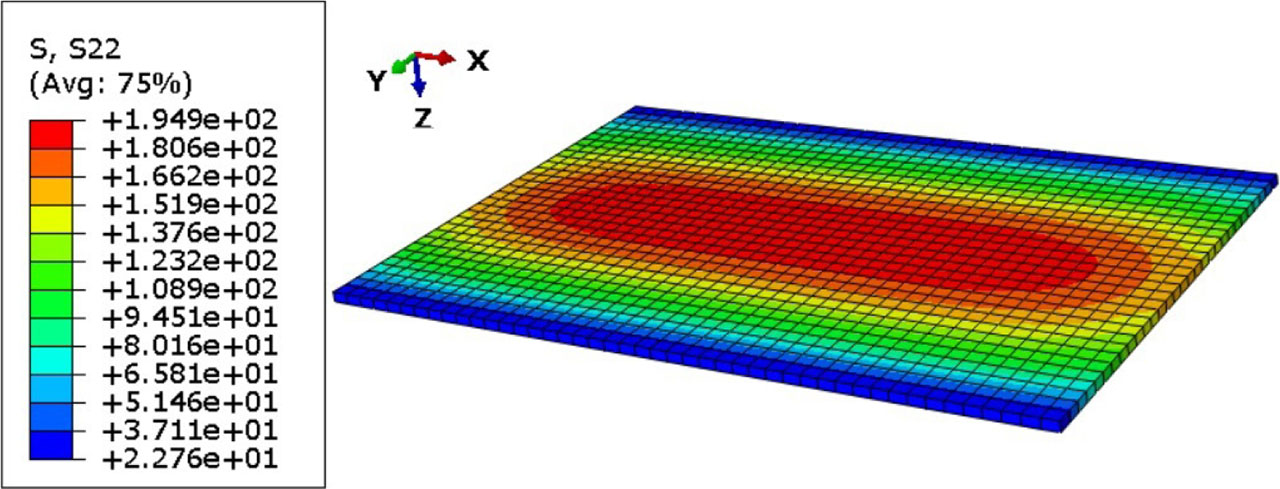
Figure 8:
Stress S22 = σy (kPa) in the concrete slab founded on soil (Winkler model: kz = 50,000 kN/m3, kx = ky = 4000 kN/m3).
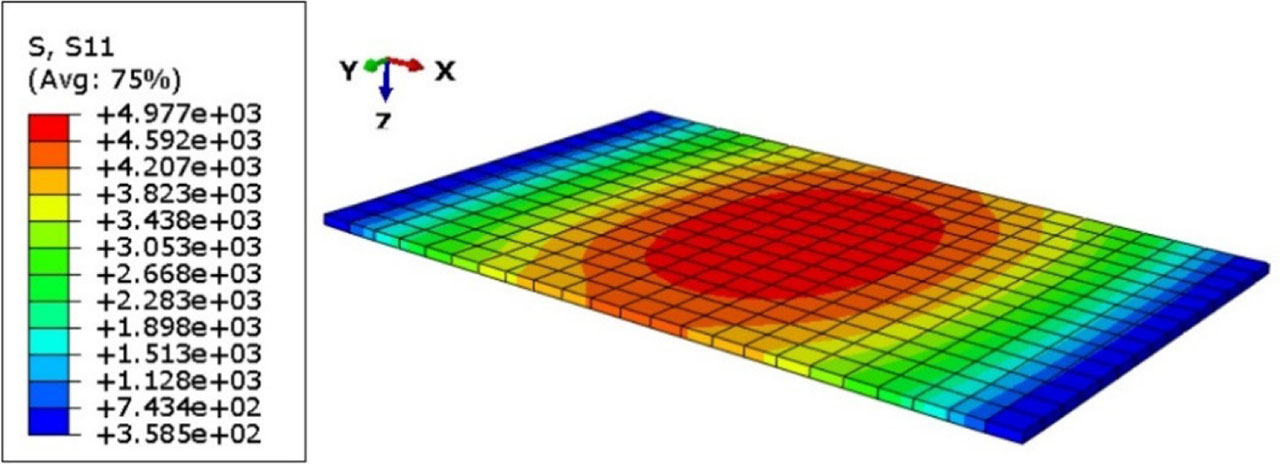
Figure 9:
Stress S11 = σx (kPa) in the concrete slab resting on the lean concrete substructure: friction coefficient μ = 0.1, kz = 50,000 kN/m3.
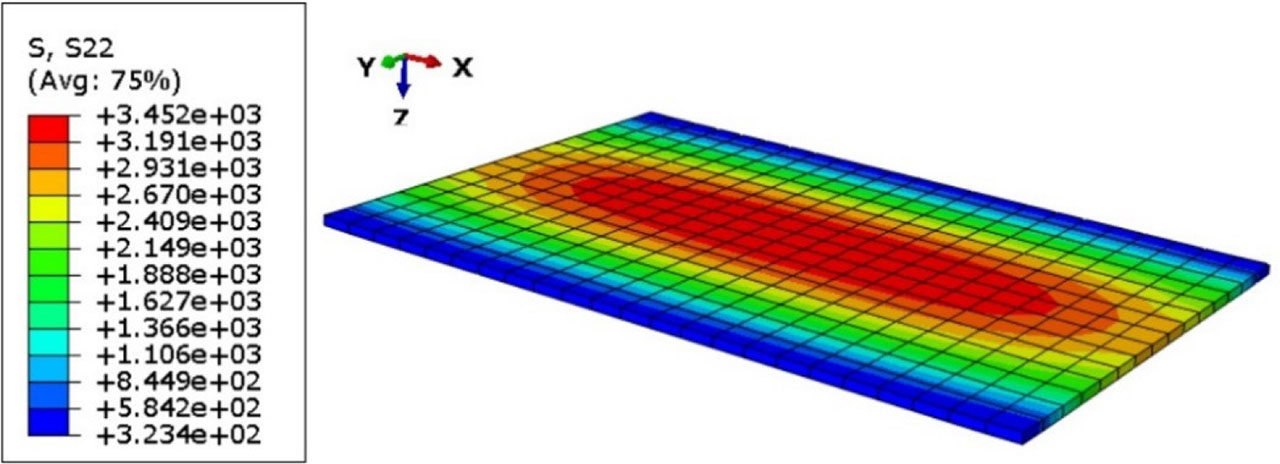
Figure 10:
Stress S22 = σy (kPa) in the concrete slab resting on the lean concrete substructure: friction coefficient μ = 0.1, kz = 50,000 kN/m3.
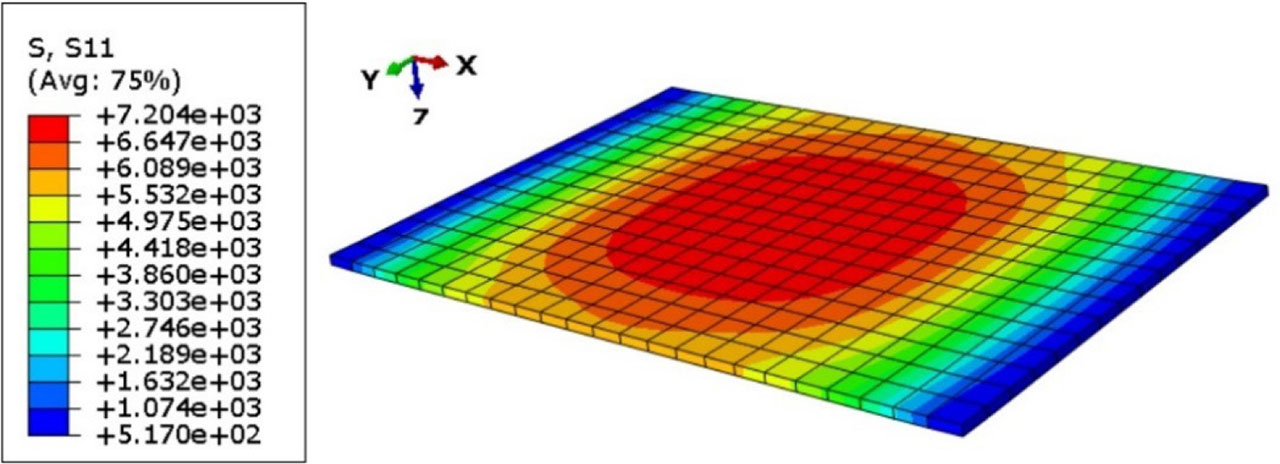
Figure 11:
Stress S11 = σx (kPa) in the concrete slab resting on the lean concrete substructure: friction coefficient μ = 0.5, kz = 10,000 kN/m3.
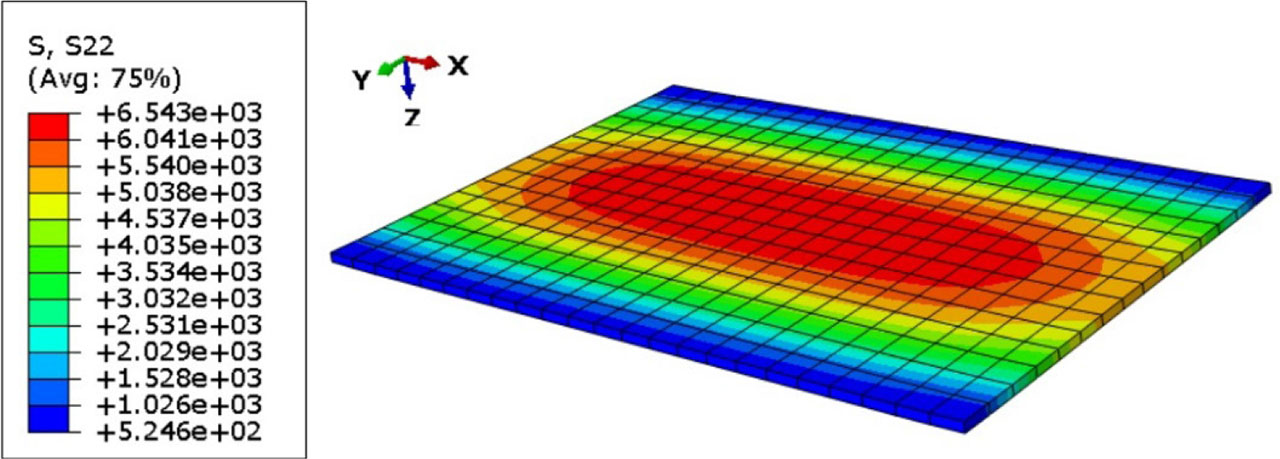
Figure 12:
Stress S22 = σy (kPa) in the concrete slab resting on the lean concrete substructure: friction coefficient μ = 0.5, kz = 10,000 kN/m3.
Table 3:
Stresses S11 = σx and S22 = σy depending on stiffness kz and friction coefficient μ.
| Numerical | μ | kz | S11 = σx (MPa) | S22 = σy (MPa) | ||
|---|---|---|---|---|---|---|
| model | (-) | (kN/m3) | Max. | Min. | Max. | Min. |
| Model ‘A’ | 0.08 | 50,000 | 0.4198 | -0.0199 | 0.1949 | 0.0228 |
| Model ‘A’ | 0.1 | 50,000 | 0.5191 | -0.0245 | 0.2427 | 0.0282 |
| Model ‘B’ | 0.1 | 10,000 | 4.7610 | 0.2423 | 3.1130 | 0.2116 |
| Model ‘B’ | 0.5 | 10,000 | 7.1070 | 0.3046 | 6.0280 | 0.3023 |
| Model ‘B’ | 0.1 | 50,000 | 4.9770 | 0.3585 | 3.4520 | 0.3234 |
| Model ‘B’ | 0.5 | 50,000 | 7.2040 | 0.5170 | 6.5430 | 0.5246 |
| Model ‘B’ | 0.1 | 100,000 | 5.0230 | 0.4017 | 3.5220 | 0.3636 |
| Model ‘B’ | 0.5 | 100,000 | 7.2210 | 0.6327 | 6.6160 | 0.6270 |
Table 4:
Maximum stresses S11 = σx and S22 = σy depending on stiffness kz and friction coefficient μ.
| kz | σx | σy | ||
|---|---|---|---|---|
| (kN/m3) | (MPa) | (MPa) | ||
| μ (-) | 0.1 | 0.5 | 0.1 | 0.5 |
| 10,000 | 4.761 | 7.107 | 3.113 | 6.028 |
| 50,000 | 4.977 | 7.204 | 3.452 | 6.543 |
| 100,000 | 5.023 | 7.221 | 3.522 | 6.616 |
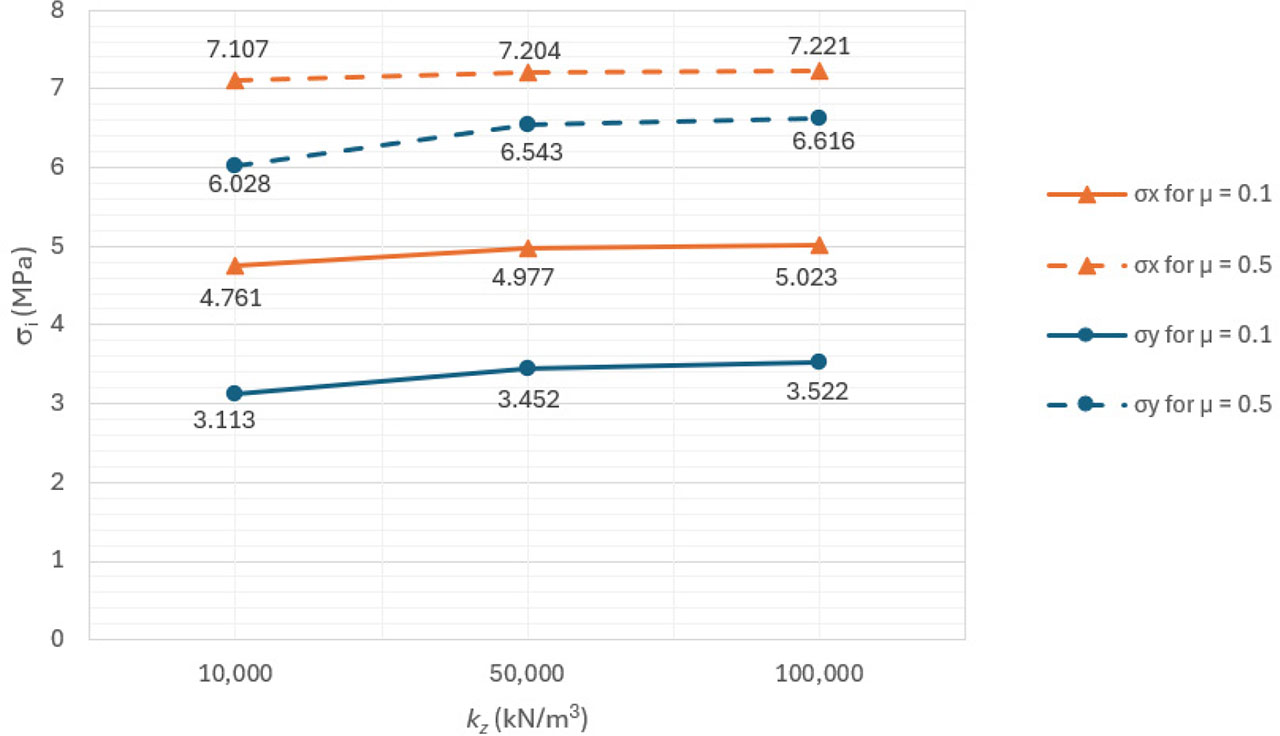
Figure 13:
Maximum stress σx = S11 and σy = S22 depending on stiffness kz and friction coefficient μ.
Table 5:
Change of maximum stresses Δσx and Δσy in relation to stresses for kz =10,000 kN/m3.
| kz | Δσx | Δσy | ||
|---|---|---|---|---|
| (kN/m3) | (%) | (%) | ||
| μ (-) | 0.1 | 0.5 | 0.1 | 0.5 |
| 10,000 | 0.0% | 0.0% | 0.0% | 0.0% |
| 50,000 | 4.5% | 1.4% | 10.9% | 8.5% |
| 100,000 | 5.5% | 1.6% | 13.1% | 9.8% |
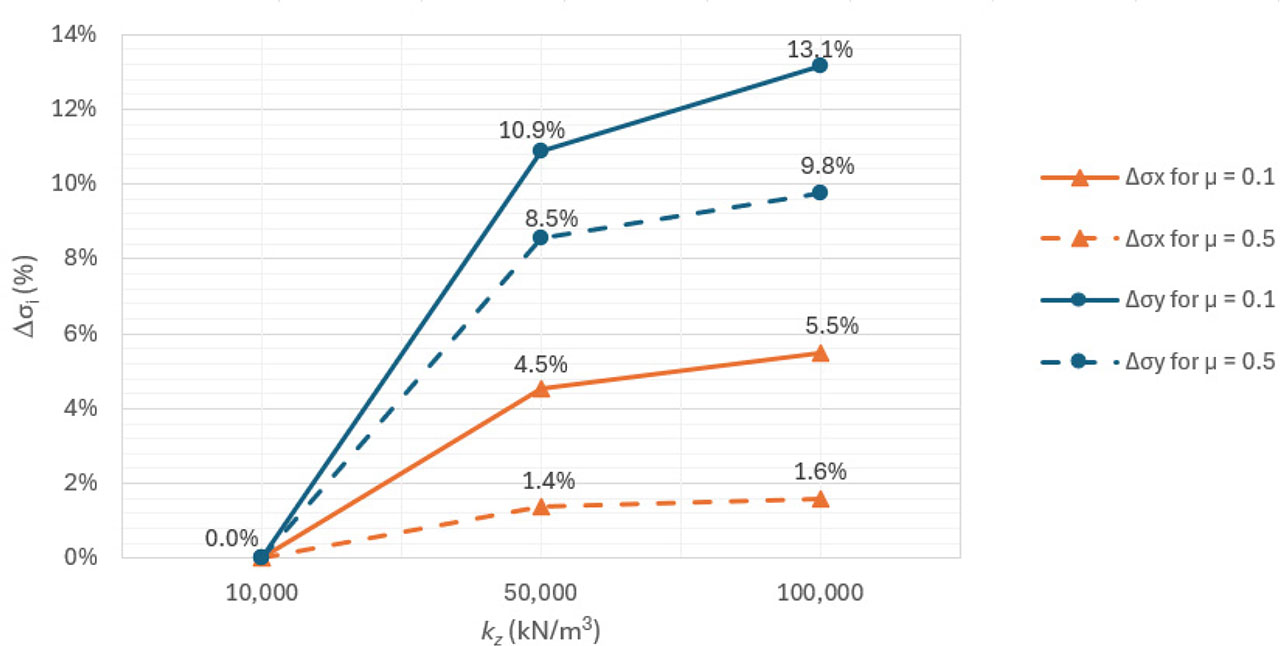
Figure 14:
Change of maximum stresses Δσx and Δσy in relation to stresses for kz =10,000 kN/m3.
Table 6:
Change of maximum stresses Δσx and Δσy in relation to stresses for μ = 0.1.
| kz | Δσx | Δσy | ||
|---|---|---|---|---|
| (kN/m3) | (%) | (%) | ||
| μ (-) | 0.1 | 0.5 | 0.1 | 0.5 |
| 10,000 | 0.0% | 49.3% | 0.0% | 93.6% |
| 50,000 | 0.0% | 44.7% | 0.0% | 89.5% |
| 100,000 | 0.0% | 43.8% | 0.0% | 87.8% |
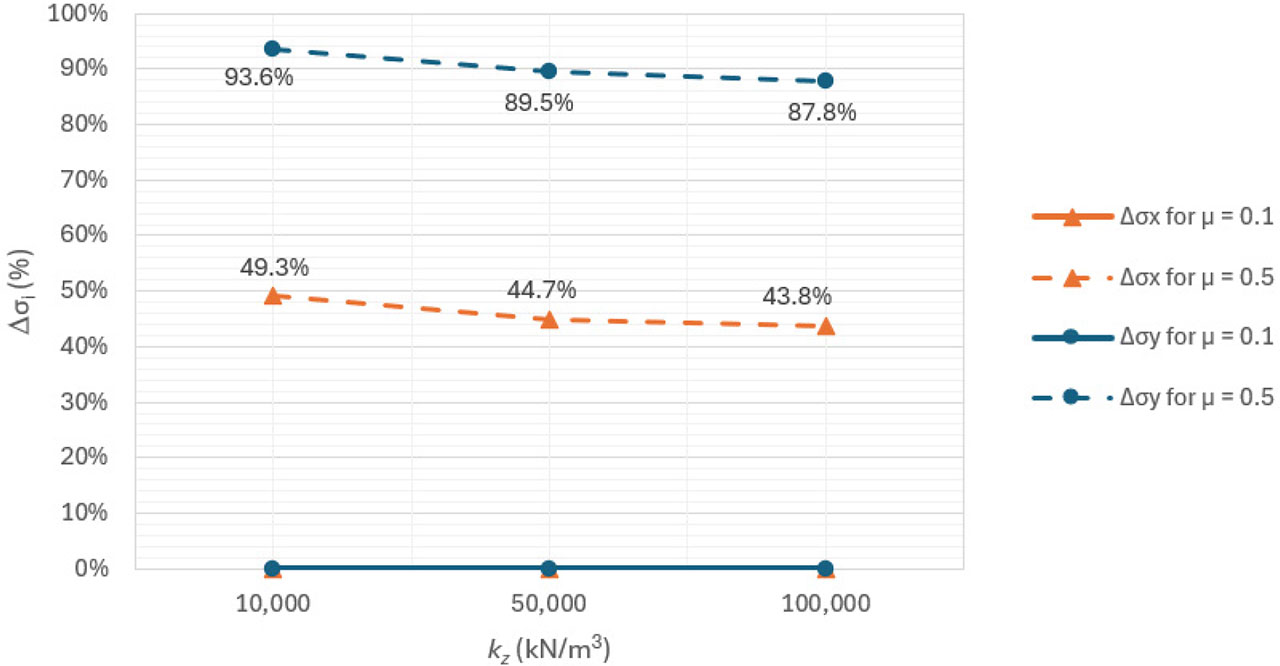
Figure 15:
Change of maximum stresses Δσx and Δσy in relation to stresses for μ = 0.1.
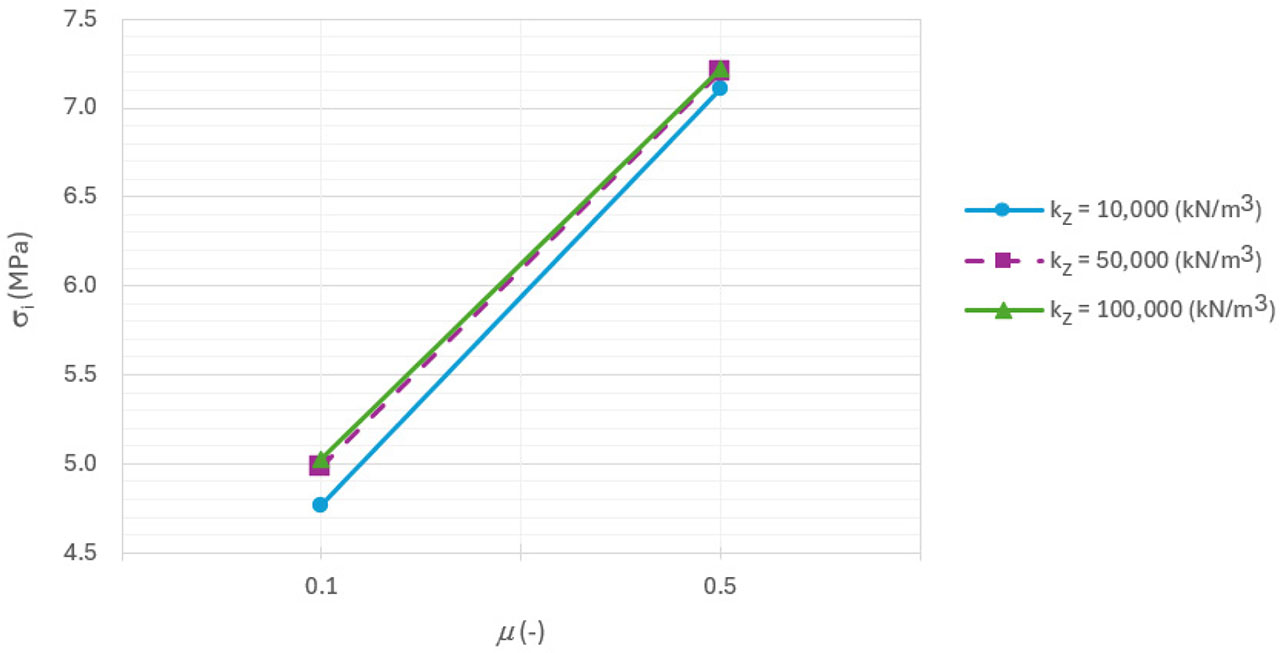
Figure 16:
Maximum stress σx depending on the friction coefficient μ and stiffness kz.
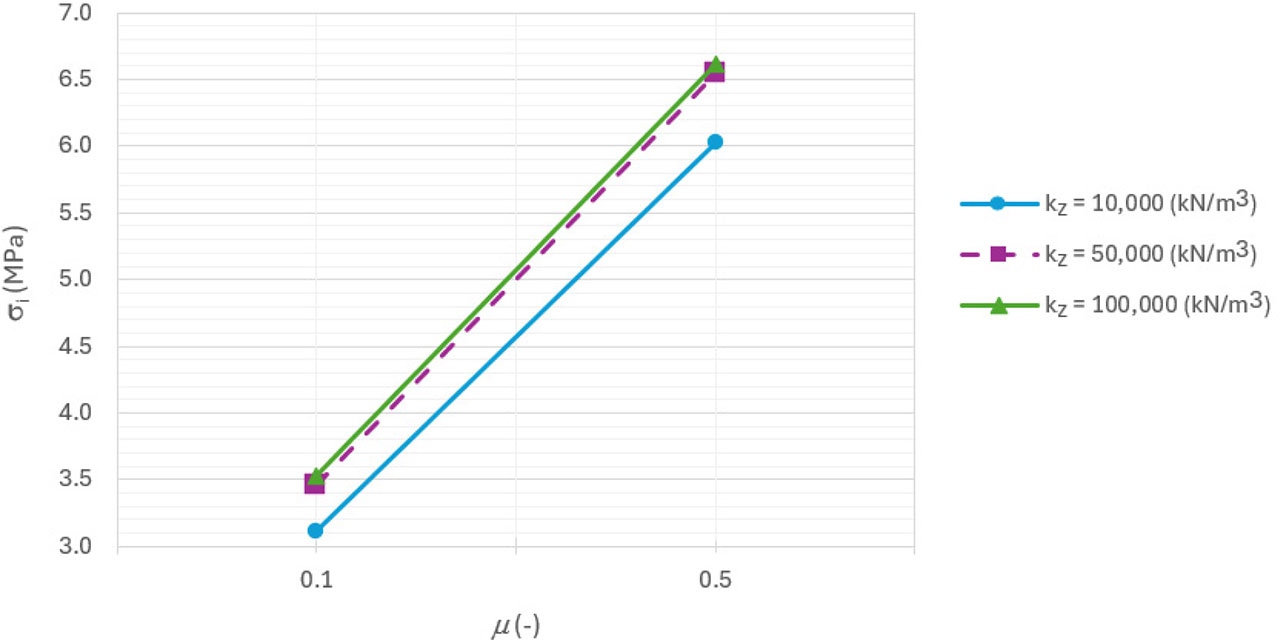
Figure 17:
Maximum stress σy depending on the friction coefficient μ and stiffness kz.