
1. Introduction
The study of thermal convection in dielectric fluids has gained much importance in recent past due to its manifold applications in nuclear reactors, ink jet printing, coalescence and many other processes (Del Río and Whitaker [7]). Several theoretical and experimental studies on the convective instabilities in a dielectric fluid layer heated from below/above in the presence of an electric field have been carried out in the recent past. The convection produced in a dielectric fluid layer heated from above was reported by Gross and Porter [10] and Turnbull [33], which was kept under the influence of a uniform electric field. Roberts [27] investigated electroconvection by assuming the dielectric constant as a function of temperature. Castellanos and Velarde [3] studied the influence of a temperature-dependent dielectric constant in the stability analysis of a fluid layer subjected to an electric field, weak unipolar injection and temperature gradient. Maekawa et al. [14] investigated the convective instability problem in alternating current (AC) and direct current (DC) electric fields using linear stability theory. Exhaustive reviews in this domain of enquiry have been presented by Jones [12] and Saville [29].
Two different types of instabilities are observed experimentally by Gross and Porter [10] and Turnbull [34] for horizontal dielectric fluid layers heated from above; the former observed a stationary instability, whereas the latter observed the manifestation of oscillatory instability, also known as overstability.
Turnbull [33] and Bradley [2] predicted oscillatory convection by using a quadratic conductivity model and a linear conductivity model, respectively. Castellanos and Velarde [3] studied the influence of a temperature-dependent dielectric constant on the stability of a liquid layer in the presence of an electric field, weak unipolar injection and temperature gradient and predicted that oscillatory instability occurs only when the heating is from above. Martin and Richardson [15] investigated the linear instability of a unipolar charge injection model and predicted numerically that stationary instability is dominant if temperature gradient is weakly stabilising, whereas oscillatory instability is dominant if the temperature gradient is strongly stabilising. Later, Martin and Richardson [16] derived a conductivity model and predicted the manifestation of oscillatory instability by investigating numerically the linear instabilities for linear quadratic and Arhenius-type conductivity variations.
Turnbull [35] also studied the effect of dielectrophoretic forces on an insulating fluid layer heated from below. He proved the validity of the principle of the exchange of stabilities for a particular set of boundary conditions for free boundaries, which were not usually used by the subsequent researchers. Bradley [2] too discussed such Bénard-type situation by assuming Prandtl number Pr to be finite and a nameless number , (c* is conductivity) and showed that the layer cannot be unstable for all top-heavy density distributions (all adverse temperature gradients), although it is plausible that they will be overstable if the electric field is sufficiently strong. Castellanos et al. [4] studied the oscillatory and steady convection in dielectric liquid layer subjected to unipolar injection heated underside.
The investigations of convective instabilities in porous media have been an important domain of research due to its wide applications in different fields like nuclear waste repository, radioactive waste management, solid matrix compact heat exchangers, thermal insulation engineering, mantle convection, geophysical systems and many more (Nield and Bejan [18],[19]). For the copious literature related to this domain of research, one may be referred to Chaudhary and Sunil [6], Ingham and Pop [11], Nield and Bejan [18],[19], Prakash et al. [23], Prakash et al. [24] and Vafai [36]. Electrothermoconvection in a dielectric fluid layer saturating porous medium subjected to an external electric field is of particular interest in the light of its possibility to reduce the fluid viscosity, which results in increasing the petroleum production and a control of heat and mass transfer in high-voltage devices by electric field (Moreno et al. [17]. Several researchers have contributed to the electrothermoconvection studies in dielectric fluid layer saturating a porous medium. The study of convective instability of dielectric fluids in porous media is also of practical importance in many domains such as chemical engineering, material science processing, biomechanics of the design of artificial organs and purification of ground water pollution (Rudraiah and Gayathri [28]). For a broad view of the subject, one may refer to Del Río and Whitaker [7], El-Sayed et al. [9], El-Sayed et al. [8], Rudraiah and Gayathri [28] and Shivakumara et al. [30].
The problem of deriving upper limits for the complex rate of an arbitrary neutral or unstable oscillatory disturbance of growing amplitude in various hydrodynamic stability problems is an important feature of fluid dynamics, especially when both the bounding surfaces are not free, so that the exact solutions in a closed form are not derivable. Banerjee et al. [1] formulated a method to combine the governing equations and boundary conditions for classic thermohaline convection problem, which, in turn, yields the desired bounds. Their work is further extended to different hydrodynamic configurations by Prakash [21], Prakash et al. [22], Prakash et al. [25] and Ram et al. [26]. Since the inability of finding the exact solutions in a closed form also exists for the case of electrothermoconvection problems when both the boundaries are not free, the upper limits for the complex growth rate for such configurations must also be found. The extension of Banerjee et al. [1] result in a more complex problem of electrothermoconvection in the domains of astrophysics, geophysics and terrestrial physics, wherein the liquid concerned has the property of electrical conduction and rotation are prevalent, is very much sought after in the present context. This paper, which mathematically establishes the upper limits for the complex growth rate of an arbitrary neutral or unstable oscillatory disturbance of growing amplitude, in a dielectric fluid layer saturating a sparsely distributed porous medium wherein a uniform rotation parallel to gravity is superimposed, may be regarded as a first step in this scheme of extended investigations. Thus, novelty of the present paper mainly relies on these newly derived upper limits for the complex growth rate of a more complex problem of electrothermoconvection, which will definitely facilitate the theoretical scientists and experimentalists in their investigations.
2. Formulation of the Problem
We consider a dielectric fluid layer of infinite horizontal extension and finite vertical depth d saturating a sparsely distributed porous medium, heated from below (Fig. 1). The fluid layer is subjected to a rotation about vertical axis with a constant angular velocity . A uniform vertical AC electric field is applied across the fluid layer. The Darcy–Brinkman model has been used to mathematically analyse this problem.
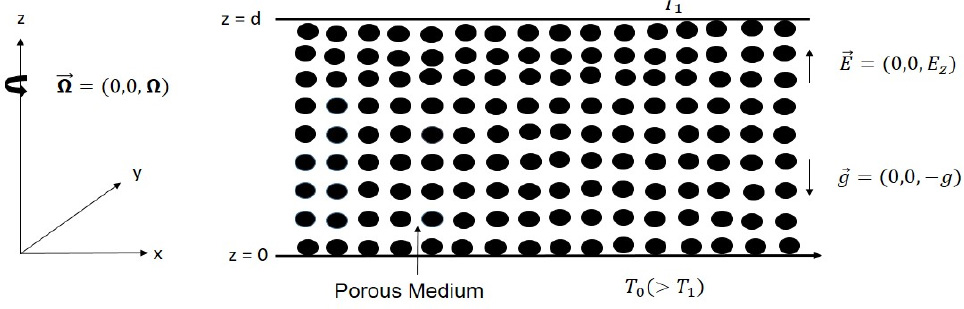
Figure 1:
Geometrical configuration of the problem.
The basic equations, governing the flow of dielectric fluid for the present model, are given by (Shivakumara et al. [31], Takashima, [32])
where , ρ0, t, ϕ, A, , p, ρ, , μ, μ, T, k, κ and respectively represent the velocity, reference density, time, porosity of the medium, ratio of heat capacities, constant angular velocity, pressure, fluid density, acceleration due to gravity, fluid viscosity, effective viscosity, temperature, permeability of the porous medium, thermal diffusivity and the force of electric origin which can be expressed as (Landau and Lifshitz [13]) Here ρe is the free charge density, ε is the dielectric constant and is the root mean square value of the electric field. In Eq. (4), the first, second and third terms respectively represent the Coulomb force, the dielectrophoretic force and the electrostrictive force. The first term can be neglected in comparison to second term since the Coulomb force due to a free charge is of negligible order compared to the dielectrophoretic force term for most dielectric fluids in a 60-Hz AC electric field (Takashima [32]. The third term is grouped with the pressure p in Eq. (2). Eq. (2) thus modifies to where is the modified pressure.The equation of state is given by
where α is the coefficient of volume expansion and T0 is the reference temperature.The Maxwell’s equations relevant to the present context are
In the light of Eq. (7), can be written as where V is root mean square value of the electric potential.The dielectric constant is given by
where ε0 is the value of dielectric constant at the reference temperature T0 and γ(> 0) is the thermal expansion coefficient of dielectric constant and is considered to be small (Maekawa et al. [14]).Now, following the linear stability theory (Chandrasekhar [5]), using basic state solutions, linearised perturbation equations, normal mode technique ascribing, to all the quantities describing the perturbation, a dependence on x, y and t of the form exp [i(kxx + kyy) + nt], we derive the non-dimensional equations given by
where is the differentiation with respect to vertical co-ordinate z, is square of the resultant wave number, n(= nr + ini) is the complex growth rate, w is z − component of the perturbation velocity, θ is perturbation temperature, ζ is z − component of perturbation vorticity, Φ is perturbation electrical potential, is the modified Prandtl number, is the ratio of viscosities, is the Darcy number, is the thermal Rayleigh number, is the modified Taylor number and is the electric Rayleigh number.The boundaries are considered to be free and rigid. Hence, the boundary conditions are given by
3. Mathematical Analysis
Now we derive the upper limits for the complex growth rate of an arbitrary neutral or unstable oscillatory disturbance of growing amplitude for a dielectric fluid layer saturating a sparsely distributed porous medium subjected to uniform vertical rotation for the cases when (I) layer is heated from below and (II) layer is heated from above.
3.1. Case I: When the fluid layer is heated from below
Subcase (i): Free boundaries
We prove the following theorem:
Theorem 1
If Rt > 0, Rea > 0, Pr > 0, Ta > 0, A > 0, Da > 0, n = nr + ini, nr ≥ 0 and ni ≠ 0, then a necessary condition for the existence of a non-trivial solution (w, θ, ζ, Φ, n) of Eqs (11)–(14) together with the boundary conditions (15) is
Proof
Multiplying Eq. (11) by w* (the superscript * henceforth denotes the complex conjugation) and integrating the resulting equation from z = 0 to z = 1, we have
Utilising Eqs (12)–(14) and the boundary conditions (15), we can write Eqs (17)–(20), on combining, yield Integrating the various terms of Eq. (21), by parts, for a suitable number of times from z = 0 to z = 1, we get Now multiplying Eq. (14) by Dθ* and integrating the resulting equation from z = 0 to z = 1, we obtain Also, when we multiply the complex conjugate of Eq. (14) by Φ and integrate over the vertical range of z, we obtain It is obvious from Eqs (23) and (24) that is real.Equating imaginary parts of both sides of Eq. (22), we get
It is evident from Eq. (25) that one cannot conclude from it, as in Pellew and Southwell’s [20] case that nr = 0 implies ni = 0 for all a2. This is due to the fact that the last two terms in the left-hand side of this equation misbehave as regards their signs. Thus, oscillatory instability may occur in certain parameter regime for the present problem. Hence, we derive upper limits for the complex growth rate of an arbitrary neutral or unstable oscillatory disturbance of growing amplitude, which are important, especially when at least one of the bounding surfaces is rigid, so that exact solutions are not obtainable. We proceed in the following manner:Multiplying Eq. (14) by Φ* and integrating, by parts, we have
(Utilising the Schwartz inequality) which implies that Thus Combining inequalities (26) and (27), we get Multiplying Eq. (12) by its complex conjugate and integrating the resulting equation, by parts, for an appropriate number of times and making use of boundary conditions (15), we obtain Since nr ≥ 0, Eq. (29) implies that Using Eq. (30) in Eq. (28), we get Multiplying Eq. (13) by its complex conjugate and integrating the resulting equation, by parts, for an appropriate number of times and making use of boundary conditions (15), we obtain Since, nr ≥ 0, from Eq. (32), we can write Using inequalities (31) and (33) in Eq. (25), we get which implies From the physical standpoint, Theorem 1 can be stated as the complex growth rate of an arbitrary neutral or unstable oscillatory disturbance of growing amplitude, in a rotating dielectric fluid layer saturating sparsely distributed porous medium heated from below, lies inside a semicircle in the right half of the nrni − plane whose centre is at the origin and radius equals (Fig. 2).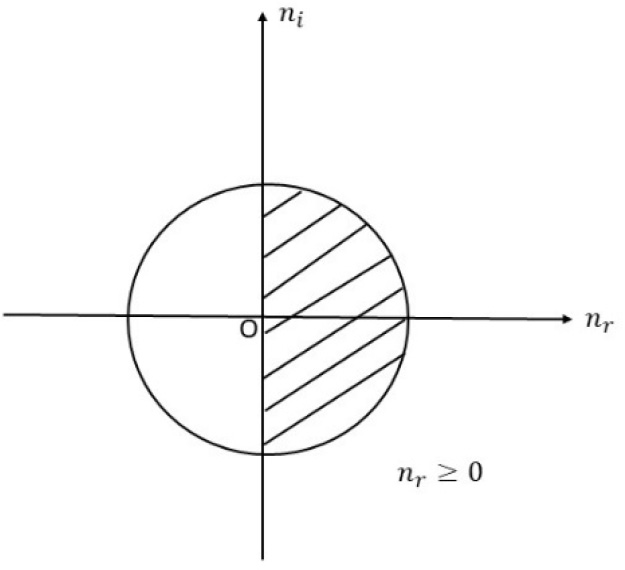
Figure 2:
Shaded region shows the region of complex growth rate in the nrni − plane.
Subcase (ii): Rigid boundaries
For the case of rigid boundaries, the boundary conditions are given by Eq. (16)
Following the same procedure as is used in Theorem 1, we derive the same integrated Eq. (22) in this case also. But for the case of rigid boundaries, the third integral in the right hand side of this equation cannot be dropped from the imaginary part without justification. This is elaborated as follows:
In this case on multiplying Eq. (14) by Dθ* and integrating the resulting equation from z = 0 to z = 1, we get
Since is real and the integral is also real by Eq. (24), therefore from Eq. (35), two cases arise:(a) When and are both real, then on equating the imaginary parts of both sides of Eq. (22) and cancelling ni (≠ 0) both sides, we obtain an equation that is exactly the same as Eq. (25) and the proof follows as for the case of free boundaries to obtain the same result.
(b) When imaginary part of = imaginary part of we proceed as follows:
Theorem 2
If Rt > 0, Rea > 0, Pr > 0, Ta > 0, A > 0, Da > 0, Λ > 0, n = nr + ini , nr ≥ 0 and ni ≠ 0 , then a necessary condition for the existence of a non-trivial solution (w, θ, ζ, Φ, n) of Eqs (11)–(14) together with the boundary conditions (16) is
Proof
Integrating the various terms of Eq. (21), by parts, for appropriate number of times and making use of Eqs (12), (13) and boundary conditions (16), we get,
Equating imaginary parts of both sides of Eq. (36) and cancelling ni (≠ 0) throughout, we get Now Using inequality (31) in inequality (38), we have imaginary part of Now multiplying Eq. (13) by ζ * and integrating from z = 0 to z = 1, we have Equating the imaginary part of Eq. (40) on both sides, we obtain Using inequality (33) in the above inequality, to get Utilizing inequalities (39) and (41) in Eq. (37), we get which clearly implies that This proves the theorem.From the physical standpoint, Theorem 2 can be stated as: the complex growth rate of an arbitrary neutral or unstable oscillatory disturbance of growing amplitude, in a rotating dielectric fluid layer saturating sparsely distributed porous medium heated from below, lies inside the region (in the right half of the nrni − plane) given by inequality (43) (Fig. 3).
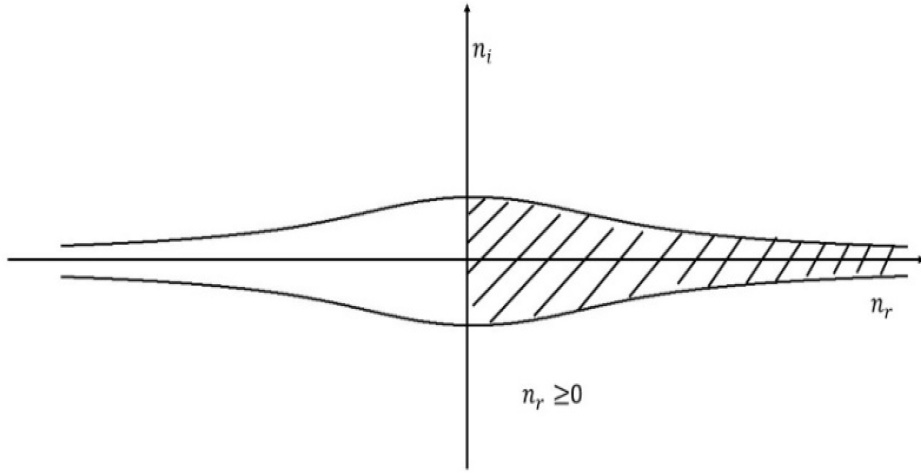
Figure 3:
Shaded region shows the region of complex growth rate in the nrni − plane.
3.2. Case II: When the fluid layer is heated from above
Subcase (i): Free boundaries
We prove the following theorem:
Theorem 3
If Rt < 0, Rea > 0, Pr > 0, Ta > 0, Λ > 0, Da > 0, A > 0, n = nr + ini, nr ≥ 0 and ni ≠ 0, then a necessary condition for the existence of a non-trivial solution (w, θ, ζ, Φ, n) of of Eqs (11)–(14) together with the boundary conditions (15) is
Proof
In the present case, Rt < 0. Thus, with Rt = −|Rt|, Eq.(11) becomes
Multiplying Eq. (44) by w* and integrating the resulting equation from z = 0 to z = 1 and adopting the same procedure that was used to prove Theorem 1, we get The imaginary part of the above equation is given by Using inequalities (30), (31) and (33) in Eq. (45), we get which implies thatFrom the physical standpoint, Theorem 3 can be stated as: the complex growth rate of an arbitrary neutral or unstable oscillatory disturbance of growing amplitude, in a rotating dielectric fluid layer saturating sparsely distributed porous medium heated from above, lies inside a semicircle in the right half of the nrni − plane whose centre is at the origin and radius equals (Fig. 4).
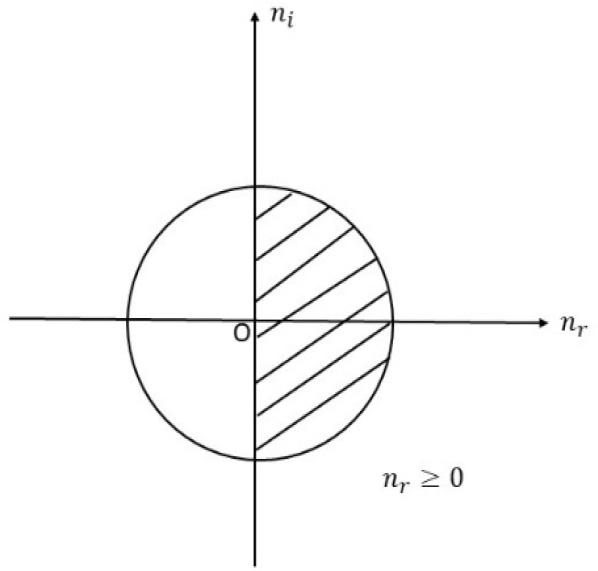
Figure 4:
Shaded region shows the region of complex growth rate in the nrni − plane.
Subcase (ii): Rigid boundaries
Similar arguments hold for the present case as were used in subcase (ii) of case I, that is, when and are both real, then we have the same result as obtained in Theorem 2 and when the imaginary part of = the imaginary part of , then we proceed as follows:
Theorem 4
If Rt < 0, Rea > 0, Pr > 0, Ta > 0, Λ > 0, Da > 0, A > 0, n = nr + ini, nr ≥ 0 and ni ≠ 0, then a necessary condition for the existence of a non-trivial solution (w, θ, ζ, Φ, n) of Eqs (11)–(14) together with the boundary conditions (16) is
Proof
Multiplying Eq. (44) by w* throughout, integrating the various terms of the resulting equation, by parts, for an appropriate number of times, by using Eqs (12), (13) and the boundary conditions (16), we get
Imaginary part of Eq. (48) can be written as Now, multiplying Eq. (12) by θ* and integrating, we have Imaginary part of the above equation is given by which implies that (utilising the Schwartz inequality)which on using inequality (30) yields
Utilizing inequalities (39), (41) and (50) in Eq. (49), we get and consequently, we have From the physical standpoint, Theorem 4 can be stated as: the complex growth rate of an arbitrary oscillatory disturbance of growing amplitude, in a rotating dielectric fluid layer saturating sparsely distributed porous medium heated from above, lies inside the region (in the right half of the nrni – plane) given by inequality (51) (Fig. 5).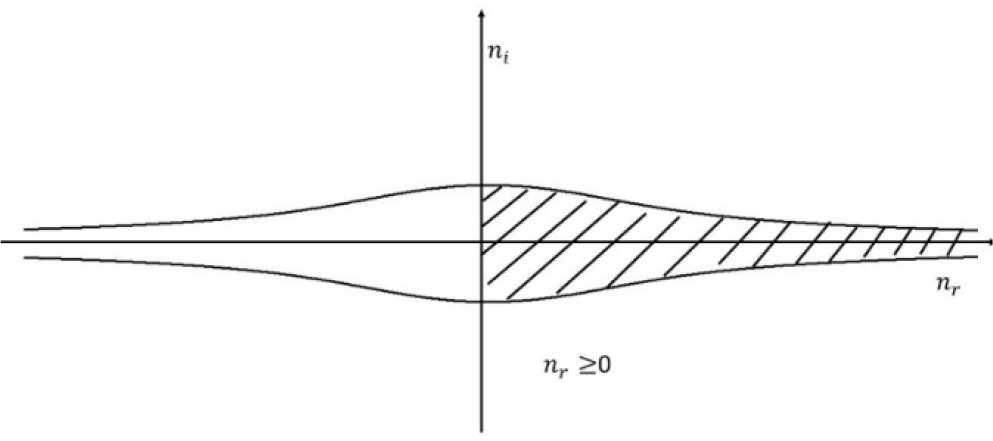
Figure 5:
Shaded region shows the region of complex growth rate in the nrni − plane.
4. Conclusions
The linear stability theory has been used to derive the upper limits for the complex growth rates in electrothermoconvection in a dielectric fluid layer in a sparsely distributed porous medium heated from below and from above in the presence of electric field for free and rigid bounding surfaces separately. The following results are obtained:
4.1. When the fluid layer is heated from below
The complex growth rate of an arbitrary neutral or unstable oscillatory disturbance of growing amplitude, in a rotating dielectric fluid layer saturating sparsely distributed porous medium, lies inside a semicircle, in the right half of the nrni − plane, with centre at the origin and radius being equal to .
For the case of rigid boundaries, when and are both real, we obtain the same region for growth rate as for the case of free boundaries. Furthermore, if the imaginary part of = the imaginary part of , then the complex growth rate of an arbitrary neutral or unstable oscillatory disturbance of growing amplitude, in a rotating dielectric fluid layer saturating sparsely distributed porous medium, lies inside the region (in the right half of the nrni − plane) given by inequality .
4.2. When the fluid layer is heated from above
3. The complex growth rate of an arbitrary neutral or unstable oscillatory disturbance of growing amplitude, in a rotating dielectric fluid layer saturating sparsely distributed porous medium, lies inside a semicircle, in the right half of the nrni − plane, with centre at the origin and radius being equal to .
4. For the case of rigid boundaries, similar arguments hold as in the case of heated from below.
Furthermore, the results derived herein involve only dimensionless quantities and are wave number independent; thus, the present results are of uniform validity and applicability.
Nomenclature
- A
ratio of the heat capacities
- a2
square of the wave number
- D
differential operator
- Da
Darcy number
- d
thickness of the porous layer
root mean square value of the electric field
electrical force
acceleration due to gravity
- k
permeability of the porous medium
- kx
horizontal wave number along the x − axis
- ky
horizontal wave number along the y − axis
- n
complex growth rate
- nr
real part of complex growth rate
- ni
imaginary part of complex growth rate
- P
modified pressure
- Pr
Prandtl number
- p
pressure
velocity
- Rt
thermal Rayleigh number
- Rea
electric Rayleigh number
- T
temperature
- T0
temperature at the lower boundary
- T1
temperature at the upper boundary
- Ta
Taylor number
- t
time
- V
root mean square value of electric potential
- (u, v, w)
velocity components
- (x, y, z)
Cartesian co-ordinates
Greek Symbols
- α
coefficient of volume expansion
- ɛ
dielectric constant
- ɛ0
reference dielectric constant
- γ
thermal expansion coefficient of dielectric constant
- κ
thermal diffusivity
- Λ
ratio of viscosities
- μ
fluid viscosity
effective viscosity
- ν
kinematic viscosity
- Ω
angular velocity
- ϕ
porosity of the medium
- Φ
perturbation electric potential
- ρ
fluid density
- ρe
free charge density
- ρ0
reference density
- θ
perturbation temperature
- ζ
z – component of perturbation vorticity
Superscript
- *
complex conjugation
Acknowledgement
The authors express their gratitude to the learned reviewer for invaluable comments and suggestions which helped them to bring the paper in the present form.