
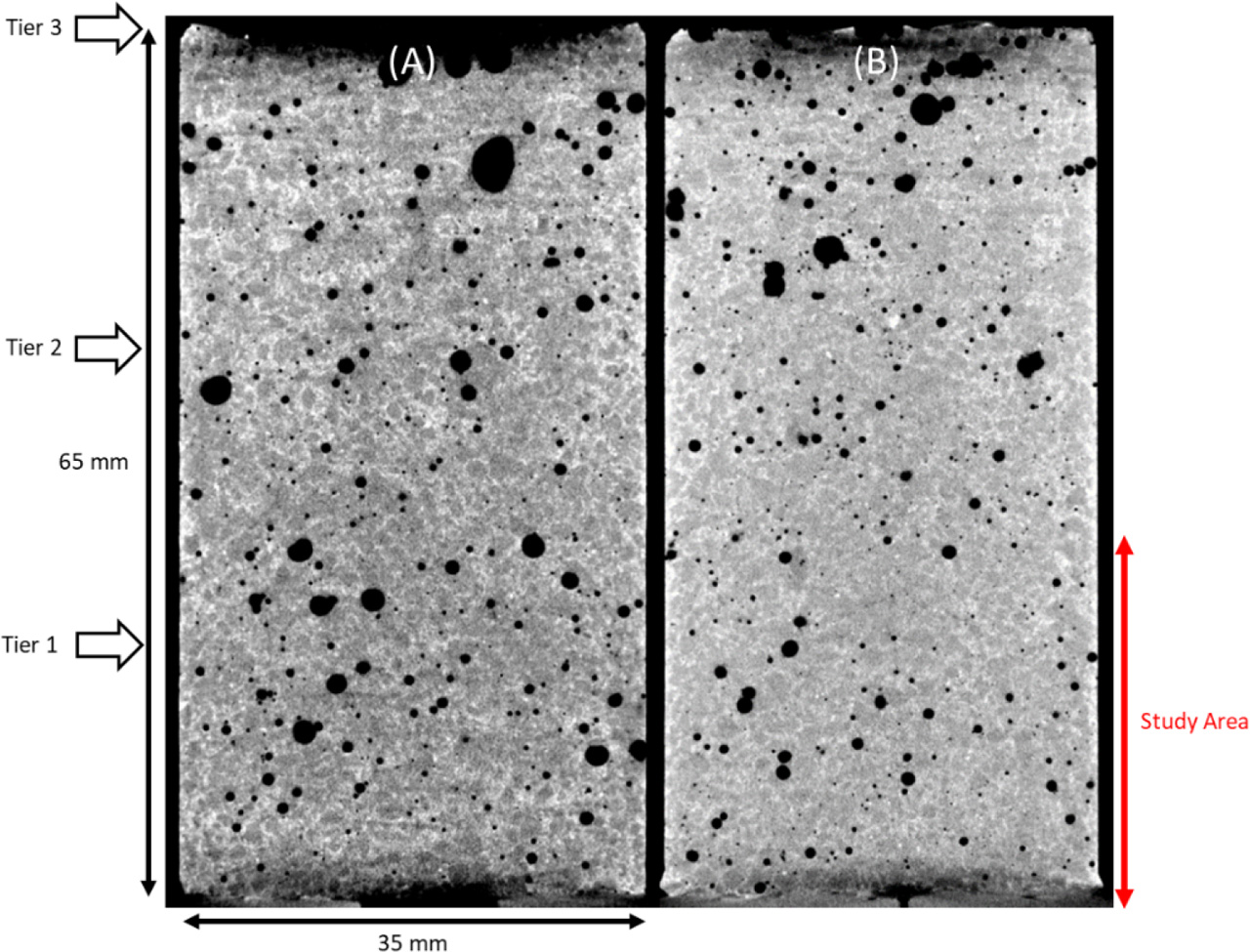
Figure 1:
Comparison of two mortar samples’ XRCT images obtained from different vibration methods: 15 sec for tiers 1 and 2 and 1 min 15 sec for tier 3 (A) versus 1 min 15 sec per tier (B).
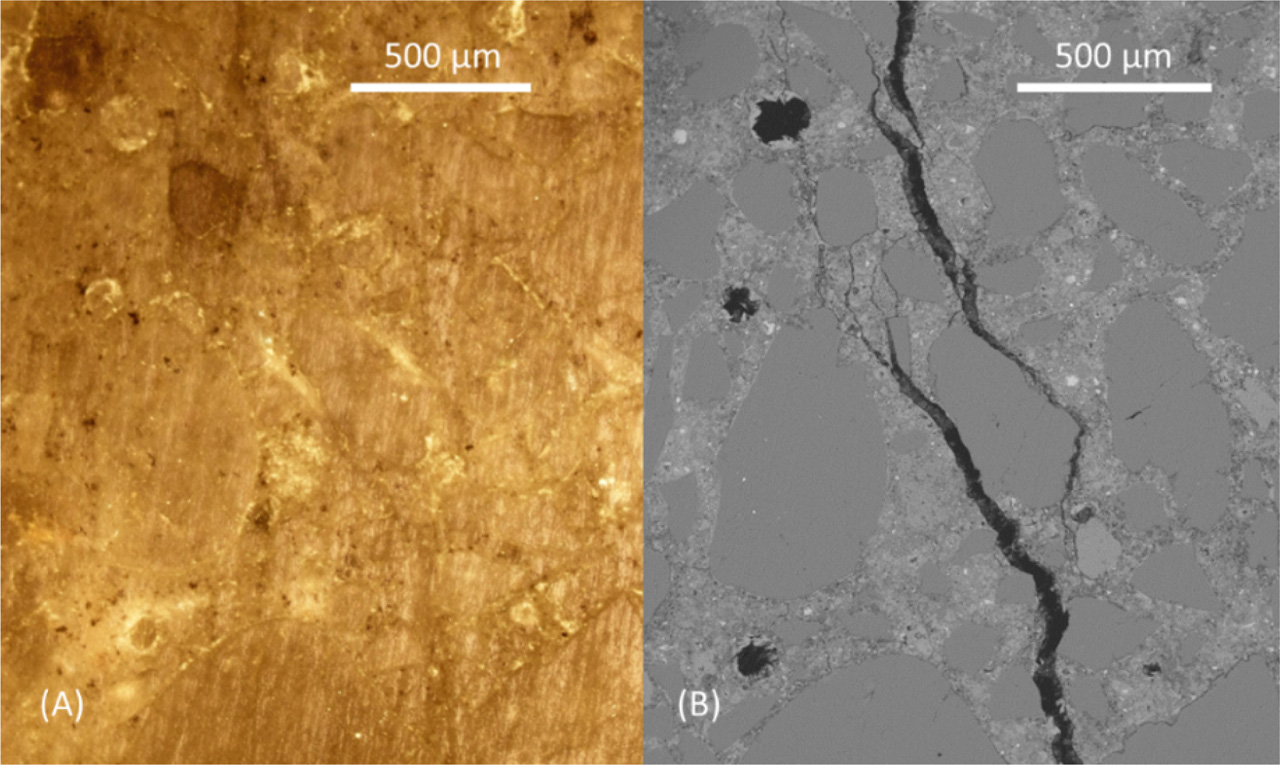
Figure 2:
The same area of the fracture in sample #39 visualised by optical microscopy (OM), magnification: x40 (A) and scanning electron microscopy (SEM) using the BSEi observation mode, magnification: x45 (B).
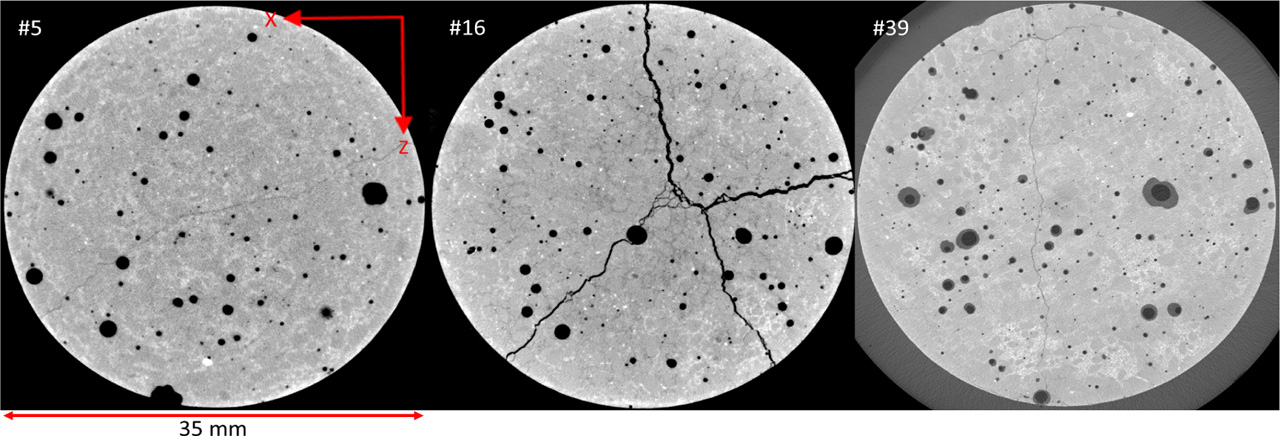
Figure 3:
Tomographic slice of samples #5, #16 and #39.
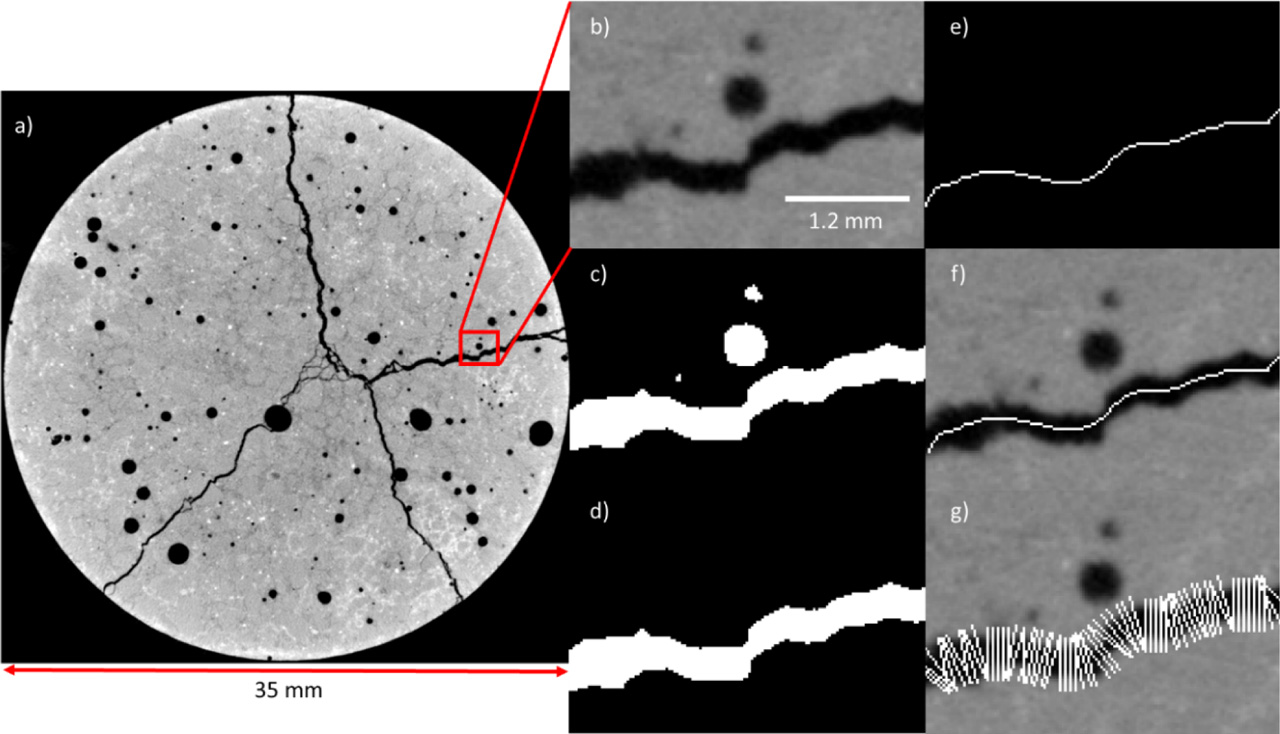
Figure 4:
Workflow employed for fracture segmentation. a) Greyscale tomographic slice of sample #16. b) Magnification of a region of interest of a). c) Mask image obtained by thresholding by boundaries, which is filtered in d) to remove structures which are not connected to the fracture. e) Skeletonised fracture. f) Checking the centre of the skeleton in relation to the fracture. g) View of grey-level profiles associated to the skeleton.
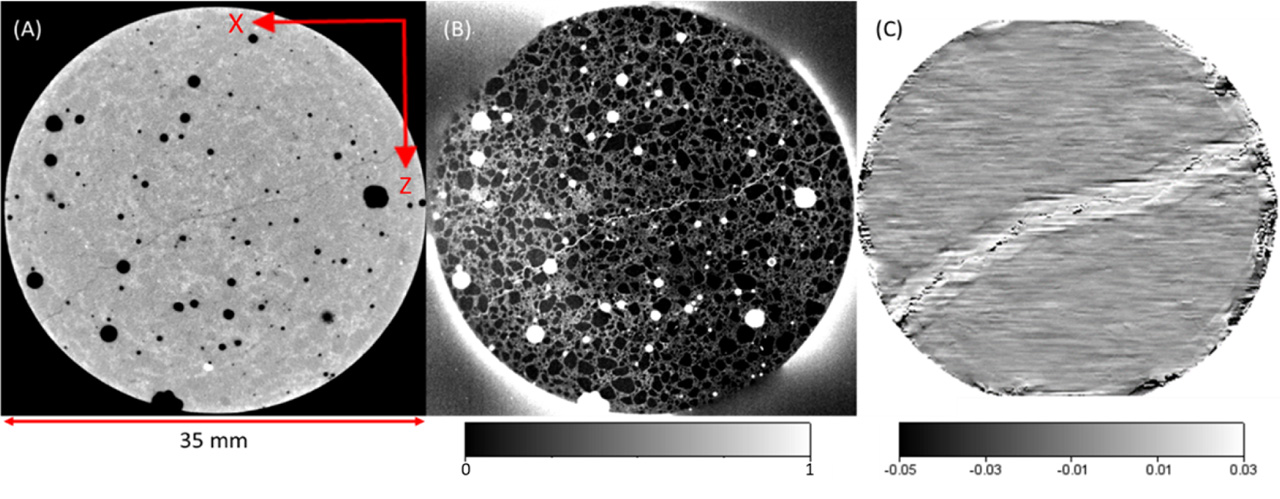
Figure 5:
Mapping of the same fractured sample, #5, with X-ray computed tomography (XRCT) (A), A/A0 mapping obtained from 14C-PMMA autoradiography (B) and the normal strain (Ɛzz) obtained by heaviside-digital volumetric correlation (H-DVC) (C).
Table 1:
Summary of average fracture opening obtained using microscopy methods: optical microscopy (OM) and scanning electron microscopy (SEM). The number of observation points is indicated in brackets.
| #5 (µm) | #39 (µm) | #16 (µm) | |
|---|---|---|---|
| OM | 15.6 ± 5.5 [12] | 29.3 ± 14.6 [80] | 131.8 ± 85.7 [33] |
| SEM | 15.8 ± 6.1 [59] | 25 ± 14.2 [121] | 129.5 ± 136.8 [137] |
Table 2:
Summary of average fracture opening obtained using X-ray computed tomography (XRCT), 14C-PMMA autoradiographs (14C-PMMA) and heaviside-digital volumetric correlation (H-DVC) methods. The numbers of data used to calculate the average values are indicated in brackets.
| #5 (µm) | #39 (µm) | #16 (µm) | |
|---|---|---|---|
| XRCT | 21.2 ± 9.1 [585] | 32.1 ± 13.1 [1549] | 120.1 ± 68.3 [3685] |
| H-DVC | 18.6 ± 8.1 [741] | - | - |
| 14C-PMMA | 18.6 ± 5.7 [3414] | 26.1 ± 8 [3331] | 180.2 ± 72.4 [6051] |
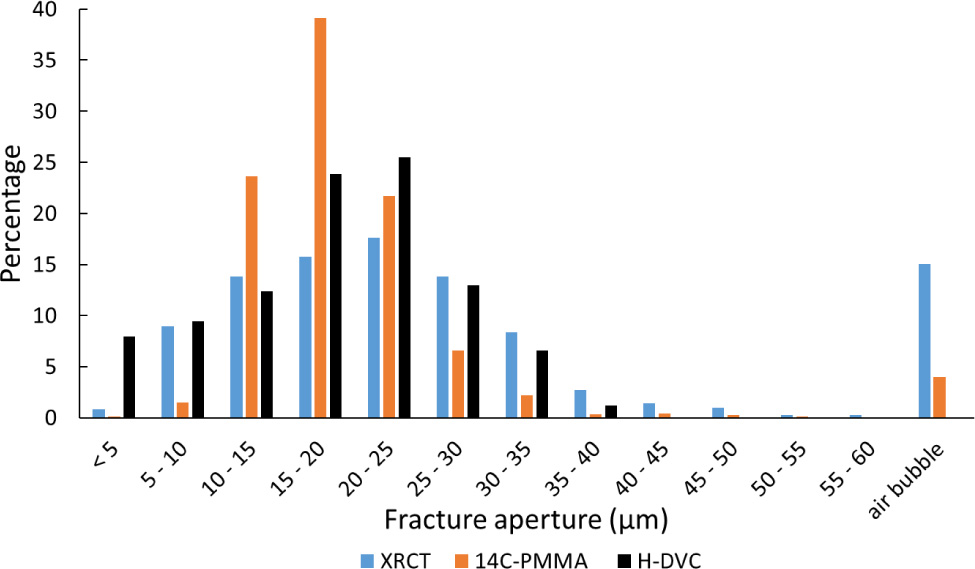
Figure 6:
Sample #5: Fracture aperture distribution, XRCT (blue), 14C-PMMA (orange) and H-DVC (black) methods. The distributions are displayed as probability density functions. Voxel size for XRCT and H-DVC methods: 54.6 µm and pixel size for the 14C-PMMA method: 10.6 µm.
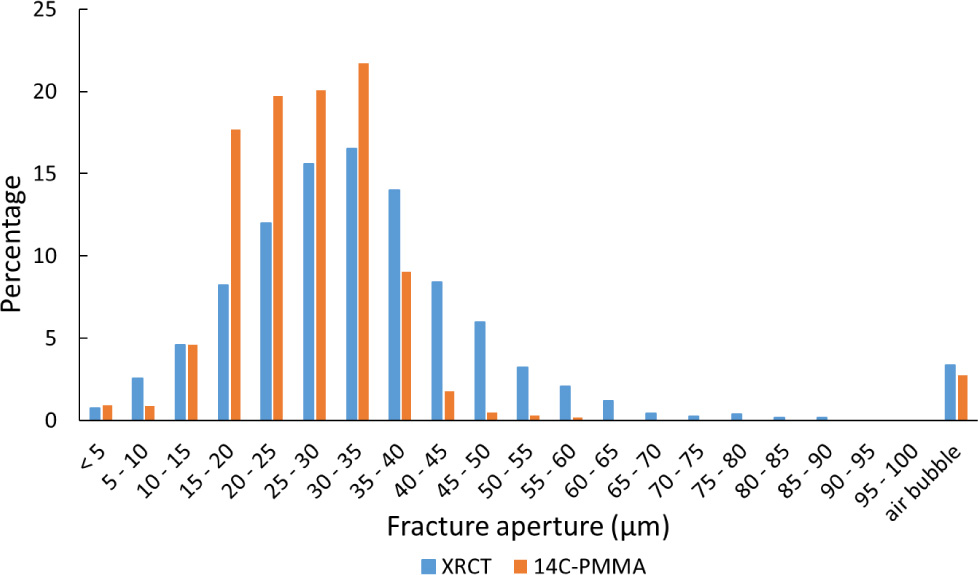
Figure 7:
Sample #39: Fracture aperture distribution, XRCT (blue) and 14C-PMMA (orange) methods. The distributions are displayed as probability density functions. Voxel size for the XRCT method: 24.4 µm and pixel size for the 14C-PMMA method: 10.6 µm.
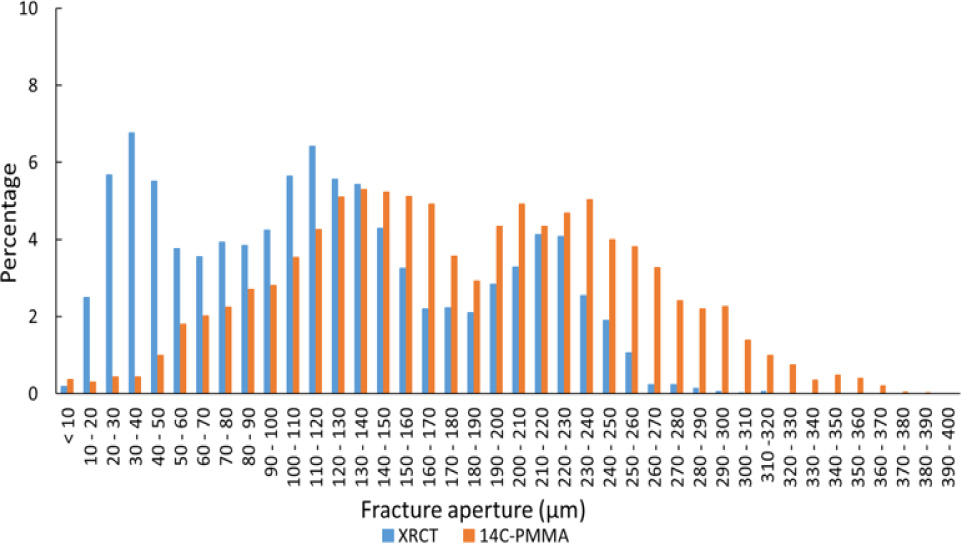
Figure 8:
Sample #16: Fracture aperture distribution, XRCT (blue) and 14C-PMMA (orange) methods. The distributions are displayed as probability density functions. Voxel size for the XRCT method: 24.4 µm and pixel size for the 14C-PMMA method: 10.6 µm.
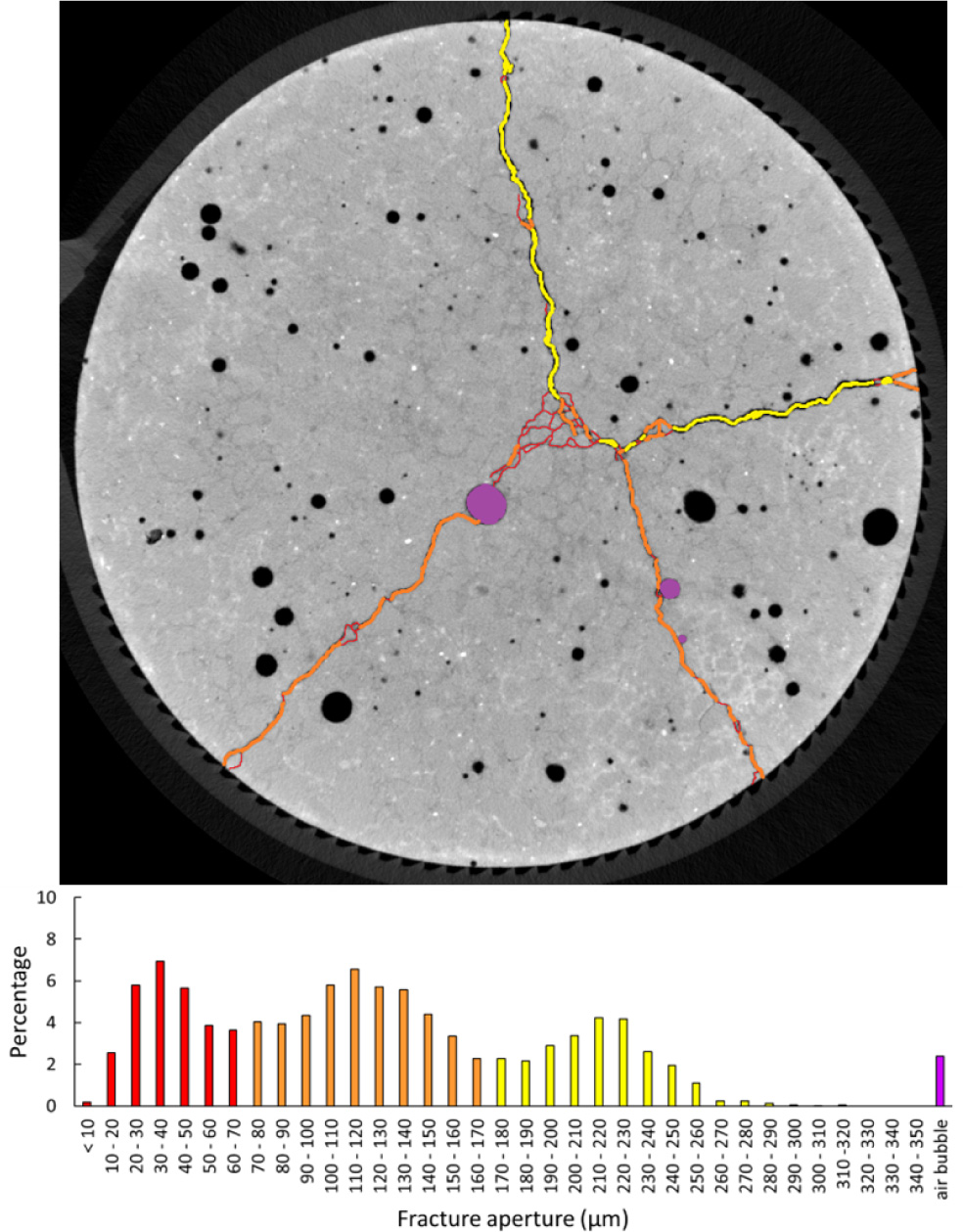
Figure 9:
Fracture apertures of sample #16 obtained with XRCT. The distributions are displayed as probability density functions. Voxel size: 24.4 µm.
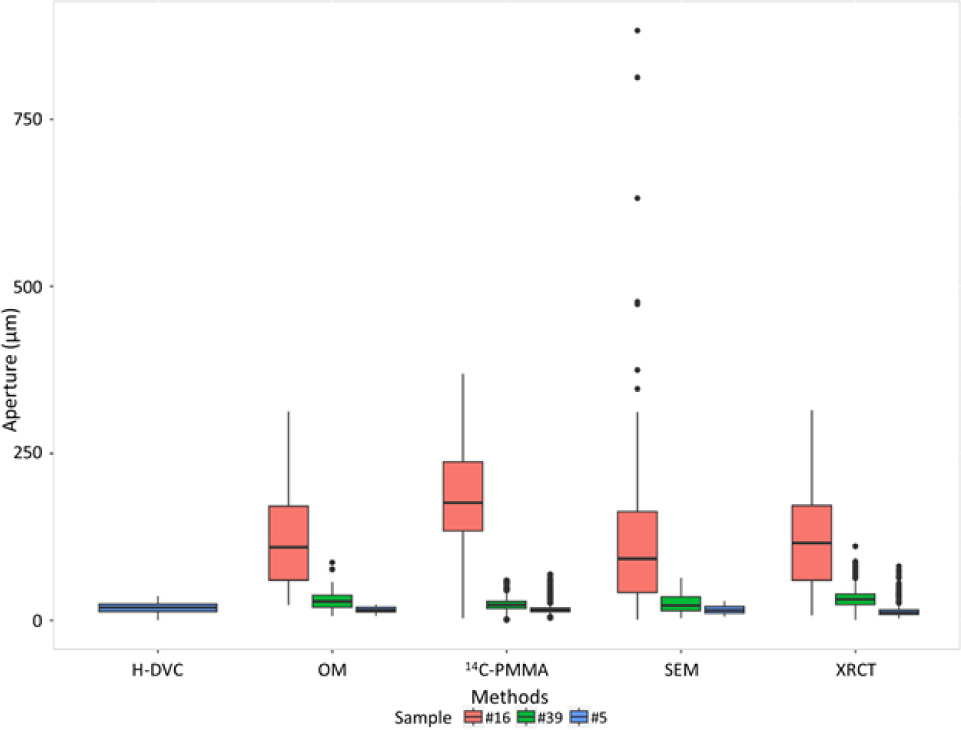
Figure 10:
Summary graphic of fracture opening obtained by the five methods. The black dots correspond to the artefact values for the XRCT and 14C-PMMA methods and for air bubbles for the OM and SEM methods.
Table 3:
Comparison of fracture densities calculated using the XRCT and 14C-PMMA methods. These results were obtained from the same data used to calculate the mean aperture values presented in Table 2, except for the 14C-PMMA method for sample #16 where all the data were considered.
| Fracture densities (mm−1) | ||
|---|---|---|
| XRCT | 14C-PMMA | |
| #5 | 3.3 ± 0.3 × 10⁻² | 3.7 ± 0.4 × 10⁻² |
| #39 | 3.8 ± 0.4 × 10⁻² | 3.5 ± 0.4 × 10⁻² |
| #16 | 9.1 ± 0.9 × 10⁻² | 7.6 ± 0.8 × 10⁻² |
Table 4:
Process duration and constraints for each method of aperture and density analysis.
| Process duration | Disadvantages | |
|---|---|---|
| OM | A few hours | Manual analysis of few points / Difficulties of fracture observation |
| SEM | 1 day | Manual analysis of few points / long analysis time |
| XRCT | 1 day | Fracture detection depends on image resolution |
| H-DVC | A few weeks / months | Fracture detection depends on image resolution / long process and analysis time, two image acquisitions |
| 14C-PMMA | A few months | Use of radioactive tracer / long process time / semi-destructive method |