
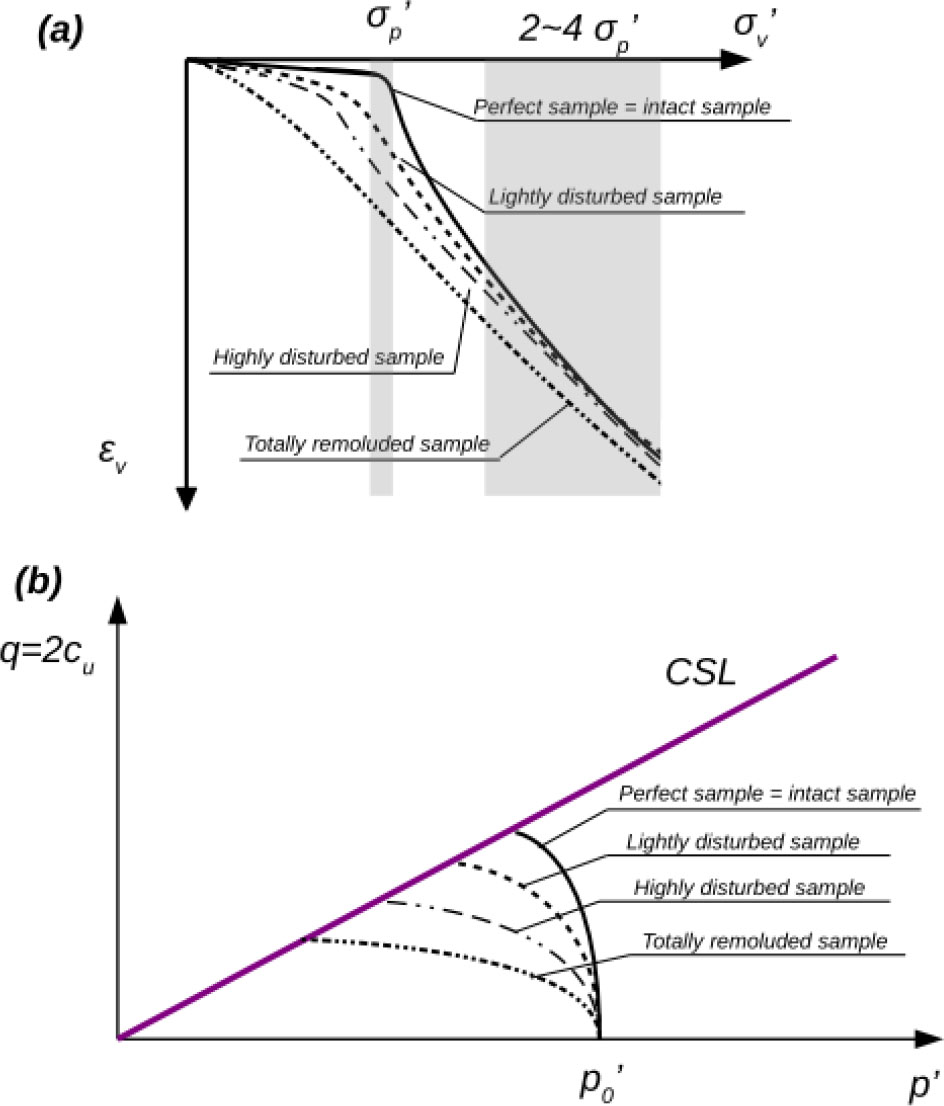
Figure 1:
Schematic presentation of soft soil sample quality influence on (a) compressibility behavior and (b) undrained shear strength (Note: σv′ = effective vertical stress; ɛv = axial strain; σp′ = preconsolidation pressure; q = deviatoric stress according to Cambridge notation; p′ = effective mean stress according to Cambridge notation; p0′ = initial mean stress; CSL = critical state line).
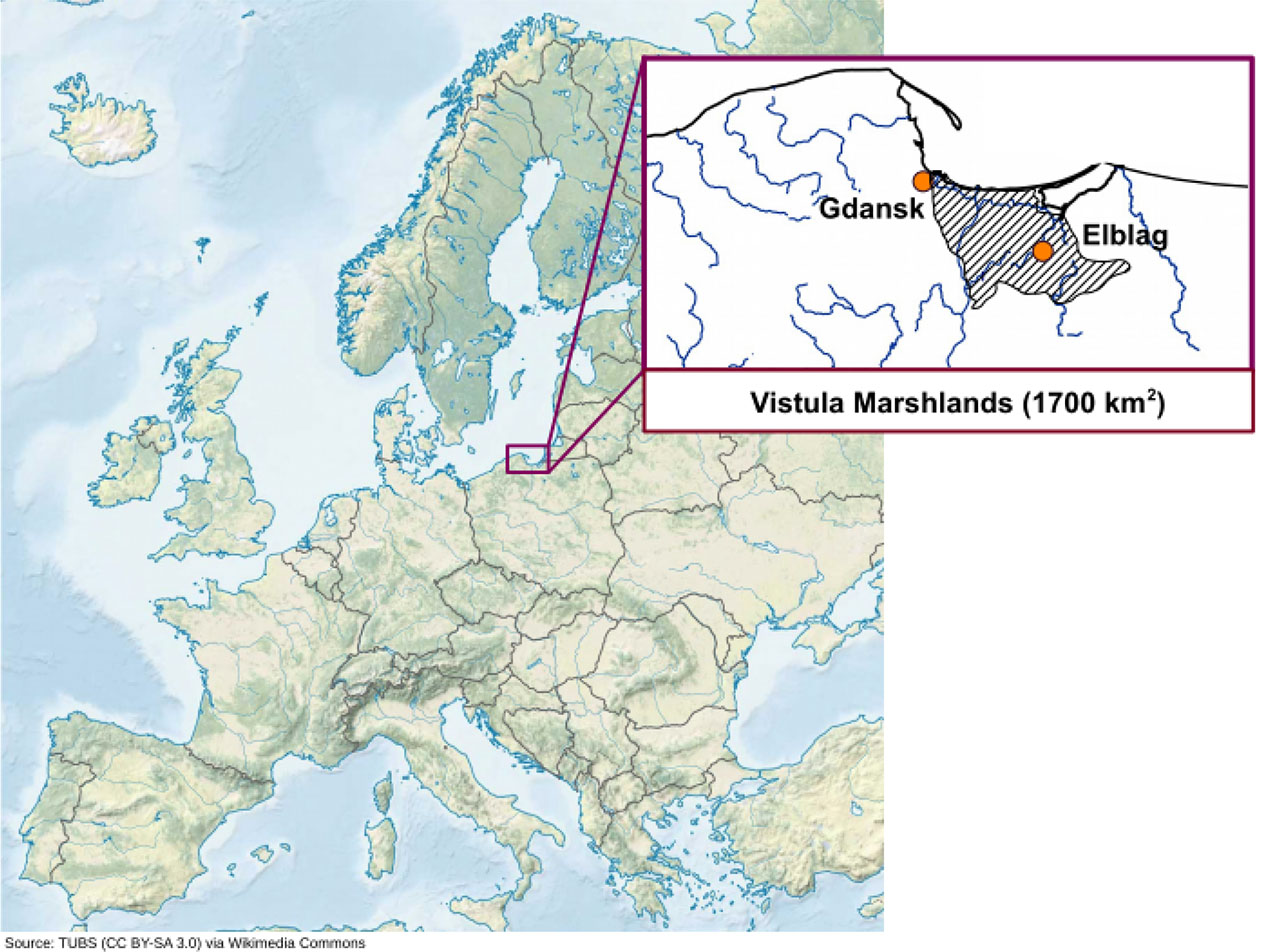
Figure 2:
Vistula Marshlands, Northern Poland.
Table 1:
Vistula Marshlands soft soils basic physical properties.
| Physical/index properties | Soil | Standard | ||
|---|---|---|---|---|
| Organic clay | Organic silt | Peat | ||
| LOI | 10%<LOI<30% | 5%<LOI<10% | LOI>30% | ASTM D2974 or PN-ISO 10694 |
| Fines | ~50% of Cl and Si | ~95% of Si | N/A | Laser diffraction method |
| wc | 63.5±21.0 | 45.5±18.5 | 261±110.4 | ASTM D2216 or PN-EN ISO 17892-1 |
| ρ | 1.58±0.16 | 1.74±0.18 | 1.17±0.27 | ASTM D854 or PN-EN ISO 17892-2 |
| Gs | 2.61±0.06 | 2.60±0.06 | 2.04±0.32 | ASTM D7263 or PN-EN ISO 17892-3 |
| LL | 82.5±32.1 | 52.0±21.0 | 268.9±115.7 | ASTM D4318 or PN-EN ISO 17892-12 |
| IP | 50.1±25.1 | 29.4±13.8 | 159.4±87.5 | ASTM D4318 or PN-EN ISO 17892-12 |
| Casagrande's chart | Along and above A-line | Above A-line | N/A | ASTM D2487 or PN-EN ISO 14688-2 |
[i] Note: LOI = loss on ignition (equivalent to organic matter content); wc = water content; ρ = soil density; Gs = specific gravity; PL = plastic limit; LL = liquid limit; ± indicates standard deviation values
Table 2:
Soil specimens used in soil sample quality evaluation.
| Soil | Time of tests after sampling [number of tests]* | |||
|---|---|---|---|---|
| 1 day | Up to 1 week | 2–3 weeks | Above 3 weeks | |
| Organic clay | 8 | 7 | 3 | 4 |
| Organic silt | 6 | 4 | 4 | 7 |
| Peat | 6 | 1 | 4 | — |
Table 3:
Soil specimens used in soil sample quality evaluation.
| SQD (Terzaghi et al., 1966) | Δe/e0 criteria (Lunne et al., 1997) | Cr/Cc (deJong et al., 2018) | ||||
|---|---|---|---|---|---|---|
| ɛvol at σ′vo[%] | SQD class | OCR 1–2 | OCR 2–4 | Rating | Cr/Cc | Rating |
| <1 | A | <0.04 | <0.03 | v. good to excellent (A) | <0.15 | High |
| 1–2 | B | 0.04–0.07 | 0.03–0.05 | good to fair (B) | 0.15–0.4 | Moderate |
| 2–4 | C | 0.07–0.14 | 0.05–0.1 | Poor (C) | >0.4 | Low |
| 4–8 | D | >0.14 | >0.1 | Very poor (D) | - | - |
| >8 | E | - | - | - | - | - |
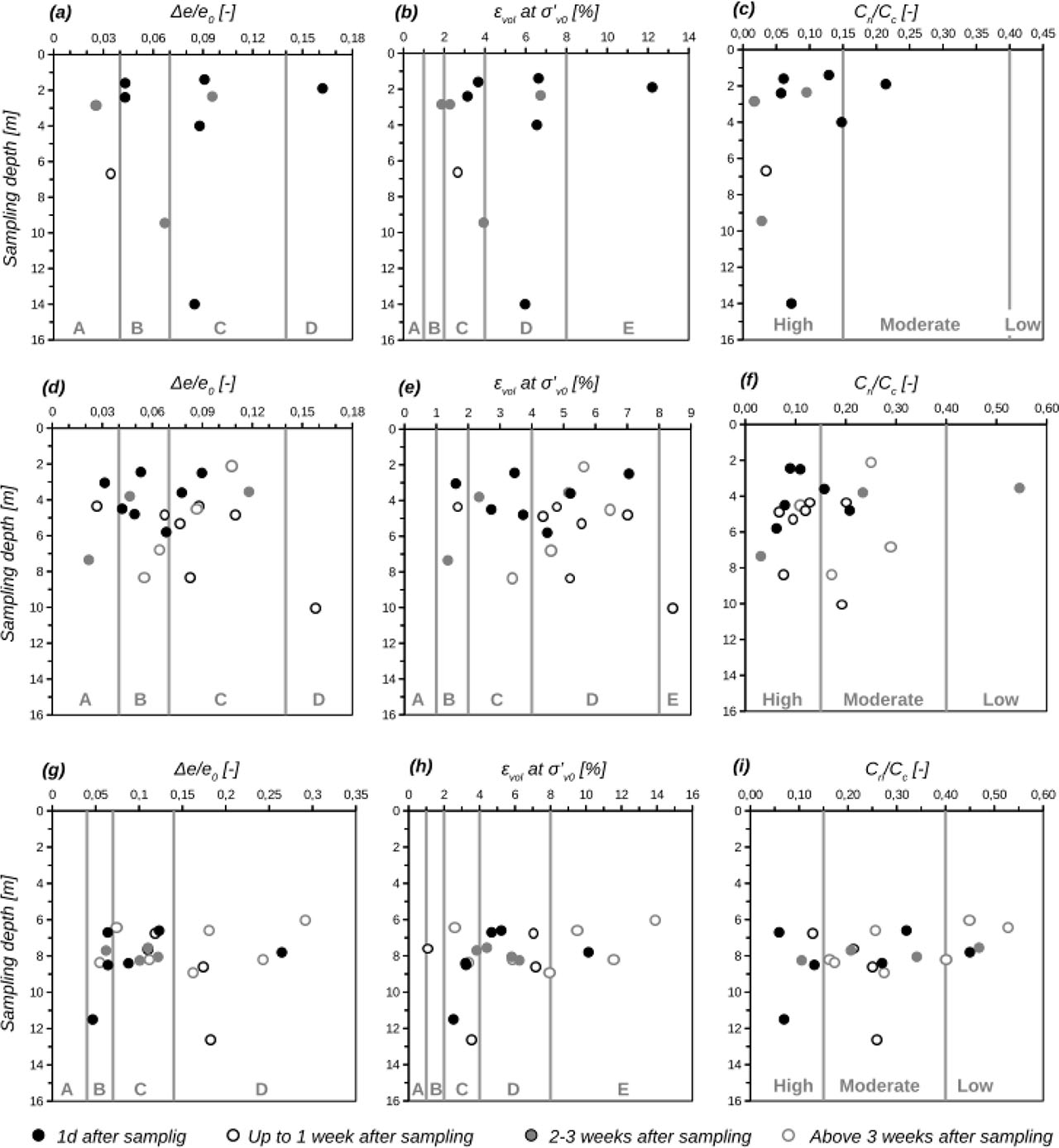
Figure 3:
Soil sample quality according to different rating systems for peats (a,b,c), organic clay (d,e,f), and organic silt (g,h,i).
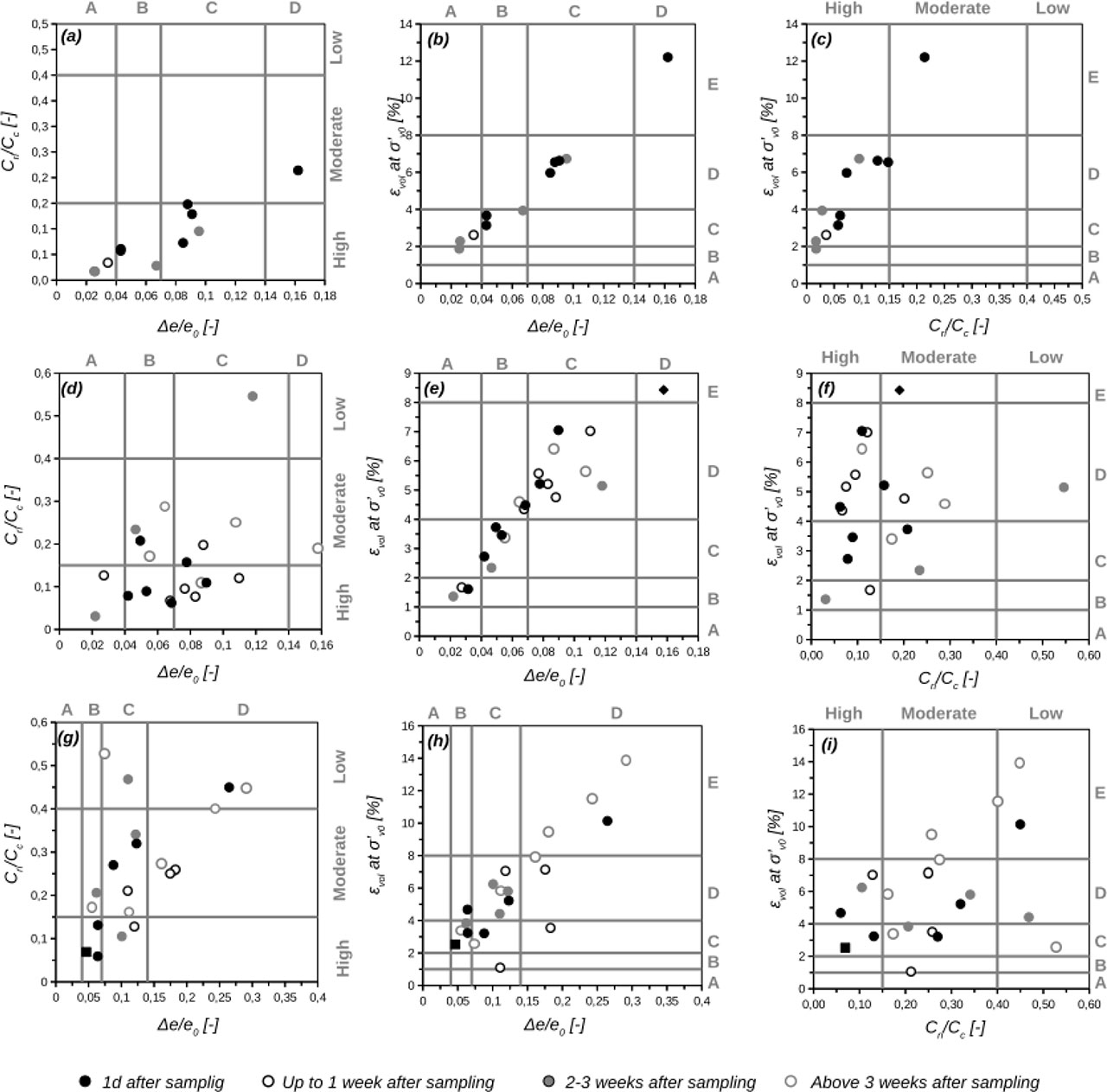
Figure 4:
Relationships between different SQD criteria for peats (a,b,c), organic clay (d,e,f), and organic silt (g,h,i).
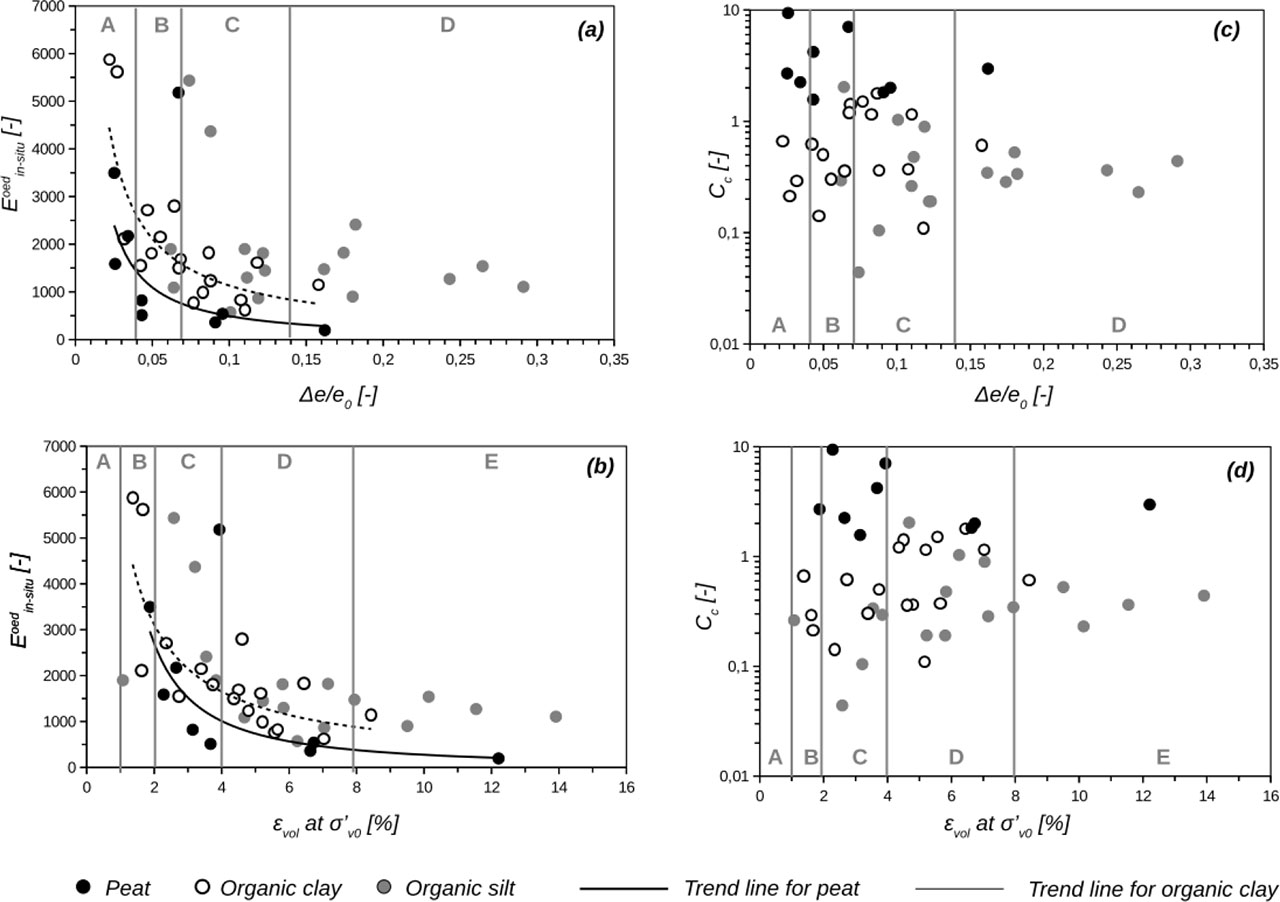
Figure 5:
Influence of sample quality on oedometric modulus and compression index.
Table 4:
Natural variability of the organic silt samples for oedometric tests.
| Sample no | Boring no | Sample depth [m] | Test method | wc [%] | ρ [g/cm3] | Gs [−] | Notes |
|---|---|---|---|---|---|---|---|
| 1 | O3 | 10.5–11 | 24h IL | 50.6 | 1.46 | 2.58 | Sample few cm to no.2 |
| 2 | O3 | 10.5–11 | 24h IL | 59.9 | 1.29 | 2.58 | Sample few cm to no.1 |
| 3 | O1 | 9.5–10 | 24h IL | 51.4 | 1.57 | 2.57 | O1 borehole is at distance of 10 m from O2 |
| 4 | O2 | 9.5–10 | 24h IL | 42.9 | 1.71 | 2.54 | O2 borehole is at distance of 10 m from O1 |
| 5 | O3 | 9.3–9.8 | 24h IL | 48.0 | 1.80 | 2.58 | |
| 6 | O3 | 10–10.5 | 24h IL | 91.0 | 1.39 | 2.46 | Very variable water content and plasticity of soil in the tube |
| 7 | O4 | 10–10.5 | 24h IL | 103.5 | 1.37 | 2.26 | Very variable water content and plasticity of soil in the tube |
| 8 | O4 | 10.5–11 | 24h IL | 55.8 | 1.53 | 2.52 | - |
| 9 | O2 | 9.5–10 | CRS* | 41.2 | 1.68 | 2.57 | - |
[i] Note: wc = water content; ρ = soil density; Gs = specific gravity; IL = incremental loading oedometer test
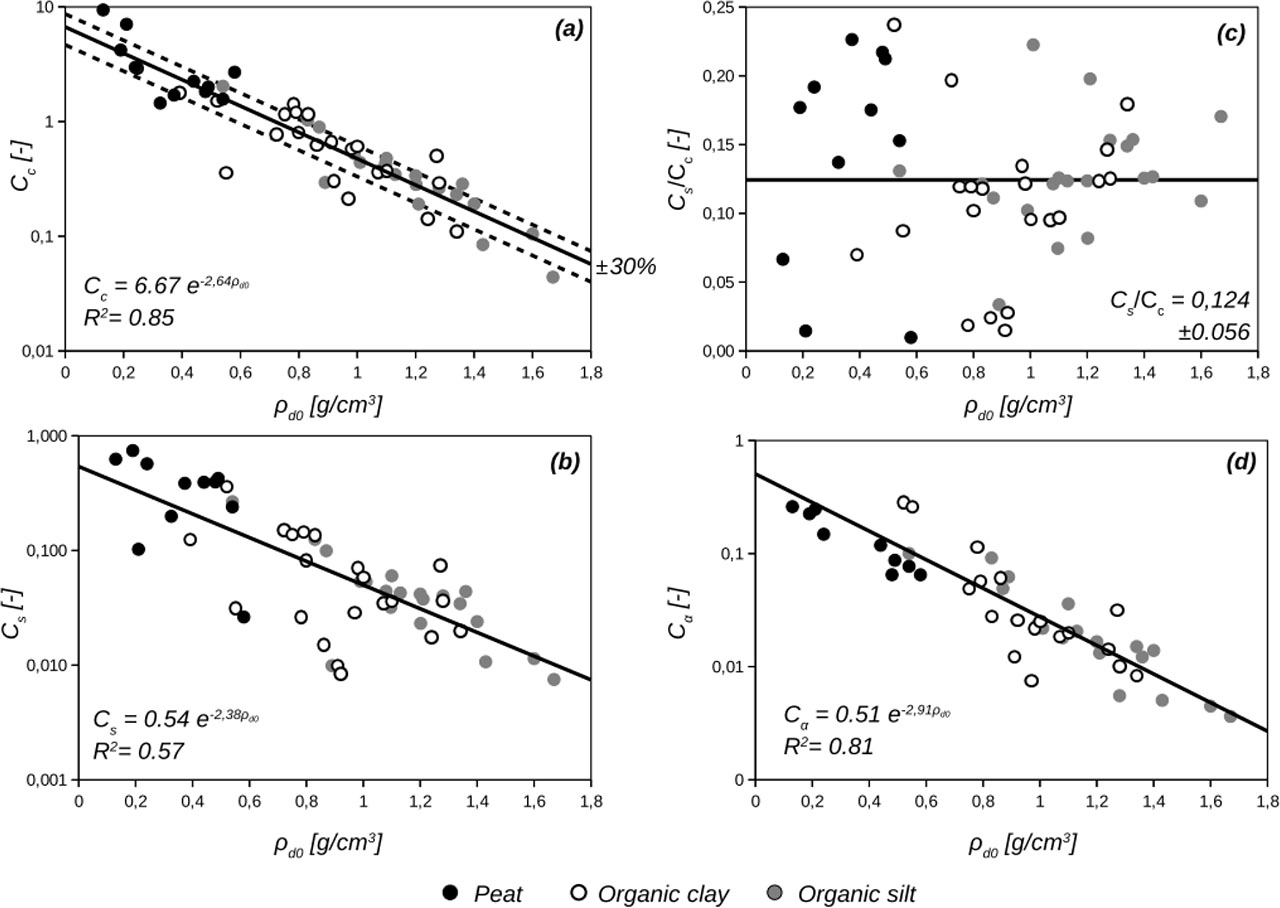
Figure 6:
Local relations of (a) Cc, (b) Cs, (c) Cs/Cc and (d) Cα with ρd0
Table 5:
Variability of constrained modulus and compression index for first group of soils (samples No. 1, 2, 3, 6, 7, and 8).
| Sample no | Eoed [kPa] | Eoedcorr [kPa] | Cc100–200kPa [−] | Cc200–400kPa [−] | ρd0 [g/cm3] | Cceq.(5) [ −] | RE [%] |
|---|---|---|---|---|---|---|---|
| 1 | 1468 | 1304 | 0.601 | 0.557 | 0.973 | 0.511 | 14.9 |
| 2 | 1342 | 1125 | 0.788 | 0.687 | 0.811 | 0.783 | 0.5 |
| 3 | 1565 | 1351 | 0.525 | 0.434 | 1.037 | 0.432 | 17.7 |
| 6 | 983 | 843 | 1.141 | 1.077 | 0.728 | 0.976 | 14.4 |
| 7 | 1175 | 973 | 0.951 | 0.816 | 0.673 | 1.127 | 18.6 |
| 8 | 1462 | 1240 | 0.583 | 0.536 | 0.982 | 0.499 | 14.4 |
| AVG | 1332 | 1140 | 0.764 | 0.684 | - | - | - |
| SD | 198 | 181 | 0.221 | 0.213 | - | - | - |
| COV | 0.14 | 0.16 | 0.29 | 0.31 | - | - | - |
[i] Note: Eoed = oedometric (constrained) modulus; Eoedcorr = oedometric (constrained) modulus corrected due to sample disturbance; Cc = compression index, number in brackets indicated stress range; ρd0 = initial dry bulk density; RE = relative error; AVG = average; SD = standard deviation; COV = coefficient of variation.
Table 6:
Variability of constrained modulus and compression index for second group of soils (samples No. 4, 5, and 9).
| Sample no. | Eoed [kPa] | Eoedcorr [kPa] | Cc100–200kPa [−] | Cc200–400kPa [−] | ρd0 [g/cm3] | Cceq.(5) [−] | RE [%] |
|---|---|---|---|---|---|---|---|
| 4 | 2949 | 2679 | 0.239 | 0.215 | 1.196 | 0.283 | 18.4 |
| 5 | 3311 | 3058 | 0.213 | 0.203 | 1.216 | 0.269 | 26.3 |
| 9 | 3125 | 2905 | 0.243 | 0.291 | 1.189 | 0.288 | 18.6 |
| AVG | 3128 | 2881 | 0.232 | 0.236 | - | - | - |
| SD | 147 | 155 | 0.013 | 0.039 | - | - | - |
| COV | 0.05 | 0.05 | 0.06 | 0.16 | - | - | - |
[i] Note: Eoed = oedometric (constrained) modulus; Eoedcorr = oedometric (constrained) modulus corrected due to sample disturbance; Cc = compression index, number in brackets indicated stress range; ρd0 = initial dry bulk density; RE = relative error; AVG = average; SD = standard deviation; COV = coefficient of variation.
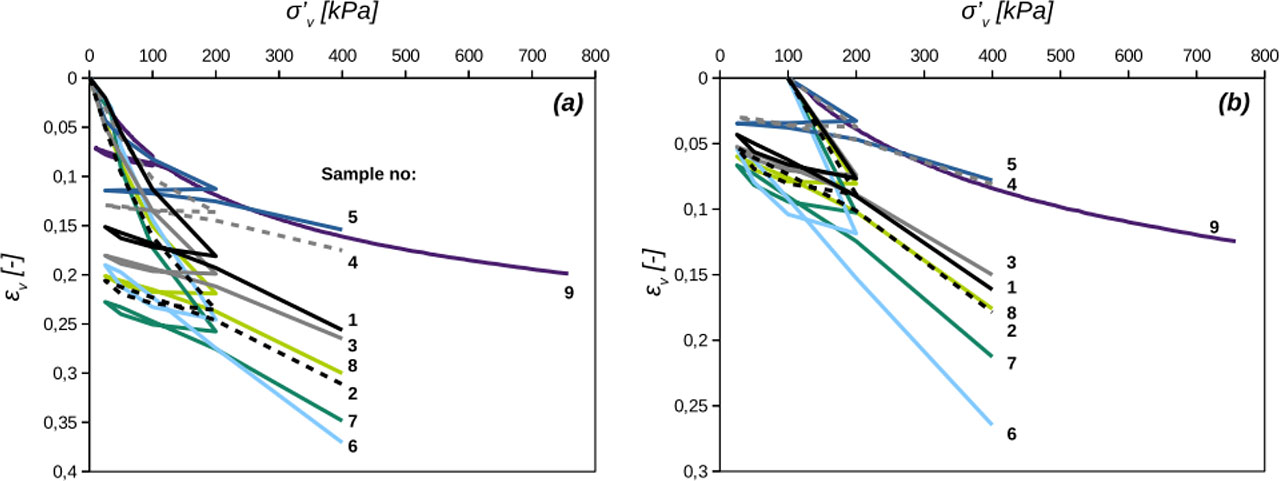
Figure 7:
(a) Raw oedometer results (lab selected seating stress level is the reference one; usually approx. 5 kPa) and (b) “corrected” plots due to soil sample disturbance (in situ stress level is the reference one, here 100 kPa).
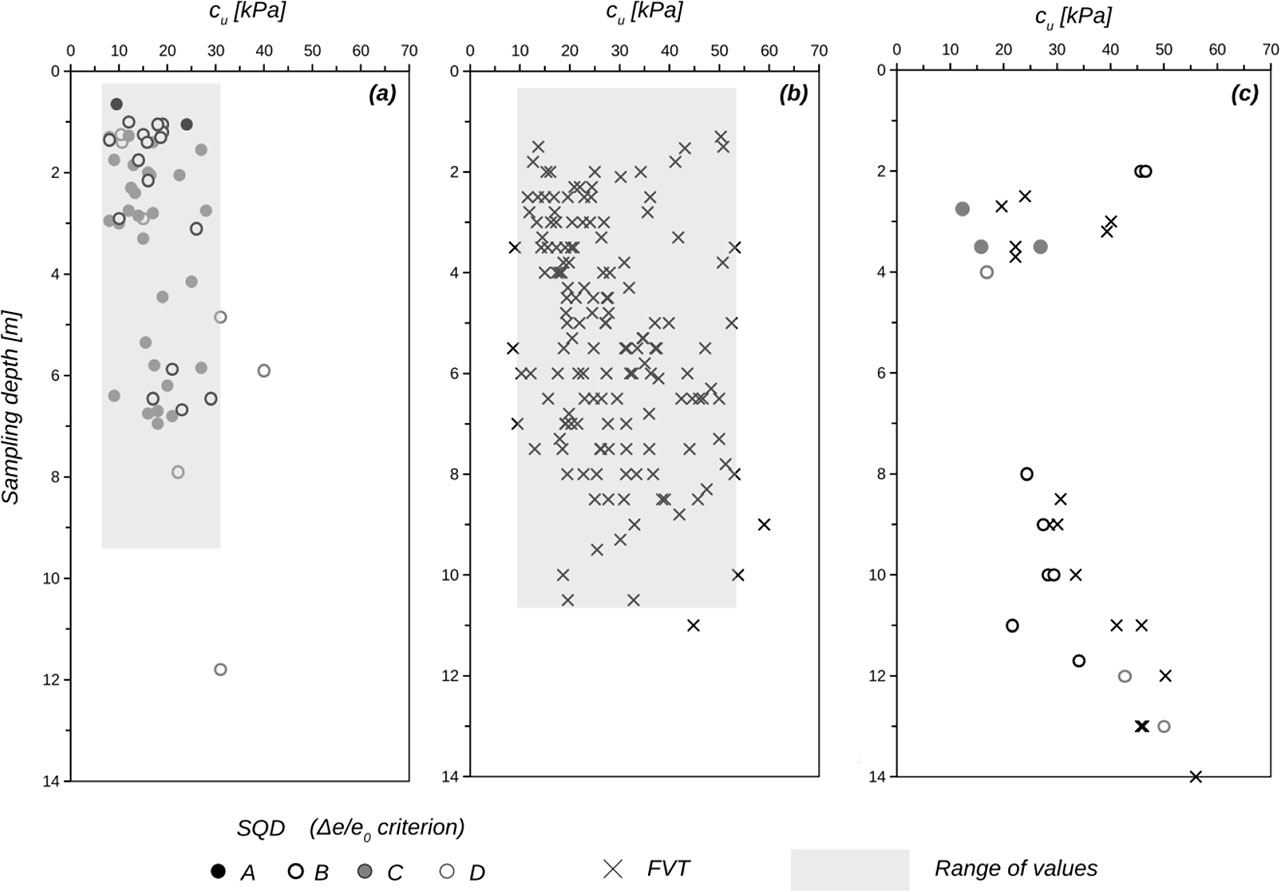
Figure 8:
General picture of undrained shear strength of soft soil in Vistula Marshlands: (a) UUC test results, (b) FVT tests, and (c) specific location values (Jazowa testing site).
Table 7:
Jazowa testing site—different cu estimates.
| Sample no | Type (Δe/e0) | Sampling/Testing depth [m] | Soil type | Test method | cu [kPa] | Rate | cu normalized to 1%/h (1) [kPa] |
|---|---|---|---|---|---|---|---|
| 1 | In situ (B) | 8 | orSi | UUC | 24.2 | 70%/h | 18.9 |
| 2 | In situ (B) | 9 | orSi | UUC | 27.3 | 70%/h | 21.3 |
| 3 | In situ (B) | 10 | orSi | UUC | 28.2 | 70%/h | 22.1 |
| 4 | In situ (B) | 10 | orSi | UUC | 29.3 | 70%/h | 22.9 |
| 5 | In situ (N/A) | 8.5 | orSi | FVT | 30.7(2) | 0.1°/s (700%/h) | 30.7(2) |
| 6 | In situ (N/A) | 9 | orSi | FVT | 30.1(2) | 0.1°/s (700%/h) | 30.1(2) |
| 7 | In situ (N/A) | 9 | orSi | FVT | 28.5(2) | 0.1°/s (700%/h) | 28.5(2) |
| 8 | In situ (N/A) | 10 | orSi | FVT | 33.5(2) | 0.1°/s (700%/h) | 33.5(2) |
| 9 | Reconstituted (A) | 9 | orSi | CK0UC | 32.7 | 1%/h | 32.7 |
| 10 | Reconstituted (A) | 9 | orSi | CK0UC | 29.3 | 1%/h | 29.3 |
| 11 | Reconstituted (A) | 9 | orSi | DSS | 27.2 | 20%/h | 22.8 |
| 12 | Reconstituted (A) | 9 | orSi | DSS | 29.3 | 20%/h | 24.5 |
[i] Note: (1) Rate dependency of organic silt was observed in lab and field tests. These tests indicates that cu increases of about 15% in one log cycle due to strain rate increase; (2) FVT tests were already corrected due to rate effects according to equation (2).
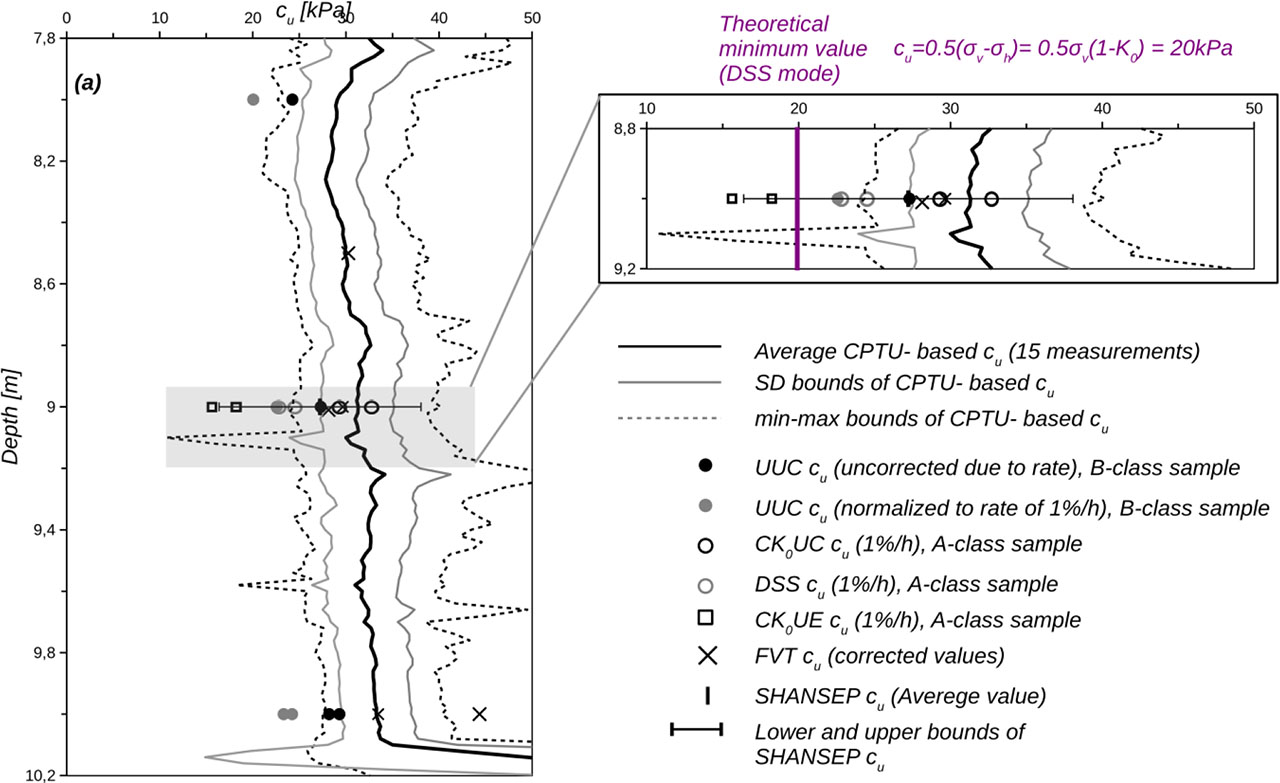
Figure 9:
Different estimates of cu for Jazowa site.
Table 8:
Organic clay—different estimates of cu (location No. 2).