
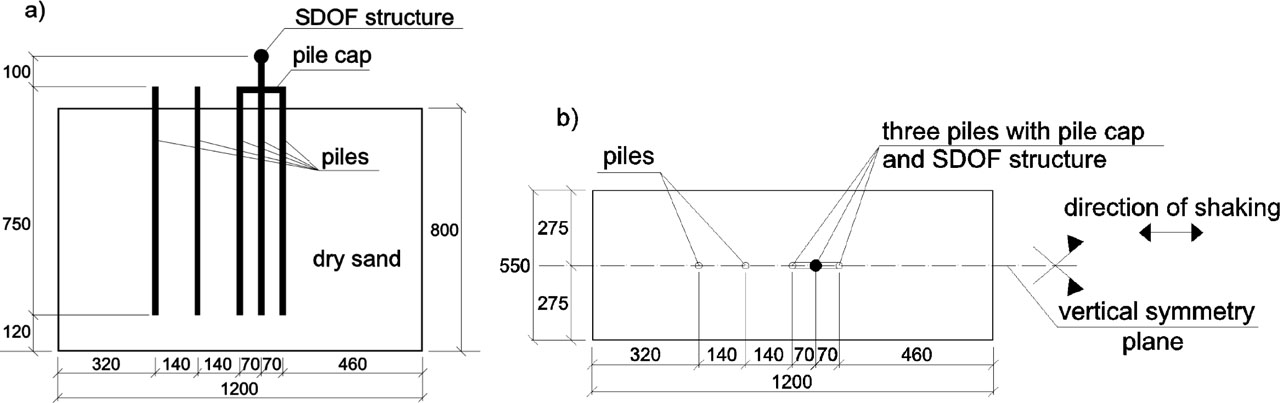
Figure 1
Geometry of numerically modelled experimental setup with a single degree of freedom (SDOF) structure: a) long side view, b) plan (dimensions in mm).
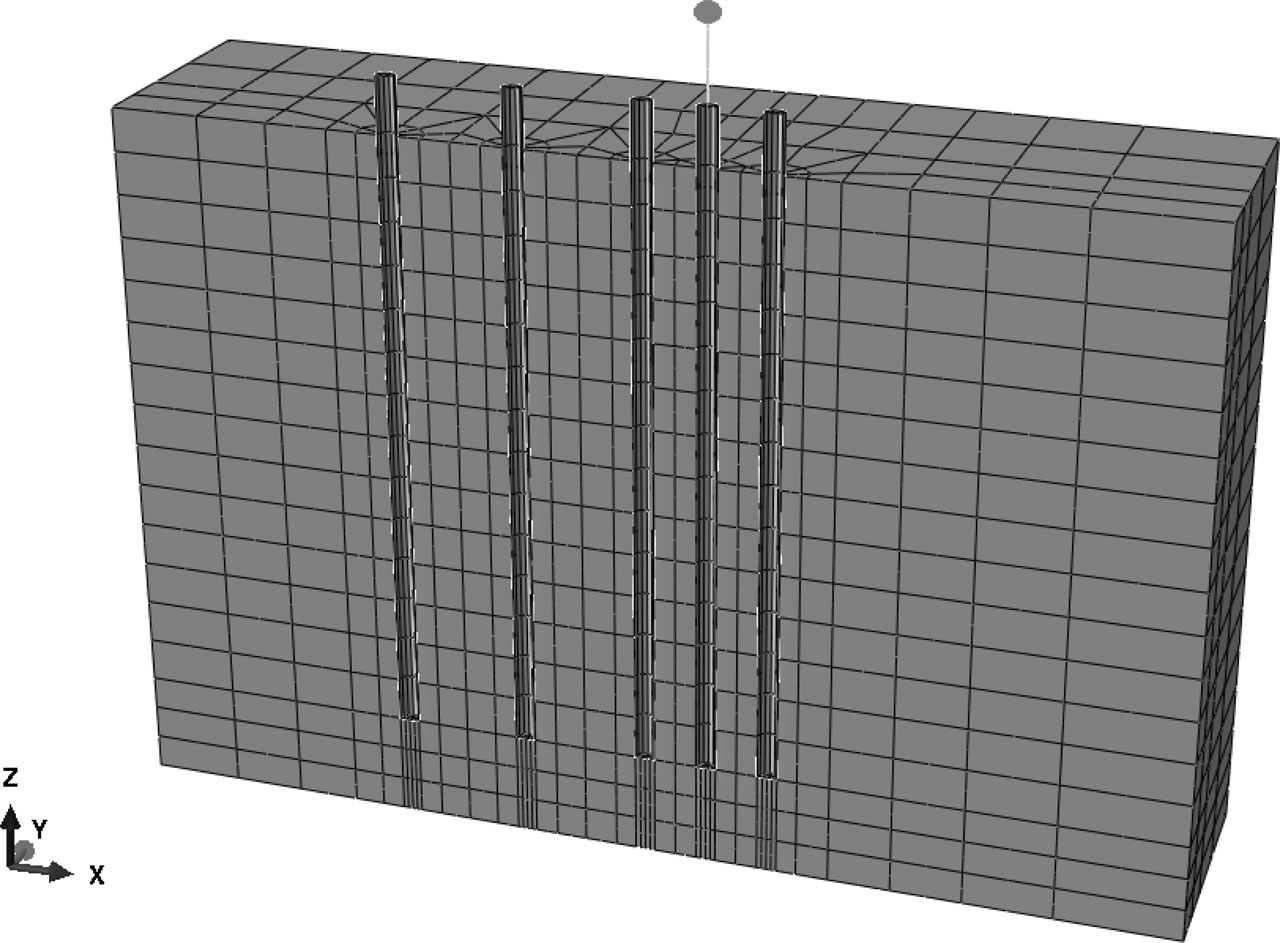
Figure 2
Mesh discretisation used in the 3D finite element model.
Table 1
Calibration of the model parameters for the hypoplastic sand model.
| Parameter | Description | Value | |
|---|---|---|---|
| Basic hypoplastictiy | φc | Critical friction angle | 33.0 |
| hs | Granular hardness (kPa) | 2.5 × 10⁶ | |
| n | Stiffness exponent ruling pressure-sensitivity | 0.42 | |
| ed0 | Limiting minimum void ratio at p = 0 kPa | 0.613 | |
| ec0 | Limiting void ratio at p = 0 kPa | 1.01 | |
| ei0 | Limiting maximum void ratio at p = 0 kPa | 1.21 | |
| α | Exponent linking peak stress with critical stress | 0.13 | |
| β | Stiffness exponent scaling barotropy factor | 0.8 | |
| Intergranular strain concept | R | Elastic range | 0.00004 |
| mR | Stiffness multiplier | 4.0 | |
| mT | Stiffness multiplier after 90° change in strain path | 2.0 | |
| βR | Control of rate of evolution of intergranular strain | 0.8 | |
| χ | Control on interpolation between elastic and hypoplastic response | 0.5 | |
| ϑ | Control on strain accumulation | 5.0 |
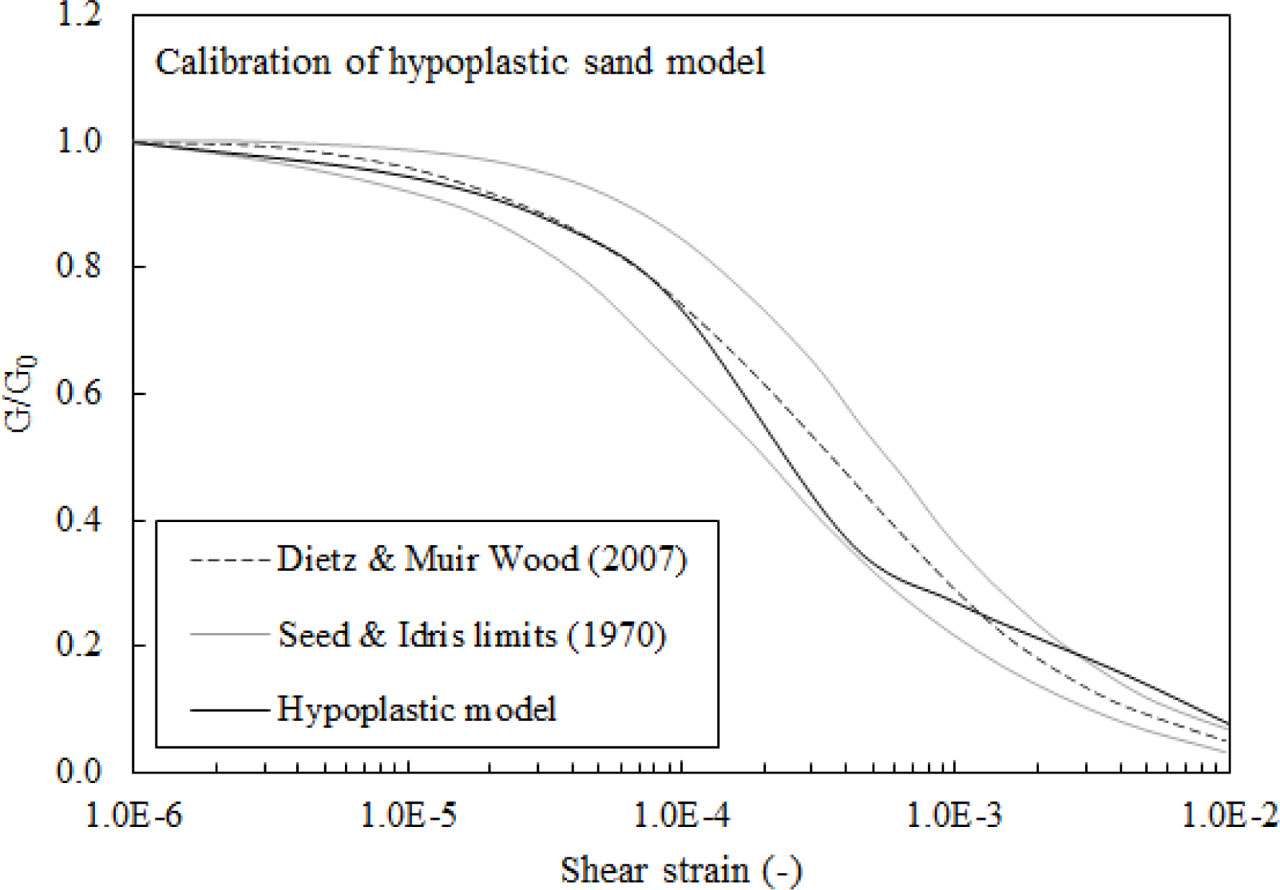
Figure 3
Calibration of the hypoplastic sand constitutive model in terms of shear stiffness degradation G/G0 against shear strain.
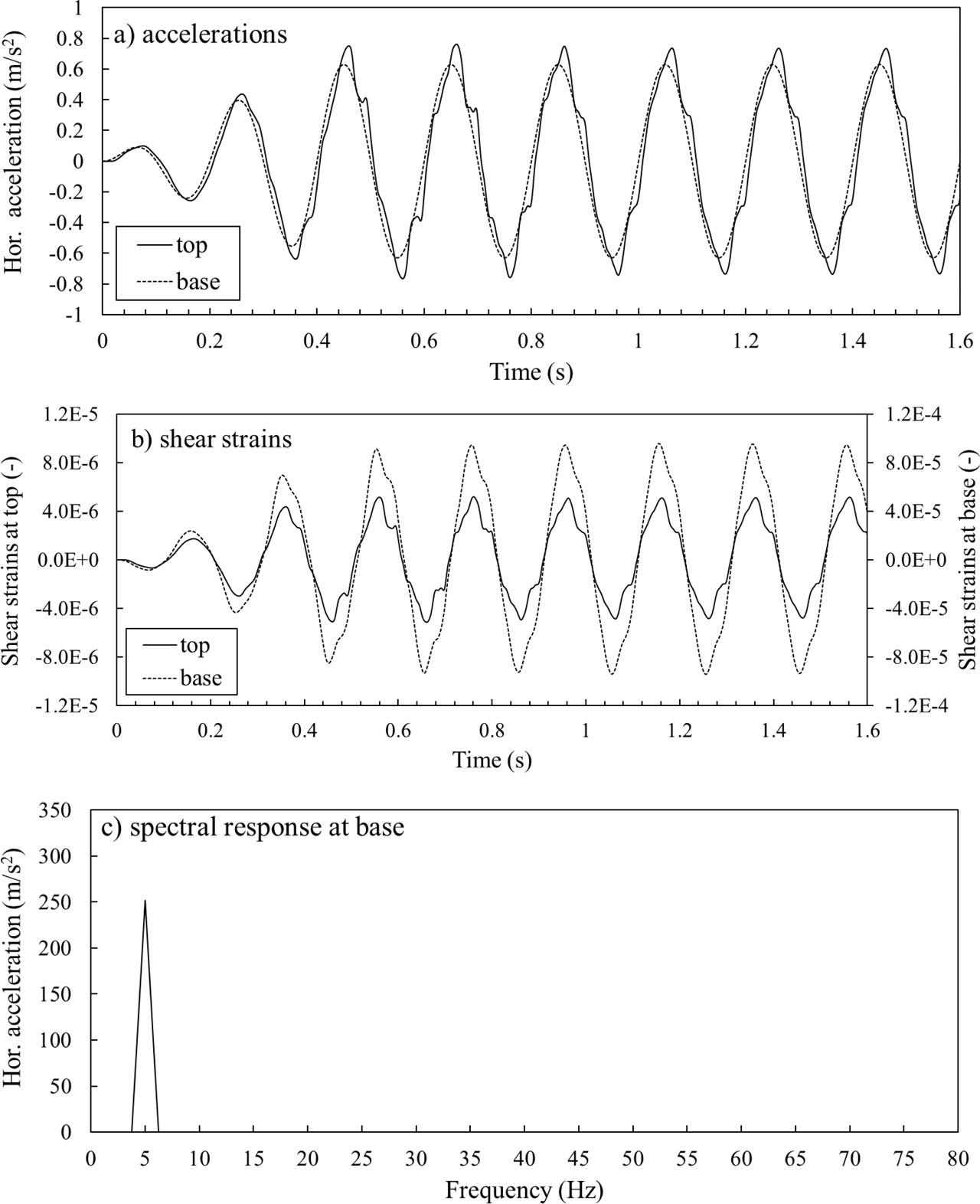
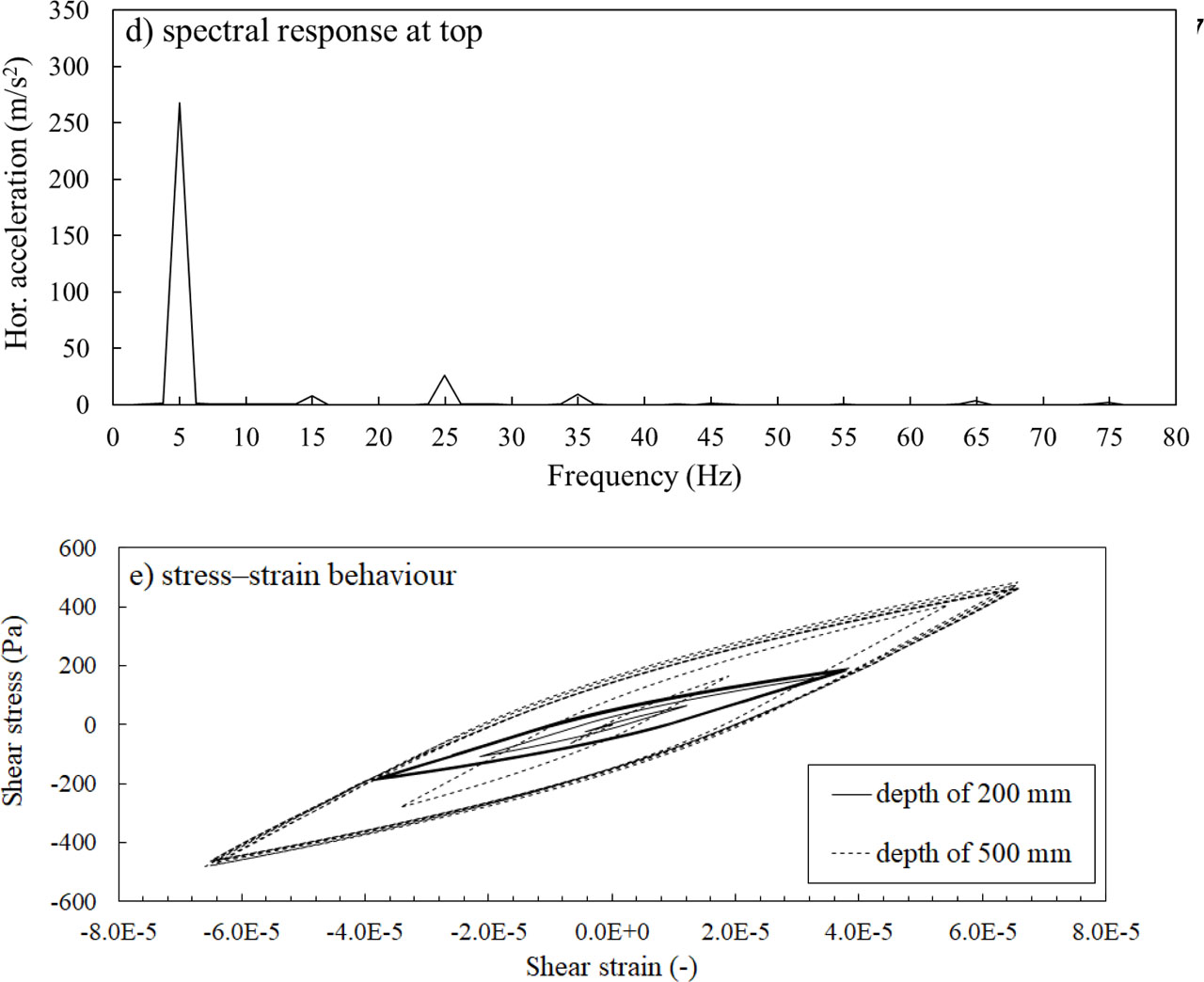
Figure 4
Free field response computed for the soil column with the chosen calibration of the hypoplastic sand model (Table 1): a) horizontal accelerations, b) shear strains, c) spectral response for horizontal accelerations at the soil base, d) spectral response for horizontal accelerations at the soil top, e) stress–strain behaviour.
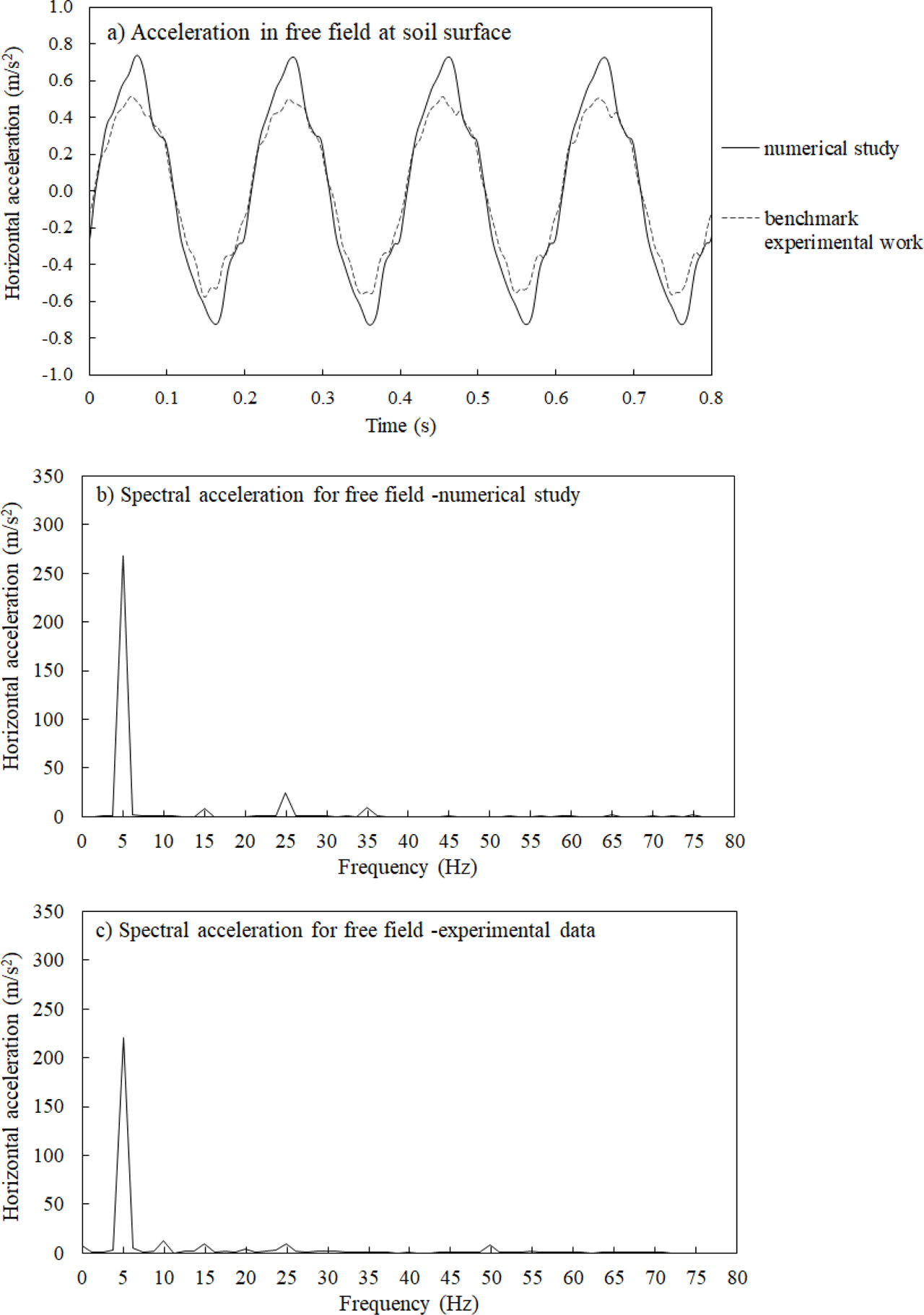
Figure 5
Comparison of the computations and the experimental measurements (Durante, 2015) in free field in the steady-state response: a) horizontal accelerations, b) evaluation of the spectral response of the computed horizontal accelerations, c) evaluation of the spectral response of the horizontal accelerations in the experiment.
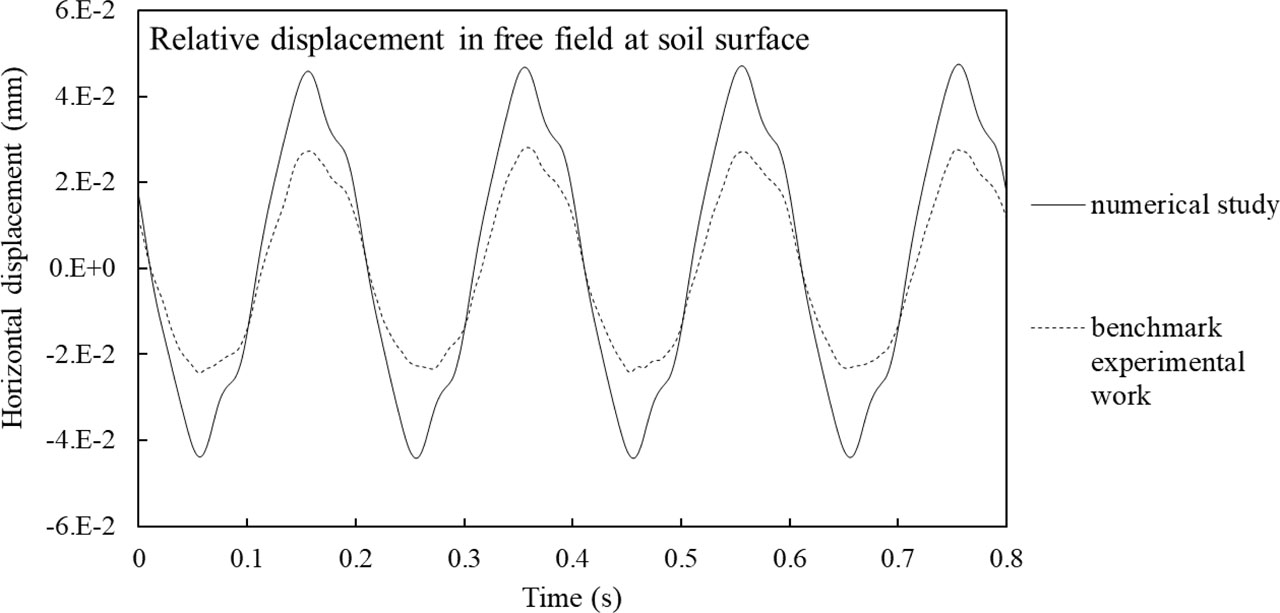
Figure 6
Comparison of relative horizontal displacements between the computations and the experimental measurements (Durante, 2015) obtained in free field in the steady-state response.
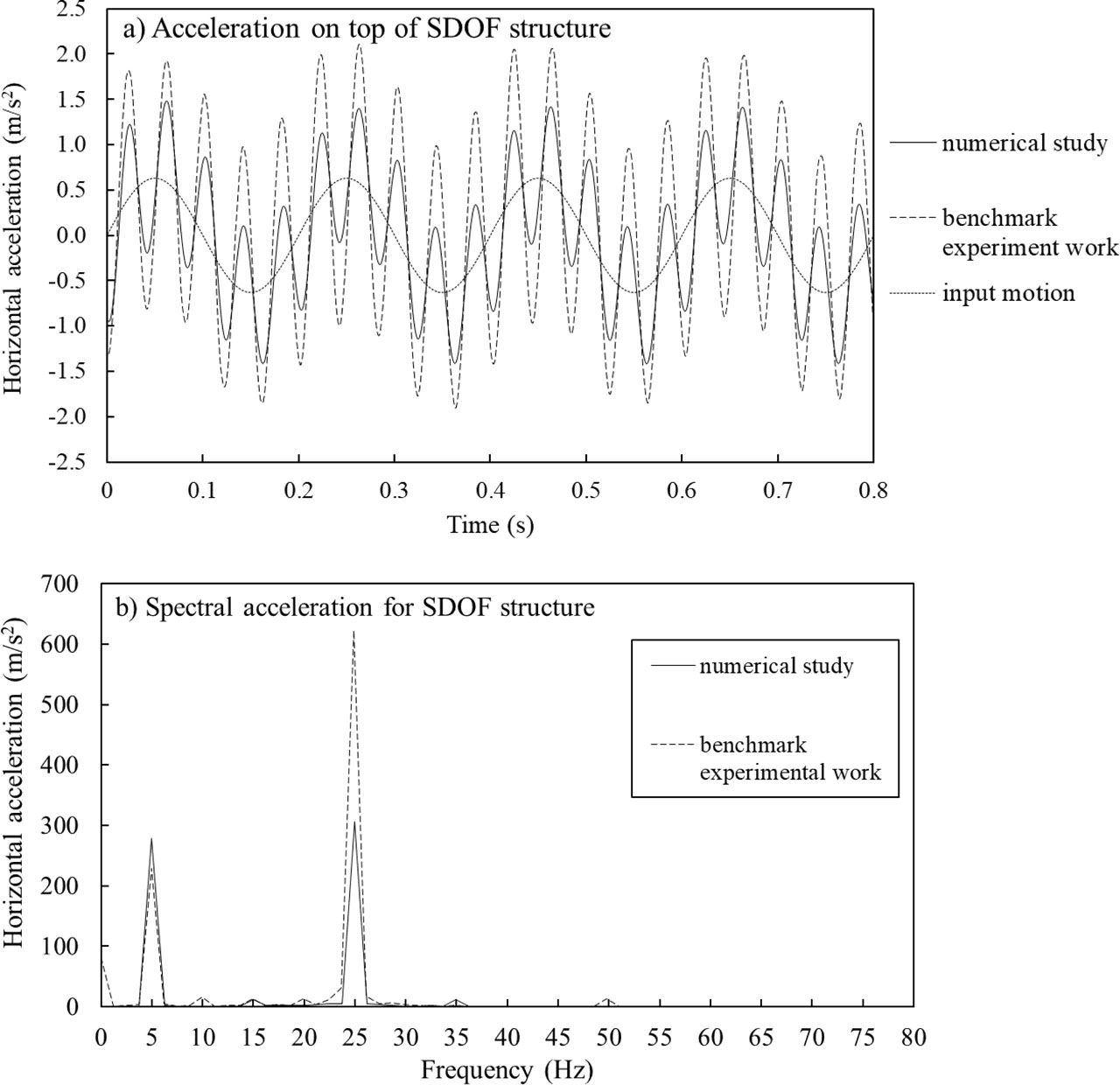
Figure 7
Comparison of the computations and the experimental measurements (Durante, 2015) obtained at the top of the structure in the steady-state response: a) horizontal accelerations, b) evaluation of the spectral response of the computed and measured horizontal accelerations.
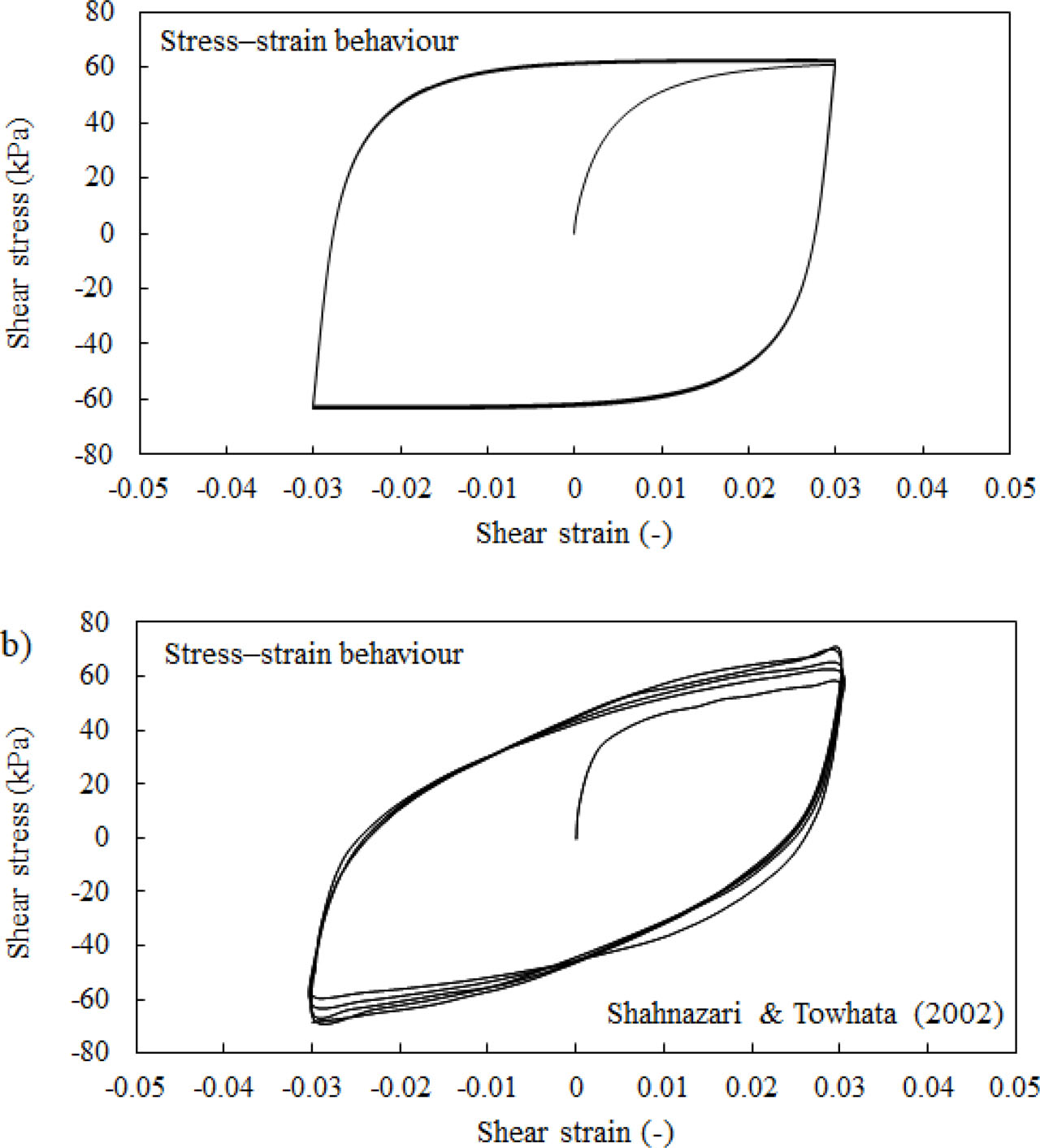
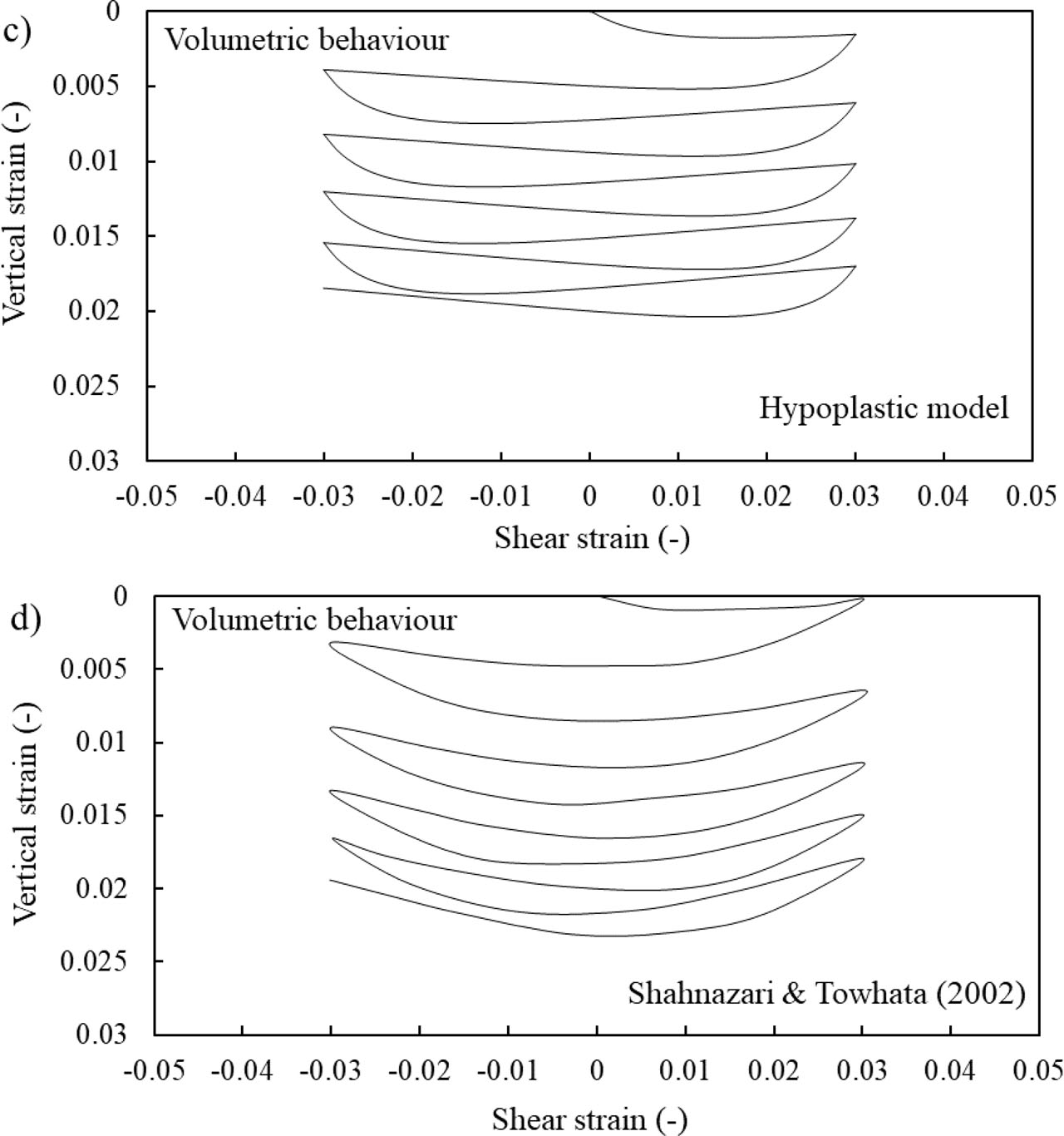
Figure A1
Comparison of a cyclic simple shear test simulated by the hypoplastic sand model and compared with experimental data from literature (Shahnazari & Towhata, 2002): a) stress–strain behaviour (simulation), b) stress–strain behaviour (experiment), c) volumetric response (simulation), d) volumetric response (experiment).