
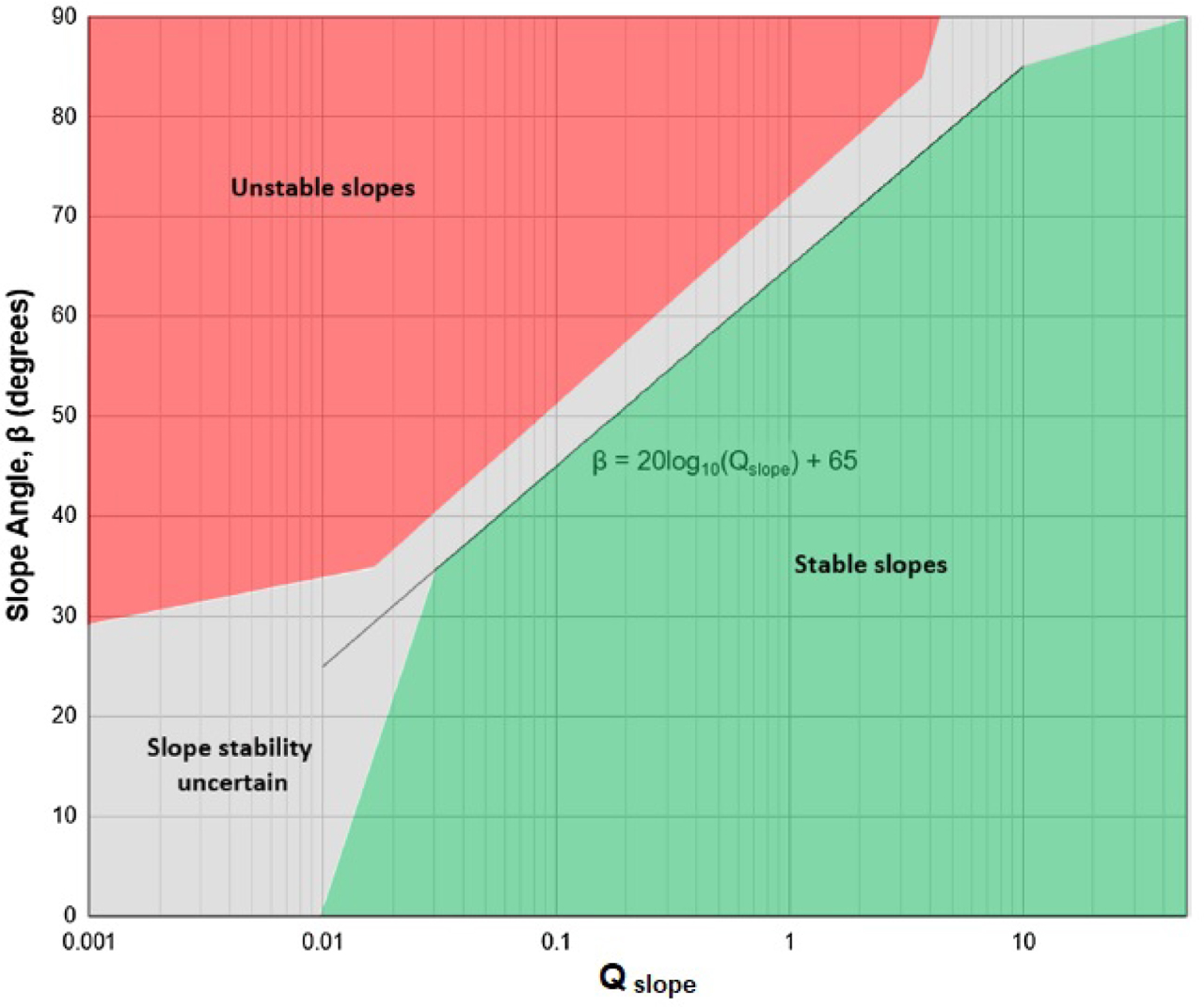
Figure 1
The Q-slope chart [1].
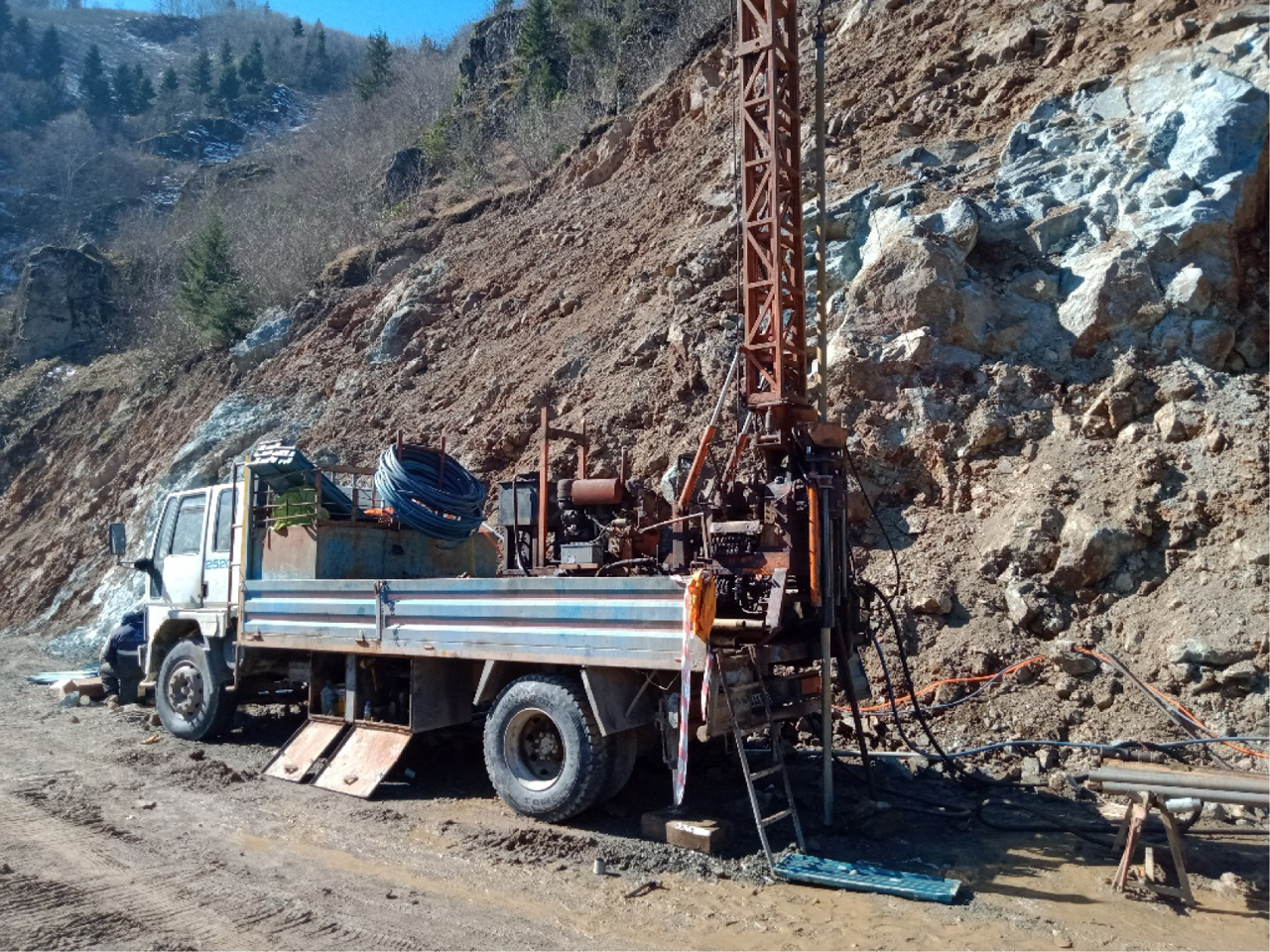
Figure 2
Drilling at the Kovanlik quarry site.
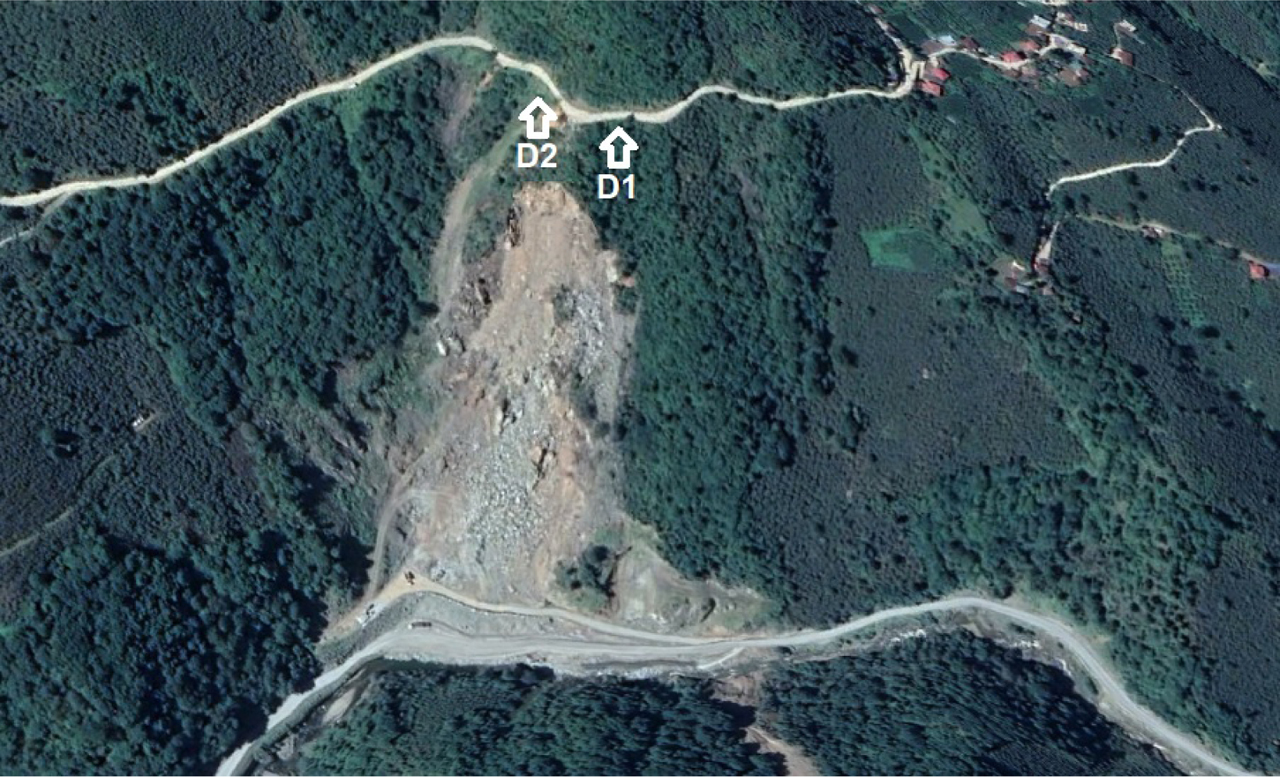
Figure 3
Shown of drilling locations (D1, D2) on the failed Kovanlik quarry.
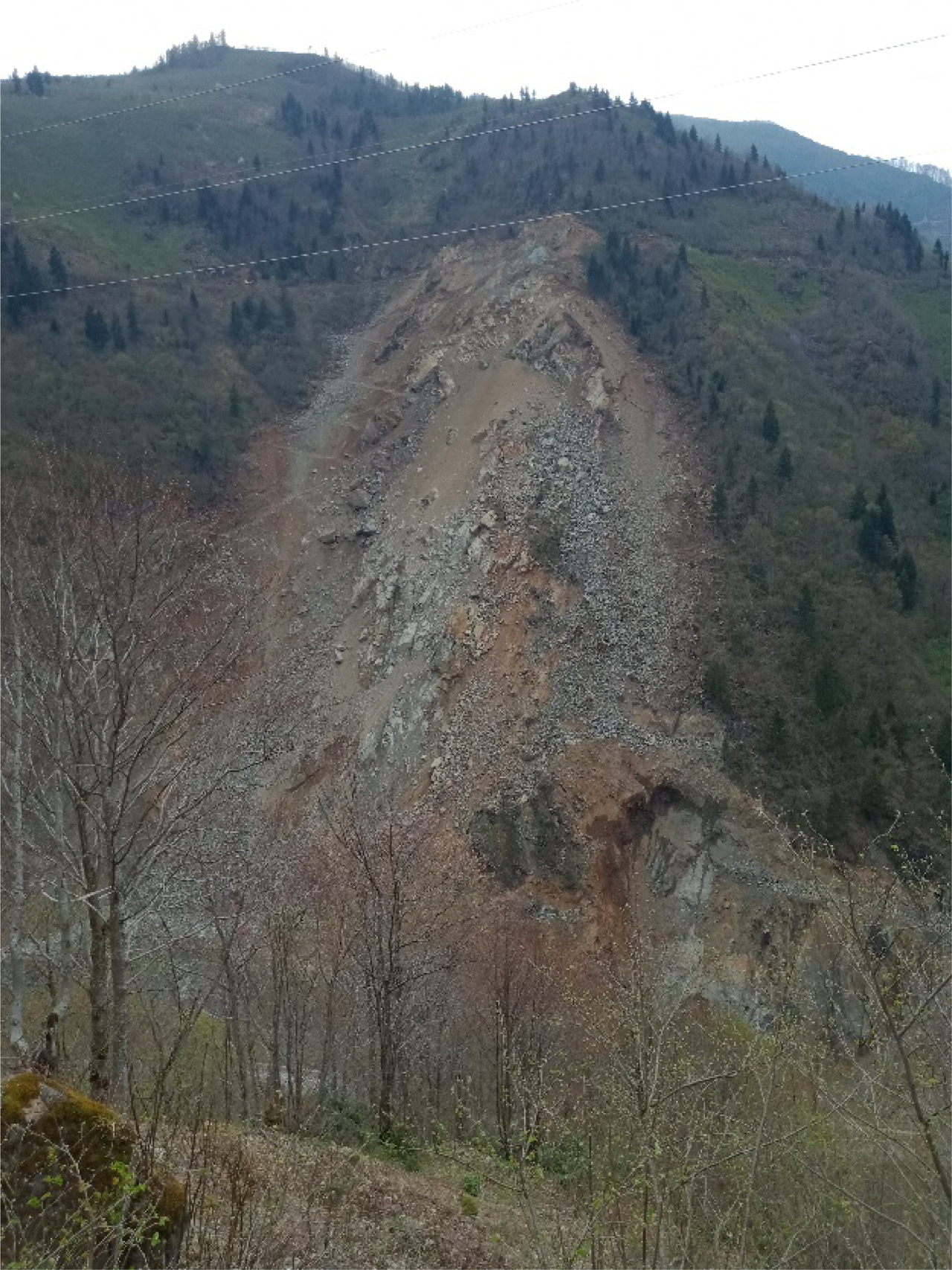
Figure 4
The Kovanlik quarry after the slope instability.
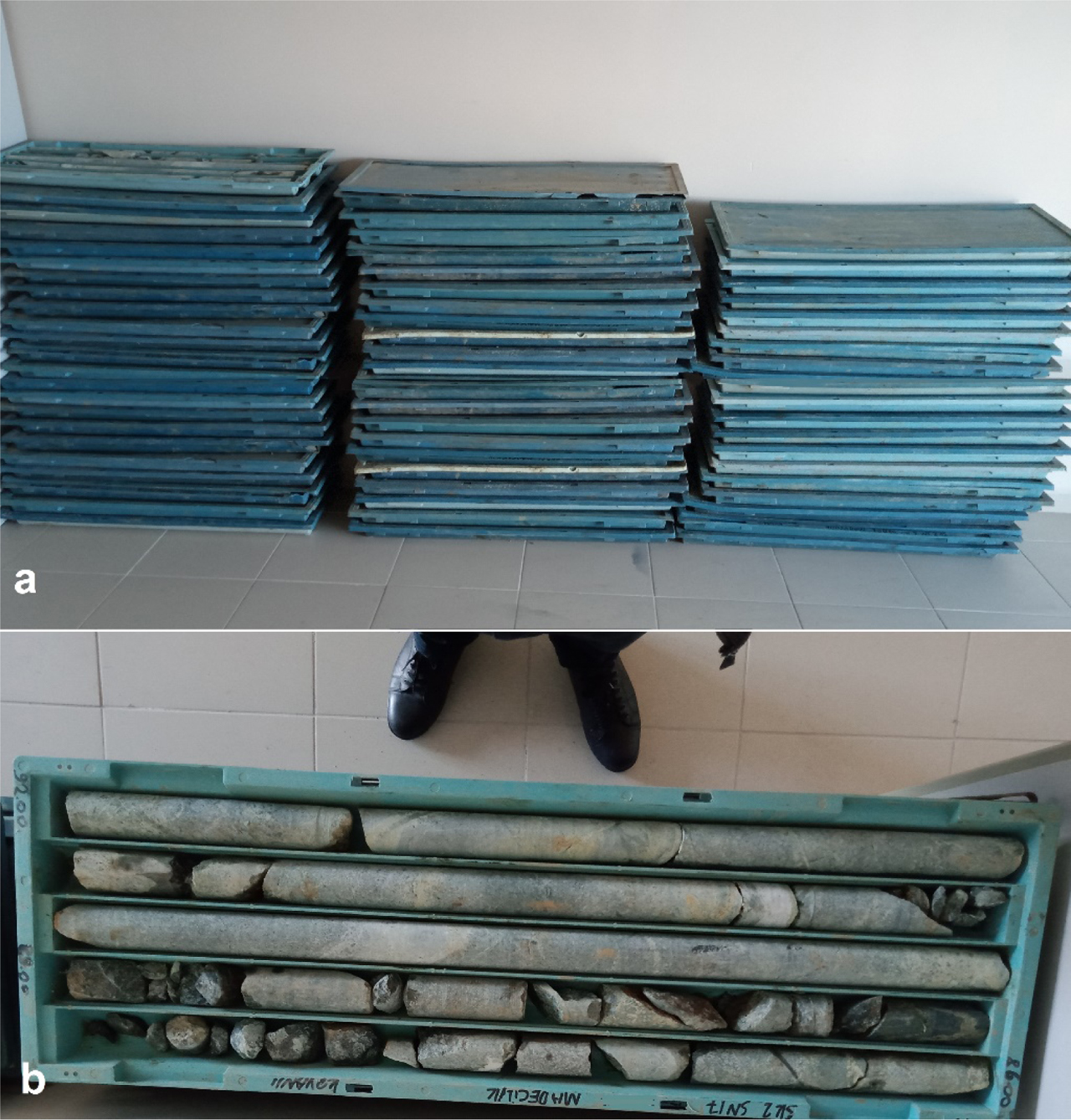
Figure 5
a) Drill cores taken from the Kovanlik quarry and b) investigations of the core samples.
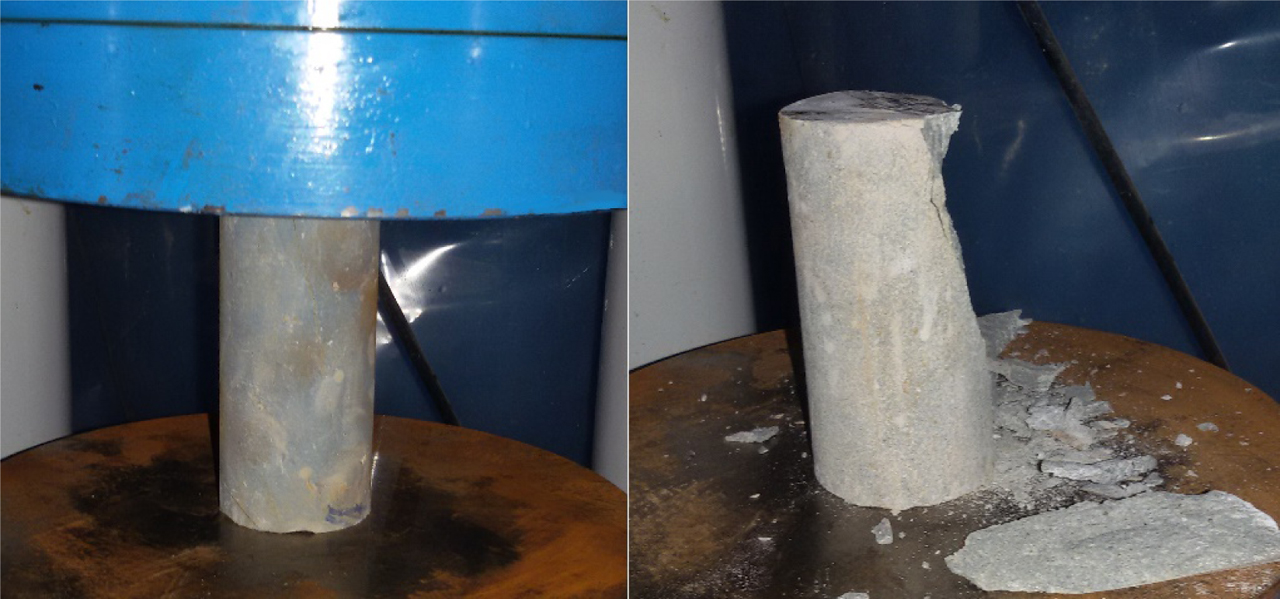
Figure 6
Uniaxial compressive strength testing.
Table 1
Jn values [1].
| Joint set number description | Jn |
|---|---|
| Massive, no or few joints | 0.5–1 |
| One joint set | 2 |
| One joint set plus random joints | 3 |
| Two joint sets | 4 |
| Two joint sets plus random joints | 6 |
| Three joint sets | 9 |
| Three joint sets plus random joints | 12 |
| Four or more joint sets, random, heavily jointed | 15 |
| Crushed rock, earthlike | 20 |
Table 2
Jr values [1].
| Description | Jr |
|---|---|
| Discontinuous joints | 4 |
| Rough or irregular, undulating | 3 |
| Smooth, undulating | 2 |
| Slickensided, undulating | 1.5 |
| Rough or irregular, planar | 1.5 |
| Smooth, planar | 1.0 |
| Slickensided, planar | 0.5 |
| Zone containing clay thick enough to prevent rock-wall contact | 1.0 |
| Sandy, gravely, or crushed zone to prevent rock-wall contact | 1.0 |
Table 3
Ja values [1].
| Description | Ja |
|---|---|
| (a) Rock-wall contact (no clay fillings, only coatings) | |
| Tightly healed, hard nonsoftening, impermeable filling, i.e., quartz or epidote | 0.75 |
| Unaltered joint walls, surface staining only | 1 |
| Slightly altered joint walls. Nonsoftening mineral coatings, sandy particles, clay-free disintegrated rock, etc. | 2 |
| Silty- or sandy-clay coatings, small clay disintegrated rock, etc. | 3 |
| Softening or low friction clay mineral coatings, i.e., kaolinite or mica. Also chlorite, talc, gypsum, graphite, etc., and small quantities of swelling clays | 4 |
| (b) Rock-wall contact after some shearing (thin clay fillings, probable thickness & 1–5 mm) | |
| Sandy particles, clay-free disintegrated rock, etc. | 4 |
| Strongly over-consolidated nonsoftening clay mineral fillings | 6 |
| Medium or low over-consolidation, softening, clay mineral fillings | 8 |
| Swelling-clay fillings, i.e., montmorillonite. Value of Ja depends on percent of swelling clay-size particles and access to water | 8–12 |
| (c) No rock-wall contact when sheared (thick clay/crushed rock fillings) | |
| Zones or bands of disintegrated or crushed rock and clay | 6–12 |
| Zones or bands of silty or sandy clay, small clay fraction (nonsoftening) | 5 |
| Thick, continuous zones or bands of clay | 13–20 |
Table 4
Jwice values [1].
| Description | Desert environment | Wet environment | Tropical storms | Ice wedging |
|---|---|---|---|---|
| Stable structure; competent rock | 1.0 | 0.7 | 0.5 | 0.9 |
| Stable structure; incompetent rock | 0.7 | 0.6 | 0.3 | 0.5 |
| Unstable structure; competent rock | 0.8 | 0.5 | 0.1 | 0.3 |
| Unstable structure; incompetent rock | 0.5 | 0.3 | 0.05 | 0.2 |
Table 5
SRFa values [1].
| Description | SRFa |
|---|---|
| Slight loosening due to surface location, disturbance from blasting or excavation | 2.5 |
| *Loose blocks, tension cracks, joint shearing, weathering susceptibility, severe blasting disturbance | 5 |
| As above (*), but strong susceptibility to weathering | 10 |
| Slope is in advanced stage of erosion and loosening due to erosions by water and/or ice-wedging effects | 15 |
| Residual slope with significant transport of material downslope | 20 |
Table 6
SRFb values [1].
| Description | σc/σ1 | SRFb |
|---|---|---|
| Moderate stress-strength range | 50–200 | 2.5–1 |
| High stress-strength range | 10–50 | 5–2.5 |
| Localized intact rock failure | 5–10 | 5–10 |
| Crushing or plastic yield | 2.5–5 | 15–10 |
| Plastic flow of strain softened material | 1–2.5 | 20–15 |
Table 7
SRFc values (RQD100: 1 m perpendicular sample of discontinuity, RQD300: 3 m perpendicular sample of discontinuity) [1].
| Description | Favorable | Unfavorable | Very unfavorable | Causing failure if unsupported |
|---|---|---|---|---|
| Major discontinuity with little or no clay | 1 | 2 | 4 | 8 |
| Major discontinuity with RQD100 ≈ 0 due to clay and crushed rock | 2 | 4 | 8 | 16 |
| Major discontinuity with RQD300 ≈ 0 due to clay and crushed rock | 4 | 8 | 12 | 24 |
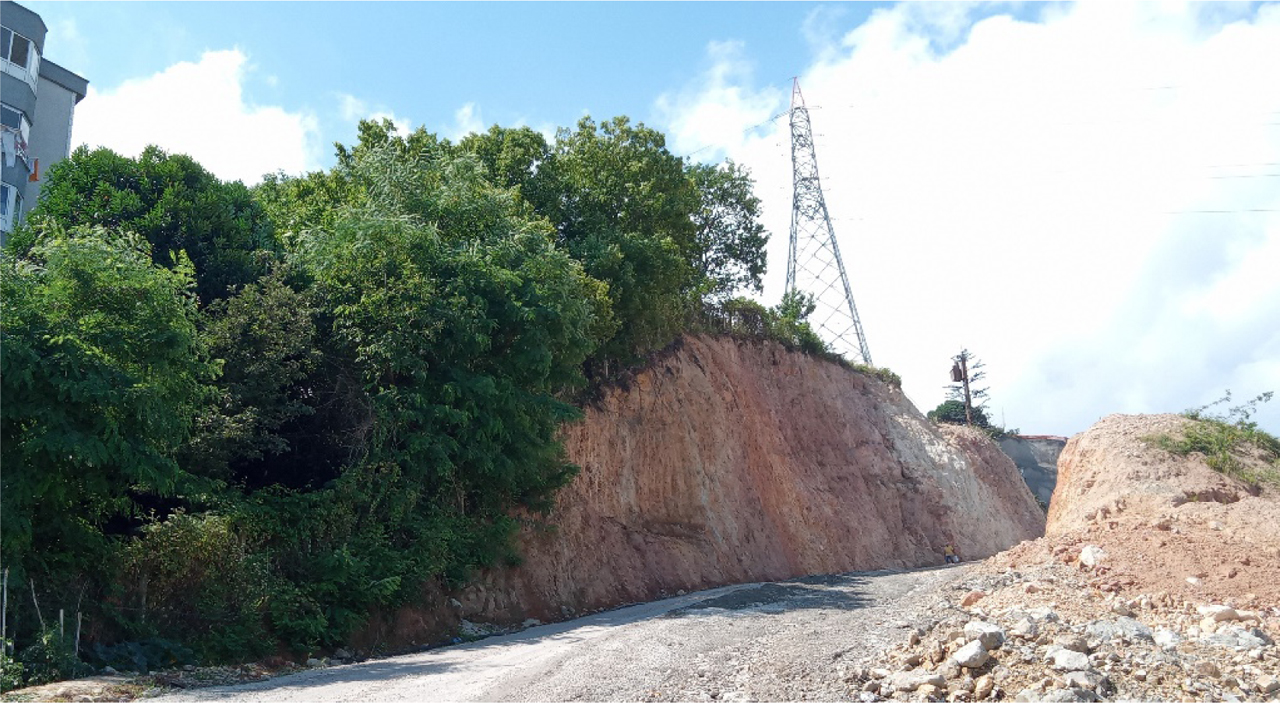
Figure 7
The Gure slope in Giresun city.
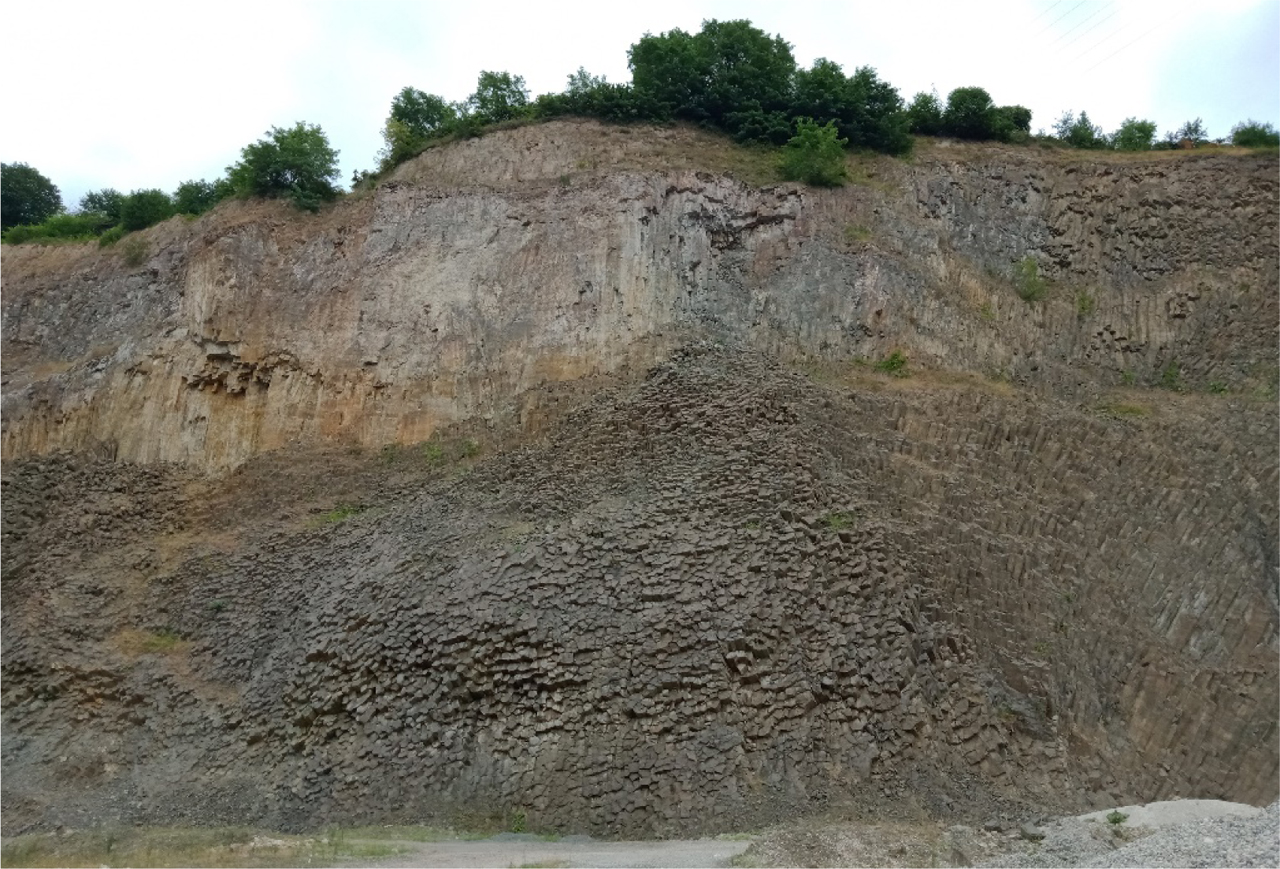
Figure 8
The Gulyali quarry in Ordu city.
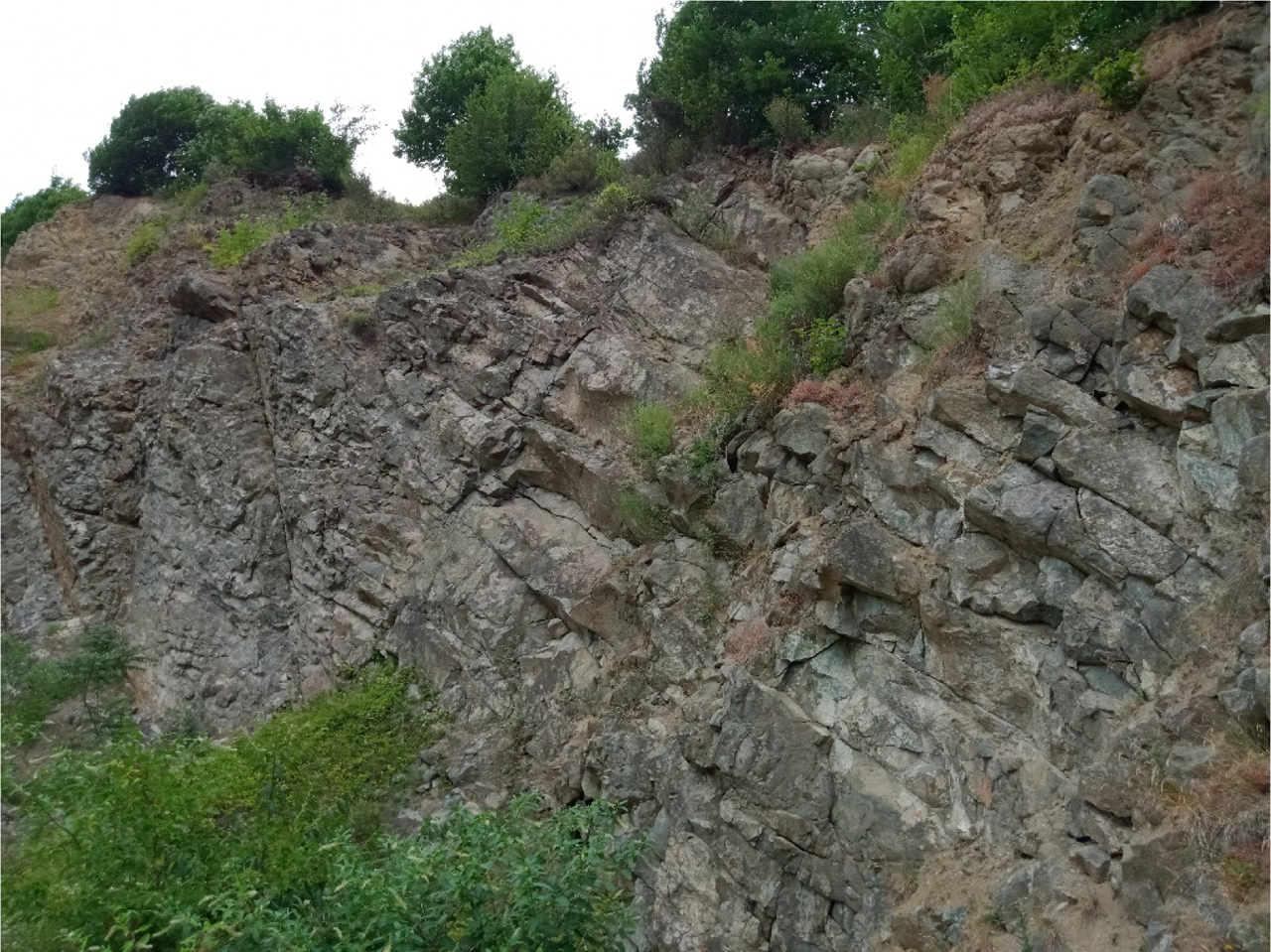
Figure 9
The Piraziz slope in Giresun city.