
Table 1
Relationships between the fall cone liquid limit and the Casagrande liquid limit for cohesive soils in the literature.
| Equations (no.) | Range of liquid limit | Cone type | Soil type | References |
|---|---|---|---|---|
| Linear relationships | ||||
| 85%–200% | 60°–60 g | Danish Eocene clays | Grønbech et al. 2011 [16] | |
| 13%–117% | 60°–60 g | Fine-grained soils | Matusiewicz et al. 2016 [28] | |
| 30%–390% | 60°–60 g | Fine-grained soils, kaolin–bentonite mixtures | Mendoza and Orozco 2001 [29] | |
| 30%–350% | 30°–80 g | |||
| <150% | 30°–80 g/100 g60°–60 g | Fine-grained soils | Shimobe 2010 [36] | |
| 27%–110% | 30°–80 g | Turkish natural soils | Wasti 1987 [42] | |
| 80%–150% | 30°–80 g | Soil–bentonite mixtures | Mishra et al. 2012 [30] | |
| 13%–117% | 30°–80 g | Fine-grained soils | Matusiewicz et al. 2016 [28] | |
| Power relationships | ||||
| >100% | 30°–80 g | Natural clays | Schmitz et al. 2004 [34] | |
| Up to approx. 600% | 30°–80 g | Fine-grained soils | O’Kelly et al. 2018 [27] | |
| <120% | ||||
| Up to approx. 600% | ||||
| <120% | ||||
[i] Note: wL(FC), fall cone liquid limit; wL30, liquid limit using 30°–80 g fall cone; wL60, liquid limit using 60°–60 g fall cone; wLC, Casagrande liquid limit; wL, BS cup, BS Casagrande cup liquid limit; wL, ASTM cup, ASTM Casagrande cup liquid limit; R2, determination coefficient; r, correlation coefficient; n, number of data points.
Table 2
Relationships between the Atterberg limits and the clay and organic matter contents in the literature.
| Equations (no.) | Soil type | References |
|---|---|---|
| Fine-grained soils with organic content below 6% | De Jong et al. 1990 [5] | |
| Holocene gyttja Iom = 0.6%–73.1% CaCO3 = 2.0%–88.4% | Długaszek 1991 [8] | |
[i] Note: LL or wLC, Casagrande liquid limit in %; PL or wP, plastic limit in %; PI, plasticity index in %; clay, clay content in %; organic C or Iom, organic matter content in %; R2, determination coefficient; r, correlation coefficient; n, number of data points.
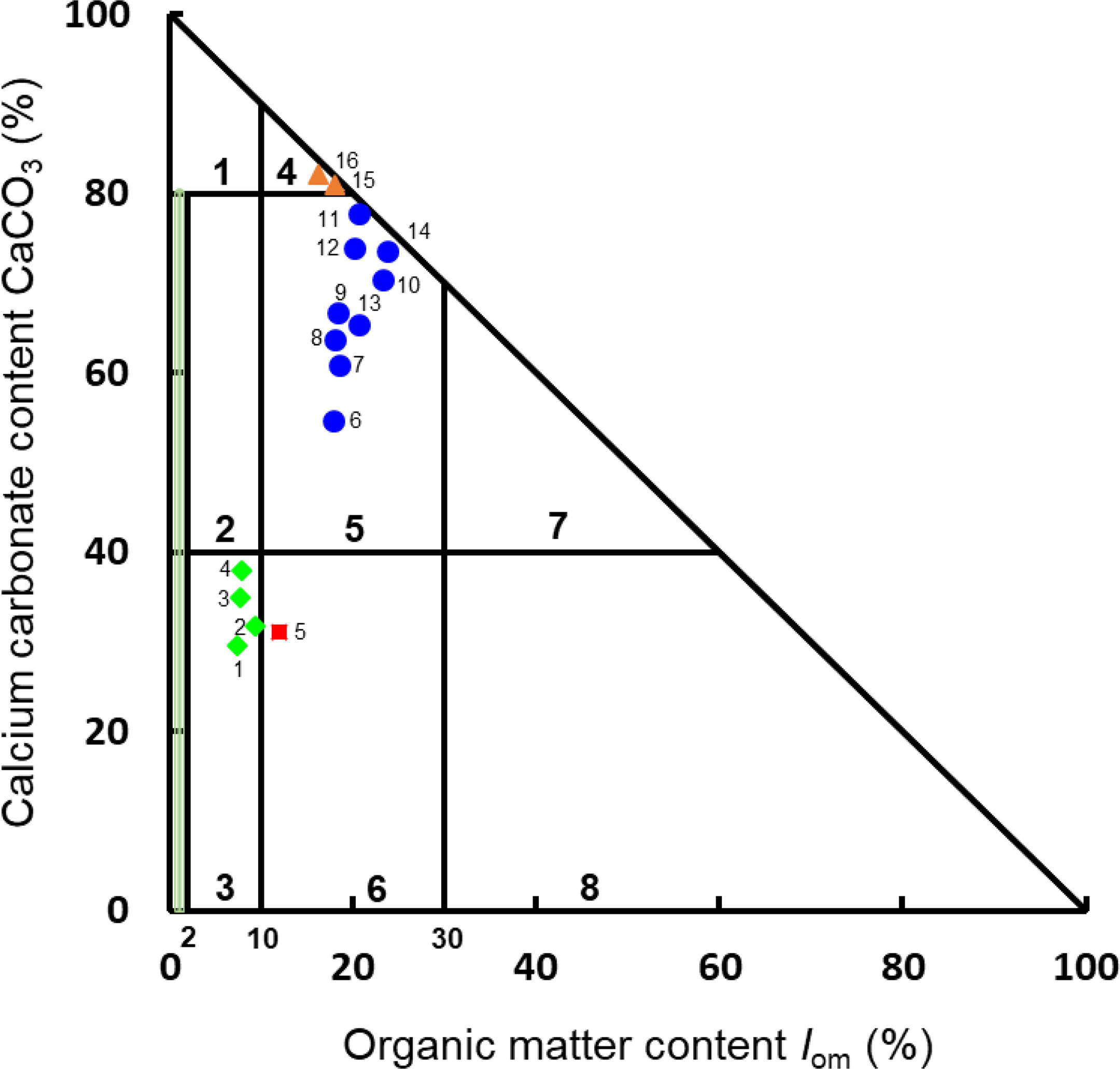
Figure 1
Tested samples of Eemian gyttja according to the classification of Długaszek [7]: Iom = 0%–2% mineral soils.
Note: 1, low organic lacustrine marl; 2, high calcareous mineral gyttja; 3, low calcareous mineral gyttja; 4, high organic lacustrine marl; 5, high calcareous mineral-organic gyttja; 6, low calcareous mineral-organic gyttja; 7, high calcareous organic gyttja; 8, low calcareous organic gyttja; 


 1–16, test number
Table 3
Laboratory test results of the index properties of Eemian gyttja.
| Test no. | Soil type | Water content wn (%) | Plastic Limit wp (%) | Liquid limit wL(%) | Calcium carbonate content CaCO3 (%) | Organic matter content Iom (%) | ||
|---|---|---|---|---|---|---|---|---|
| Casagrande wLC | Cone 60° wL60 | Cone 30° wL30 | ||||||
| 1 | Gyttja (3) | 62.3 | 50.9 | 81.0 | 76.7 | 81.5 | 29.6 | 7.44 |
| 2 | 67.8 | 62.4 | 88.0 | 86.4 | 87.2 | 31.7 | 9.41 | |
| 3 | 61.3 | 60.7 | 80.9 | 75.1 | 78.1 | 34.9 | 7.69 | |
| 4 | 58.5 | 56.6 | 82.3 | 81.5 | 85.5 | 37.9 | 7.92 | |
| 5 | Gyttja (6) | 74.4 | 68.0 | 104.5 | 101.5 | 105.5 | 31.1 | 12.0 |
| 6 | Gyttja (5) | 102.1 | 119.2 | 150.4 | 148.5 | 163.6 | 54.7 | 17.8 |
| 7 | 98.7 | 122.2 | 136.1 | 135.5 | 137.5 | 60.9 | 18.6 | |
| 8 | 98.9 | 100.8 | 140.0 | 137.1 | 143.6 | 63.8 | 18.1 | |
| 9 | 110.1 | 116.8 | 156.2 | 156.8 | 159.0 | 66.7 | 18.4 | |
| 10 | 115.6 | 130.7 | 152.5 | 154.8 | 160.1 | 70.4 | 23.3 | |
| 11 | 87.1 | 130.9 | 159.2 | 166.1 | 171.0 | 77.7 | 20.6 | |
| 12 | 100.3 | 125.9 | 155.2 | 159.5 | 162.0 | 74.0 | 20.2 | |
| 13 | 97.7 | 97.7 | 121.3 | 125.4 | 130.6 | 65.4 | 20.7 | |
| 14 | 118.5 | 110.5 | 164.5 | 171.6 | 173.8 | 73.6 | 23.8 | |
| 15 | Marl (4) | 90.6 | 114.3 | 139.1 | 131.6 | 140.1 | 81.0 | 18.1 |
| 16 | 79.9 | 110.1 | 131.0 | 130.8 | 133.4 | 82.1 | 16.2 | |
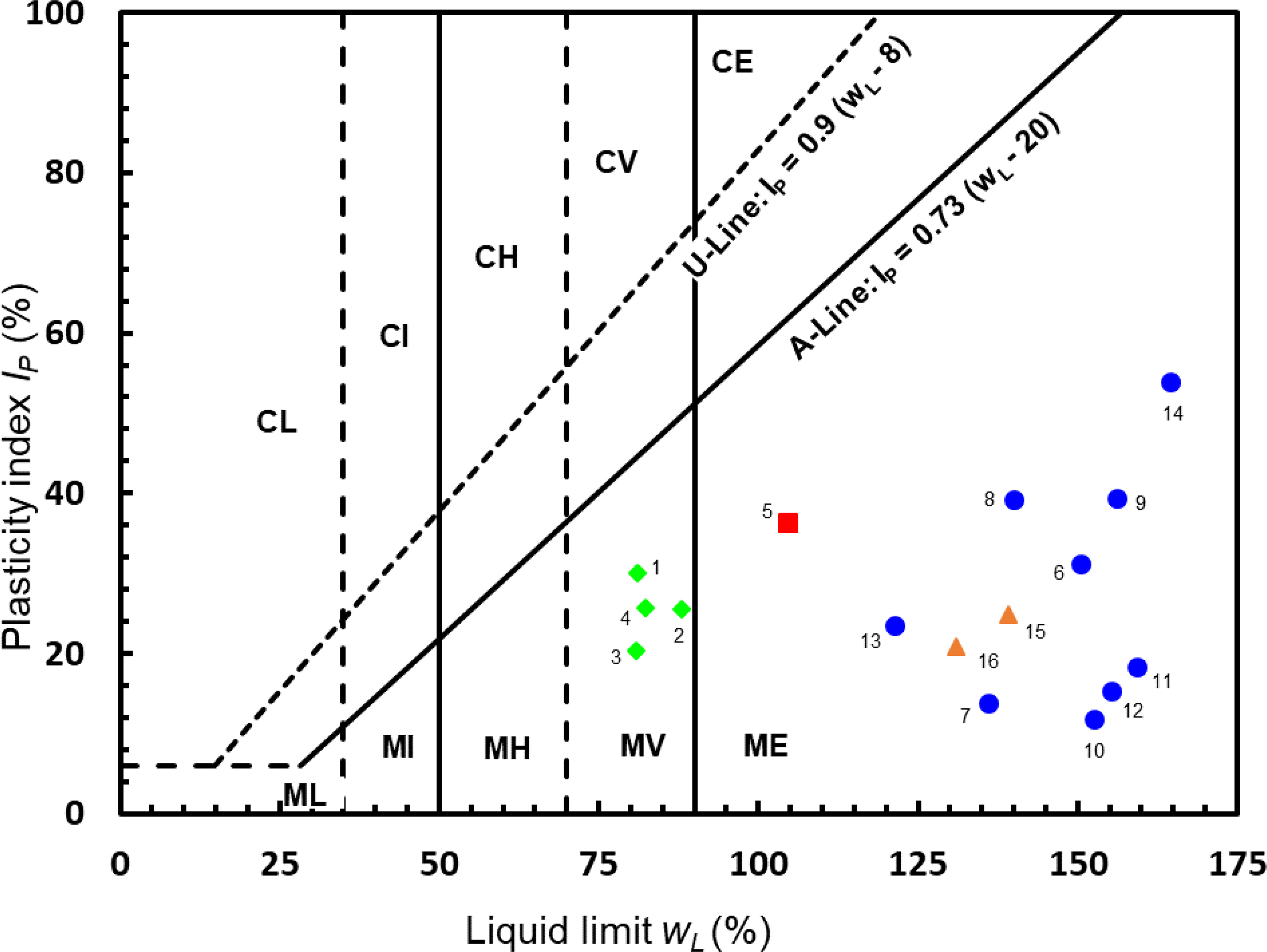
Figure 2
Tested samples shown on Casagrande’s plasticity chart.
Note: 1–16, test number.
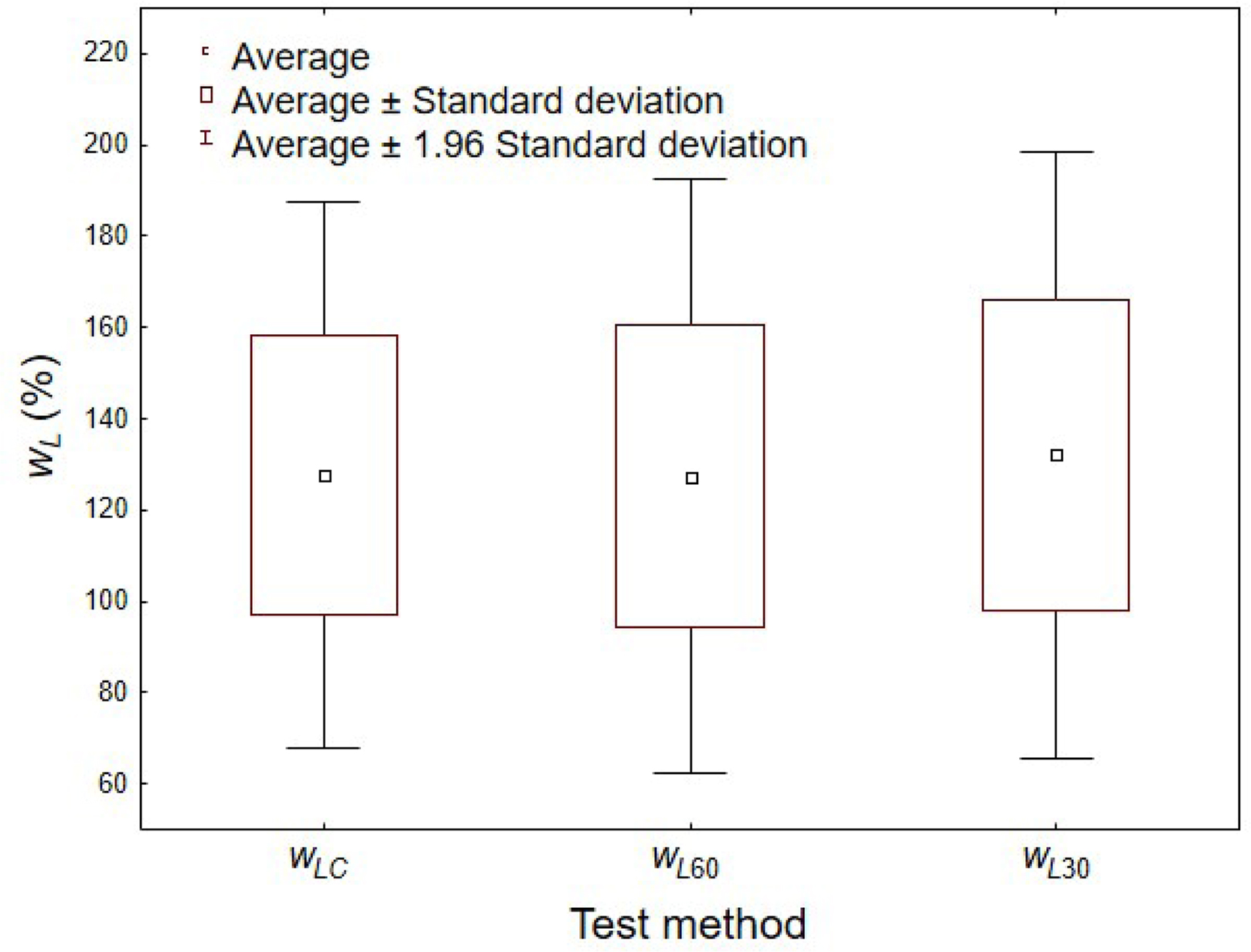
Figure 3
Average values of the liquid limit wL depending on the test method.
Table 4
Linear and power regression models of relationships between the liquid limit wL determined by Casagrande method and fall cone methods for Eemian gyttja.
| Equations (no.) | R2 (−) | n (−) | SEE | Max. RE (%) |
|---|---|---|---|---|
| 0.989 | 16 | 3.62 | ±5 | |
| 0.990 | 16 | 3.58 | ±7 | |
| 0.990 | 16 | 3.41 | ±5 |
[i] Note: RE, relative error; SEE, standard error of estimation.
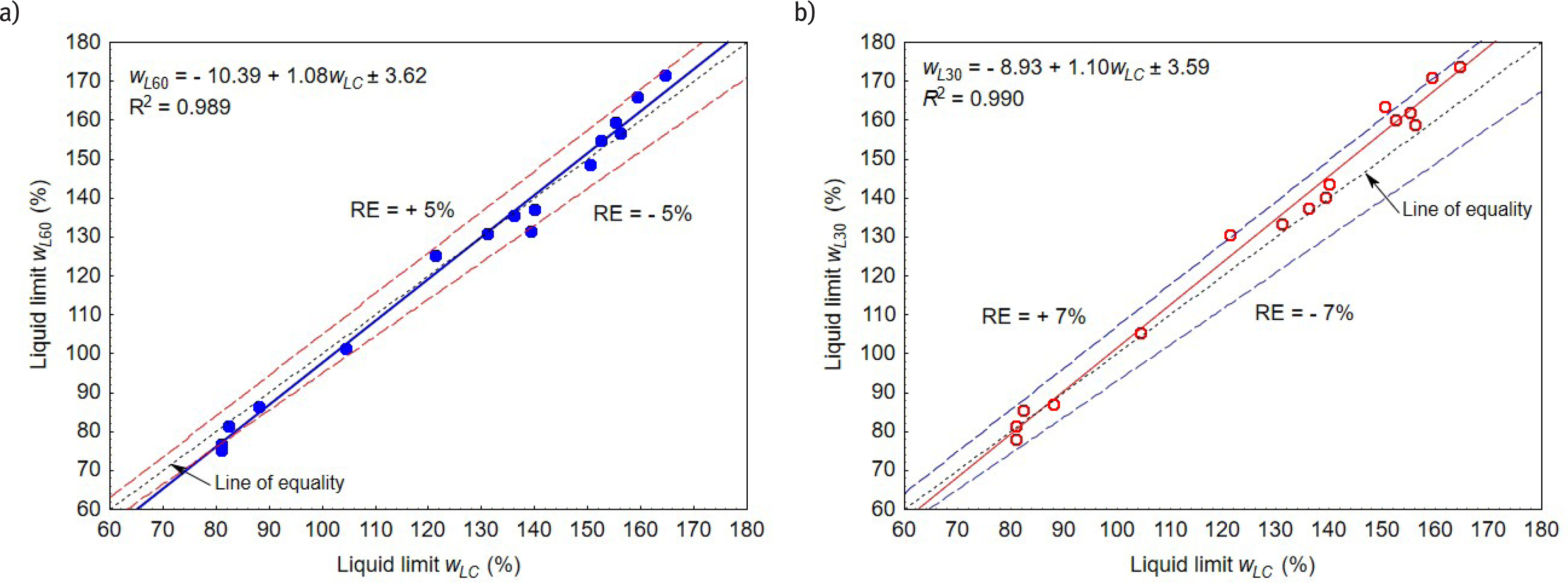
Figure 4
Regression models of relationships between the liquid limits: a) wL60 = f(wLC), b) wL30 = f(wLC).
Note: RE, relative error.
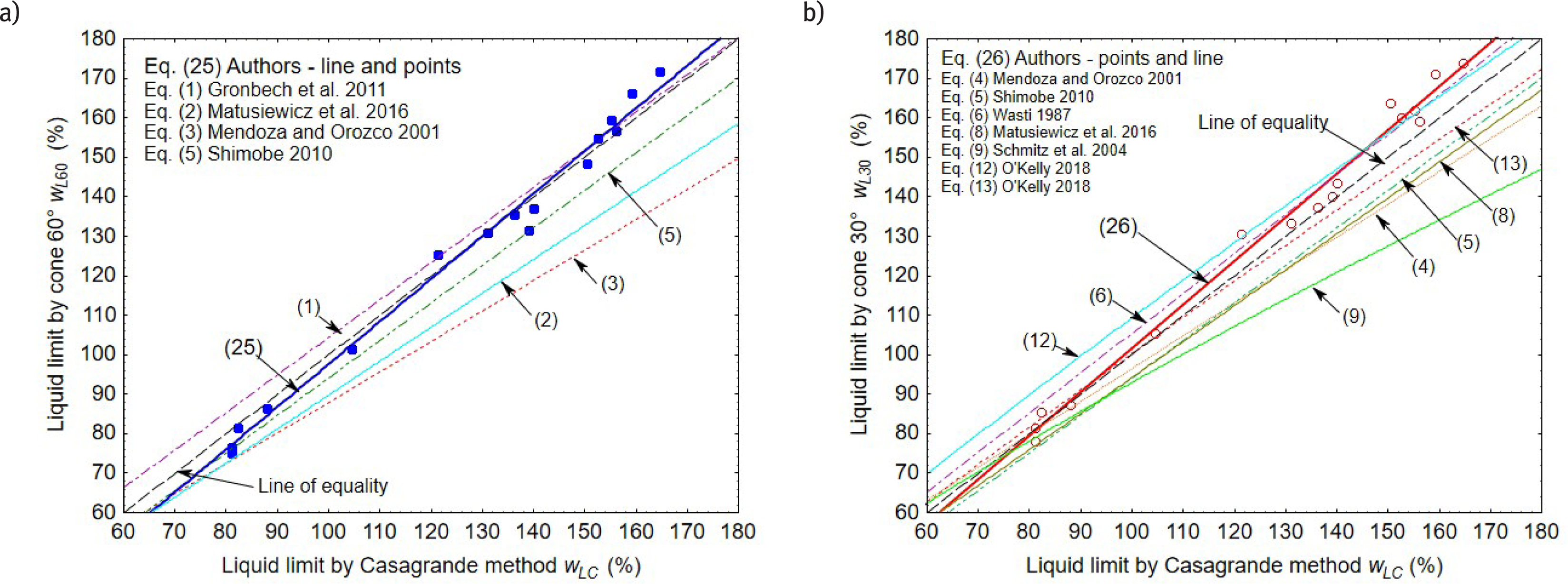
Figure 5
Comparison of relationships obtained by the authors for Eemian gyttja with relationships for cohesive soils taken from the literature: a) wL60 = f(wLC), b) wL30 = f(wLC).
Table 5
Single- and two-factor linear regression models of the plastic limit (wP) and liquid limit (wLC) relationship versus the organic matter content (Iom) and/or calcium carbonate content (CaCO3) relationship for Eemian gyttja.
| Equations (no.) | R2 (−) | SEE | Max. RE (%) |
|---|---|---|---|
| 0.833 | 12.15 | ±17 | |
| 0.786 | 13.75 | ±20 | |
| 0.874 | 10.93 | ±16 | |
| 0.876 | 11.13 | ±20 | |
| 0.731 | 16.39 | ±20 | |
| 0.887 | 11.04 | ±15 |
[i] Note: RE, relative error; SEE, standard error of estimation.
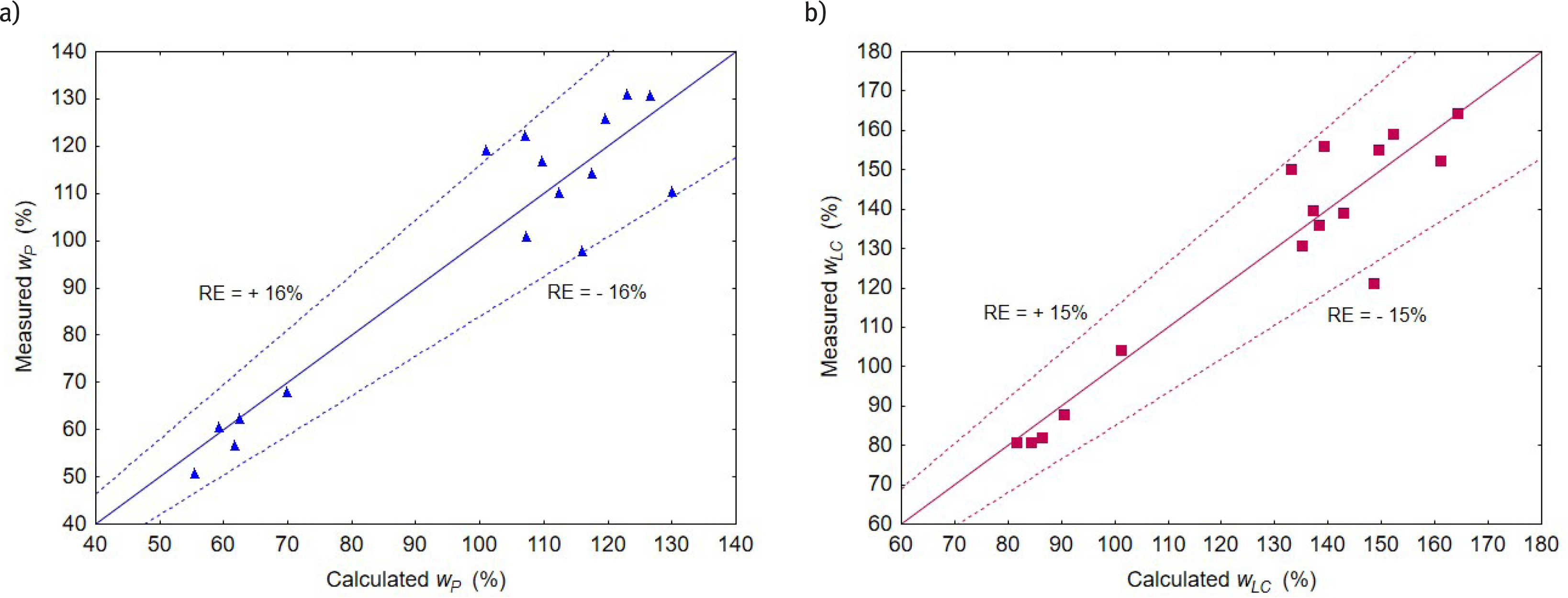
Figure 6
Comparison between the measured and calculated values: a) wP and wP from Equation (30) in Table 5, b) wLC and wLC from Equation (33) in Table 5 of Eemian gyttja, with zones of maximum RE for regression models.
Note: RE, relative error.
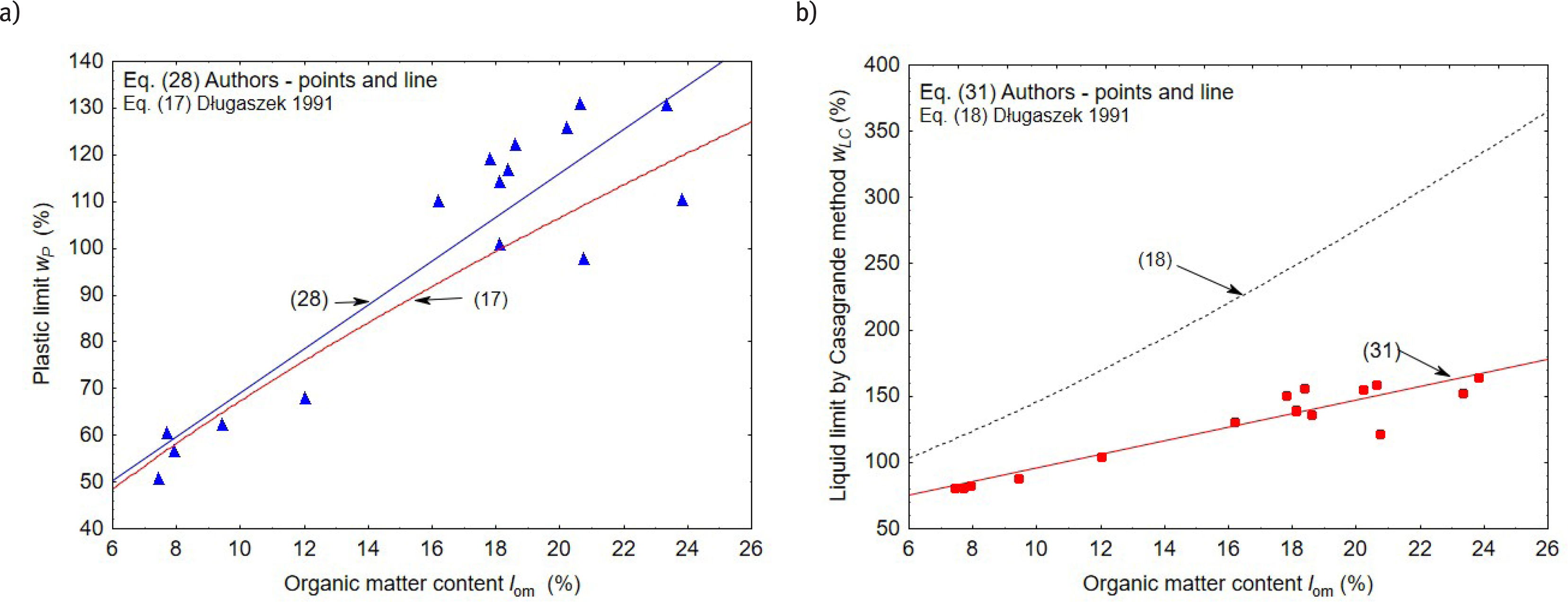
Figure 7
Comparison of relationships obtained by the authors for Eemian gyttja with the relationships for Holocene gyttja obtained by Długaszek: a) wP = f(Iom), b) wLC = f(Iom).