
Table 1
Index properties of sand-silt mixtures.
| Materials | Fc (%) | Gs | D10 (mm) | D50 (mm) | Cu | Cc | emin | emax |
|---|---|---|---|---|---|---|---|---|
| Clean sand | 0 | 2.650 | 0.17 | 0.41 | 2.82 | 1.10 | 0.623 | 0.848 |
| 10 | 2.653 | 0.08 | 0.38 | 5.28 | 1.70 | 0.487 | 0.811 | |
| Sand-silt mixtures | 20 | 2.656 | 0.04 | 0.33 | 9.80 | 1.92 | 0.455 | 0.776 |
| 30 | 2.659 | 0.03 | 0.32 | 13.31 | 0.84 | 0.421 | 0.749 | |
| 40 | 2.662 | 0.02 | 0.25 | 15.17 | 0.01 | 0.489 | 0.803 | |
| Chlef silt | 100 | 2.667 | - | 0.03 | - | - | 0.593 | 0.783 |
Table 2
Chemical analysis of tested materials [3].
| Composition (%) | Chlef sand | Chlef silt |
|---|---|---|
| Fire loss | 14.34 | 10.85 |
| Total Silica (SiO2) | 55.89 | 48.95 |
| Alumina (Al2O3) | 5.58 | 34.08 |
| Oxide of iron (Fe2O3) | 7.58 | 1.43 |
| Oxide of titane (TiO2) | 0.00 | 0.00 |
| Lime (CaO) | 15.42 | 0.20 |
| Magnesia (MgO). | 0.00 | 0.42 |
| Potash (K2O) | Traces | 2.26 |
| Oxide of sodium (Na2O) | Traces | 0.06 |
| Sulfates SO4 | 0.28 | 0.00 |
| Chlorides CL-Solubles in water | 0.14 | 0.00 |
| Carbonates CaCO3 | 24.60 | 0.00 |
| Insolubles | 0.53 | 0.00 |
| Organic materials | 0.00 | 0.00 |
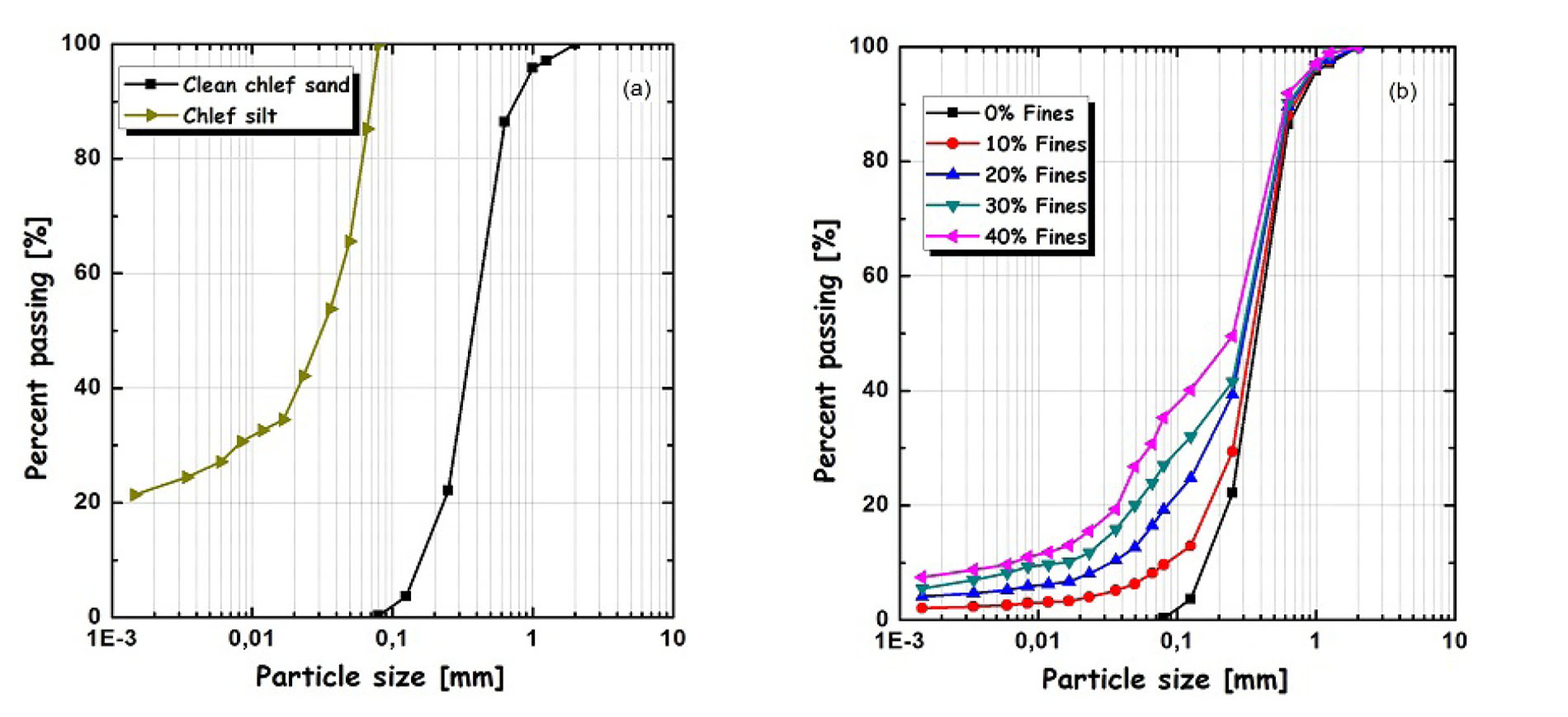
Figure 1
Grain size distribution curves of tested materials: (a) Sand and silt, (b) Sand-silt mixtures.
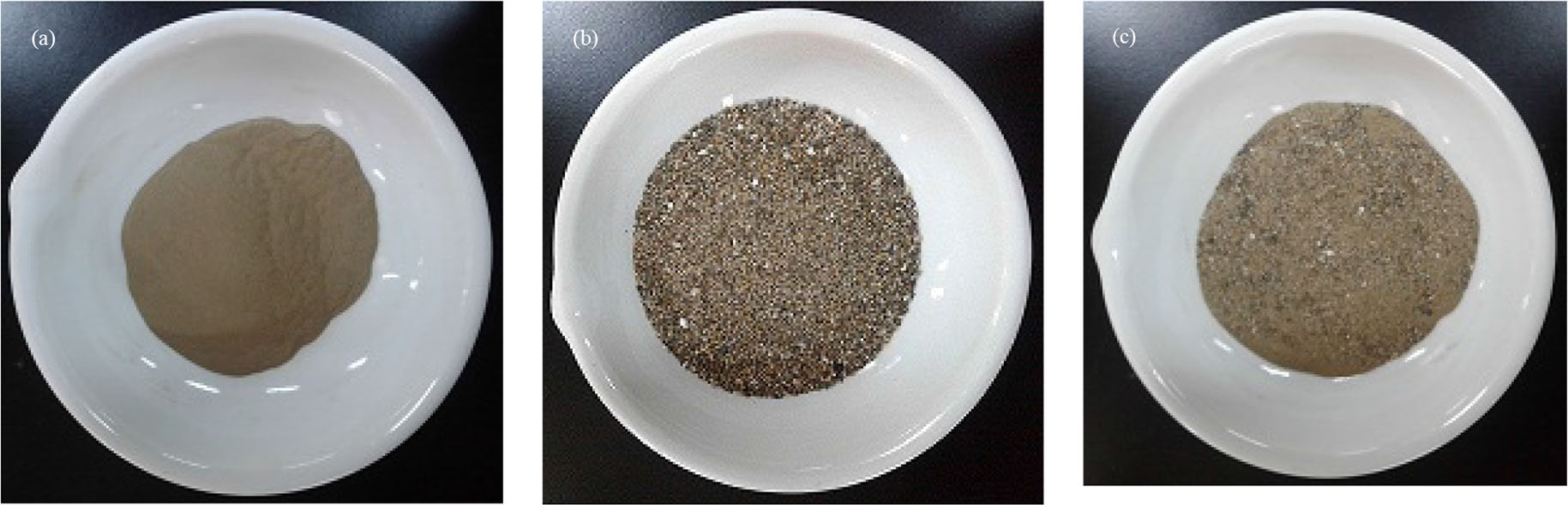
Figure 2
Materials used in this study: (a) fines content, (b) clean sand, (c) samples prepared by dry deposition sand-silt mixtures.
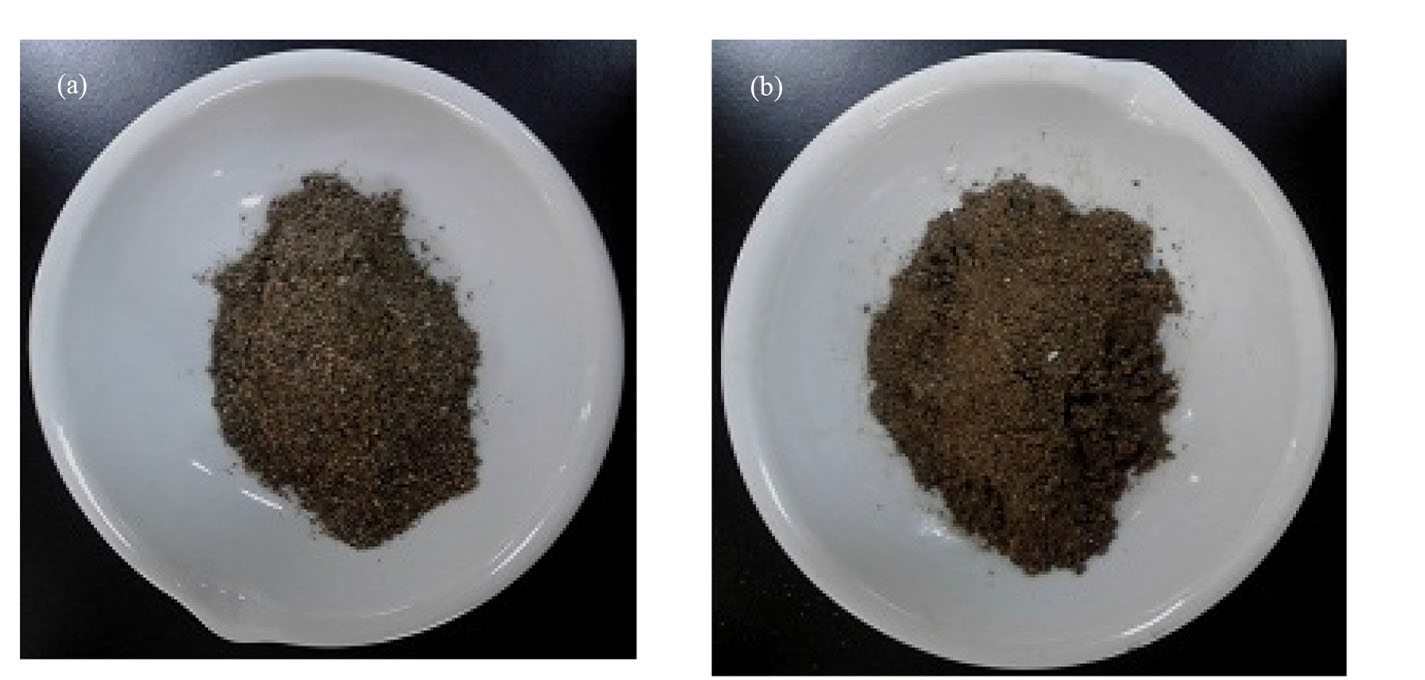
Figure 3
Samples prepared by wet deposition: (a) clean sand, (b) sand-silt mixtures.
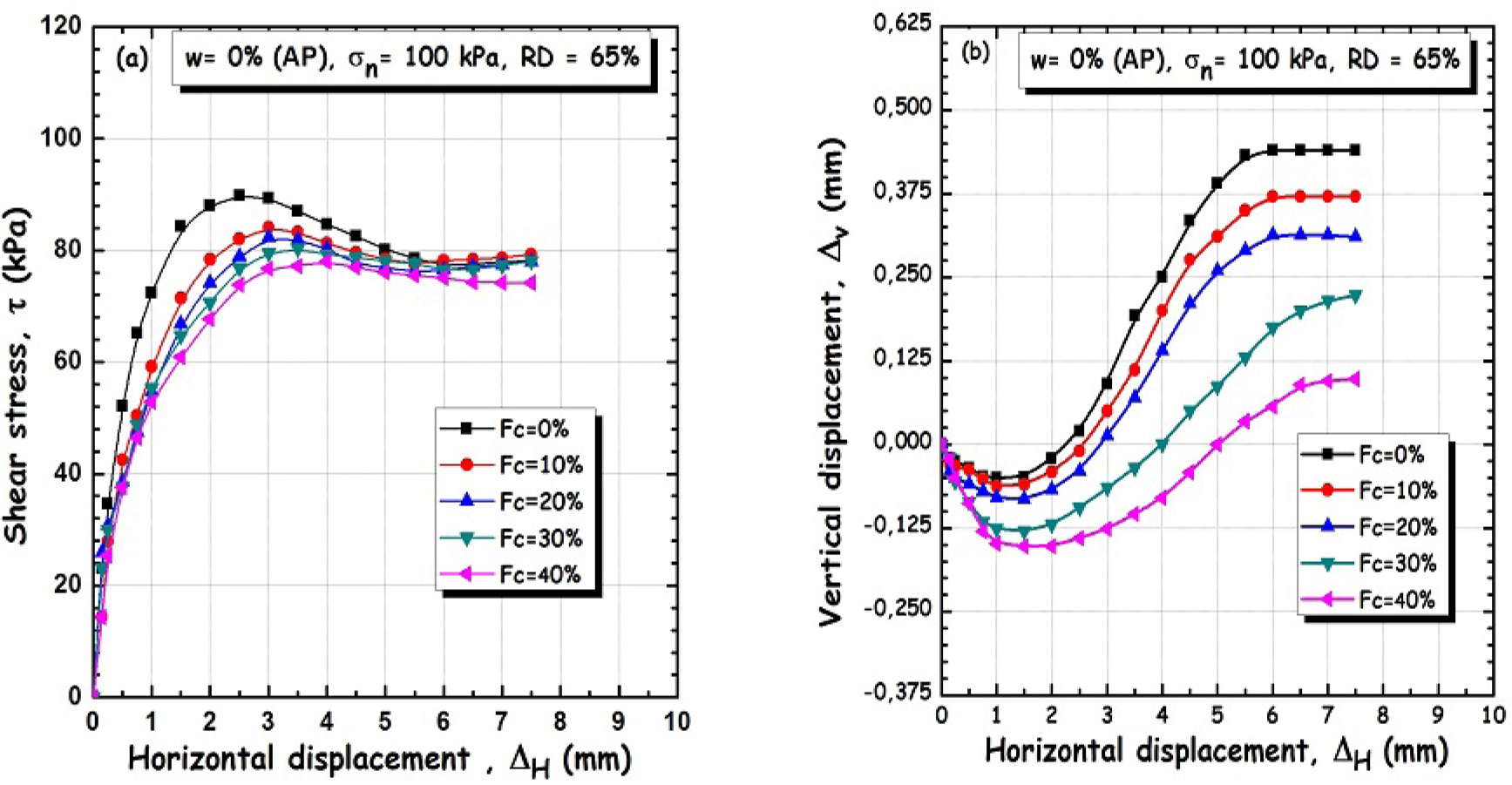
Figure 4
Effect of fines content on the mechanical behaviour of sand-silt mixtures (RD = 65%, σn = 100 kPa): (a) variation of the shear strength versus horizontal displacement, (b) variation of vertical displacement versus horizontal displacement.
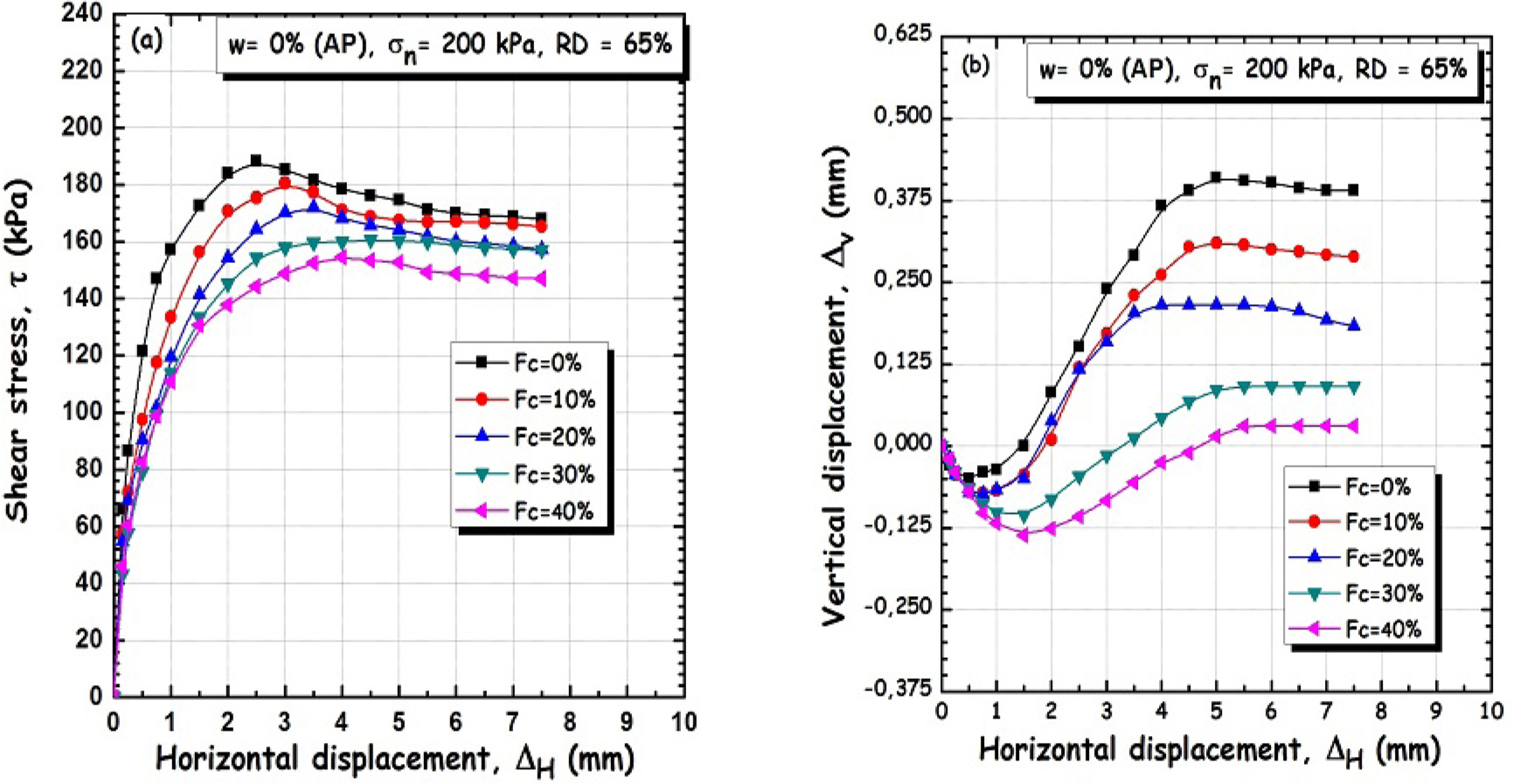
Figure 5
Effect of fines content on the mechanical behaviour of sand-silt mixtures (RD = 65%, σn = 200 kPa): (a) variation of the shear strength versus horizontal displacement, (b) variation of vertical displacement versus horizontal displacement.
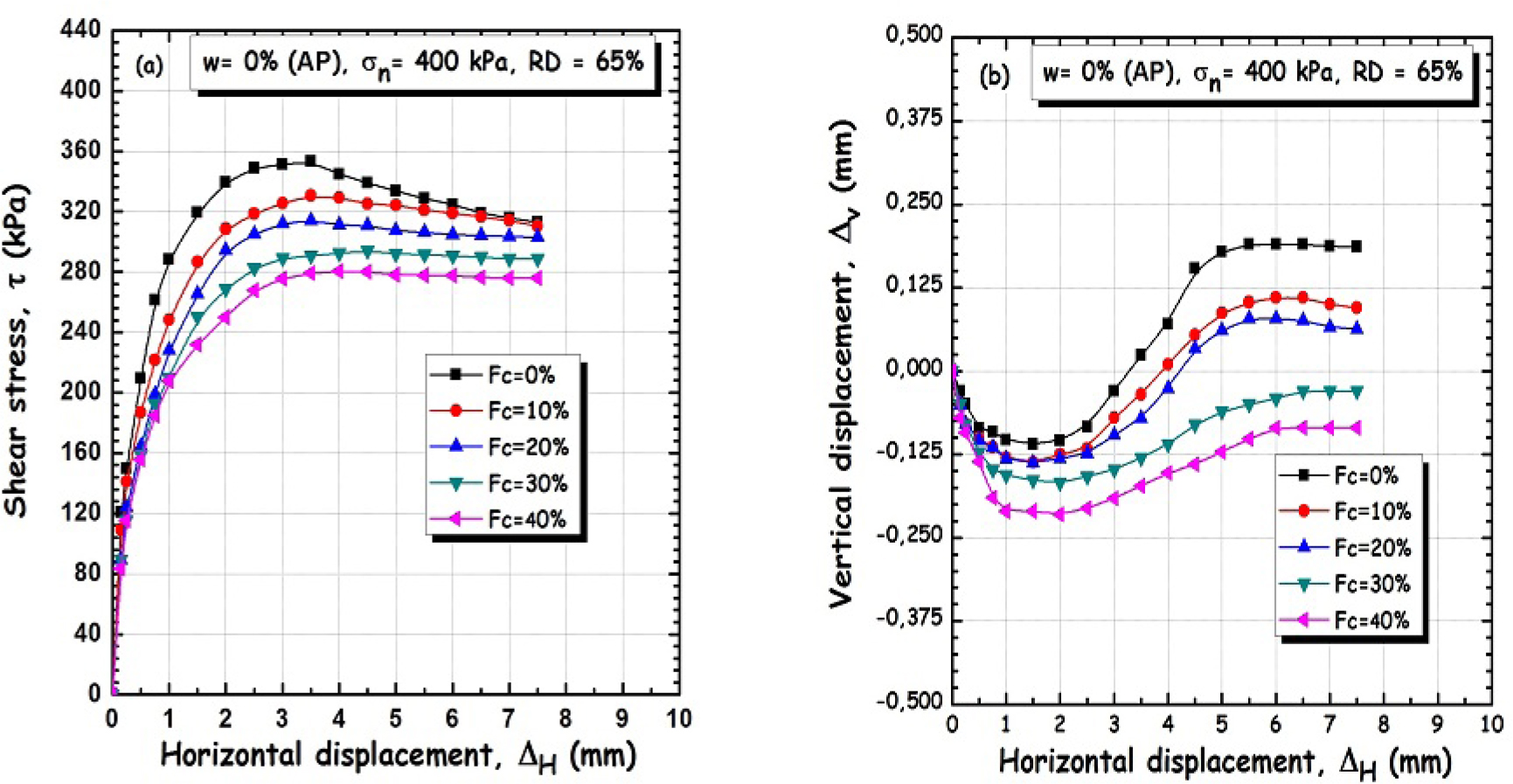
Figure 6
Effect of fines content on the mechanical behaviour of sand-silt mixtures (RD = 65%, σn = 400 kPa): (a) variation of the shear strength versus horizontal displacement, (b) variation of vertical displacement versus horizontal displacement.
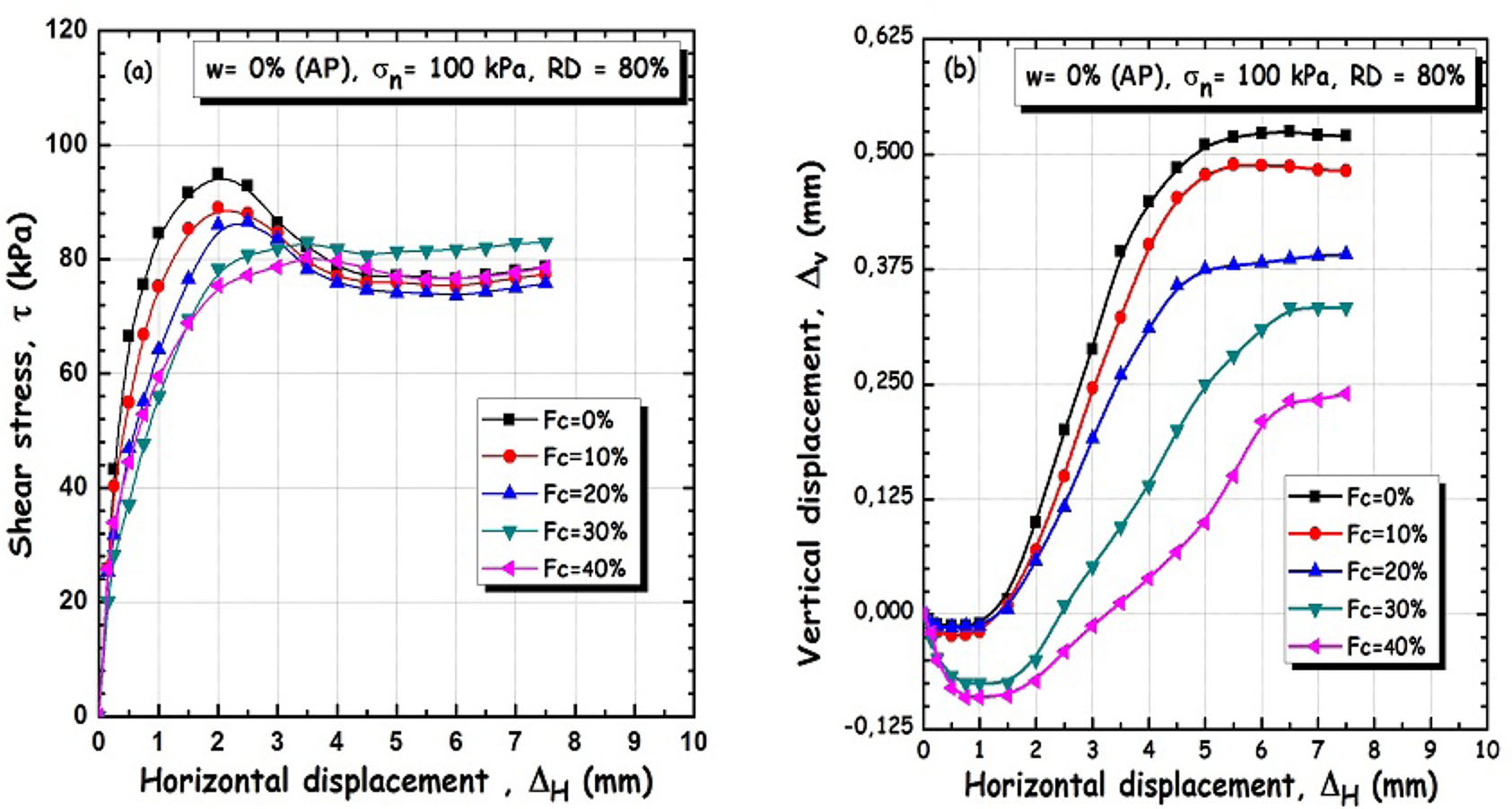
Figure 7
Effect of fines content on the mechanical behaviour of sand-silt mixtures (RD = 80%, σn = 100 kPa): (a) variation of the shear strength versus horizontal displacement, (b) variation of vertical displacement versus horizontal displacement.
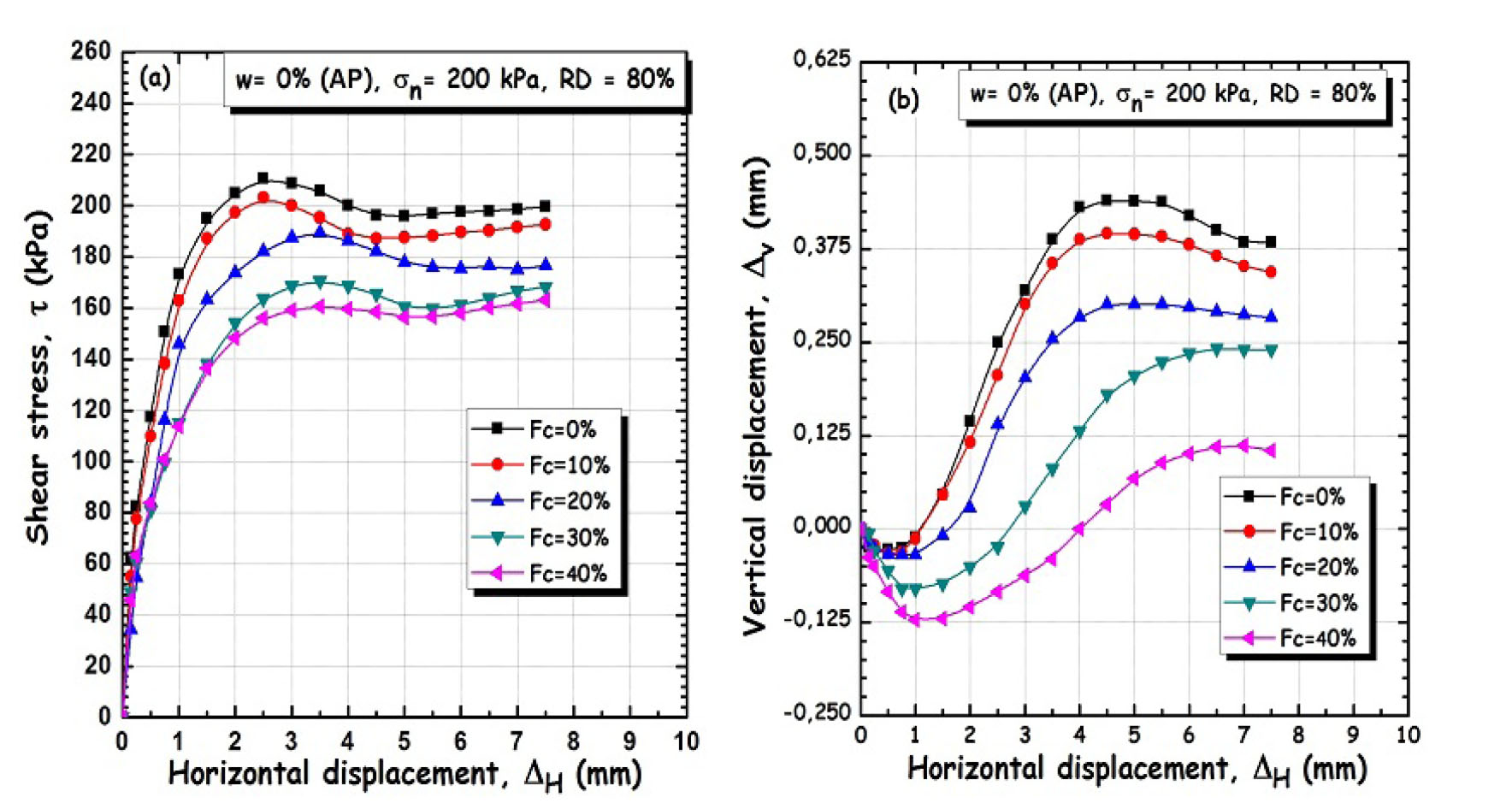
Figure 8
Effect of fines content on the mechanical behaviour of sand-silt mixtures (RD = 80%, σn = 200 kPa): (a) variation of the shear strength versus horizontal displacement, (b) variation of vertical displacement versus horizontal displacemen.
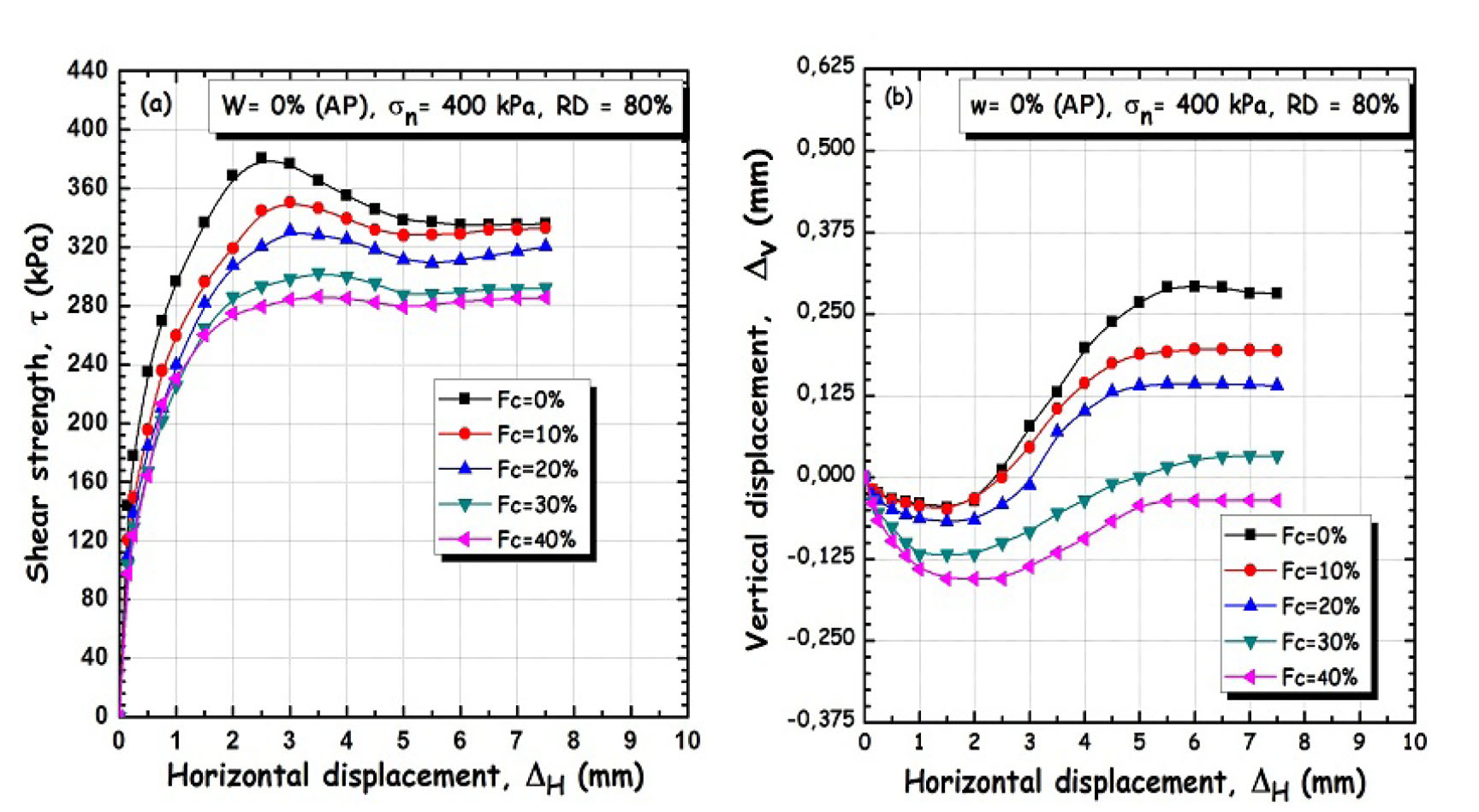
Figure 9
Effect of fines content on the mechanical behaviour of sand-silt mixtures (RD = 80%, σn = 400 kPa): (a) variation of the shear strength versus horizontal displacement, (b) variation of vertical displacement versus horizontal displacement.
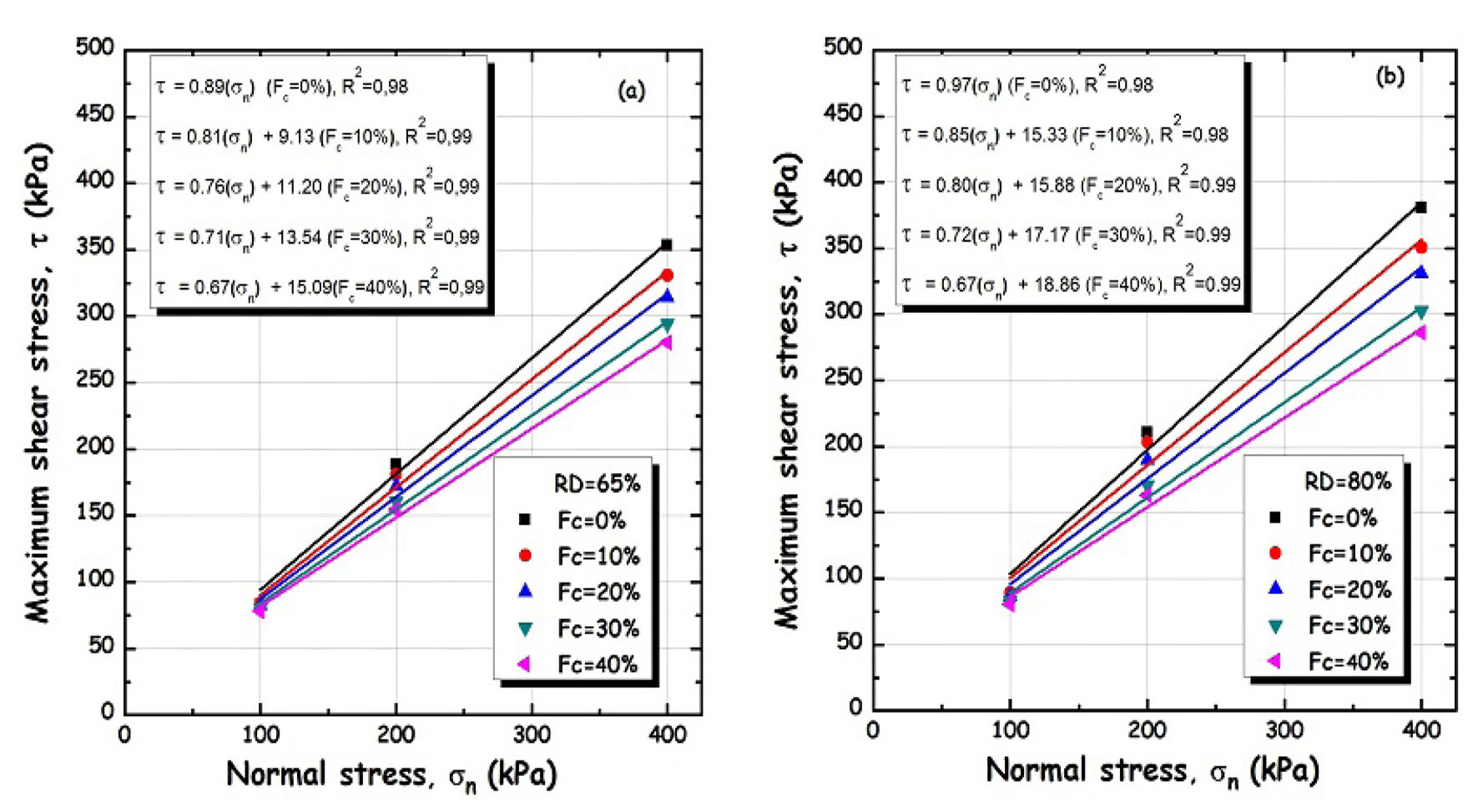
Figure 10
Effect of fines content on the mechanical behaviour of sand: Maximum shear stress versus normal stress.
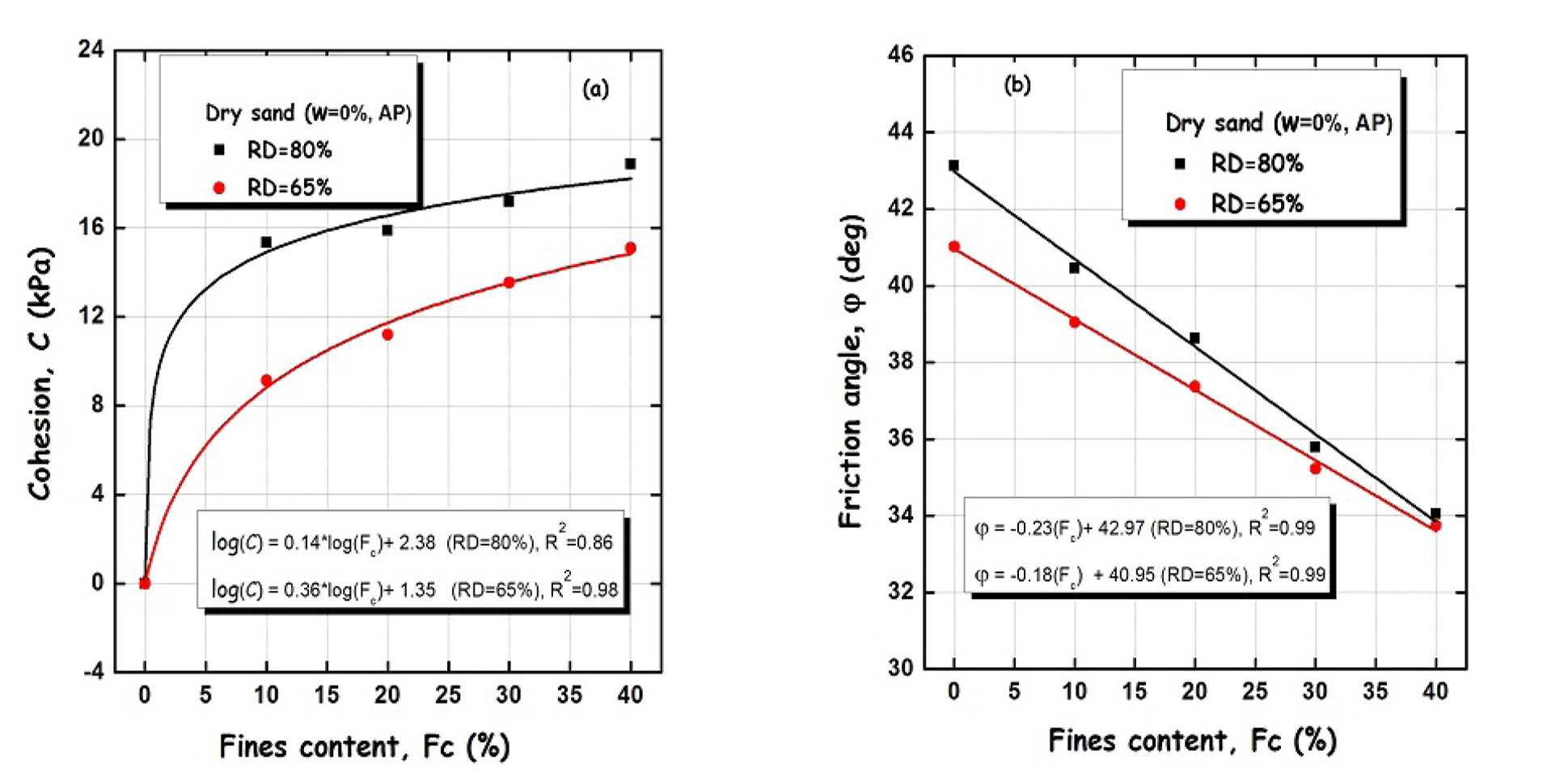
Figure 11
Effect the fines content on the mechanical characteristics of (clean) sand, (a) cohesion versus fines content, (b) friction angle versus fines content.
Table 3
Cohesion and friction angle for tests result.
| Material | Fc (%) | RD (%) | c (kPa) | j (°) |
|---|---|---|---|---|
| Clean sand | 0 | 65 | 0 | 41.67 |
| 85 | 0 | 44.13 | ||
| 10 | 65 | 9.13 | 39.01 | |
| 80 | 15.33 | 40.36 | ||
| Sand-silt mixtures | 20 | 65 | 11.20 | 37.23 |
| 80 | 15.88 | 38.66 | ||
| 30 | 65 | 13.54 | 35.37 | |
| 80 | 17.17 | 35.75 | ||
| 40 | 65 | 15.09 | 33.82 | |
| 80 | 18.86 | 34.05 |
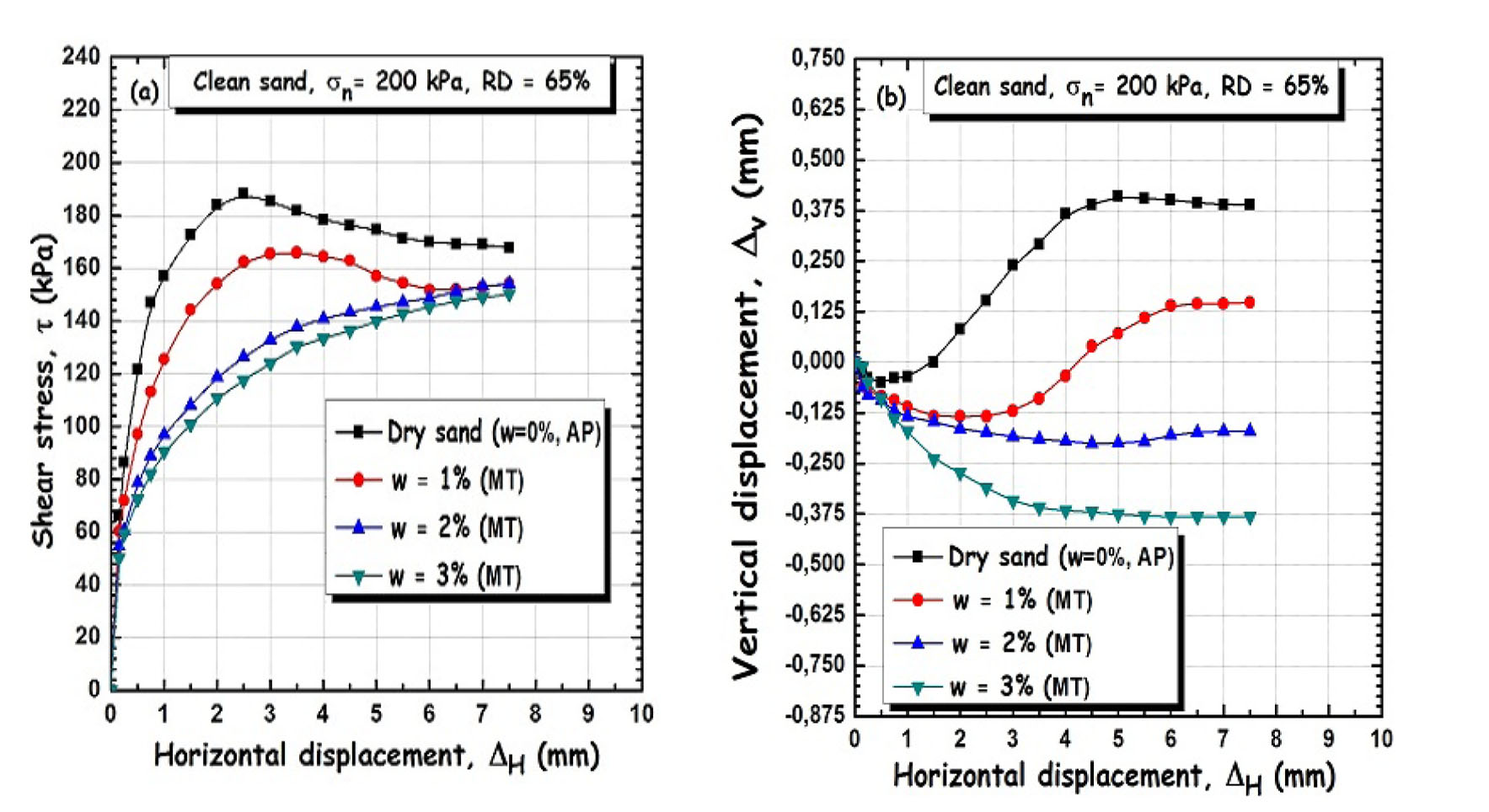
Figure 12
Effect of water content on the mechanical behaviour of clean sand (RD = 65%, σn = 200 kPa): (a) variation of the shear strength versus horizontal displacement, (b) variation of vertical displacement versus horizontal displacement.
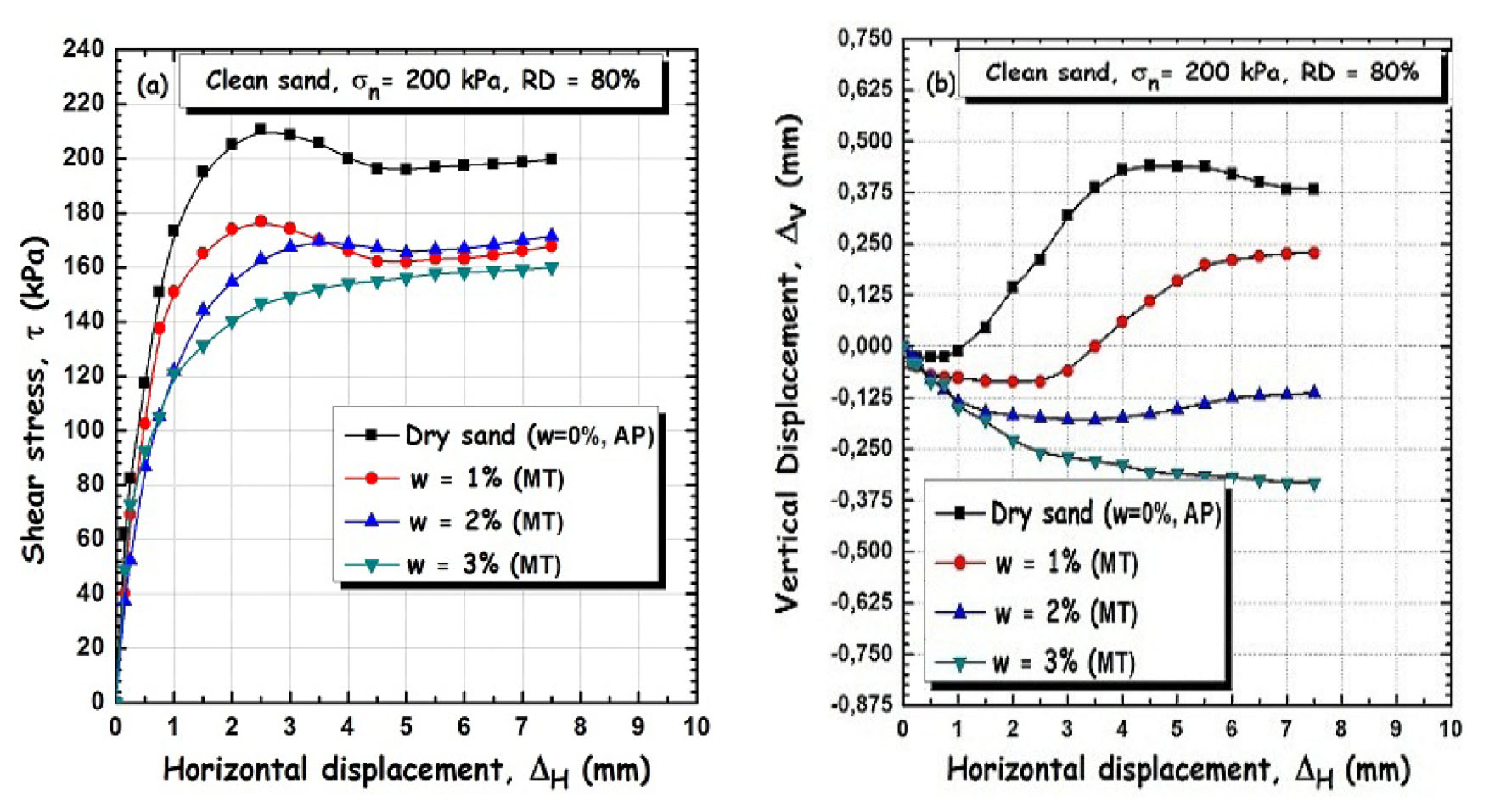
Figure 13
Effect of water content on the mechanical behaviour of clean sand (RD = 80%, σn = 200 kPa): (a) variation of the shear strength versus horizontal displacement, (b) variation of vertical displacement versus horizontal displacement.
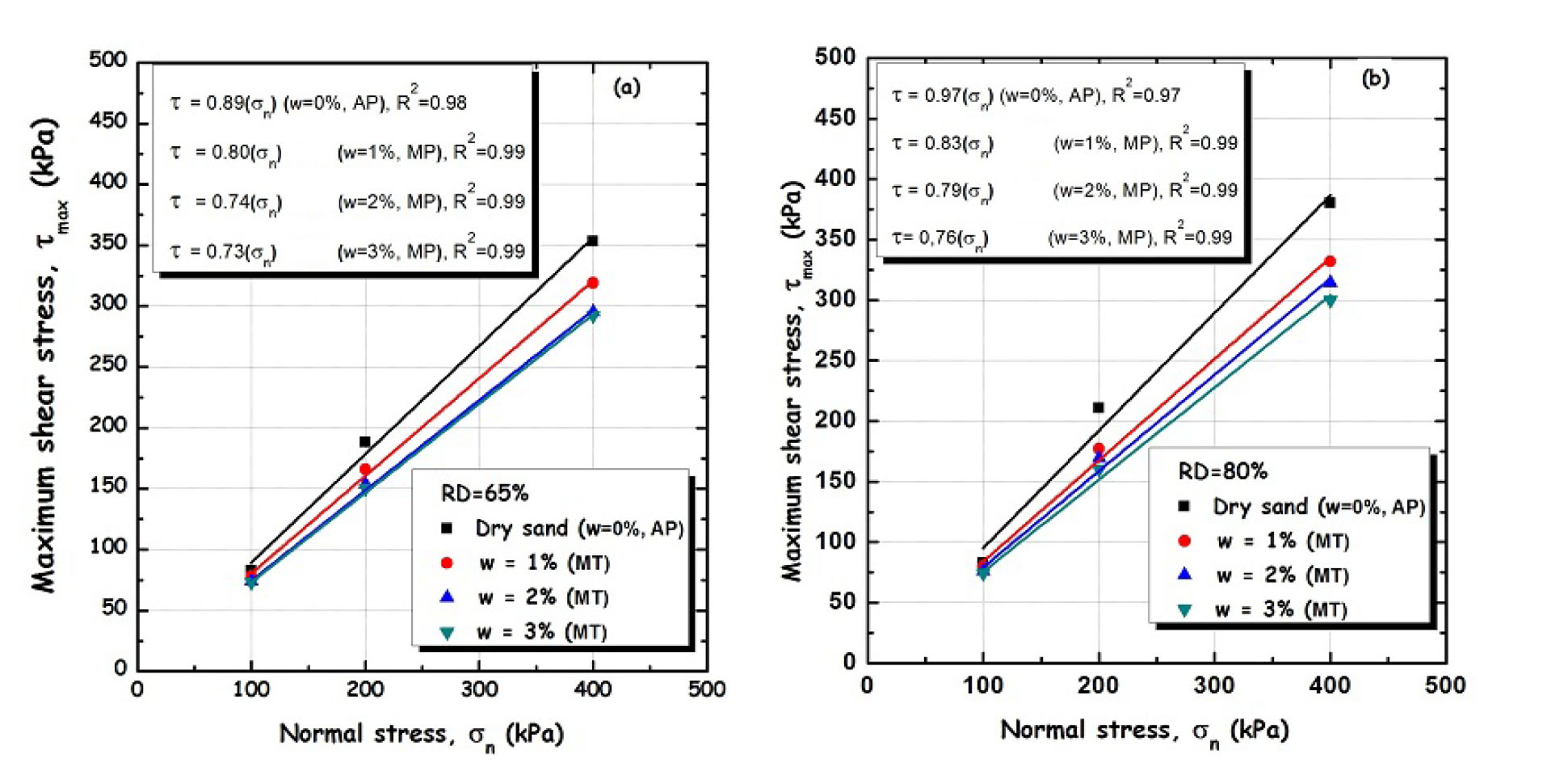
Figure 14
Effect of water content on the mechanical behaviour of clean sand: Maximum shear stress versus normal stress.
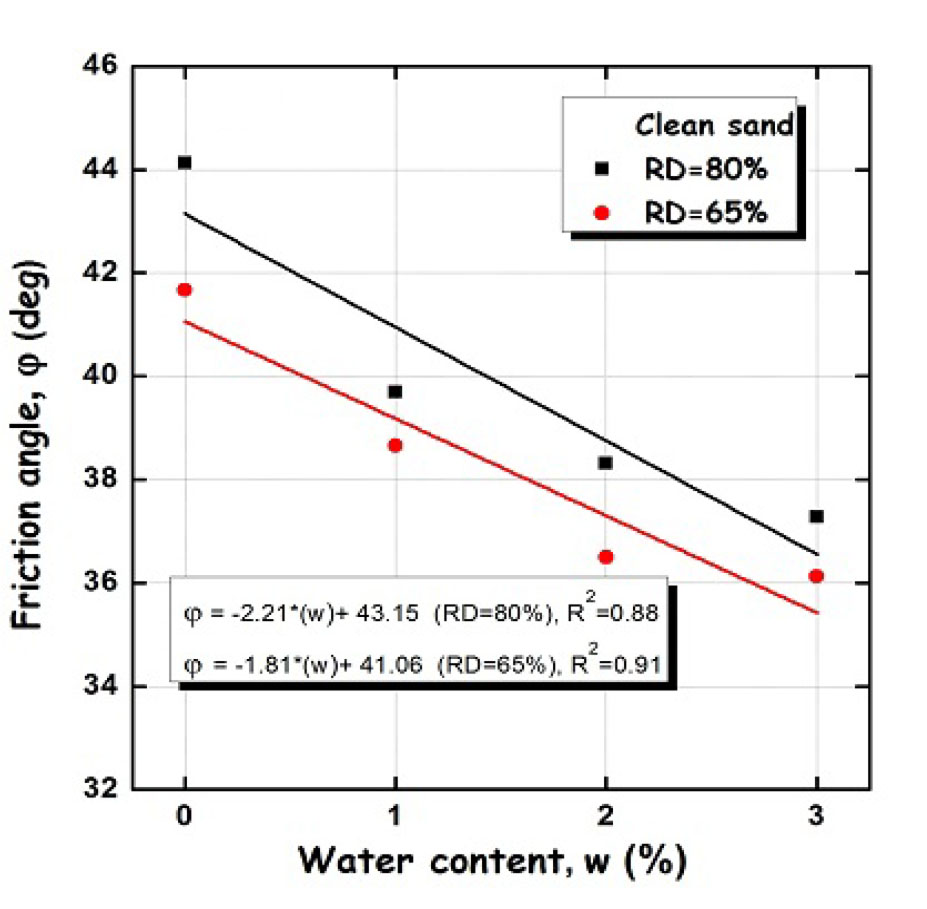
Figure 15
Effect of water content on the friction angle versus water content of clean sand.
Table 4
Cohesion and friction angle for test result.
| Material | w (%) | RD (%) | c (kPa) | j (°) |
|---|---|---|---|---|
| Clean sand | 0 | 65 | 0 | 41.67 |
| 85 | 0 | 44.13 | ||
| 1 | 65 | 0 | 38.66 | |
| 80 | 0 | 39.69 | ||
| 2 | 65 | 0 | 36.50 | |
| 80 | 0 | 38.31 | ||
| 3 | 65 | 0 | 36.13 | |
| 80 | 0 | 37.23 |
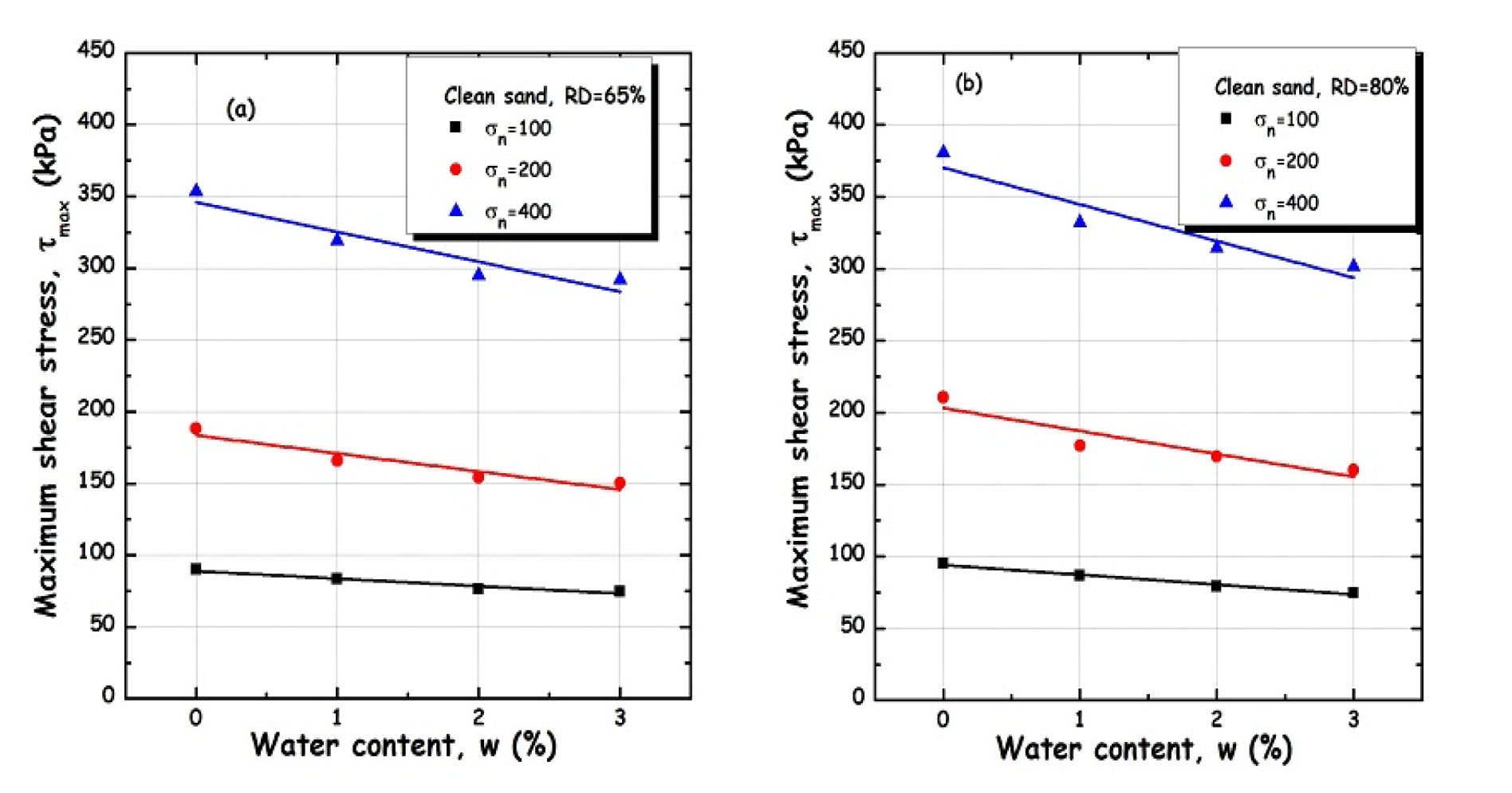
Figure 16
Effect of water content on the mechanical behaviour of clean sand: (a) RD = 65%, (b) RD = 80%.
Table 5
Coefficients A, B and R2 for equation (2).
| sn (kPa) | RD (%) | A | B | R2 |
|---|---|---|---|---|
| 100 | 65 | −5.221 | 88.869 | 0.94 |
| 200 | −12.52 | 183.33 | 0.90 | |
| 400 | −20.73 | 345.97 | 0.89 | |
| 100 | 80 | −6.83 | 94.153 | 0.98 |
| 200 | −15.94 | 203.42 | 0.87 | |
| 400 | −25.48 | 370.26 | 0.90 |
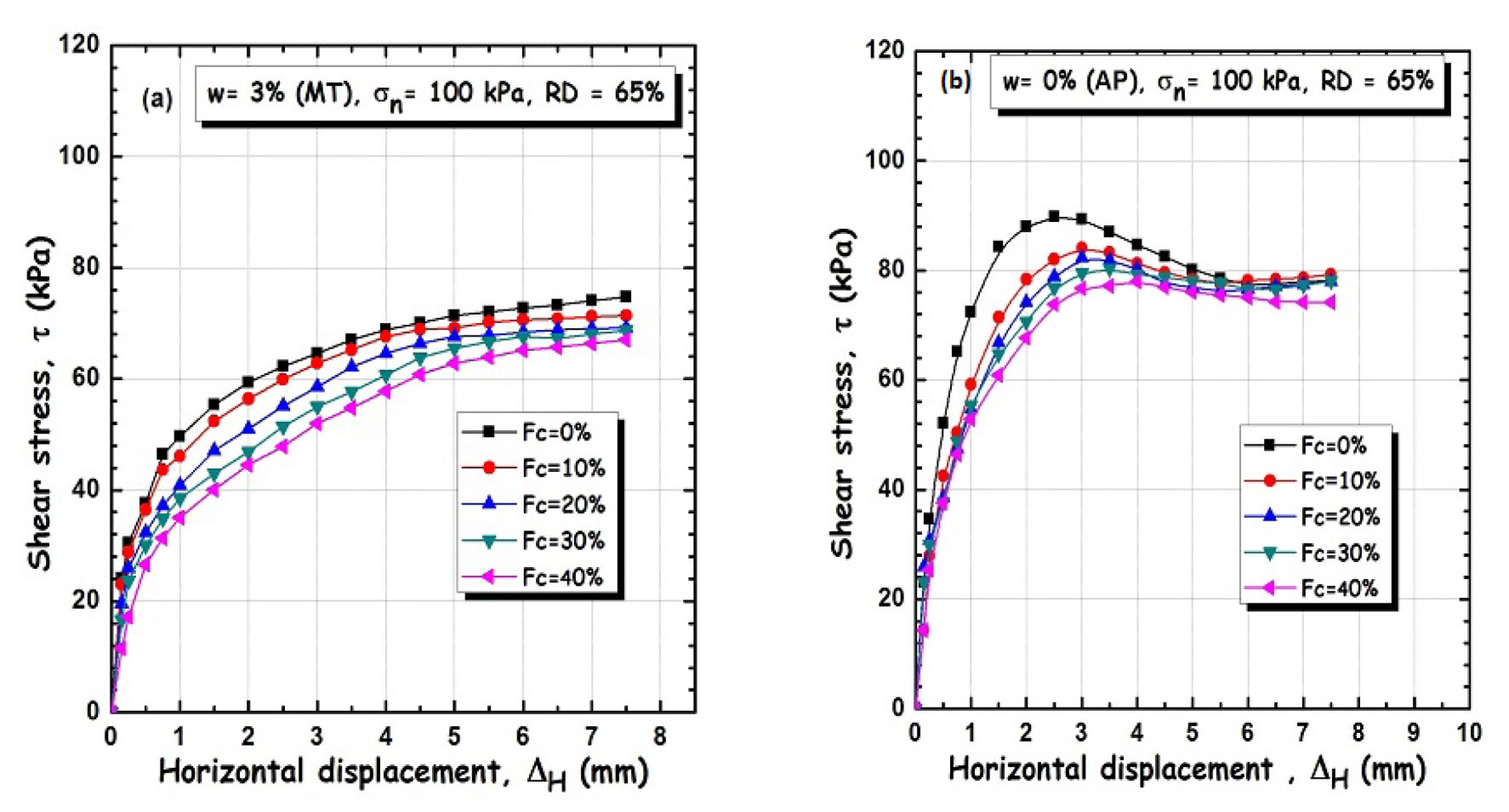
Figure 17
Effect of fines content on the mechanical behaviour of sand-silt mixtures (RD = 65%, σn = 100 kPa): (a) variation of the shear strength versus horizontal displacement (w = 3%), (b) variation of the shear strength versus horizontal displacement (w = 0%).
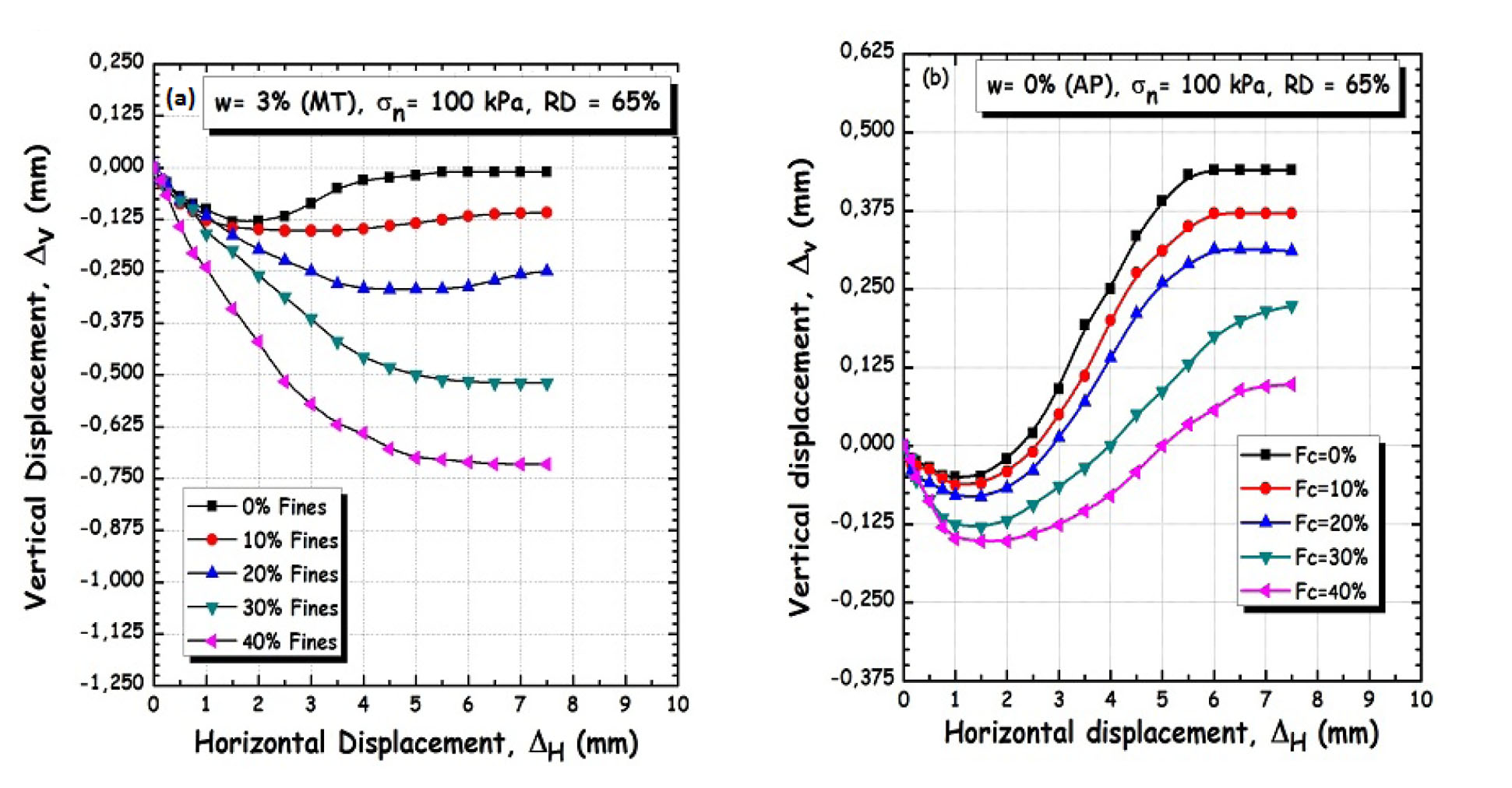
Figure 18
Effect of fines content on the mechanical behaviour of sand-silt mixtures (RD = 65%, σn = 400 kPa): (a) variation of vertical displacement versus horizontal displacement (w = 3%), (b) variation of vertical displacement versus horizontal displacement (w = 0%)
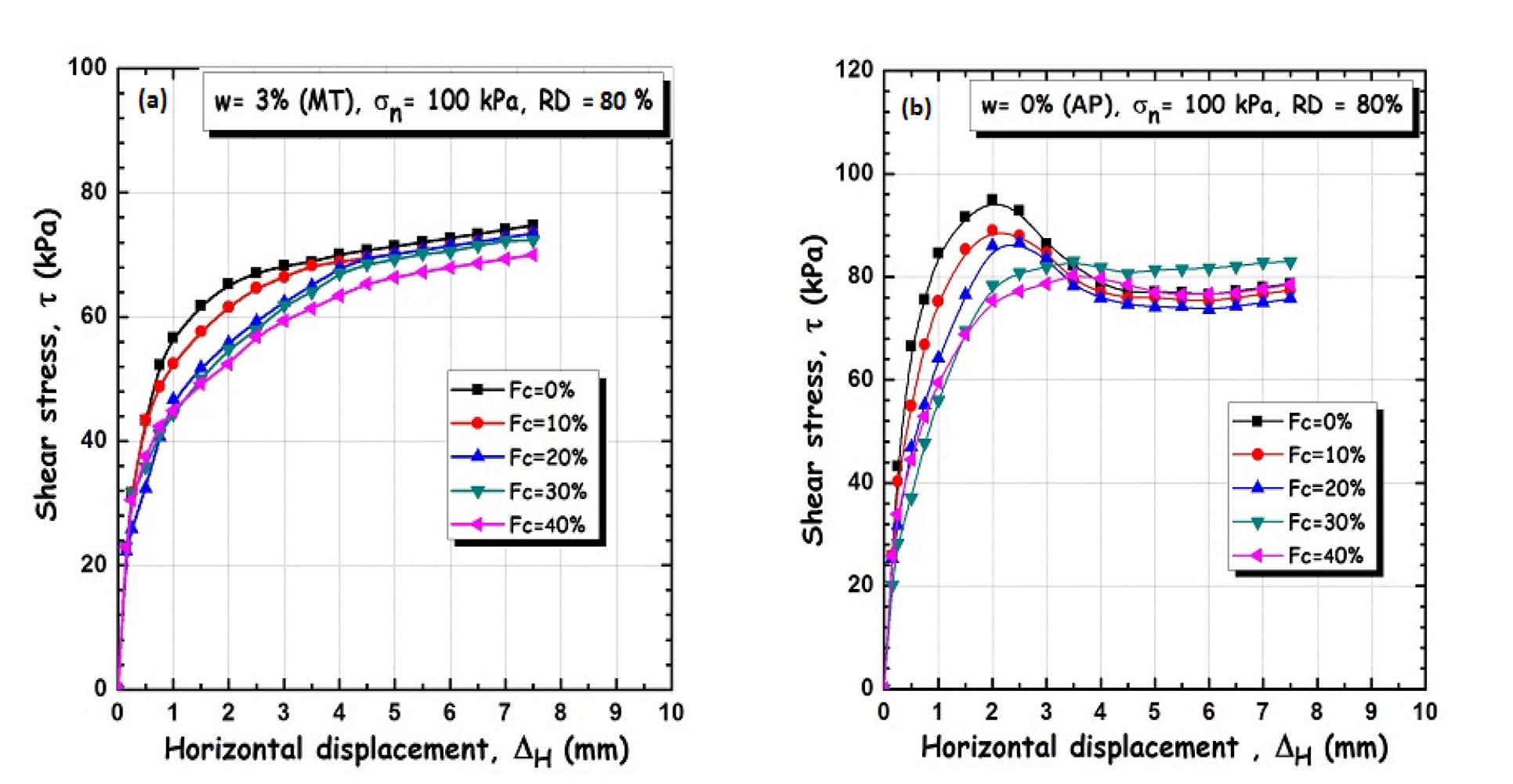
Figure 19
Effect of fines content on the mechanical behaviour of sand-silt mixtures (RD = 80%, σn = 100 kPa): (a) variation of the shear strength versus horizontal displacement (w = 3%), (b) variation of the shear strength versus horizontal displacement (w = 0%).
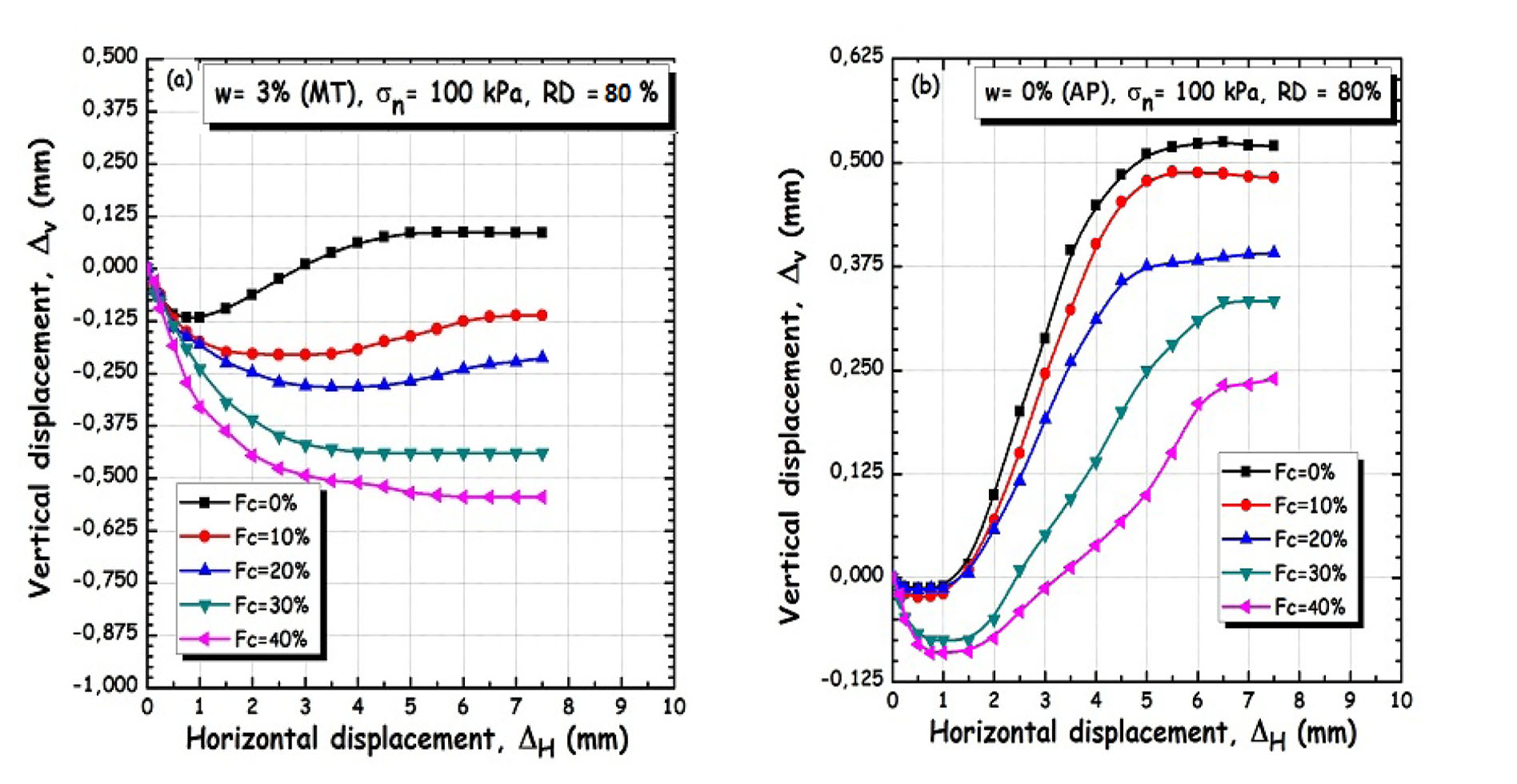
Figure 20
Effect of fines content on the mechanical behaviour of sand-silt mixtures (RD = 80%, σn = 400 kPa): (a) variation of vertical displacement versus horizontal displacement (w = 3%), (b) variation of vertical displacement versus horizontal displacement (w = 0%)
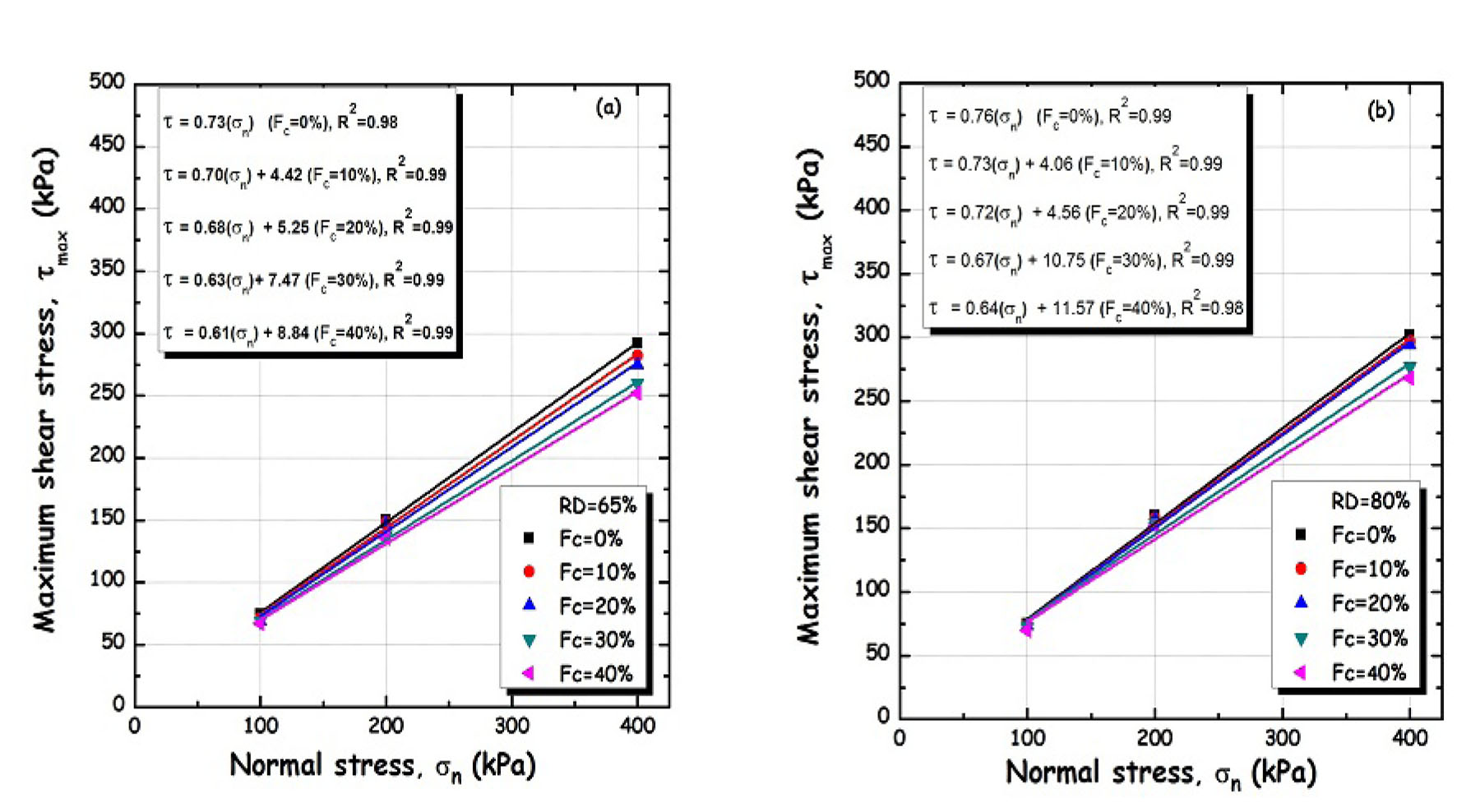
Figure 21
Effect of fines content on the mechanical behaviour of sand-silt mixtures: Maximum shear stress versus normal stress (w = 3%).
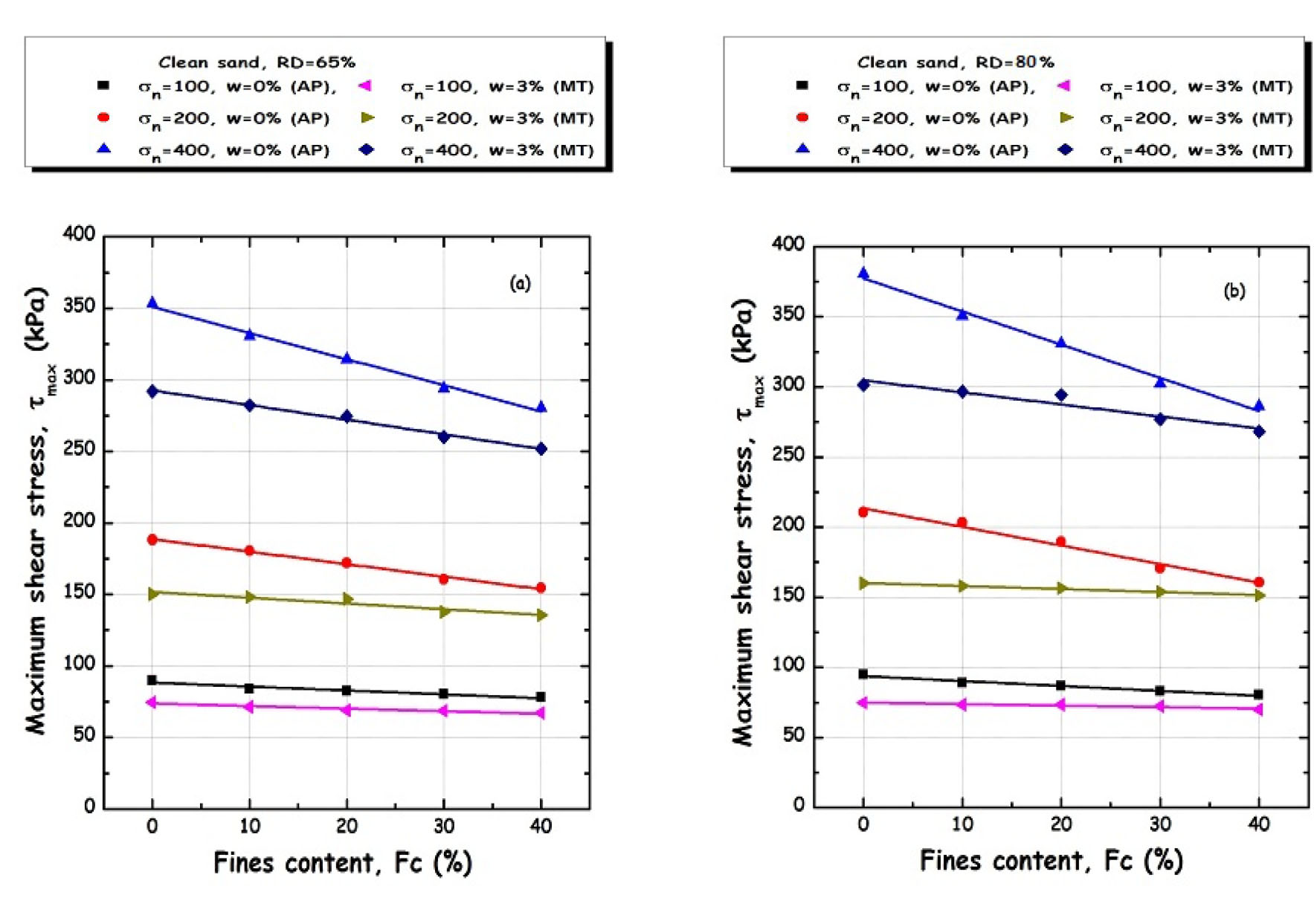
Figure 22
Effect of depositional method on the mechanical behaviour of clean sand: (a) RD = 65%, (b) RD = 80%.
Table 6
Coefficients A, B and R2 for equation (3) (RD = 65%).
| sn (kPa) | Preparation method | A | B | R2 |
|---|---|---|---|---|
| 100 | Air pluviation (AP) | −0.274 | 88.4 | 0.93 |
| 200 | −0.875 | 188.68 | 0.99 | |
| 400 | −1.823 | 350.92 | 0.99 | |
| 100 | Moist tamping (MT) | −0.179 | 73.794 | 0.92 |
| 200 | −0.400 | 151.71 | 0.90 | |
| 400 | −1.024 | 292.67 | 0.99 |
Table 7
Coefficients A, B and R2 for equation (3) (RD = 80%).
| sn (kPa) | Preparation method | A | B | R2 |
|---|---|---|---|---|
| 100 | Air pluviation (AP) | −0.351 | 93.826 | 0.97 |
| 200 | −1.325 | 213.47 | 0.98 | |
| 400 | −2.366 | 377.46 | 0.99 | |
| 100 | Moist tamping (MT) | −0.106 | 74.932 | 0.88 |
| 200 | −0.214 | 160.2 | 0.98 | |
| 400 | −0.860 | 304.74 | 0.91 |
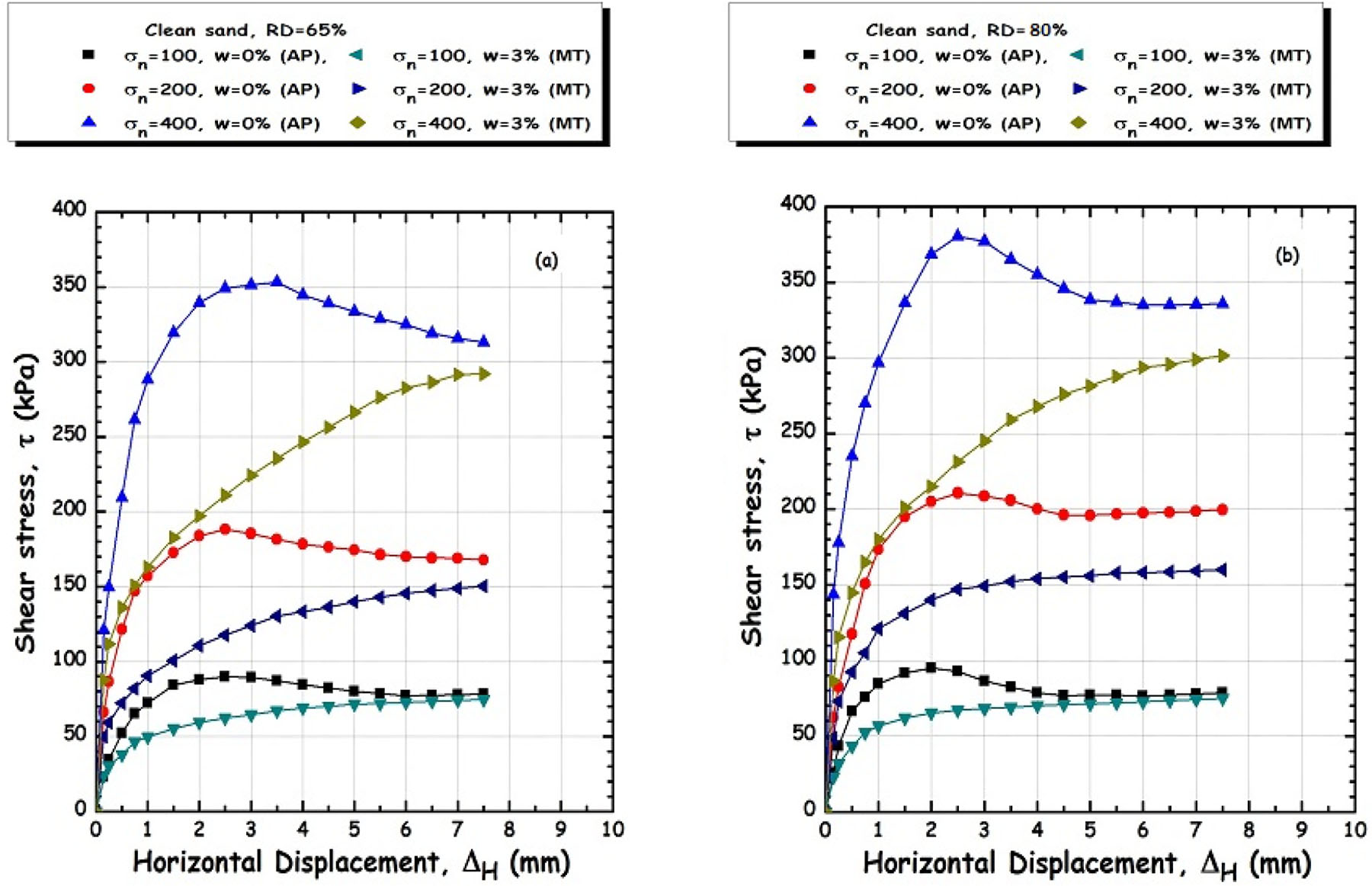
Figure 23
Effect of the depositional method on the mechanical behaviour of clean sand: (a) variation of the shear strength versus horizontal displacement (RD = 65%), (b) variation of the shear strength versus horizontal displacement (RD = 80%).