
1. Introduction
In the context of modern global competition, the growth of the innovation sector clearly distinguishes the living standards between developing and developed countries and provides a foundation for sustainable economic growth. Technological progress has not only altered the structure and scale of production but also greatly enhanced the quality of life for people. Today, humanity strives to maximize socio-economic benefits by reducing the use of natural, labor, and time resources — a goal that heavily relies on technological progress and the advancement of innovative processes.
To promote a country’s innovative growth, it is essential to implement a well-founded and thoughtfully designed state innovation policy, carry out organizational and institutional reforms, and enhance the legal norms that govern innovative processes. These efforts must ensure the stimulation of investment in innovation, encourage financing for innovative projects, and improve the effectiveness of funding mechanisms within the start-up ecosystem. Therefore, we consider the critical analysis of state innovation policy and the study of issues related to start-up financing mechanisms to be especially important.
The research aims to analyze the current sources of start-up funding in Georgia — including government programs and private investments — and to evaluate their effectiveness within the framework of national innovation policy. To accomplish this, the following objectives were established:
To assess Georgia’s current innovative development using the Global Innovation Index;
To study and analyze the sources of startup ecosystem financing both globally and within Georgia;
To evaluate state innovation policy;
To assess the impact of start-up ecosystem funding in Georgia.
The study's theoretical importance lies in expanding the current theoretical and methodological foundation regarding state innovation policy and the financing of the start-up ecosystem. Its practical value is shown in implementing the proposals and recommendations developed through the research, which the government can use to design and carry out measures aimed at guiding innovative processes. The study's originality is demonstrated by the high practical usability of the proposed measures for the government, entrepreneurs, and funders of the start-up ecosystem.
The development of the theoretical framework and the formulation of conclusions in this study were significantly influenced by both Georgian and international scholars on innovation policy and startup ecosystems. In their monograph Perspectives of Innovative Economic Development in the Region under Global Economic and Business Challenges, Abuselidze and Badulesko (2025) examine key issues related to innovative development and innovation policy. Kakulia’s monograph Key Directions for Improving the Management of Innovation Activities (2009) addresses urgent and problematic aspects of government regulation and management of innovation processes, emphasizing the importance of startup growth. Mekvabishvili (2016) highlights the role of the state in the country’s innovative progress and stresses the importance of the regulatory approaches chosen by the government. Kokiashvili (2020) focuses on the role and significance of innovation systems and their components. Tsverava (2021) considers the effectiveness of state innovation policy as a key factor in overcoming crises.
In their work Challenges and Perspectives of the Startup Ecosystem for the Development of Innovative Economy in Georgia, Abuselidze et al. (2024) highlight modern models of start-up ecosystem formation and development, as well as current issues and emerging challenges related to these processes. The study Modern State of Innovative Development of Georgia: Challenges and Prospects (Abuselidze & Meladze, 2023) addresses Georgia’s current innovative development and analyzes the main challenges it faces.
Graham’s self-published online article Startup – Growth (2012) emphasizes the crucial role of start-ups and highlights the importance of their financing. Kidder, in The Startup Playbook: Secrets of the Fastest-Growing Startups from Their Founding Entrepreneurs (2013), considers enhancing start-up financing mechanisms to be a key requirement for a country’s innovative development. Lupton and Willis (2021), in their work The COVID-19 Crisis: Social Perspectives, underline the role of state innovation policy in the post-pandemic era. Salido et al. (2013), in “The Accelerator and Incubator Ecosystem in Europe,” focus on funding mechanisms within the startup ecosystem, such as accelerators and innovation incubators.
Miller and Bound (2011), along with Abuselidze and Sarjveladze (2025), examine key issues in start-up development and see venture capital as a more effective way to finance startups. The works of Shaikhutdinova et al. (2024) and Pavlovskyi et al. (2025) discuss the consistency of state investment and innovation policies, noting that such alignment influences the success of funding mechanisms for innovative projects. In the article “Ensuring Competitive Advantages of the Banking Sector of Ukraine in the Context of Global Digital Transformation” (Slobodianyk et al., 2024), the focus is on innovative activities in the service sector, viewing it as a critical factor for competitiveness in today's world.
2. Methodology
Methodologically, the study employs both quantitative and qualitative analyses. It focuses on understanding how state regulation either supports or, conversely, hampers the financial sustainability of start-ups, as well as on identifying ways to improve support mechanisms to enhance the innovative environment. Accordingly, the research is based on an in-depth review of relevant theoretical literature and the statistical analysis of collected quantitative data.
In analyzing the theoretical materials, both empirical and logical methods were used, along with synthesis and analysis techniques. In the empirical part of the research, the current mechanisms for financing the start-up ecosystem in Georgia were examined, and their strengths and weaknesses identified. Using logical reasoning, the study determined the relationships between various factors affecting specific phenomena, helping to identify relevant patterns and regularities. Through synthesis and analysis, the impact of each influencing factor on the issue examined and on the final research results was assessed.
In analyzing the statistical data, the study used methods of data aggregation, classification, graphical presentation, comparison, dynamic analysis, and structural analysis. As a result, the statistical information was processed to meet the research aims and objectives, and its outcomes were considered in forming the study’s conclusions and recommendations. Statistical data were obtained from the Global Innovation Index and the electronic databases of the National Statistics Office of Georgia.
Based on the analysis of qualitative and quantitative data, the authors’ viewpoints are supported, and the proposed recommendations, suggested measures, and conclusions are justified.
3. Results and Discussion
In today’s rapidly changing world, pursuing an innovative economy is crucial for sustainable economic growth and global competitiveness. As a result, conducting a detailed analysis of the factors that promote or hinder a country’s innovative economic development has become essential (Abuselidze & Badulski, 2025). The rollout of new technologies and an innovation-focused ecosystem has gained particular attention during the pandemic and post-pandemic periods. Modern models for building and developing startup ecosystems, along with related processes, help transform them into sources of innovation and facilitate the transfer of resources necessary for economic progress (Abuselidze et al., 2024).
In Georgia, the rate of digitalization and the adoption of innovative methods in small and medium-sized businesses remains insufficient. As a result, Georgian companies face difficulties in competing globally and encounter obstacles in developing and implementing new management and production systems (Strategy, 2024).
The modern world is characterized by rapidly changing events. Dynamic and fast-evolving realities have shown the global community that one of the most effective ways to accelerate economic and political development is through a country’s innovation policy. One key component of national innovation policy is the mechanism for funding start-up projects (Lupton & Willis, 2021). A country’s innovative growth depends on its national innovation policy, which defines the goals of national and regional authorities in the innovation sector, outlines main activity directions, and establishes governance strategies and regulations (Abuselidze & Meladze, 2023; 2025). From an innovation development perspective, understanding the role of the state is especially important. The state should act as a primary catalyst for creating an innovation-driven economy and encourage the development of a modern innovation–cognitive economic model, which supports integration into the global economy and boosts competitiveness (Mekvabishvili, 2016). Achieving the strategic and tactical goals of national innovation policy creates the necessary socio-economic, organizational, legal, cultural, and informational environment for a country’s innovative progress (Slobodianyk et al., 2024).
The modern world is characterized by rapid changes across all areas of human activity—from economic shifts and advancements to scientific breakthroughs and technological progress. In this context, innovation systems are crucial in guiding the direction of national innovation policies, supporting startups, and maintaining competitiveness (Shaykhutdinova et al., 2024).
The development of financing mechanisms in the start-up ecosystem is significantly shaped by state innovation policy at both regional and national levels. As a vital component of a country’s economic strategy, state innovation policy defines the goals for public authorities, guides their actions, and establishes governance methods and regulations for innovative activities. It also details the types of financing available for innovation processes and the tools used to support the start-up ecosystem. Innovation policy aims to create a system that encourages the effective use of technological advances and innovation outcomes, supports start-up projects, and ultimately lays the groundwork for producing competitive goods, stimulating economic growth, and fulfilling society’s changing needs. Within this framework, a well-structured concept for developing innovative activities should be crafted, along with key directions for government support, national programs and projects, new mechanisms for engaging small and medium-sized enterprises, and a practical action plan to implement these initiatives.
Georgia lacks abundant natural resources that would give it a significant edge in global competitiveness. Furthermore, natural resources are no longer the main factor for competitiveness; technology and innovation have taken their place (Abuselidze & Meladze, 2024). Therefore, Georgia’s economic growth must focus on an innovation-driven model. Since gaining independence, Georgia has adopted this approach to innovative development, starting with the 1990s enactment of the Law of Georgia On Science, Technologies and Their Development.
2010 – Establishment of the Shota Rustaveli National Science Foundation of Georgia (SRNSFG);
2012 – Development of the Innovation Concept of Georgia;
2012 – Establishment of the Technology Transfer Centre (TTCG);
2014 – Creation of the Georgia Innovation and Technology Agency (GITA);
2014 – Launch of the state programme Produce in Georgia;
2015 – Establishment of the Research and Innovation Council;
2015 – Development of the “Georgia 2020” Socio-Economic Development Strategy;
2016 – Adoption of the Law of Georgia on Innovations;
2016 – Establishment of the Business and Technology University within the “Silicon Valley Tbilisi” project;
2024 – Development of the “Digital Economy and Information Society Development Strategy of Georgia 2025–2030”.
Today, scientific and technological parks, industrial innovation laboratories, innovation laboratories, and innovation hubs have gradually been established and are operational across the country.
There are various criteria for evaluating a country’s level of innovative development. Similarly, technological and innovation-driven transformations are reflected in a nation’s macroeconomic indicators and influence its structure. Additionally, a country’s innovative progress is measured through periodic ratings published by international organizations. In global practice, the most commonly used indices for assessing innovative capacity include: the Global Innovation Index (GII), the Global Competitiveness Index (GCI), the Knowledge Economy Index (KEI), the Bloomberg Innovation Index, OECD indicators, Standard & Poor’s, Fitch, Moody’s, Doing Business, the Heritage Foundation, and others.
These international indices are based on different assessment methods, which often lead to variations in published results. The Global Innovation Index (GII) is calculated using about 80 indicators grouped into seven main categories: (1) Institutions; (2) Human Capital and Research; (3) Infrastructure; (4) Market Sophistication; (5) Business Sophistication; (6) Knowledge and Technology Outputs; and (7) Creative Outputs (GII, 2025). Georgia’s position in the Global Innovation Index for 2011–2025 is shown in Diagram 1.
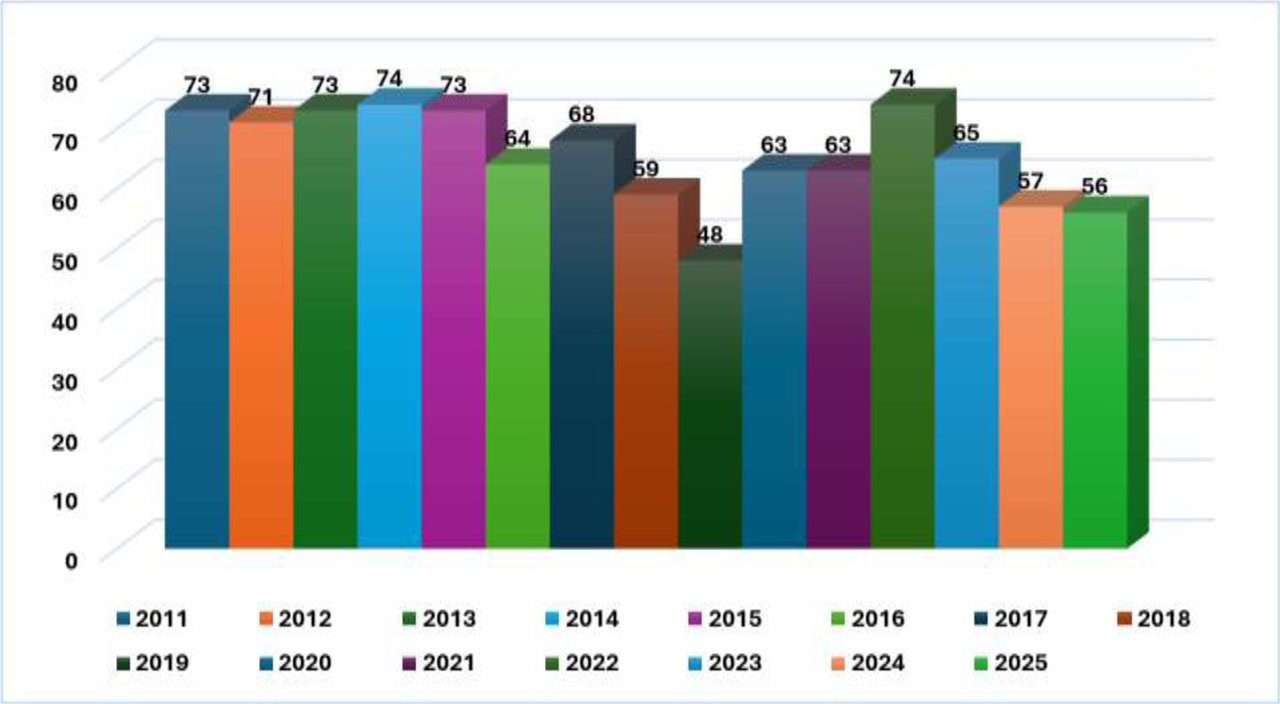
Diagram 1.
Georgia's place in the Global Innovation Index ranking, 2011–2025.
Note: The 2025 data are not final and were retrieved on 08 November 2025.
Source: Compiled by the authors based on GII data. www.wipo.int
As shown in Diagram 1, Georgia’s best performance was in 2019, when it ranked 48th with a score of 36.98. This represented an improvement of 11 positions from the previous year, mainly driven by positive developments in the categories of Institutions and Infrastructure, which scored 74.3 and 44.7 points, respectively.
The lowest ranking—74th—was recorded in 2022 with a score of 27.91. Georgia also ranked 74th in 2014; however, that year's score was higher, at 34.53. In 2022, the weakest category was Creative Outputs (13.4 points), while the strongest was Institutions (70.7 points).
Over the past four years, Georgia’s ranking on the index has generally improved. Based on preliminary data for 2025, Georgia is currently ranked 56th.
The Global Innovation Index annually produces not only an overall ranking but also separate rankings based on Innovation Inputs and Innovation Outputs. The trends of these indicators over the last five years are shown in Diagram 2.
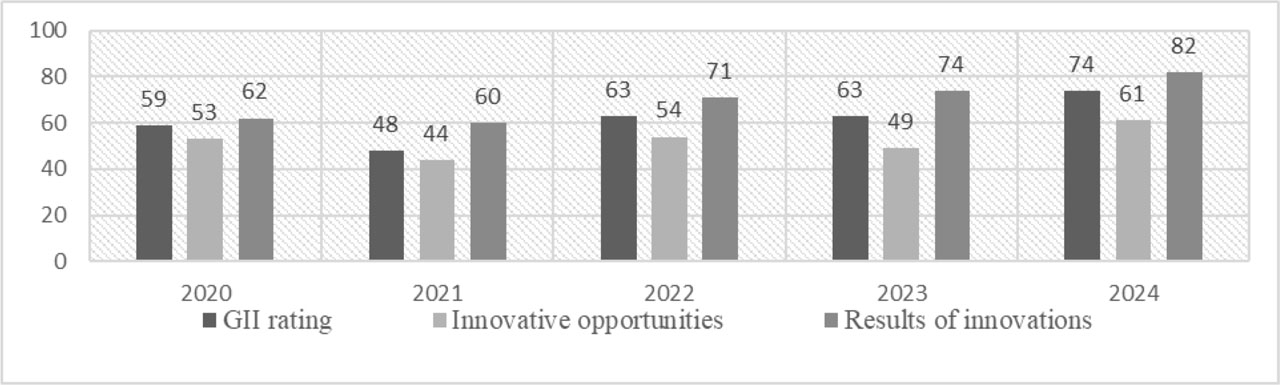
Diagram 2.
Georgia's place in the ranking according to innovative opportunities and innovation results, dynamics of 2020–2024
Source: Compiled by the authors based on GII data. www.wipo.int
According to Diagram 2, from 2020 to 2024, Georgia’s innovation input ranking consistently exceeded its innovation output ranking. This indicates that the country’s existing potential and innovative capabilities are not being effectively utilized to generate outcomes.
From the perspective of the country’s economic growth and the strengthening of its innovation capacity, developing the start-up ecosystem is especially important. In this process, the effectiveness of financing mechanisms and how well they align with the country's economic realities are essential (Graham, 2012). Additionally, the sources of funding for the start-up ecosystem—including government programs, private investments, and international grants—determine the success of the government's innovation policies in supporting start-ups (Vassil, 2016).
In academic discourse, interpretations of what defines start-ups vary. Generally, a start-up is viewed as any new venture where companies explore a product and a market. Although the term “start-up” literally means a “new beginning,” in modern usage it usually refers to a fast-growing company driven by technology and innovation (Kidder, 2013). A start-up describes an activity through which a small business develops into a large company, closely linked to technology and innovation, as these elements help companies gain competitive advantages worldwide. Therefore, most successful start-ups offer technological and innovative products or services. Creating and growing start-ups requires a supportive environment and favorable conditions—what is now called the start-up ecosystem. One of the most critical factors in building and strengthening this ecosystem is access to financial resources, as well as the ability to secure and manage them. For a well-functioning ecosystem, the support of educational institutions and a clear government role in innovation policy are essential.
The development process of a startup ecosystem includes several stages, which can be categorized as follows:
Seed – conducting market research and developing ideas;
Early – development of a pilot version of the product;
Expansion – the development of the final version of the product.
‘Late’ – release of the existing product.
Buy-out – return on investment (sale of production rights and/or shares).
At each stage of the startup ecosystem's development, appropriate funding sources are necessary. These sources are highly specific and depend on the efficiency of the overall financing system. International practice shows that startup financing systems typically include the following components:
Personal funds.
Angel investors.
Accelerators.
Venture capital.
Crowdfunding platforms.
State and international grants.
Bank loans.
Angel investors are individuals who provide capital to start-ups in exchange for equity or debt. They are often successful businesspeople with industry knowledge and experience. Angel investors typically look for new business ideas and investment opportunities; therefore, connecting with them is relatively easy in today’s digital age. This financing method is widely and effectively used in the United States and other developed Western European countries.
A start-up accelerator is a funding method used when entrepreneurs lack not only the necessary capital but also a fully developed business idea. Accelerators are therefore connected to the market research and idea development stage (the seed phase). They support emerging companies financially as well as through technical and business development assistance, in exchange for equity (Miller, 2011).
Venture capital involves financial resources allocated to high-tech business and investment projects, primarily aiming to generate substantial long-term returns. This process includes investing through funds created by multiple companies and/or individuals. The fund’s profits and losses are then shared proportionally among its owners. Venture capital is characterized by long return periods (typically around 10 years), low liquidity during early stages, high risk, and the potential for significant returns. In addition to financial investment, venture capital offers managerial, marketing, technological, and consulting support. International experience shows that venture capital markets exhibit steady annual growth, highlighting the high effectiveness of this mechanism (Andreosso, 2021).
A relatively new way to fund start-ups is crowdfunding, which uses online platforms that let creators of technological and innovative ideas gather money from different contributors. These platforms act as meeting points for innovators and people interested in funding start-up projects.
In addition to the mechanisms mentioned earlier, start-up projects can be financed through internal company resources, government and international grants, or bank loans. However, because of the high risk and long payback periods, these sources are less commonly used in practice.
In 2014, to develop the startup ecosystem, Georgia’s Innovation and Technology Agency was established under the Ministry of Economy and Sustainable Development. Its mission is to promote the application of technology and innovation across all sectors of the economy, support the growth of knowledge and innovation, increase funding for innovations and high-tech projects, and organize thematic trainings, seminars, conferences, workshops, and other events (Statute, 2014).
An essential institution for supporting the effective operation of start-up ecosystems and innovation systems is the Research and Innovation Council, established in 2015. Its main role is to develop recommendations for creating an innovation-driven economy, establishing an innovation ecosystem, financing start-ups, and commercializing innovations. It also provides guidance on the allocation of budgetary resources and attracting funding from donor organizations and financial institutions. Additionally, the Council oversees national and regional innovation initiatives to ensure their coordinated implementation (Statute, 2015).
The practice of start-up ecosystem financing in Georgia includes several major programmes:
Start-up Georgia.
Innovation financing grants.
Produced in Georgia.
Horizon 2020.
Global Startup Fund.
Future Laboratory.
TBC Bank’s Startup Program.
Bank of Georgia – Women Start-up Program.
These programs have financed several start-up projects in Georgia; however, their scale and number remain inadequate for the broader development of the start-up funding system. Therefore, boosting investment in startups and high-tech innovative projects continues to be vital.
A systemic approach to stimulation is guided by a combination of different tools and methods, which, beyond their immediate effects, also show interacting relationships. These methods can be categorized into direct and indirect instruments.
Direct instruments include government funding for scientific and technological research, concessional loans for startups, and full or partial subsidies on interest payments for bank loans. This category also encompasses preferential state programs for risk insurance.
Indirect instruments, by contrast, include measures that foster a supportive financial and economic environment for start-up growth, such as tax incentives. For example, tax benefits may be used on the portion of a company’s profit reinvested into research activities or technological upgrades.
Below is Diagram 3, which shows the innovation activity of enterprises in Georgia—specifically, the percentage of enterprises that introduced product (goods/services) innovations during 2016–2024.
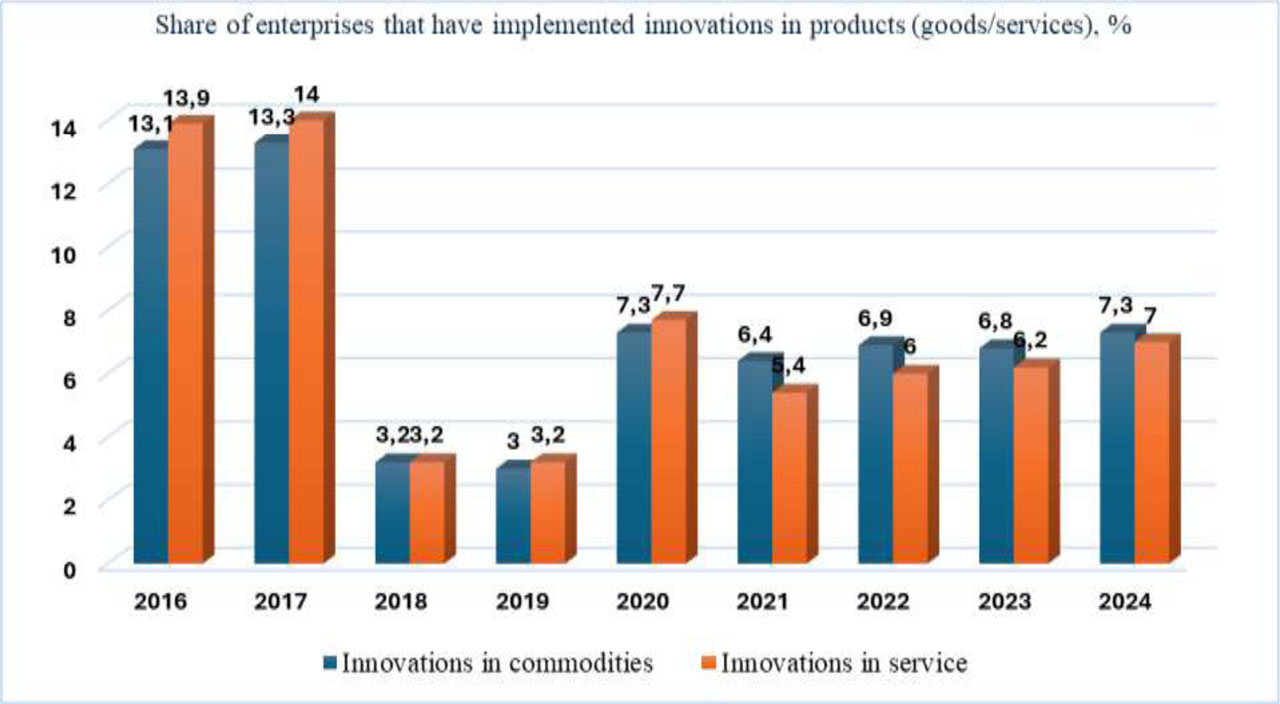
Diagram 3.
Innovative activity of enterprises
Source: based on the data of the National Statistics Office of Georgia. www.geostat.ge
Diagram 3 shows that the innovation activity of enterprises in Georgia follows non-linear patterns. The highest activity levels occurred in 2016–2017, while the lowest were seen in 2018–2019. From 2016 to 2020, service-related innovations made up a larger share compared to product (goods) innovations. However, from 2021 to 2024, this trend reversed, with product innovations exceeding service innovations.
Based on the analysis of the reviewed literature and presented data, it can be concluded that the processes of innovative development in Georgia, as well as the conditions for financing the start-up ecosystem, require active government intervention. This should be systematically addressed within the framework of national innovation policy. The study of financing conditions for the start-up ecosystem in Georgia revealed the following key deficiencies:
Insufficient capital.
Low engagement from investors and the private sector.
Regulatory barriers and bureaucratic hurdles;
Lack of information.
Insufficient support for securing additional financing.
Incorrect project choice;
Misalignment of priorities.
Incompetence in management.
Limited communication.
Low competition because of few start-ups.
Lack of participation in evaluating the business plan.
To tackle these issues, the study suggests the following recommendations:
Increase state budget funding for the start-up ecosystem.
Offer technological support to startup entrepreneurs;
Involve financiers and the government in developing business plans.
Provide practice-focused consultations and training sessions;
Strengthen partnerships among the state, business sector, and higher education institutions.
Promote advertising and increase public awareness;
Facilitate attracting more financial resources.
Engage start-up entrepreneurs using performance monitoring, incentives, and accountability mechanisms.
Create a versatile regulatory framework.
4. Conclusion
Based on the findings of this study, it can be concluded that Georgia's current innovation policy is ineffective at producing tangible results. The policy lacks clearly defined mechanisms for funding innovative projects, does not adequately address the efficiency of start-up project financing, and fails to set specific indicators to accurately measure productivity. The results also show that Georgia's innovative development is unsatisfactory, and its development trends are not promising.
Mechanisms for financing start-up ecosystems that are widely used in other countries have not been successfully adopted in Georgia. This is mainly due to limited resources, low investor participation, poor communication, lack of expertise, and low competition. As a result, the number of companies implementing innovative processes, developing new management and organizational practices, and producing high-tech and innovative products remains low.
As a result, private sector demand for financing start-up projects remains limited, underscoring the issue of insufficient diversification and variety in financing mechanisms. This, in turn, leads to lower competitiveness in this sector and worsens the difficulties involved in improving financing systems.
The study's recommendations for developing Georgia’s startup ecosystem and effectively supporting innovative processes include these measures:
Increase state budget spending on startup ecosystem funding.
Improve technological support for startup founders.
Engage investors and government officials in developing business plans.
Encourage ongoing monitoring, assessment, and support of startups based on their future performance.
Provide practical-oriented consultation and training programs;
Strengthen partnerships among the state, business sector, and higher education institutions.
Support marketing and awareness campaigns.
Aid in attracting more financial resources.
Create a versatile regulatory framework.
Promote access to international grants.
Implement a comprehensive and systematic approach to supporting startups.
It should be noted that these recommendations aim to strengthen state policy, increase the involvement of the private sector and educational or research institutions, ensure the sustainable development of the innovation ecosystem, and boost national competitiveness.