
1. Introduction
Port performance has now emerged as a key indicator of global logistics competitiveness Min-Ho Ha and all, (2017). In the face of intensified maritime trade and the increasing integration of supply chains, ports are required to rethink their governance and operating models by incorporating the levers of modern logistics based on technology, coordination, and sustainability Belmoukari and all., (2023).
Global logistics has undergone a profound and accelerated transformation, shaped by three interdependent dynamics: the globalization of trade, the digitalization of processes, and the automation of productive and operational systems Belmoukari and all., (2023). This triple transformation has disrupted the traditional structure of supply chains, altering not only production and distribution patterns but also the way economic actors interact Belmoukari and all., (2023); Zakaria Elkharmali, Ouail El Kharraz,. (2025).
In a world characterized by the expansion of international trade, the multiplication of freight flows, and market volatility, logistics has become a strategic infrastructure serving the competitiveness of nations and firms Fikru, Eyakem and all., (2021). It is no longer limited to the simple movement of goods, it now embodies a global nervous system that ensures the fluidity, responsiveness, and resilience of global value chains Angappa Gunasekaran and all., (2017).
Technological progress has significantly reshaped the contours of this discipline Belmoukari and all., (2023). Logistics and freight transportation are no longer merely operational functions related to storage or delivery but have become genuine sources of competitive advantage Angappa Gunasekaran and all., (2017). The emergence of intelligent technologies such as cyber-physical systems, connected sensors, integrated digital platforms, and task robotization has driven the rise of new logistics paradigms based on the convergence between the physical and digital worlds Belmoukari and all., (2023).
Digitalization and automation are not confined to warehouses or industrial supply chains, they are profoundly transforming port logistics, a central node of international trade, Zhenqing Su, (2026). Maritime ports, long perceived as simple transshipment areas, are now emerging as fully integrated logistics platforms connecting maritime transport with road, rail, and digital networks Angappa Gunasekaran and all., (2017). They ensure the continuity of global flows, enhance territorial competitiveness, and contribute to the stability of supply chains Fikru, Eyakem and all., (2021). This strategic centrality makes ports critical spaces where economic, technological, environmental, and geopolitical issues converge Min-Ho Ha and all, (2017).
Yang and all, (2021) demonstrate that the digitalization and automation of container terminals significantly improve crane productivity and reduce vessel waiting times, while enhancing coordination among the various actors within the port system.
Panagiotis Tsagkaris and all,. (2025), go further by analyzing the integrated planning in automated terminals. Their findings show that such innovations can reduce operational costs by up to 8.9%, while improving internal traffic flow and enhancing safety. Their study reveals that intelligent management of flows and resources is now at the core of performance gains in modern ports.
Similarly, Danladi et al., (2025); Zakaria Elkharmali, Ouail El Kharraz,. (2023), highlight that structural port reforms implemented in several emerging economies have led to an average productivity increase of 1.9%, mainly through improvements in technical efficiency and the introduction of new technologies. This trend confirms that technological and organizational transformation constitutes one of the major levers of port competitiveness.
Despite the growing volume of research on container terminal operations and logistics modernization, the literature remains conceptually and structurally fragmented. Existing studies predominantly address specific themes such as automation technologies, operational efficiency, governance reforms, or digital solutions, often in isolation. However, there is limited systematic evidence on how these research streams have evolved over time, how they are interconnected, and which themes have emerged as dominant or marginal within the field of container terminal operations research.
Moreover, while numerous empirical and analytical studies report operations improvements at the terminal level, there is a lack of comprehensive bibliometric investigations that synthesize this expanding body of knowledge. In particular, the literature lacks an overarching mapping of intellectual structures, thematic clusters, and research trajectories that explain how technological, organizational, and logistics-oriented perspectives jointly shape the academic discourse on container terminal operations.
To address this gap, the present study adopts a bibliometric approach to systematically analyze recent research trends in container terminal operations. By examining publication patterns, influential authors, thematic evolution, and knowledge networks, this study provides a structured overview of the field and identifies emerging research directions. In doing so, it contributes to clarifying the conceptual foundations of container terminal operations research and offers a robust analytical basis for future empirical and theoretical investigations.
2. Methodology
2.1. Data source and database choice
There are several bibliographic databases available; however, Scopus was selected as the primary data source for this study for several reasons. First, Scopus offers broad coverage of scientific publications across multiple disciplines. Second, it ensures a high level of quality control through rigorous indexing standards. Third, it is particularly relevant to the field of container terminal and port-related research.
Therefore, all data collection efforts were concentrated on Scopus in order to maintain consistency and focus on a single, reliable database. For this reason, other databases were intentionally excluded from the analysis.
2.2. Keyword construction and Dataset refinement
Boolean operators (AND, OR) were used to construct the search strategy. The operator AND was applied to combine different concepts, while OR was used to include similar or equivalent terms in order to capture all relevant studies.
The search was conducted within the fields of Title, Abstract, and Keywords (TITLE-ABS-KEY) to ensure comprehensive coverage and detailed information retrieval. Accordingly, the following search string was applied: (“container terminal” OR “container port”) AND (performance OR efficiency OR productivity).
In bibliometric analysis, it is essential to cover a sufficiently long period to observe the evolution of research trends. Therefore, this study focused on publications produced between 2015 and 2026. During the refinement process, duplicate documents were removed, and only publications belonging to relevant subject areas were retained, namely: Engineering, Computer Science, Social Sciences, Decision Sciences, Mathematics, Business, Management and Accounting, Environmental Science, Energy, and Economics, Econometrics and Finance.
The document types included in the dataset were articles, conference papers, book chapters, reviews, conference reviews, and books. All available languages were retained in order to enhance the comprehensiveness and added value of the analysis. The languages identified in the dataset were English, Chinese, Spanish, Korean, Persian, German, and Croatian.
After applying these selection criteria, a total of 1,529 documents were identified. The data were exported in CSV format and included the following information:
➢ Citation information: Author(s), document title, year, EID, source title, volume, issue, pages, citation count, source and document type, publication stage, DOI, and open access status.
➢ Bibliographical information: Affiliations, serial identifiers (e.g., ISSN), PubMed ID, publisher, editor(s), language of the original document, correspondence address, and abbreviated source title.
➢ Abstract and keywords: Abstract, author keywords, and indexed keywords.
➢ Funding details: Funding number, acronym, sponsor, and funding text.
➢ Other information: Tradenames and manufacturers, accession numbers and chemicals, conference information, and references.
2.3. Bibliometric tools
The bibliometric analysis was conducted using the bibliometrix package through the biblioshiny() interface in R version 4.5.2. The following analyses were performed:
➢ Sources (most relevant sources) help researchers identify the principal publication outlets in the field and guide them toward reliable and relevant research results.
➢ Authors (most relevant authors and authors’ production over time) make it possible to identify the most productive contributors, whose work can inform future studies and methodological approaches.
➢ Words (most frequent words, word cloud, words’ frequency over time, and trend topics) help ensure alignment with appropriate keywords and their evolution over time, thereby facilitating the literature search process.
➢ Conceptual structure (conceptual structure map – method: MCA) allows the identification of the underlying conceptual framework of the field, as well as emerging and dominant research themes that warrant further discussion.
➢ Social structure (collaboration network and countries’ collaboration world map) helps identify the most productive countries in the field and highlights patterns of collaboration among authors, thereby indicating potential opportunities for future cooperation.
3. Results
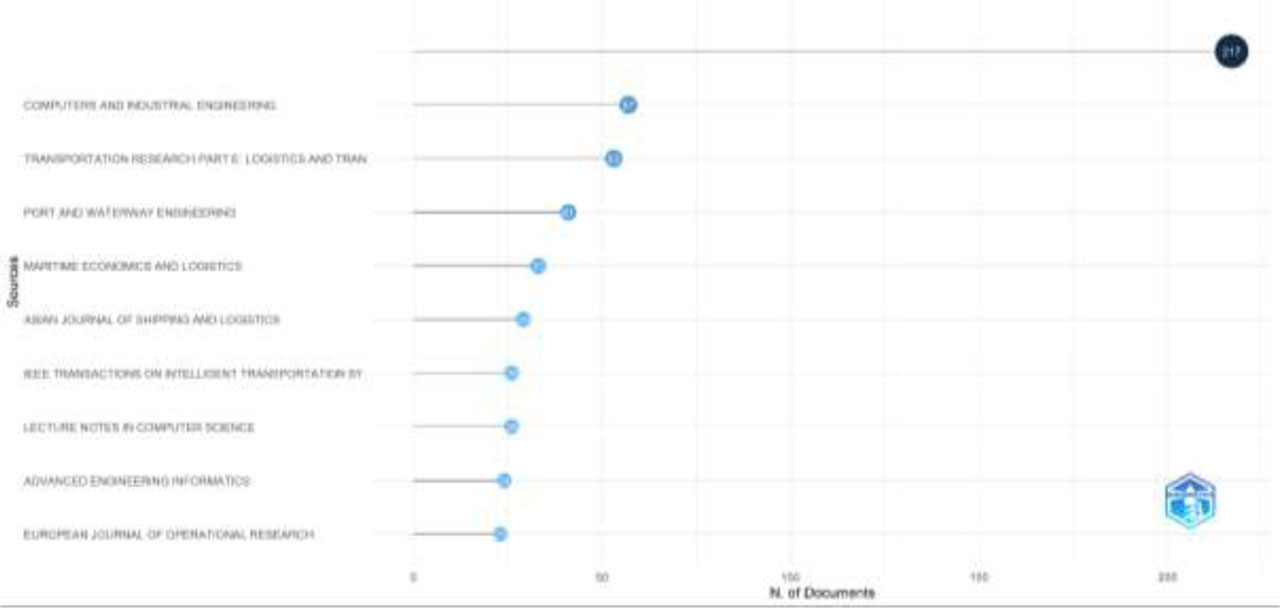
Figure 1.
Most Relevant Sources
Source: By author, (Scopus-based bibliometric analysis, 2015–2026).
Figure 1 gives us full details regarding the most relevant sources by highlighting the core journals that are dominating container terminal research, it also shows that the most productive journal accounts for a total of 217 publications.
The journal of Computers and Industrial Engineering has been ranked first with 57 documents, followed by the journal of Transportation Research Part E: Logistics and Transportation Review with 53 documents, the journal of Port and Waterway Engineering with 41 documents, the journal of Maritime Economics and Logistics with 33 documents, the Asian Journal of Shipping and Logistics with 29 documents, the journal of IEEE Transactions on Intelligent Transportation Systems with 26 documents, the journal of Lecture Notes in Computer Science with 26 documents, the journal of Advanced Engineering Informatics with 24 documents, the European Journal of Operational Research with 23 documents.
It seems that the journal of Computers and Industrial Engineering is leading the field of container terminal operations for many reasons, it publishes original contributions on the development of new computerized methodologies, as well as the applications of those methodologies to problems. The journal encourages submissions that expand the frontiers of the fundamental theories and concepts underlying industrial engineering techniques.
This important ranking can be explained also by the journal’s strong bibliometric indicators, including an SJR (2024) of 1.628, a Q1 quartile classification, an H-index of 176, coverage spanning from 1976 to 2025, a CiteScore of 13.2, and an Impact Factor of 6.5.
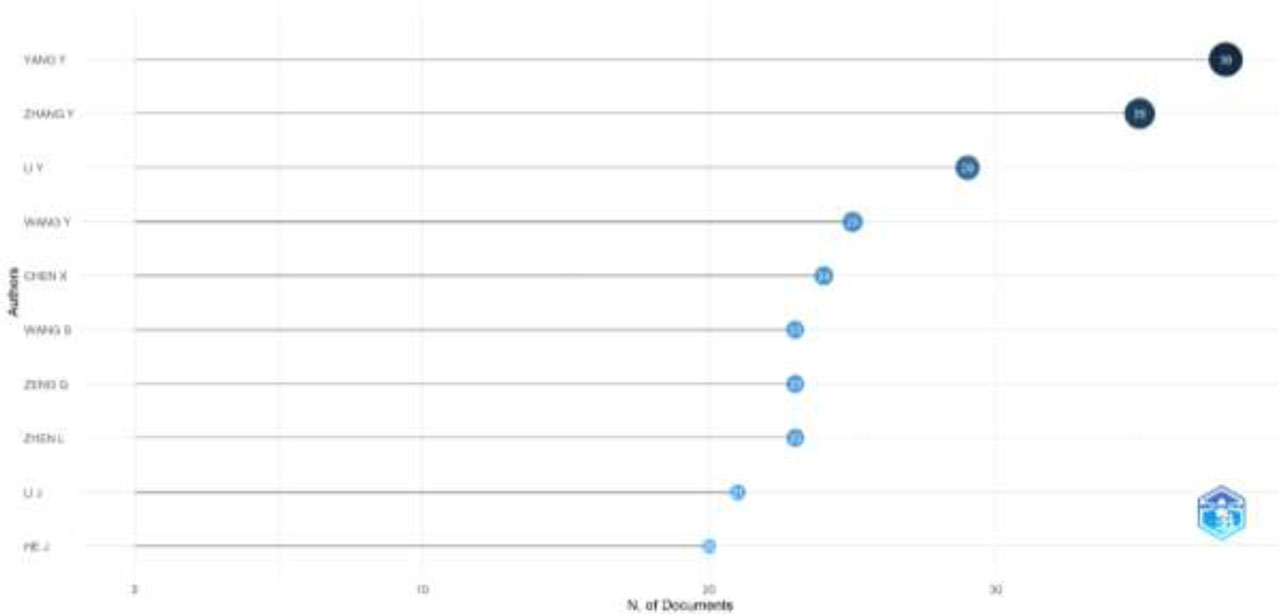
Figure 2.
Most Relevant Authors
Source: By author, (Scopus-based bibliometric analysis, 2015–2026).
Figure 1 gives us full details regarding the most relevant authors by identifying the highly productive authors that are mainly from East Asia.
It seems that Yang, Y. is the most relevant author with 38 documents, followed by Zhang, Y. with 35 documents, Li, Y., with 29 documents, Wang, Y. with 25 documents, Chen, X. with 24 documents, Wang, S., Zeng, Q., and Zhen, L. with 23 documents, Li, J. with 21 documents, and He, J. with 20 documents.
The prominence of authors such as Yang, Y., Zhang, Y., Li, Y., and Wang, Y. reflects the leading role of countries most notably China in advancing port automation and smart terminal development as part of their national maritime and logistics strategies.
Their high publication output aligns with sustained public investment in automated container terminals, large-scale pilot initiatives, and data-driven port management practices in major hubs such as Shanghai, Qingdao, Ningbo-Zhoushan, and Tianjin.
This concentration of research output indicates that academic production is closely linked to real world operational implementation, supported by strong collaboration between port authorities, terminal operators, and research institutions.
The presence of several highly productive authors with comparable publication volumes further suggests the existence of well-structured research networks, highlighting that leadership in port automation is driven by coordinated national innovation systems rather than isolated individual efforts.
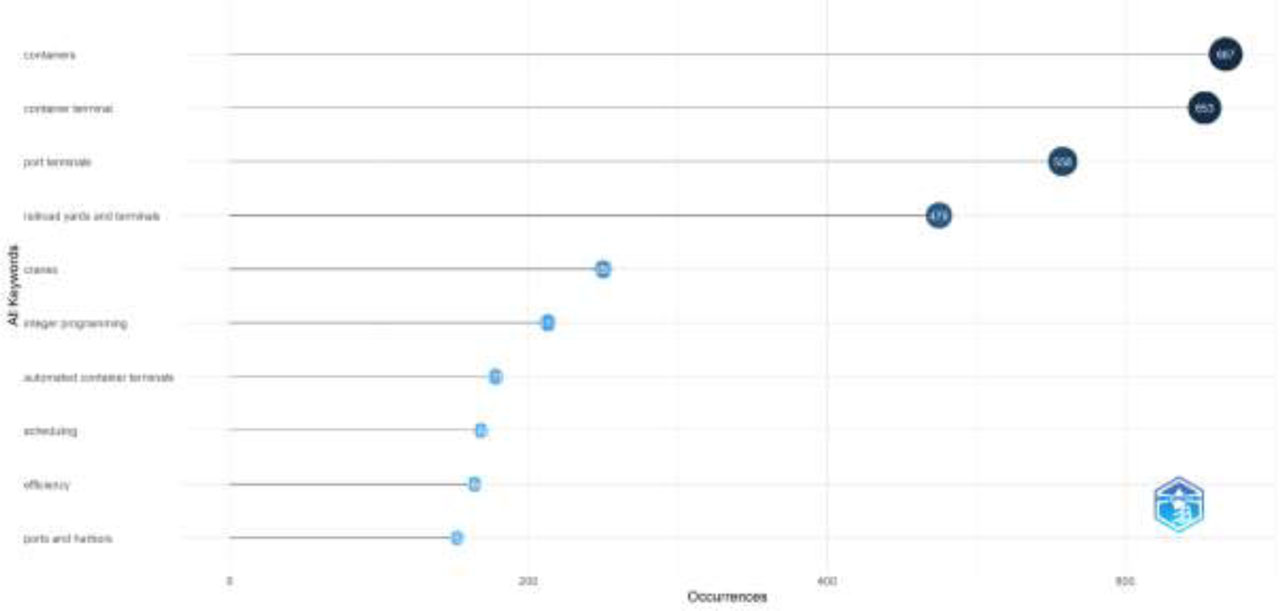
Figure 3.
Most Relevant Words
Source: By author, (Scopus-based bibliometric analysis, 2022–2026).
Figure 3 gives us an overview of the dominant keyword patterns in recent container terminal research. The distinction drawn between foundational terms (containers, container terminal, port terminals) and more analytical or methodological keywords (integer programming, automated container terminals, cranes, scheduling) is appropriate and helps clarify the conceptual versus operational orientation of the literature. This differentiation demonstrates that recent research is moving beyond descriptive port studies toward data-driven and optimization-focused approaches.
This shift is driven by key changes in modern container terminals. Higher operational complexity, capacity constraints, larger vessels, and pressure to reduce turnaround times have increased the need for advanced analytical tools and automation technologies. Consequently, researchers rely more on optimization models, decision-support systems, and automation-based solutions to address real-time operational challenges. The growing presence of analytical and automation-related keywords reflects a direct response to these evolving operational conditions
The link between dominant keywords and performance dimensions reinforces the performance-oriented nature of the analysis. Analytical methods and automation technologies enable the transformation of infrastructure and equipment into measurable performance gains, including higher productivity, improved efficiency, increased throughput, and reduced vessel and container dwell times.
The strong emphasis on technical and efficiency-related keywords also indicates a mainly technocentric research focus. While short- and medium-term operational optimization dominates the literature, broader issues such as governance, institutional frameworks, sustainability, and human-centered aspects receive less attention. This imbalance highlights a gap and points to the need for more integrated research approaches.
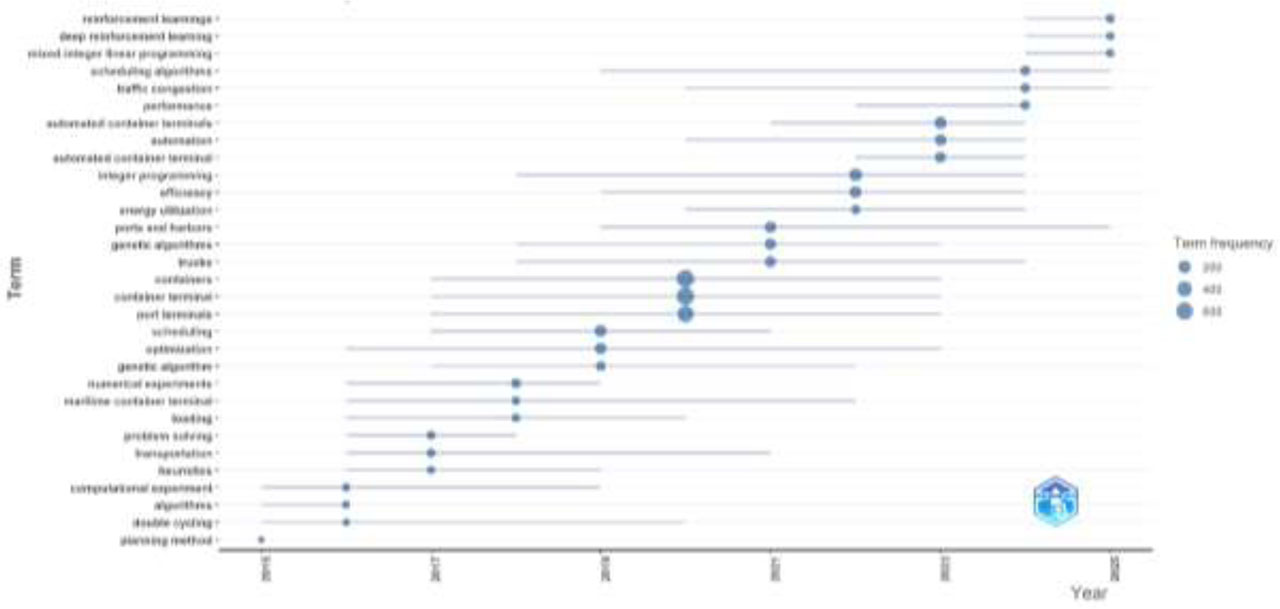
Figure 4.
Trend Topics
Source: By author, (Scopus-based bibliometric analysis, 2022–2026).
Figure 7 gives us full details regarding the evolution of research topics in container terminal studies over time. Early research mainly focused on general operational issues such as planning methods, algorithms, heuristics, transportation, and problem-solving. These topics reflect an initial emphasis on basic optimization and operational planning.
From the mid-period onward, research increasingly shifted toward container terminal–specific themes, including scheduling, optimization, container terminals, ports and harbors, and efficiency. This change indicates a stronger focus on terminal operations and performance improvement.
In recent years, advanced and technology-driven topics have become more prominent. Keywords such as automation, automated container terminals, integer and mixed-integer programming, reinforcement learning, and deep reinforcement learning show a clear move toward intelligent, data-driven, and real-time decision-making approaches. This trend reflects the growing complexity of terminal operations and the need for advanced tools to manage congestion, resource allocation, and performance.
The figure highlights a clear progression from traditional operational methods to advanced analytical and automation-based approaches. This evolution supports the study’s focus on automation, connectivity, and collaboration as key drivers of modern container terminal performance.
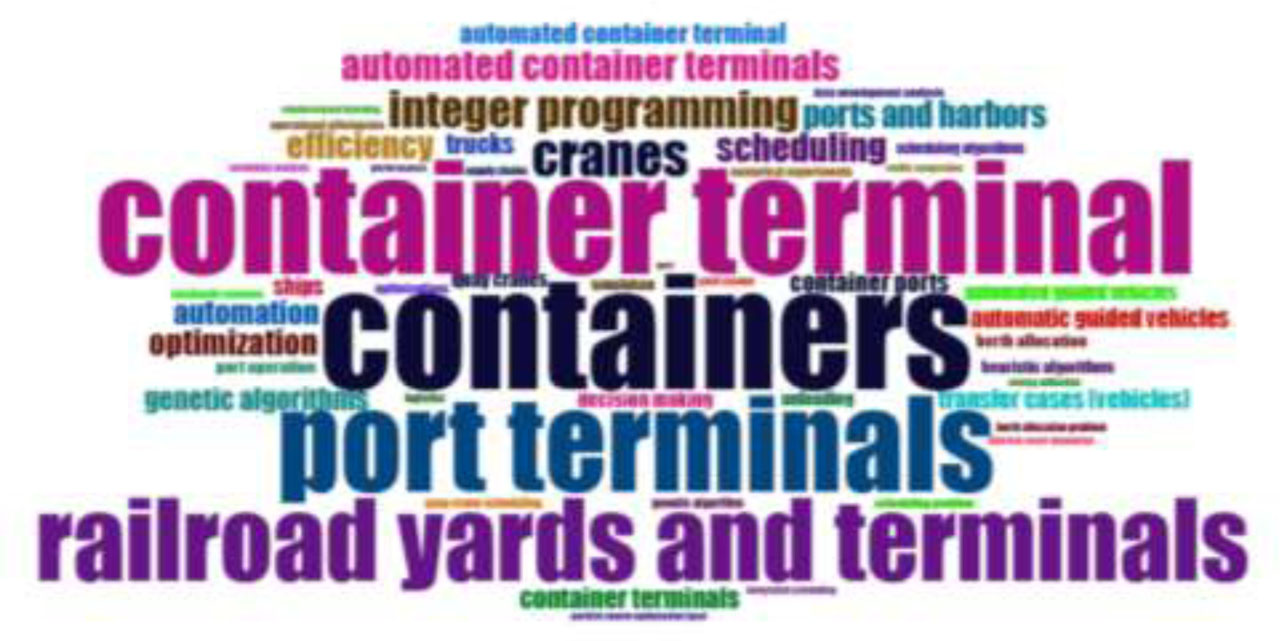
Figure 5.
Word Cloud
Source: By author, (Scopus-based bibliometric analysis, 2022–2026).
Figure 5 illustrates a word cloud constructed from the most frequently used author keywords in the dataset. The size of each word represents how often it appears in the literature, allowing us to quickly identify the main concepts that dominate research on container terminal operations.
The visualization shows that terms such as “container terminal,” “containers,” “port terminals,” and “railroad yards and terminals” occupy the most prominent positions. Their visibility highlights the strong operational and infrastructure focus of the field. In most studies, container terminals are examined as complex logistics systems that require the coordination of maritime transport, yard operations, and land transportation activities.
Beyond these core concepts, the word cloud also reveals the strong presence of analytical and optimization-related terms, including “integer programming,” “scheduling,” “optimization,” “genetic algorithms,” and “heuristic algorithms.” The prominence of these keywords indicates that a large share of the literature concentrates on solving operational decision-making problems such as quay crane scheduling, yard space allocation, and container flow optimization. This pattern confirms the important role played by operations research methods and computational optimization techniques in container terminal research.
The figure also highlights several technology-oriented keywords, such as “automated container terminals,” “automation,” “automated guided vehicles,” and “transfer cranes.” The increasing presence of these terms reflects the growing interest in port automation and intelligent terminal systems designed to improve operational efficiency, reduce vessel turnaround times, and enhance the utilization of terminal resources.
It should be noted that this word cloud suggests that the intellectual structure of container terminal research remains largely technology-driven and operations-focused, with a strong emphasis on optimization methods and automation technologies. In comparison, topics related to management, governance, and sustainability appear less frequently, indicating potential research opportunities to explore the strategic and institutional dimensions of container port systems.
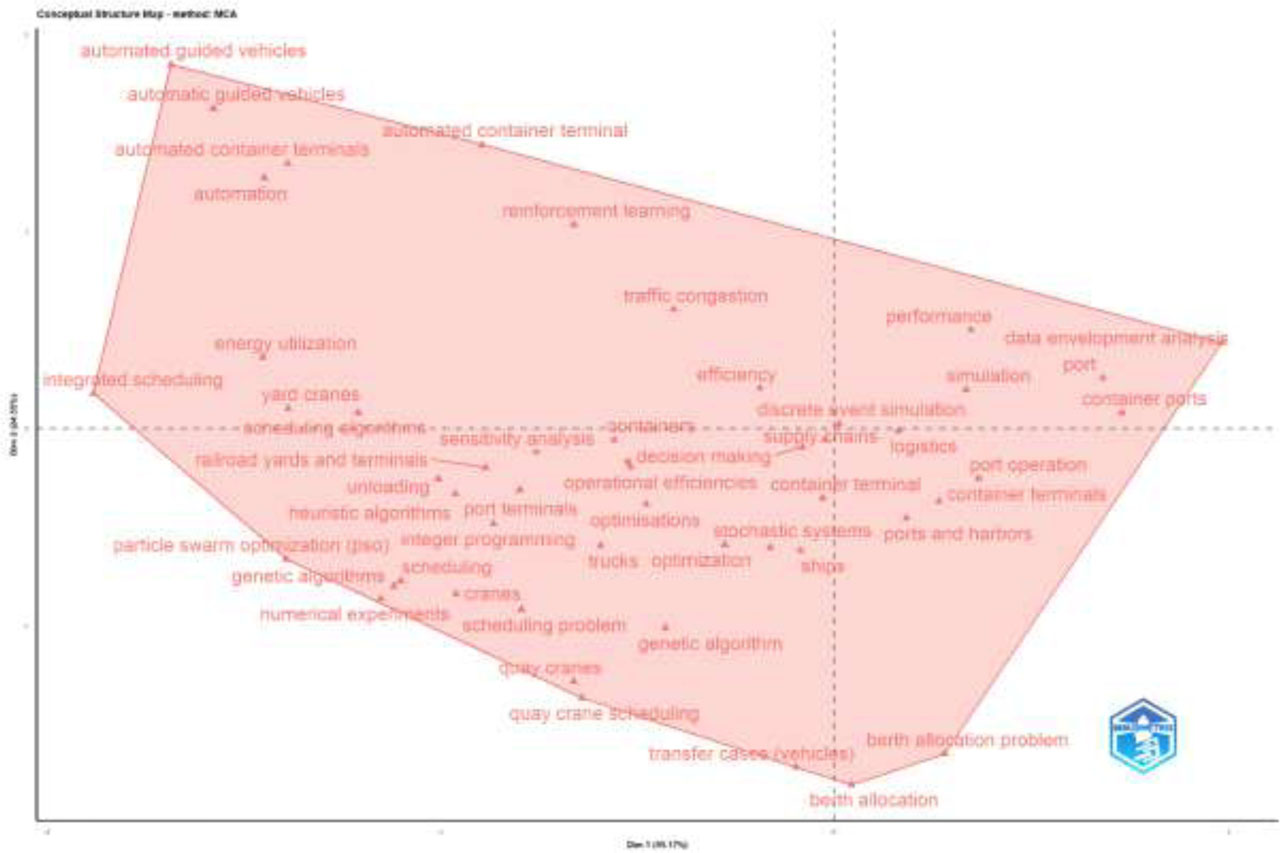
Figure 6.
Conceptual Structure Map – Method: MCA
Source: By author, (Scopus-based bibliometric analysis, 2022–2026).
Figure 6 presents the conceptual structure map generated using Multiple Correspondence Analysis (MCA), which allows the identification of the main thematic relationships within the container terminal research landscape
The map reveals a clear differentiation between two dominant conceptual orientations in the literature. On the left side of the figure, a cluster of keywords is primarily associated with automation technologies and algorithmic optimization methods. Terms such as automated container terminals, automation, automated guided vehicles, reinforcement learning, genetic algorithms, and heuristic algorithms appear closely connected. This grouping reflects the strong influence of computational intelligence and optimization techniques in addressing complex operational challenges in container terminals, particularly those related to scheduling, resource allocation, and operational coordination.
In contrast, the right side of the map is characterized by keywords associated with operational performance and port system management. Concepts such as performance, data envelopment analysis, simulation, port operation, logistics, and container ports indicate a research stream focused on evaluating terminal efficiency and system-level performance. This cluster highlights the growing use of performance evaluation models and simulation approaches to assess operational effectiveness and support decision-making in port management.
The central area of the map contains keywords such as containers, decision making, operational efficiency, optimization, and supply chains. Their intermediate position suggests that these topics serve as conceptual bridges linking the two main research orientations. They represent the operational core of container terminal studies, where technological solutions and managerial performance considerations intersect.
Another notable element of the figure is the presence of specialized operational problems, including quay crane scheduling, berth allocation, and transfer vehicles, located toward the lower part of the map. These topics represent well-established operational research problems that continue to receive significant scholarly attention due to their direct impact on terminal productivity and vessel turnaround times.
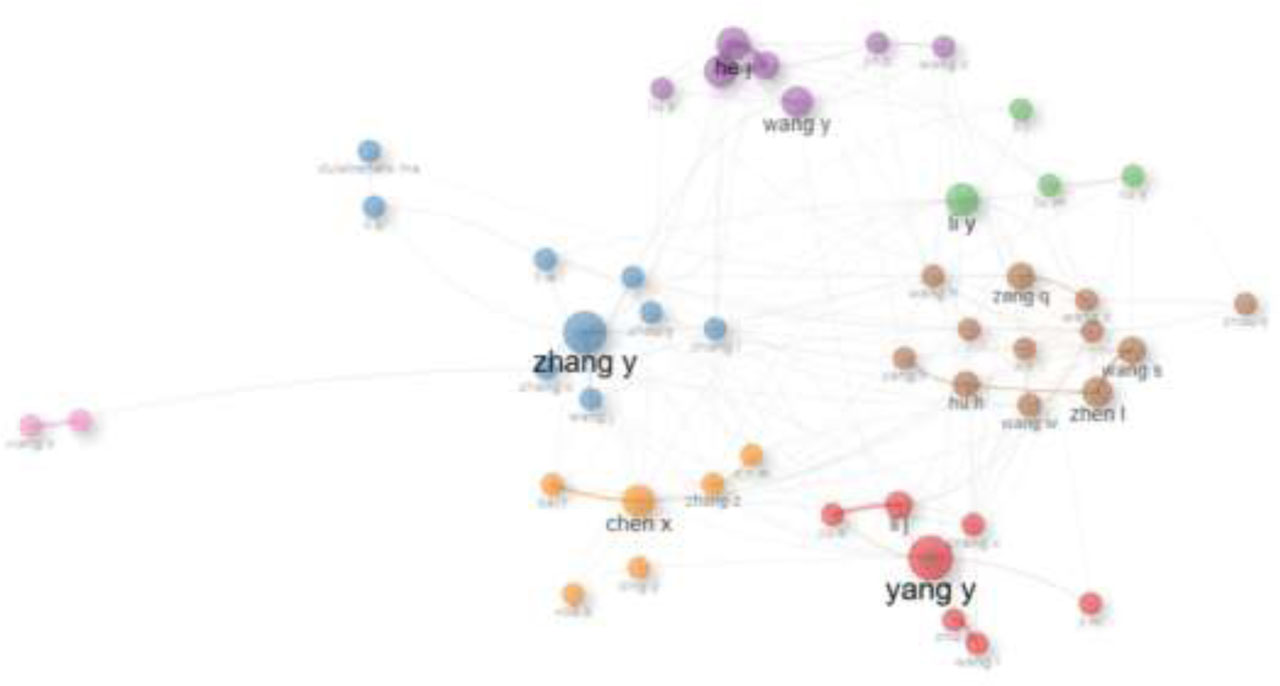
Figure 7.
Collaboration Network
Source: By author, (Scopus-based bibliometric analysis, 2022–2026).
Figure 7 illustrates the collaboration network among authors in container terminal research, providing insights into the social structure and knowledge production dynamics of the field.
The network reveals the presence of several well-defined collaboration clusters, indicating that research activity is organized around structured groups of authors rather than isolated individual contributions. Prominent nodes such as Zhang Y., Yang Y., Zhen L., and Wang Y. occupy central positions within the network, reflecting their strong influence and high level of connectivity. Their centrality suggests that these authors act as key knowledge hubs, facilitating the diffusion of ideas and contributing significantly to the development of the field.
A closer examination of the network structure highlights a high density of connections within clusters, particularly among authors affiliated with East Asian institutions. This confirms that scientific production in container terminal research is strongly concentrated within specific regional innovation systems, where collaboration between universities, research centers, and port authorities is well established. Such tightly connected clusters indicate efficient knowledge exchange at the local level and reflect the alignment between academic research and large-scale implementation of smart port technologies.
However, the network also reveals a relatively limited level of inter-cluster connectivity. While strong collaborations exist within groups, links between different clusters appear less dense, suggesting a degree of fragmentation in the global research landscape. This structural pattern indicates that knowledge circulation remains partially localized, with limited integration across different research communities and geographical regions.
From a critical perspective, this fragmentation raises important concerns regarding the interdisciplinarity and global diffusion of knowledge. Given the inherently global nature of maritime logistics, the observed collaboration structure may constrain the development of universally applicable models and limit the exchange of diverse methodological and contextual perspectives. In particular, the dominance of a few central clusters may reinforce intellectual concentration, where research agendas are shaped by a limited number of influential groups.
Furthermore, the network structure suggests that collaboration is predominantly oriented toward technically focused research domains, with limited evidence of cross-disciplinary interaction involving management, policy, or sustainability-oriented scholars. This reinforces the broader finding of a technocentric bias in the field and highlights the need for more inclusive and interdisciplinary collaboration frameworks.
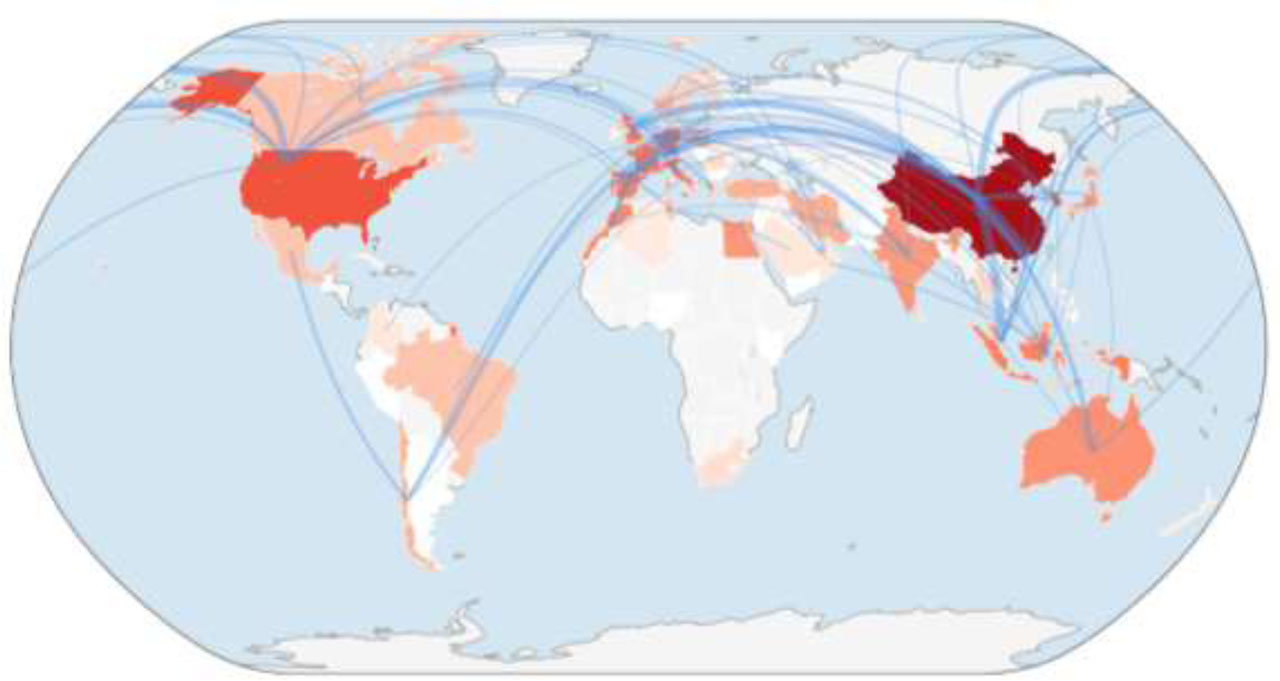
Figure 8.
Countries Collaboration
Source: By author, (Scopus-based bibliometric analysis, 2022–2026).
Figure 8 presents the global collaboration network among countries in container terminal research, offering a macro-level perspective on the geographical distribution and international connectivity of scientific production in the field.
The map clearly shows that research activity is highly concentrated in a limited number of leading countries, with China emerging as the dominant contributor, followed by the United States and several European nations. The intensity of the color distribution indicates that these countries account for the largest share of publications, confirming a strong geographical concentration of knowledge production. This pattern reflects the strategic importance of container ports in these regions, as well as sustained investments in port infrastructure, digitalization, and automation technologies.
In terms of collaboration flows, the network highlights dense and well-established connections between major research hubs, particularly across Asia, Europe, and North America. China appears as a central node within the global network, maintaining strong collaborative ties with both developed and emerging economies. These connections suggest an active exchange of knowledge and a high level of international engagement, especially in technologically advanced research areas related to automation and intelligent port systems.
However, a closer examination reveals a clear asymmetry in global collaboration patterns. While leading countries are highly interconnected, large parts of Africa, Latin America, and some regions of the Middle East remain weakly represented or marginally integrated into the global research network. This uneven distribution indicates that scientific collaboration in container terminal research is not globally balanced, but rather concentrated within a limited set of economically and technologically advanced regions.
From a critical perspective, this geographical imbalance raises important concerns regarding inclusivity, knowledge diffusion, and contextual diversity. The dominance of a few countries may lead to a concentration of research agendas, where priorities are shaped by the needs and capabilities of highly automated port systems. As a result, the specific challenges faced by developing ports such as infrastructure limitations, institutional constraints, and hybrid operational models may remain underexplored in the literature.
Moreover, the structure of international collaboration suggests that partnerships are primarily driven by technological and engineering-oriented research, with limited integration of policy, governance, and socioeconomic perspectives across regions. This reinforces the broader finding of a technocentric orientation in the field and highlights the need for more globally inclusive and interdisciplinary research collaborations.
4. Discussion
The results reveal a clear and consistent dominance of engineering and operations research journals, such as Computers and Industrial Engineering and Transportation Research Part E. This confirms not only the methodological orientation of the field but also the dominance of an engineering paradigm in structuring scientific production (Dragović et al., 2020); Weerasinghe et al., 2024). Across the dataset, container terminal research appears heavily anchored in quantitative optimization approaches, reflecting a form of methodological concentration that prioritizes efficiency-driven problem solving (Steenken et al., 2004; Stahlbock & Voß, 2008). While this has enabled significant advances in operational performance, it also suggests a form of methodological myopia, where alternative perspectives particularly managerial and socio-organizational dimensions remain underexplored.
The study identifies a significant structural shift in the literature around 2020. Prior to this period, research mainly focused on classical optimization techniques and general operational planning problems (Bierwirth & Meisel, 2010; Gharehgozli et al., 2016). However, recent years have been characterized by the rapid emergence of advanced technologies, including automation systems, intelligent optimization, and artificial intelligence-based approaches such as reinforcement learning (Grafelmann & Jahn, 2023; Zheng et al., 2022). The dataset clearly shows an increasing prevalence of these topics, confirming a transition toward data-driven and algorithmically intensive research (Raeesi et al., 2023). While this shift reflects the growing complexity of terminal operations and the need for real-time decision-making, it also raises a critical question: to what extent is the field becoming overly technology-driven? The increasing reliance on advanced computational models may unintentionally marginalize broader strategic, institutional, and human-centered considerations.
Despite this technological progress, the results highlight a persistent and structural imbalance in the literature. Across the 1,529 publications analyzed, research addressing governance, sustainability, and human-centered management remains marginal compared to the dominance of automation and optimization studies. This indicates not simply a gap, but a systematic underrepresentation of key dimensions necessary for understanding port systems as complex socio-technical environments (Puertos del Estado, 2024). From a theoretical perspective, this suggests that the field remains insufficiently integrated within broader socio-technical and interdisciplinary frameworks (Geels, 2004). As a consequence, many proposed models risk lacking external validity, as they are developed under idealized assumptions that overlook institutional constraints, stakeholder interactions, and organizational realities.
The conceptual structure analysis further reinforces this diagnosis by revealing the coexistence of two relatively disconnected research streams. On one hand, a technology-driven stream focuses on automation, algorithms, and computational optimization. On the other hand, a performance-oriented stream emphasizes efficiency measurement, simulation, and operational evaluation (Dragović et al., 2017; Böse, 2020). The limited integration between these streams highlights a fragmented intellectual structure, where technological innovation is not sufficiently linked to strategic performance management. This fragmentation is problematic, as it constrains the development of holistic models capable of capturing the full complexity of container terminal systems, where technical efficiency, organizational processes, and governance mechanisms are deeply interconnected.
Another important insight concerns the geographical concentration of research output. The dataset clearly shows the prominence of authors affiliated with East Asian institutions, reflecting the leading role of countries such as China in advancing automated and smart port systems (Liu et al., 2024). China currently operates 18 fully automated container terminals with 27 more under construction or renovation, accounting for the largest share of automated terminal infrastructure worldwide. While this concentration is associated with strong innovation ecosystems and large-scale infrastructure investments, it also introduces a contextual bias in the literature. Many studies are based on highly automated terminals, which limits the generalizability of findings to ports operating under different technological and institutional conditions. This raises important concerns regarding the transferability of existing models, particularly for developing regions where hybrid or semi-automated systems remain dominant.
Furthermore, although the analysis of collaboration networks indicates the presence of structured research communities, the level of interdisciplinary integration remains limited. Given that container terminals operate as complex socio-technical systems, the current fragmentation between engineering, management, and policy-oriented research reduces the explanatory power and practical relevance of the field (Lau et al., 2017; Bai et al., 2021). Strengthening cross-disciplinary collaboration is therefore essential for advancing more comprehensive and applicable research frameworks (Raeesi et al., 2023).
Finally, the results confirm that container terminal research is strongly performance-oriented, with a predominant focus on quantitative indicators such as crane productivity, throughput, and turnaround time. While these metrics are essential, their dominance reflects a narrow definition of performance centered on operational efficiency. Broader dimensions such as resilience, adaptability, environmental sustainability, and social impact remain underexplored (World Bank, 2024). This limitation is particularly critical in the context of increasing global supply chain disruptions and sustainability pressures (Lücker et al., 2025; Caniato et al., 2025), where performance can no longer be reduced to purely operational metrics (Jiang et al., 2025; Frontiers in Sustainability, 2025).
4. Conclusion
This study provides a comprehensive bibliometric analysis of container terminal research, offering a structured understanding of its intellectual evolution, thematic orientation, and collaboration patterns. Based on a dataset of 1,529 publications indexed in Scopus between 2015 and 2026, the findings clearly demonstrate that the field has undergone a significant transformation, shifting from traditional operational planning and heuristic-based approaches toward data-driven, automation-oriented, and algorithmically intensive research.
The results confirm the dominance of engineering and optimization paradigms, with a strong emphasis on efficiency, scheduling, and computational modeling. At the same time, the analysis reveals a persistent structural imbalance, where research on governance, sustainability, and human centered management remains significantly underrepresented. The conceptual structure further highlights a fragmented knowledge landscape, characterized by limited integration between technological innovation and performance management perspectives. In addition, the geographical and collaboration analyses show a high concentration of research output in specific regions, particularly East Asia, raising concerns about contextual bias and the generalizability of existing findings.
By addressing the research objective, this study contributes to the literature by moving beyond descriptive bibliometric mapping and providing a critical diagnosis of the field. It highlights not only the dominant research trajectories but also the neglected dimensions that limit the development of holistic and practically applicable models of container terminal performance. In this sense, the study reinforces the need to conceptualize container terminals as complex socio-technical systems, where technological, organizational, and institutional factors must be jointly considered.
Despite its contributions, this study is subject to several limitations. First, the analysis is based exclusively on the Scopus database, which, although comprehensive, may not capture all relevant publications indexed in other databases such as Web of Science or regional repositories. Second, the study relies on bibliometric techniques, which primarily analyze metadata (keywords, authors, citations) and may not fully capture the depth and contextual nuances of individual studies. Third, the focus on the 2015–2026 period, while appropriate for capturing recent trends, may overlook earlier foundational contributions that have shaped the field.
In light of these limitations, several directions for future research emerge (Zakaria Elkharmali, Ouail El Kharraz, and all,. 2026). First, future studies should adopt mixed-method approaches combining bibliometric analysis with systematic literature reviews or qualitative content analysis to provide deeper insights into theoretical and methodological developments. Second, there is a need to expand research toward underexplored dimensions, particularly governance models, sustainability strategies, and human factors, in order to develop more balanced and interdisciplinary frameworks. Third, comparative and context-sensitive studies should be encouraged to better understand the applicability of existing models across different types of ports, especially in developing and emerging economies.
From a practical perspective, the findings suggest that port authorities, terminal operators, and policymakers should not rely solely on technological solutions to enhance performance. Instead, they should adopt integrated strategies that combine automation with effective governance, stakeholder coordination, and sustainability considerations. Strengthening international and interdisciplinary collaboration is also essential to ensure more inclusive and globally relevant knowledge production.