
1. Introduction
The issues of public value of research and non-academic benefits are of increasing importance in the contemporary world of science. Reliable estimates of the social impact of planned research are increasingly required by funding agencies, which recognize the need to demonstrate exemplary impacts, outputs, and outcomes, such as the development of new technologies, the improvement of diagnostic tools, medications, and public values and policies that contribute to society (Lane, 2009). In particular, research universities should demonstrate the ability to make scientific discoveries and create innovations that benefit the public good (Owen-Smith, 2020).
Different types of organizations form and transform social values and conditions. They are both the driving forces behind creating value for society and the results of the environment in which they operate (Lindgreen et al., 2019). Despite the many differences between universities and business organizations, they share a common sense of operation, which is to provide a good that is useful to society. Already in classical approaches, the justification for the existence of enterprises is to provide good for society (Drucker, 2008).
Demonstrating the benefits to society is particularly important for scientific organizations that receive public funding. Research universities so funded usually demonstrate significant benefits to society in terms of both research impact and educational activities. However, this is not always the case, and organizations funded by private sponsors also recognize the importance of the effects that can be observed in their environment. However, the need for analyses of the political and social impact achieved is particularly noticeable to decision-makers responsible for allocating public funds for research. The benefits resulting from scientific research that are visible to external stakeholders concern ‘improving society’ and ‘making a positive change’ in various areas, such as the environment, society, economy, quality of life, culture, and health (Samuel & Derrick, 2015).
In connection with the requirements for applications for public funding of scientific research projects, applicants are required to demonstrate the ability to obtain results that go beyond the state of knowledge and to achieve benefits from research that are related to scientific excellence and positive research impact from the point of view of the public at large. Modern research teams should recognize that introducing methodological innovations is one of the effective ways to obtain or increase existing social impact, and also facilitates the implementation of its monitoring and ongoing evaluation processes.
The use of innovative solutions in research processes can effectively enrich the obtained results, support the creation of new knowledge and its exchange with the environment. It is particularly important to notice the opportunities resulting from the use of new transformative innovations with significant potential to drive the technological revolution, as well as economic growth and productivity. Artificial intelligence is currently the driving force of many introduced methodological innovations. The currently dynamic development of artificial intelligence technology can generate a radical change in the current paradigms and accelerate the generation of further innovations or at least transformation within the digital ICT technological paradigm (Damioli et al., 2025).
The aim of this paper is to identify the current main methodological trends and to determine the factors that influence the adoption of responsible methodological innovations based on AI, in order to streamline advanced scientific research to enhance the public value of research, increase the efficiency of scientific research, and improve the working environment in research organizations. The study uses observations of management processes and evaluation of research projects, quantitative literature research methods, qualitative and in-depth analysis of selected publications. Responsibility of innovation is expressed in such a way of selecting and using research methods in scientific research that they not only bring an extension of knowledge, but also real public value of research and benefits for society measured by adopted measures of societal impact. This research builds upon previous studies on the importance of methodological innovations in enhancing the social impact of scientific research (Grzeszczyk, 2025). Research on social impact provides a concrete foundation for analyzing broader questions about the public value of research - a concept that is inherently more complex to define and measure.
As a result of the research, the determinants of AI-based methodological innovations that drive the creation of social compatibility and public value of scientific research have been identified. This creates opportunities to improve the processes of planning and implementing research in terms of building methodological foundations that support increasing research innovation, obtaining results that go beyond the state of knowledge, and improving the public value of research. Conclusions were also formulated regarding the effective planning and implementation of research characterized by significant public values and compatibility between science and society.
2. Public Value of Research
Scientific achievements have an impact on almost all aspects of human functioning, which is particularly visible during breakthrough events such as the coronavirus pandemic, during which scientific achievements shape public debates, influence government decisions and the functioning of entire societies. Attempts are even being made to build comprehensive models that allow us to learn how to effectively drive knowledge and science, in an interdisciplinary perspective, within the integrated field of the science of science covering many scientific subfields (Krauss, 2024). Comprehensive research in this interdisciplinary field allows for the useful exploration of reproducible patterns of scientific careers, mechanisms of productivity and creativity, and roots of scientific impact (Wang & Barabási, 2021).
Higher education institutions are under great pressure from governments to be sources of public value of research, which can play a significant role in supporting social, economic and environmental progress by providing new knowledge, responsible innovations and technology transfer processes. The benefits associated with scientific research conducted within the humanities and social sciences have until recently been relatively difficult to quantify. It is possible to define the public value by referring to the inherent principle and purpose of those concerning the public good, which in turn is related to at least three meanings of the term ‘value’, i.e. use value (utility and usefulness), price value (worth and quality), and normative value (evaluation and judgement) (Brewer, 2013). The key problem is the search for a reasonable public value and desired research impact, but there are real threats of politicisation of research priorities due to centrally implemented national evaluation systems (Broadhurst, 2015).
The conduct of research should demonstrate that the research is valuable to society and has broad benefits beyond academia (excluding the extension of academic knowledge), i.e., for individuals, groups in different geographical locations or society as a whole. Such socio-economic benefits may concern quality of life, health care services, public policy, culture, etc. It is the duty of public higher education institutions to demonstrate responsible performance of scientific work that is intended to solve complex problems useful for the public good.
It is necessary to plan and forecast the public value and social utility of research results, regardless of the type of scientific discipline, already at the stage of formulating the research concept and developing applications for research funding. Potential benefits should be estimated in the context of possible research beneficiaries. It is worth relying on interdisciplinary approaches, looking for AI-based methodological innovations, building relationships with various stakeholder groups, with particular emphasis on external target groups. Stakeholders should accept the designed and applied measures of wider short and longer-term impacts. With the help of research impact, the public value of study becomes visible (Watermeyer, 2012). The term “broader impacts” is used to refer to one of the most important criteria concerning the contribution of scientific study toward societal goals, which is required for public research grants funded by US National Science Foundation initiatives (Bozeman & Youtie, 2017).
Academic researchers and institutions are increasingly interested in the public perception of higher education research outcomes, in the context of various effects on countries, and benefits for individuals, societies, and economies. It is not easy to understand the essence of social benefits resulting from research, because the traditional understanding of research quality is different from approaches related to the public value of research and the impact of research, and therefore separate criteria and methods of assessment are introduced for these two different areas. Interest in conducting research that brings benefits to society is shown by academics, institutions employing them, as well as policy makers and organizations funding research activities. Such organizations exert pressure to demonstrate evidence-based research impact and to measure the public value of research in the context of delayed social benefits. Bibliometric analyses and research results presented in scientific publications are of little use in this respect, which are important for building prestige and imaging scientific quality, which plays a role rather only in the scientific community. Dissemination of research results at conferences and in scientific publications can only be associated with social impact to a small extent.
The utility of scientific research for society is easier to quantitatively demonstrate for research conducted within the disciplines of science, technology, engineering, and mathematics (STEM) compared to social sciences and humanities. Among the indicators can be found e.g. revenues obtained from commercialization of research results or from the sale of licenses, the number of patents, case studies of technological solutions used in practice. It is more difficult to select objectively verifiable indicators for the disciplines of social sciences and humanities (SSH) and in their case, it is primarily based on qualitative criteria and expert methods. It is advisable to conduct scientific performance assessments in accordance with adaptive and contextualized approaches, which can replace the less useful quantitative indicators related to bibliometric studies (Robinson-Garcia et al., 2023).
In order to facilitate the process of ranking research universities and the allocation of public research funds, national evaluation systems are being developed, among which the British framework has a long tradition, which analyses case studies of knowledge transfer between academic and non-academic stakeholders (Fenby-Hulse et al., 2019). Such systems are based on the general principles of academic policy developed over the years within the framework of neoliberal government agendas and the principles of the Research Excellence Framework (REF) and also related to other areas of university activity, such as the Teaching Excellence Framework (TEF) (McKay, 2025).
National evaluation systems are designed to facilitate the implementation of knowledge exchange systems as a result of efficient and effective spending of public funding. Among the more important indicators, reported within the REF and other similar frameworks, are those related to the social impact of research. One of the possibilities of obtaining or increasing such impact is to perceive opportunities in the appropriate direction of the selection of methodological approaches. Their appropriate selection can help to raise the level of research quality and increase the involvement of external stakeholders and social influence.
In various countries, national systems are being developed to support scientific performance and build research capacity through improving university research management. Paying attention to the aspects of efficient management of public research projects can be helpful in meeting the complex challenges associated with conducting interdisciplinary activities by diverse teams interested in obtaining high-quality research and positive social impact. It turns out that sometimes too little attention is paid to the appropriate selection of methodological approaches and research management practices (Bahtilla & Huang, 2024). Effectively obtaining good quality research results and the associated public value requires appropriate attention to innovative research management and the appropriate selection of methodological approaches that take into account existing achievements related to AI technologies.
3. Research Methodology
The adopted research methodology results from the recognition of the need and possibility of designing assumptions and useful factors for the implementation of responsible methodological innovations, which can be selected primarily in terms of the possibility of monitoring and ongoing assessment of social impact during the course of scientific research, which aims to continuously increase social impact and, as a result, ensure a satisfactory public value of research. This choice of research scope is justified by the potential to enhance the achieved impact through responsible innovations based on AI. The general research problem is the permanent improvement of conducted scientific research aimed at increasing the societal impact, and the process of continuous improvement may consist in the use of selected AI technologies.
Defining the general problem opens up a wide research space and in order to specify it, the following research questions were formulated.
How should AI technologies be used to ensure the greatest possible public value and social impact of scientific research observed already at the stage of research implementation?
How can the existence of a link between the responsible use of AI technologies and achieving increased social impact (compared to the lack of appropriate use of AI methods) be justified?
How can responsible innovative AI solutions contribute to increasing the expected social impact to be achieved after the completion of research implementation?
What AI technologies in particular are useful for strengthening the social impact associated with scientific research results?
The following research methods were planned to be used: observations of selected management and evaluation processes of research projects, literature research, quantitative literature research methods, qualitative and in-depth analysis of selected publications, which were focused on identifying the determinants of increasing the social impact of scientific research by introducing responsible methodological innovations based on modern computing technologies, in particular AI technology. The obtained research results are to allow for the formulation of conclusions regarding the improvement of research planning and implementation processes, as well as supporting monitoring, ongoing evaluation and estimation of the future value of societal impact.
Scopus abstract and citation database was selected as a source of quantitative bibliometric data, which contains a lot of information related to the social sciences. Based on data obtained from the Scopus database, a time series of publication numbers related to selected keywords and conclusions from quantitative analyses were presented.
When developing the assumptions of the literature research, inspiration was drawn from the PRISMA method (Preferred Reporting Items for Systematic Reviews and Meta-Analyses), which is considered a useful method for conducting analysis in various fields, including social sciences and management studies (Mishra & Mishra, 2023).
The following research program was adopted:
1) defining the problem, scope of research, and research questions,
2) initial selection of quantitative search criteria,
3) specifying search parameters,
4) preparing data for in-depth qualitative analyses,
5) qualitative analysis of relationships between keywords.
The research results became the basis for discussion and formulation of conclusions, in particular regarding the determinants of increasing the social impact of scientific research through the introduction of responsible methodological innovations based on selected AI technologies.
4. Results and Discussion
It was assumed that in the literature analysis, it is worthwhile to combine keywords that refer to the use of AI-based, responsible methodological innovations that can enhance the public value of research and the social impact of study. This is consistent with the understanding of enhancing the implementation of responsible research and innovation frameworks in scientific programs financed from public funds (e.g., Horizon Europe), impact-oriented research assessment, and science policy and ethics discourse. The result of such research can be a generalized reflection on the social determinants of AI-based methodological innovations that drive the creation of social compliance and public value of scientific research. This creates the basis for identifying the mechanisms of selecting research methods (in accordance with the concept of responsible methodologies) and designing responsible research innovation that influence the outcomes for society – expressed by public value and social impact of study. Societal impact has a more practically measurable dimension, and is related to the public value of research, which has a broader meaning and context.
Three problem areas were taken into account: artificial intelligence, responsible research methodologies (related to achieving the public value of research), and social impact.
In the first area the following keywords were used: “machine learning”, “neural networks”, “artificial intelligence”, “AI”, “knowledge engineering”, “expert systems”, “knowledge-based systems”, “deep learning”, “AI-based”, “data-driven”, “predictive analytics”, “large language models”, “natural language processing”, “NLP”.
In the second area, the following keywords were included: “responsible research”, “responsible innovation”, “responsible methodologies”, “methodological innovation”, “public value of research”, “research methodology”, “research design”, “participatory research”, “stakeholder engagement”, “citizen science”, “knowledge co-creation”.
For the third area the following were used: “research impact”, “social outcome”, “social contribution”, “social value”, “social impact”, “societal impact”, “social benefit”, “public engagement”, “policy impact”.
The search parameters were specified as follows:
1) search within titles, keywords and abstracts of publications,
2) limitation to articles in journals, book chapters and conference papers,
3) publications in English,
4) publication period 2014–2024 (research was conducted in May 2025),
5) subject areas: social sciences, decision sciences, business, management and accounting, multidisciplinary.
43 publications were found for the selected search parameters, and the time series of annual numbers of publications are presented in Figure 1, which shows moderate interest in the past and a significant increase in research related to this issue since 2021. This can be justified by the recent development of key technological innovations and efficient AI models, which have begun to find increasingly interesting applications. Figure 2 presents the number of selected publications by country. The largest number of publications is affiliated with institutions in the United States (13), United Kingdom (8), India (6), Canada (4) and France (4). In the first two countries, there are advanced national systems for evaluating the performance of higher education institutions. In the remaining countries, there is also a large or rapidly growing experience in estimating research impact. For example, in India, research and public policies aimed at enhancing the scientific standing of public institutions are undergoing dynamic development (Gupta et al., 2025).
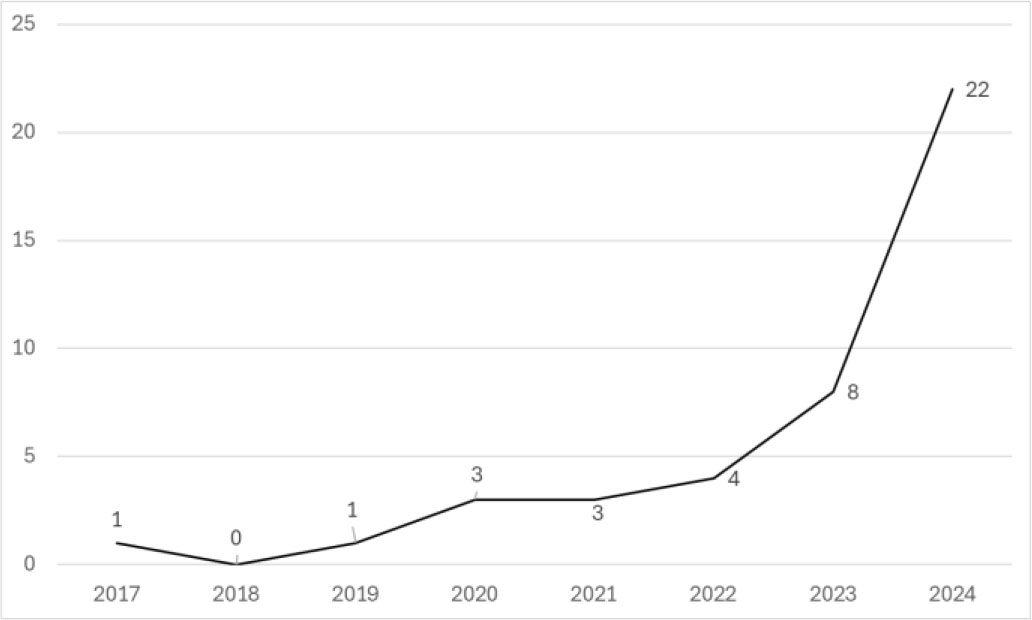
Figure 1.
Time series of annual numbers of publications
Source: own calculations based on Scopus
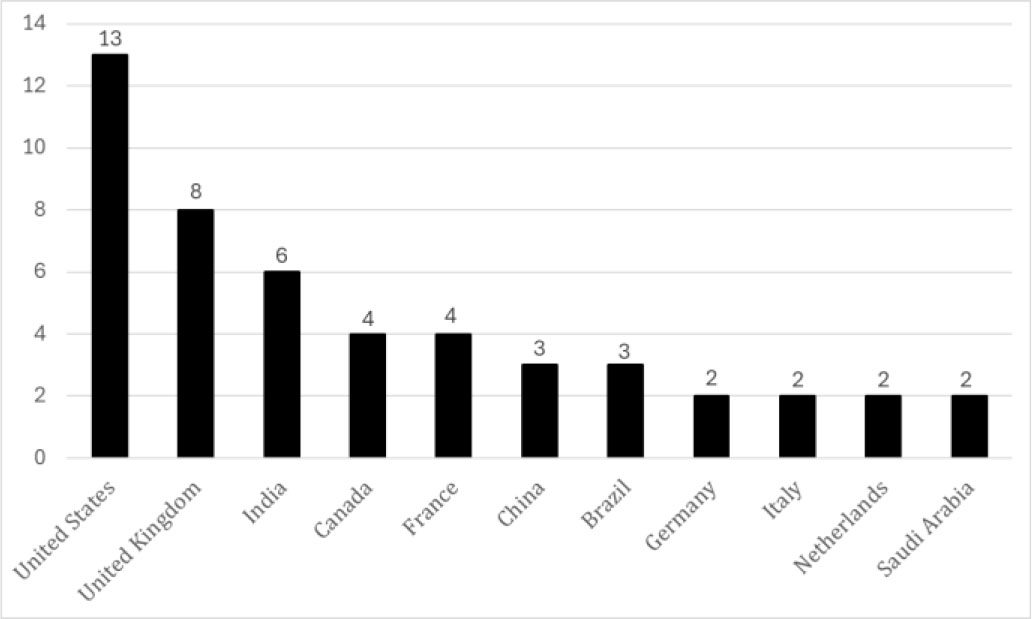
Figure 2.
Publications by country
Source: own calculations based on Scopus
The trends observed are also confirmed by the results of the analyses of funding sponsors. The influence of such well-known public sponsors of research as: European Commission, UK Research, and Innovation and Government of Canada. There are slightly fewer publications related to research sponsored by Australian Research Council, Economic and Social Research Council, Bundesministerium fur Bildung und Forschung, National Science Foundation, Department of Education and Training, Canadian Institutes of Health Research, National Natural Science Foundation of China and others of this kind.
When seeking an answer to the first research question about the possibility of ensuring public value and social impact at an early stage of research, it is necessary to ensure the responsible and reflective implementation of AI methods throughout the entire life cycle of research projects. This can be achieved, for example, by developing real-time public engagement with the support of AI platforms (tools based on natural language processing, chatbots or digital forums), permanently collecting and analyzing stakeholder opinions using data mining to process diverse and large data sets from, for example, social media. Early involvement of different stakeholder groups facilitates social integration into research processes, builds public trust and supports the preparation of final research results with consideration of ethical and social responsibility aspects.
In order to justify the answer to the second research question regarding the existence of a link between the responsible use of AI technologies and achieving greater social impact, the following arguments can be given: efficient, accurate and timely analyses of complex, multidimensional data using AI methods, reactive, adaptive and dynamic responses of AI systems to social information, scalability, inclusiveness and possibilities of reaching larger and more diverse groups of stakeholders, which enables representative findings, ethical innovations (transparent, fair, explainable) strengthening public trust. AI-based methodological innovations should facilitate the provision of clear and credible justifications of the obtained results for recipients, e.g. using neural networks, because it allows building trust in research results and improving decision-making processes (Grzeszczyk & Grzeszczyk, 2022).
In terms of answering the third research question, responsible AI innovations can increase long-term societal impact primarily through: facilitating knowledge transfer, predicting long-term societal effects (AI-based simulation models and scenario planning tools), sustaining stakeholder engagement (AI platforms supporting social panels or open data portals) (Ferencek & Kljajić Borštnar, 2025), supporting evidence-based decision-making and enabling replication and scaling - responsible AI methods can be reused or adapted by others to broadly spread the impact of the original research across sectors and regions, long after the research project ends.
When identifying AI technologies (in relation to the fourth research question), the following examples can be indicated: Natural Language Processing (NLP) (analyzing public discourse and stakeholder opinions) (Ngai et al., 2025), machine learning (discovering hidden patterns in large and heterogeneous data sets regarding e.g. community opinions, survey results, socio-economic data analyses), sentiment and emotion analysis (providing insight into public reactions and assessing the attitudes of research recipients), AI-enhanced simulation and modeling tools (testing policy scenarios and assessing potential future effects of research results), recommendation systems, AI for participatory platforms (facilitating interaction and consensus-building by supporting citizen science, collaborative research, and co-creation).
Based on the conducted research, the following factors can be identified as key determinants in the responsible use of methodological innovations based on AI. These innovations contribute to streamlining advanced scientific research, enhancing its public value and social impact, improving research efficiency, and creating better working environments within research organizations. The main factors include active stakeholder engagement, adaptive research management, the ethical and transparent use of AI models, the implementation of explainable models that justify the obtained results, interdisciplinary data-driven approaches, continuous assessment of social impact through feedback mechanisms, and adherence to sustainability principles.
Active stakeholder engagement involves researchers, decision-makers, communities, and end-users, ensuring that research outcomes are aligned with real societal needs. Adaptive research management relies on systematic progress monitoring, enabling dynamic adjustments to methods and strategies for improved results. The ethical and transparent design of AI models promotes their responsible use and strengthens public trust in research outcomes. Moreover, the implementation of explainability models provides clear justification for the obtained results, further building confidence in intelligent solutions.
Users of AI tools should be fully aware of the technologies they employ and retain control over the types of data being processed. Compliance with personal data protection regulations must be ensured, along with human oversight in data processing, in accordance with the Human-in-the-Loop concept. Interdisciplinary approaches foster collaboration across diverse scientific domains, leading to more comprehensive and innovative solutions. Continuous assessment of social impact, combined with responsiveness to feedback, supports the ongoing evaluation and prediction of societal effects, allowing for the adaptation of solutions to maximize their social benefits. Environmental protection should also be prioritized in the storage and processing of large datasets, with particular attention to minimizing the energy consumption and ecological footprint of AI systems.
Compared with traditional methods, AI technologies enable the implementation of scalable solutions, the detection of subtle patterns and trends that might otherwise remain unnoticed, and the more effective targeting of interventions toward different social groups. Identifying emerging trends and social challenges during research allows projects to adjust their direction dynamically, reinforcing their contribution to societal well-being and maximizing the expected social benefits.
3. Conclusions
The use of AI-based methodological innovations in scientific research can lead to more effective, faster, and more efficient achievement of results of significant social significance. Responsible and well-targeted use of AI methods can not only facilitate and accelerate research, but also have strategic importance in achieving public value and social impact of study. Integration of ethical, inclusive, and adaptive AI methods into research processes enables easier and more efficient achievement of results that are more scientifically significant, but also have greater social justification related to lasting impact beyond the academy.
Responsible methodological innovations based on AI technologies can play a significant role in streamlining research processes in terms of increasing scientific performance, scientific excellence and benefits for the environment of higher education institutions. It is advisable to dynamically and agilely adapt research priorities in a feedback loop to increase this impact based on continuous analysis and assessment of this impact during the implementation of research projects. Integration of new computational technologies in research processes can facilitate the introduction of significant innovations, enabling easier and faster achievement of desired results. Research on responsible methodological innovations requires further deepening due to the dynamic development of AI technologies and the emergence of next generations of intelligent solutions that may be useful in this area.
Acknowledgments
This scientific work was financed from the state budget under the program of the Minister of Science and Higher Education in Poland, called “Science for Society II” (project no. NdS-II/SP/0409/2023/01). The amount of co-financing and the total value of the project were PLN 280,500.
