
Table 1
Summary of studies discussed in the Review of Literature
| Reference | Methodology | Country/sample age range | Main Findings |
|---|---|---|---|
| Anderson, M., and Jiang, J. (2018). | n = 743, Pew research center survey, quantitative | US/13–17 years) | The internet is mostly used for communication via social media, which aids in the establishment of friendships and provides emotional support. |
| Barker, V. (2009). | n = 734, quantitative | California/minimum 18 years | Participants with high self-esteem use the internet for communicative purposes, whereas those with low self-esteem utilise it for social compensation and identity construction. There are gender variations in how males and females use the internet, with females utilising it for interaction and recreation and males using it for social identity construction and recompense. |
| Brikjær, Michael and Kaats, Micah (2019)s | n = 1,160 + 77,600, Mixed Study, qualitative and quantitative | Five Nordic countries (Denmark, Finland, Iceland, Norway, and Sweden). /14–29 years | Excessive usage of social media has been shown to be detrimental to young people's well-being. |
| C. Longobardi, M. Settanni, M. A. Fabris, D. Marengo (2020) | n = 345, quantitative | Italy/11–16 years | Social media (Instagram) has a negative effect on adolescents’ psychological well-being. |
| Christian Schemer, Philipp K Masur, Stefan Geiß, Philipp Müller, Svenja Schäfer (2021) | n = 4,338, Longitudinal study, quantitative | Germany/16–18 years | The frequency with which people utilise the internet in general and social networking sites in particular is not significantly associated to subjective well-being. |
| Crowe, N., and Bradford, S. (2006). | three-year field study, data collected from Forums and News group postings, Semi-structured interviews, quantitative | UK/13–18 years | The use of the internet for gaming and entertaining by children and adolescents is important for self-expression and identity formation. |
| Cummings, J. N., Butler, B., and Kraut, R. (2002). | n = 1,066 email based listservs, survey, quantitative | Pennsylvania/college students | The purpose of utilising the internet is to facilitate interpersonal communication through the exchange of email, chat sessions via instant messaging services, and visits to chat rooms. Among all of them, interpersonal communication is the most important application of the internet for enhancing well-being. |
| Dr. Fatih Bayraktar and Zübeyit Gün (2007) | n = 686, quantitative | North Cyprus/12–17 years | Adolescents used the internet for entertainment and communication purposes in general. Additionally, excessive time spent on the internet is positively associated with compulsive internet use, which is further correlated with depression. |
| E Bozzola · 2019 | Systemetic Literature Review | adolescents | Excessive time spent on the Internet has a negative effect on psychological well-being. |
| Gross et al. (2002) | n = 130, quantitative | California/11–13 years | There is a positive correlation between adolescents’ use of the internet for social connections with peers and their happiness. Online time was not found to be connected with daily well-being. |
| Gross, E. F. (2004). | n = 261, Daily Reports, quantitative and qualitative | California/13–16 years | There is no correlation between time spent online and well-being |
| Hugues Sampasa-Kanyinga and Rosamund F. Lewis. (2015) | n = 753, Survey, quantitative | Canada/12–18 years | Over two hours of daily usage of social networking sites is independently connected with poor mental health, significant levels of psychological distress, and suicidal thinking. As a result, adolescents with poor mental health are greater internet users. Thus, time spent on the internet is associated with poor mental health. |
| Jackson, L. A., Von Eye, A., Barbatsis, G., Biocca, F., Fitzgerald, H. E., & Zhao, Y. (2004) | n = 117, Survey, quantitative | US/average age 38.6 years | Internet use has no effect on the psychological well-being or social connectedness, regardless of the time of using internet. |
| Jean M. Twenge (2019) | n ≥ 1,000, review of Longitudinal and experimental studies | UK and US/adolescents | Digital media use has a negative correlation with psychological well-being. Additionally, non-users of digital media have a poorer level of well-being than light users. |
| Kilic, A. F., and Güzeller, C. (2017). | n = 3,170, quantitative | Turkey/14–17 years | There are considerable gender disparities in the reasons for using the internet among adolescents in various grades. Duration of using Internet influence purpose of using internet. |
| Kim, C. (2017) | n = 178, online survey, quantitative analyis | Sothern California | Social media is the most effective method of communication outside of class and is consequently employed as an educational tool. |
| Kraut, R., and Burke, M. (2015) | Review | US | The use of the internet to communicate with close friends and family members has been shown to improve psychological well-being. through reductions in despair, isolation, and anxiety, as well as improvements in subjective well-being, although chatting with strangers has been shown to be detrimental to well-being. |
| Liu, D., Baumeister, R. F., Yang, C. C., and Hu, B. (2019) | n = 1,935, Meta-analysis | California/15–25 years |
|
| Lung F-W, Shu B-C, Chiang T-L, Lin S-J (2020) | n = 1,457, cohort study, quantitative analysis | Taiwan | There is a negative correlation between time spent on the internet and adolescent happiness. Those who spend more than five hours online during the holidays were at an increased risk of self-harm and are unhappy. |
| Mathers et al. (2009) | n = 925, cross sectional study, quantitative analysis | Australia/13–19 years | Adolescents’ time spent on the internet, particularly playing games, is inversely associated with their happiness and well-being. |
| McDool, E., Powell, P., Roberts, J., and Taylor, K. (2020) | n = 6,310, Longitudinal Study, quantitative | England/10–15 years | Internet use is connected with decreased well-being across a variety of sectors. Spending a significant amount of time online (five hours or more) had a significant negative correlation with all areas of wellbeing except friendship. |
| Mesch (2001) | n = 927, Face-to-face survey, quantitative | Israel/13–18 years | Adolescents who are socially isolated spend more time online, and internet use does not supplant other social activities. |
| Nie, N. H., Hillygus, D. S., and Erbring, L. (2008). | n = 6,000, Survey, quantitative analysis | US/18–64 years | Time spent online has an adverse effect on social relationships, and the time of day spent online dictates the sort of relationship that is impacted. |
| Otsuka Y, Kaneita Y, Itani O, Jike M, Osaki Y, Higuchi S, Kanda H, Kinjo A, Kuwabara Y, Yoshimoto H. (2020) | n = 64,417, Survey, quantitative analysis | Japan/12–19 years | Unhappiness was substantially connected with maleness and bad lifestyle practises such as skipping breakfast, having poor sleep quality, and indulging in some problematic internet use. Unhappiness appears to be significantly related to how Japanese adolescents spend their daily lives. |
| Park, H. (2015) | n = 72,435, Survey, quantitative Analysis | Korea | Internet use for non-academic activities between 0 and 1 hour per day has a beneficial influence on adolescents’ happiness. Adolescents who do not utilise the internet for non-academic purposes are dissatisfied. |
| Park, So-Youn, and Yang, So-Nam. (2015) | n = 72,060, online survey data, quantitative analysis | North Korea/13–16 years | Lower level of subjective pleasure and a lack of social support are associated with increased internet time. |
| Rains, S. A., and Young, V. (2009) | n = 4,081, meta-analysis | Non-students | Participants who took part in a computer-mediated support group were more likely to have better social support, less despair, and greater happiness. |
| Ranieri, J., Guerra, F., Martelli, A. et al. (2021) | n = 113, quantitative analysis | Italy/18–25 years | More than six hours per day of internet use isn’t necessarily linked to mental health issues, and internet use doesn’t adversely affect well-being. |
| Richard H. Hall (2016) | n = 28, quantitative analysis | US/18–19 Years | Internet use has a negative correlation with happiness. Using the internet to seek knowledge has a good correlation with happiness. The amount of time spent on the internet for emotive expression has no correlation with happiness. |
| Richard H. Hall (2017) | n = 34, Longitudinal study, Mixed study (quantitative and qualitative) | US/18–19 years | Spending more time on the internet playing online games is associated with unhappiness, whereas spending more time examining facts and accumulating information and spending less time on the internet is associated with happiness. |
| Richard H. Hall (2018) | n = 34, quantitative analysis | US/18–19 years | Those who spend less time on the internet and refrain from expressing negative feelings on the internet are happier. Those who spend time on the internet researching facts and information are also happy. |
| Richard H. Hall (2019) | Literature review | Varied populations | According to recent studies, the internet is positively associated with happiness, and the major objective of internet usage is social connection. This link is mediated and moderated by a number of factors. |
| Shen, C., and Williams, D. (2011) | n = 5,000, survey data from Everquest II, quantitative analysis | US/Average age = 31.6 years | Various activities revealed both time displacement and social enhancement effects. The effects of internet and MMO use were highly reliant on the users’ goals, situations, and personal traits. 1. More internet time predicts more loneliness. 2. Meeting strangers online was linked to higher loneliness. Communication with family and friends, both near and far, had a mixed or no effect on psychological well-being. Notably, persons who utilise the internet to obtain knowledge felt less lonely. |
| Subrahmanyam K, Lin G. (2007) | n = 156, quantitative analysis | Los Angeles/15–18.4 years | In terms of internet use and well-being, the findings indicate that there is no correlation between the total amount of time spent online and time spent on email and well-being. Additionally, time spent is unrelated to perceived parental and close friend support. |
| Techatassanasoontorn, A. A., and Thaiprasert, N. (2013) | n = 100, Literature review | Thailand/18–22 years | Life satisfaction and well-being of young adults are influenced by positive feelings derived from internet activity. |
| Thierry Pénard, Nicolas Poussing, Raphaël Suire (2013) | n = 1,332, Luxemburgish data, European Value survey, quantitative analysis | Europe/18–89 years | Internet users report higher levels of happiness than non-users. For adolescents, the association between internet use and happiness is stronger. |
| Tsai, M. J., and Tsai, C. C. (2010) | n = 936, cluster sampling, quantitative analysis | Taiwan/average age = 14.59 years | The aim and intensity of internet use were found to be significantly different between boys and girls. Boys prefer to use the Internet to gather information, whilst girls prefer to use it for socialising. Additionally, boys used the internet at a considerably higher rate than girls. |
| Twenge, J. M., Martin, G. N., and Campbell, W. K. (2018) | n = 1.1 million, cross sectional study, quantitative | US/13–18 years | Electronic communication and screens (eg, social media, the internet, texting, and gaming) have a negative impact on adolescents’ self-esteem, life satisfaction, and happiness as compared to non-screen activities such as in-person social engagement and sports/exercise. |
| Twenge, J. M., Martin, G. N., and Spitzberg, B. H. (2018) | n = 1,021,209, Survey, quantitative | US/13–18 Years | On average, adolescents spend 4–6 hours each day using digital media, which includes the internet, texting, and social media. |
| Valenzuela, S., Park, N., and Kee, K. F. (2009) | n = 2603, Random web survey, quantitative | US | There is a positive correlation between the intensity of Facebook use and students’ levels of happiness, social trust, civic engagement, and political participation. |
| Valkenburg, P. M., and Peter, J. (2007). | n = 800, Survey, quantitative, | Dutch/10–17 Years | Time spent online chatting with friends has been shown to correlate positively with happiness and well-being. Instant messaging positively moderates the relationship between internet usage and well-being of adolescents. |
| Valkenburg, P. M., and Peter, J. (2009). | literature review | adolescents | The use of the internet has a favourable correlation with social connectivity and well-being. |
| Van den Eijnden, R. J. J. M., Meerkerk, G. J., Vermulst, A. A., Spijkerman, R., and Engels, R. C. M. E. (2008). | n = 663, Cross-sectional and longitudinal study, quantitative | Netherland/12–15 Years | Depression and net addiction are correlated positively with internet use, but loneliness is adversely correlated with it. The most common use of the internet is instant messaging, followed by entertainment and informational purposes. Addiction and communication go hand in hand |
| Vilhelmson, B., Thulin, E., and Elldér, E. (2017) | n = 7,366, Survey, cross-sectional data, quantitative analysis | Sweden/15–84 Years | There is a strong correlation between the amount of time spent using ICTs and one's leisure time. Excessive Internet use has a negative impact on outdoor and athletic activities, but does not affect time spent with friends and family. |
| Wang L, Tao T, Fan C, Gao W (2015) | n = 1,727, quantitative analysis | China/12–25 Years | Online happiness is not correlated with real-world contentment. |
| Yang-Sook Yoo, PhD, RN, Ok-Hee Cho, PhD, RN, Kyeong-Sook Cha, PhD, RN (2013) | n = 74,980, Survey, quantitative analysis | Korea/12–19 Years | Utilising the internet for more than four hours per day results in suicidal ideation, attempted suicide, a melancholy mood, significant subjective stress, and a lack of or inability to experience happiness. |
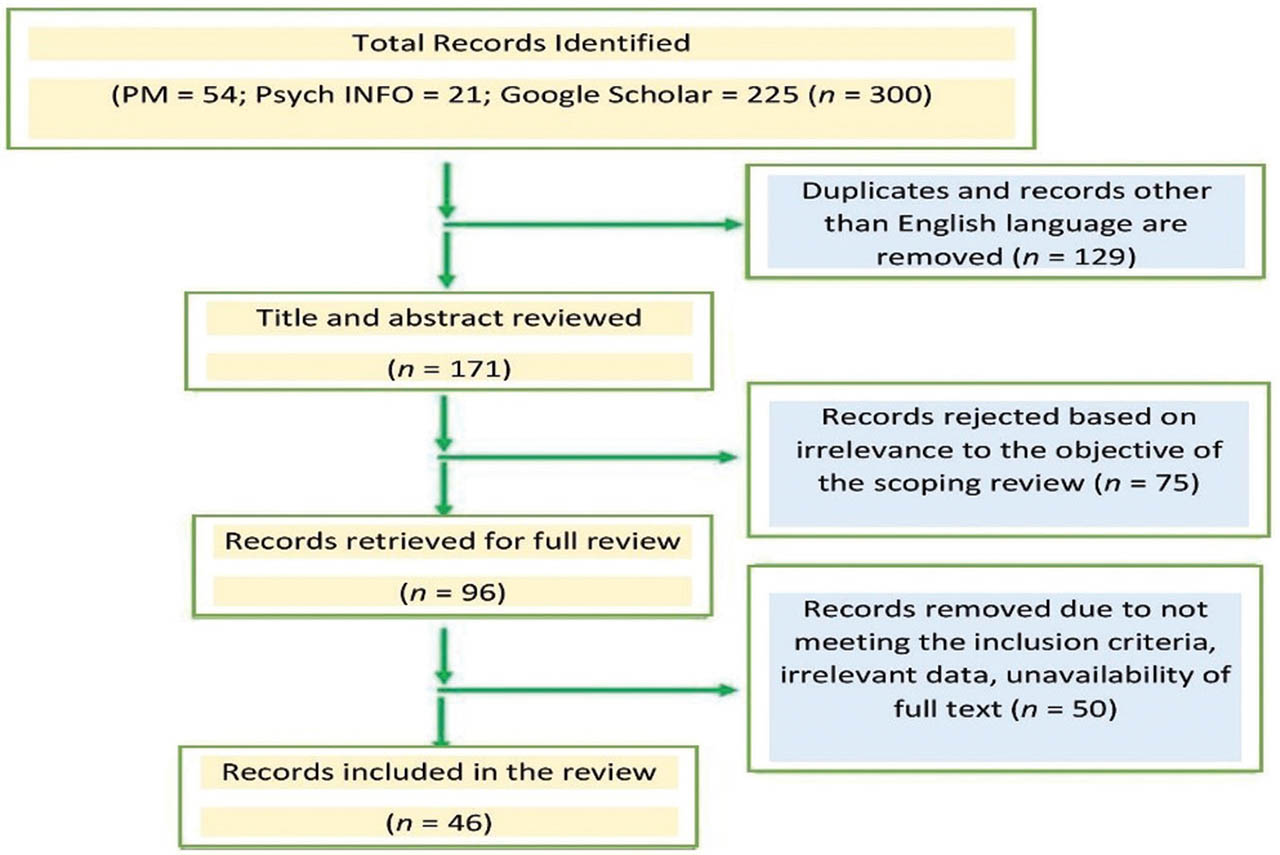
Figure 1
Flow chart showing selection of studies.