
WHAT’S NEW? WHAT IS IMPORTANT?
In this small retrospective HFpEF-treated cohort, no statistically detectable difference in genitourinary safety was identified between dapagliflozin and empagliflozin. Symptomatic UTI was uncommon; most events in the original composite endpoint were asymptomatic bacteriuria.
1. INTRODUCTION
Sodium–glucose cotransporter 2 inhibitors (SGLT2i) are guideline-directed therapy for heart failure across the ejection-fraction spectrum, including HFpEF [1,2]. Their glucosuric mechanism raises concern about genital mycotic infection and, less consistently, urinary infection [3,4]. Comparative genitourinary safety between individual SGLT2 inhibitors remains clinically relevant because dapagliflozin and empagliflozin are both used for HFpEF.
In a United States claims-based HFpEF cohort, Riaz et al. found no significant difference in UTI, genital infection, or their composite among dapagliflozin, empagliflozin, and canagliflozin [5]. A Danish target-trial emulation in metformin-treated type 2 diabetes similarly reported nearly identical UTI risk with empagliflozin and dapagliflozin, although modest relative increases in genital infection and phimosis were observed with empagliflozin [6]. A recent EMPEROR-Pooled analysis across the heart-failure ejection-fraction spectrum found that lower UTI and mycotic genitourinary infection were more frequent with empagliflozin than placebo, whereas pyelonephritis or urosepsis was not increased; the cardiovascular benefit of empagliflozin was preserved regardless of infection occurrence [7].
The present study compares dapagliflozin and empagliflozin in a single-centre cohort initiated for physician-documented HFpEF, separating symptomatic UTI from asymptomatic bacteriuria and reporting other genitourinary adverse events over 6 months.
2. MATERIALS AND METHODS
2.1. Study Design and Population
This retrospective, single-centre comparative cohort study was conducted at Clinical Hospital “Prof. Dr. Th. Burghele”, Bucharest, Romania. Electronic medical records identified 263 adults initiated on dapagliflozin or empagliflozin for physician-documented HFpEF between August 2023 and September 2025. Eligibility required age ≥18 years, incident SGLT2-inhibitor use, no exposure during the preceding 6 months, no active genitourinary infection at baseline, and at least 6 months of continuous follow-up. The final analytic cohort comprised 239 participants: 113 receiving dapagliflozin 10 mg once daily and 126 receiving empagliflozin 10 mg once daily.
HFpEF was defined from the treating physician’s recorded diagnosis. Individual left-ventricular ejection fraction values, natriuretic peptide concentrations, New York Heart Association class, and formal HFpEF scores were not systematically extracted; objective confirmation could not be independently reproduced from the analytic dataset. Individual diabetes status was also not captured as a validated analytic variable.
Of 124 dapagliflozin candidates, 11 were excluded: 9 did not complete 6 months of follow-up, 1 died, and 1 discontinued after Fournier’s gangrene at approximately 6 months. Of 139 empagliflozin candidates, 13 were excluded: 11 did not complete follow-up and 2 died. Requiring complete follow-up can create selection bias by excluding early deaths, discontinuations, and transfers.
The study was conducted in accordance with the Declaration of Helsinki and approved by the Institutional Ethics Committee of Clinical Hospital “Prof. Dr. Th. Burghele”, Bucharest, Romania (approval 7056, July 21, 2023). Individual informed consent was waived because this was a retrospective analysis of pseudonymized routine clinical data.
2.2. Outcome Definitions
The original outcome was any documented bacteriuria/UTI within 6 months of the index date. Symptomatic UTI required documented dysuria, frequency, urgency, suprapubic pain, or fever attributed to UTI. Asymptomatic bacteriuria required a documented positive urine culture without attributed urinary symptoms. Complete culture-testing denominators for all participants in each treatment arm were not retained; therefore, the total number tested or cultured per arm cannot be reported. Secondary outcomes were fracture, amputation, diabetic ketoacidosis, Fournier’s gangrene, genital fungal infection, and phimosis among men.
2.3. Statistical Analysis
Continuous variables are summarized as mean ± standard deviation and median [interquartile range]. Categorical outcomes are reported as n (%). Absolute risk differences with 95% Newcombe confidence intervals were calculated as empagliflozin minus dapagliflozin. Fisher’s exact test was used for exploratory between-group testing. Outcomes with zero events in both groups are reported as “No events observed” without odds ratios. A multivariable logistic regression model evaluated the original documented bacteriuria/UTI composite and included treatment, age, sex, and baseline eGFR; treatment was coded as empagliflozin versus dapagliflozin. Continuous covariates were standardized. Analyses were performed in Python using NumPy, SciPy, and statsmodels.
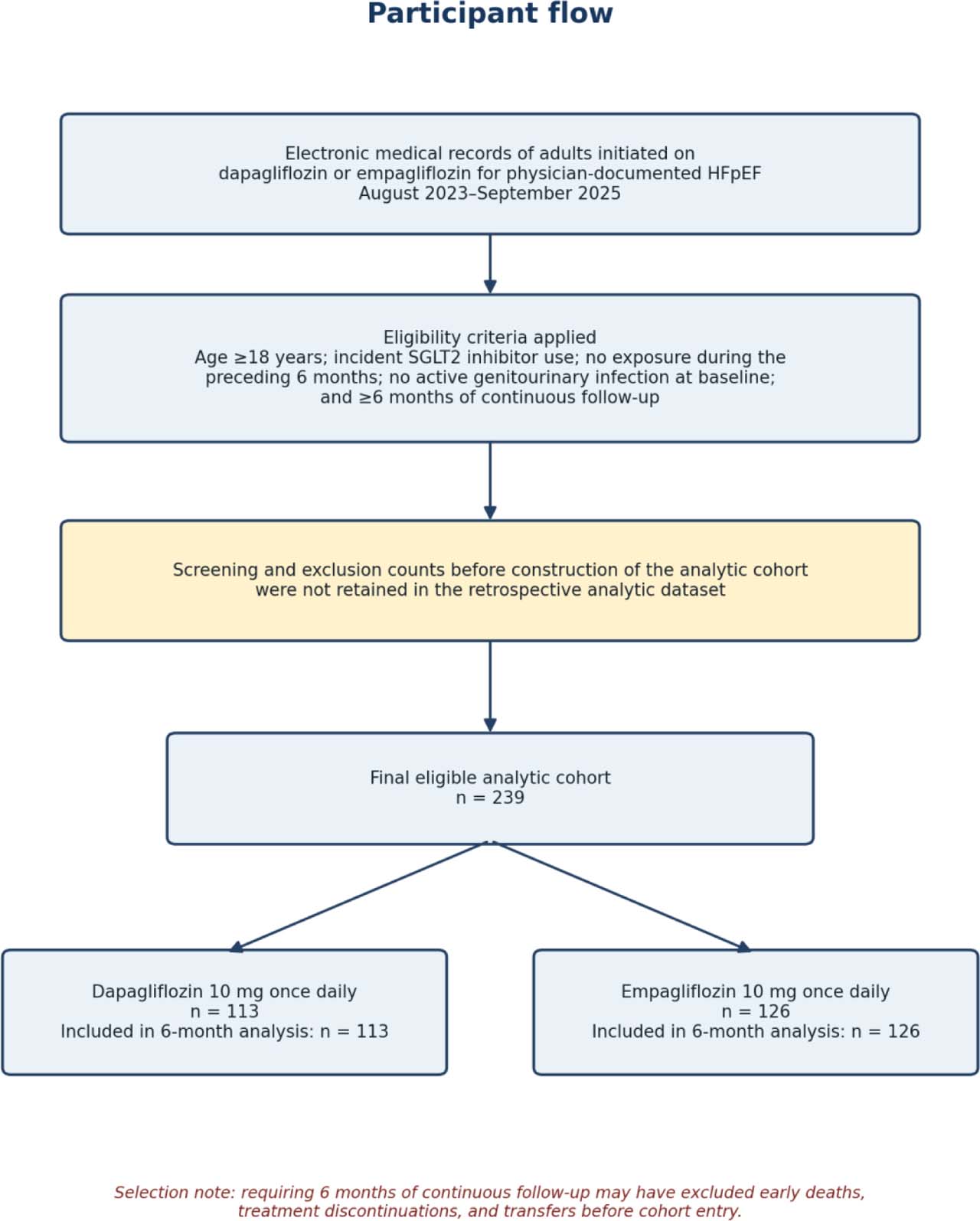
Figure 1.
Participant flow and construction of the analytic cohort. HFpEF, heart failure with preserved ejection fraction; SGLT2, sodium–glucose cotransporter 2.
3. RESULTS
3.1. Baseline Characteristics
The empagliflozin group was younger than the dapagliflozin group (mean age 66.40 ± 6.36 versus 71.43 ± 10.67 years; p = 0.0001). Other measured baseline characteristics did not differ statistically between groups (Table 1).
Table 1.
Baseline characteristics by treatment group.
| Characteristic | Dapagliflozin (n = 113) | Empagliflozin (n = 126) | Effect estimate | p value |
|---|---|---|---|---|
| Age, years, mean ± SD (median [IQR]) | 71.43 ± 10.67 (71 [64–80]) | 66.40 ± 6.36 (67 [62.25–70]) | N/A | 0.0001 |
| BMI, kg/m2, mean ± SD (median [IQR]) | 26.91 ± 4.08 (27 [24–30]) | 26.55 ± 2.97 (26.70 [24.82–28.30]) | N/A | 0.480 |
| HbA1c, %, mean ± SD (median [IQR]) | 5.52 ± 1.00 (5.10 [4.90–6.40]) | 5.55 ± 0.98 (5.10 [5.00–6.35]) | N/A | 0.751 |
| Systolic BP, mmHg, mean ± SD (median [IQR]) | 133.89 ± 12.02 (135 [125–140]) | 136.27 ± 11.63 (135 [126.25–145]) | N/A | 0.097 |
| eGFR, mL/min/1.73 m2, mean ± SD (median [IQR]) | 60.24 ± 13.28 (55 [49–71]) | 59.88 ± 12.53 (55 [50–69]) | N/A | 0.966 |
| Male sex, n (%) | 67/113 (59.3%) | 72/126 (57.1%) | OR 1.09 [0.65–1.83] | 0.793 |
| Dyslipidaemia, n (%) | 104/113 (92.0%) | 112/126 (88.9%) | OR 1.44 [0.60–3.48] | 0.512 |
| Smoking, n (%) | 48/113 (42.5%) | 43/126 (34.1%) | OR 1.43 [0.84–2.41] | 0.230 |
3.2. Bacteriuria, Symptomatic UTI, and Other Adverse Events
The original documented bacteriuria/UTI composite occurred in 21/113 (18.6%) dapagliflozin-treated participants and 25/126 (19.8%) empagliflozin-treated participants, a risk difference of 1.3 percentage points (95% CI −8.9 to 11.2; empagliflozin minus dapagliflozin). Symptomatic UTI occurred in 4/113 (3.5%) and 5/126 (4.0%), while documented asymptomatic bacteriuria occurred in 17/113 (15.0%) and 20/126 (15.9%). Complete culture-testing denominators were unavailable, so these proportions use the full treatment-arm denominators and should not be interpreted as positivity rates among those cultured.
The Fournier’s gangrene event occurred in a 68-year-old man with HFpEF after approximately 6 months of dapagliflozin treatment. The available dates did not allow determination of whether onset was on or immediately after day 180. Dapagliflozin was discontinued and the patient did not meet the complete 6-month follow-up criterion; he is therefore represented among the dapagliflozin exclusions in Figure 1 and not as an outcome event in the fixed 239-participant analytic cohort. He required broad-spectrum antimicrobial therapy, surgical intensive care, and debridement. The event does not establish causality or a comparative treatment effect.
Table 2.
Six-month adverse events in the final analytic cohort.
| Outcome | Dapagliflozin | Empagliflozin | Risk difference, percentage points [95% CI] | p value |
|---|---|---|---|---|
| Any documented bacteriuria/UTI | 21/113 (18.6%) | 25/126 (19.8%) | 1.3 [−8.9 to 11.2] | 0.870 |
| Symptomatic UTI | 4/113 (3.5%) | 5/126 (4.0%) | 0.4 [−5.3 to 5.9] | 1.000 |
| Documented asymptomatic bacteriuria | 17/113 (15.0%) | 20/126 (15.9%) | 0.8 [−8.6 to 10.0] | 1.000 |
| Fracture | 1/113 (0.9%) | 0/126 (0.0%) | −0.9 [−4.8 to 2.2] | 0.473 |
| Amputation | 0/113 (0.0%) | 0/126 (0.0%) | No events observed | N/A |
| Diabetic ketoacidosis | 0/113 (0.0%) | 0/126 (0.0%) | No events observed | N/A |
| Genital fungal infection | 6/113 (5.3%) | 5/126 (4.0%) | −1.3 [−7.6 to 4.4] | 0.760 |
| Phimosis (males only) | 2/67 (3.0%) | 1/72 (1.4%) | −1.6 [−8.9 to 4.8] | 0.609 |
3.3. Adjusted Bacteriuria Model
In the logistic model of the original documented bacteriuria/UTI composite, the adjusted odds ratio for empagliflozin versus dapagliflozin was 1.62 (95% CI 0.76–3.45; p = 0.208). Older age was associated with higher odds and male sex with lower odds of the composite. Baseline eGFR was not independently associated with the outcome (Table 3).
3.4. Precision of the Primary Estimate
The composite risk-difference interval extended from −8.9 to 11.2 percentage points. The absence of statistical significance should not be interpreted as equivalence or as evidence that smaller clinically relevant differences are absent.
4. DISCUSSION
In this retrospective single-centre cohort, no statistically detectable difference between dapagliflozin and empagliflozin was found for symptomatic UTI, asymptomatic bacteriuria, or the original composite endpoint. The original endpoint was dominated by asymptomatic bacteriuria, making it broader than clinical UTI and likely explaining the relatively high cumulative incidence. The 95% confidence interval for the composite risk difference ranged from −8.9 to 11.2 percentage points and therefore remained compatible with clinically meaningful benefit or harm in either direction. The findings should not be interpreted as equivalence. The single Fournier’s gangrene event occurred in a 68-year-old man with type 2 diabetes after approximately 6 months of dapagliflozin treatment and required broad-spectrum antibiotics, surgical intensive care, and extensive debridement, as described in the Results. This isolated event cannot establish causality or a comparative difference between treatments.
The crude comparison is broadly consistent with large head-to-head observational evidence in metformin-treated type 2 diabetes, which reported a UTI risk ratio of 0.98 (95% CI 0.95–1.01) for empagliflozin versus dapagliflozin [7]. That study population and indication differ substantially from the present HFpEF-treated cohort. It also found statistically significant, although modest, increases with empagliflozin in genital infection (RR 1.14, 95% CI 1.04–1.25) and phimosis (RR 1.23, 95% CI 1.04–1.52) [7].
Our genital-event estimates were based on only 11 genital fungal infections and 3 phimosis cases. Their direction differed from the large comparator study, but the confidence intervals were wide and the data cannot distinguish a true drug difference from chance. Phimosis is most appropriately evaluated among uncircumcised men without pre-existing phimosis. Circumcision status and pre-existing phimosis were not available, and 6 months may be too short to detect incident scar-related phimosis.
Glucosuria provides a plausible mechanism for genital fungal infection, whereas evidence for a corresponding increase in symptomatic UTI is less consistent [3, 4, 9,10,11]. This distinction reinforces the importance of separating symptomatic infection from asymptomatic bacteriuria. The present study was a retrospective cohort study, not a cross-sectional study.
This mechanistic dissociation is not unique to SGLT2i pharmacology; it recapitulates a pattern long recognized in poorly controlled diabetes more broadly, in which glucosuria-driven local hyperglycemia predisposes to genital candidal colonization and vulvovaginitis or balanitis through impaired neutrophil oxidative killing, altered periurethral and genital flora, and enhanced adherence of Candida and uropathogenic organisms to glucose-exposed epithelium, without a correspondingly consistent increase in culture-confirmed UTI [10]. A systematic review and meta-analysis of randomized controlled trials across the SGLT2i class similarly found a consistent, several-fold increase in genital infection risk relative to placebo, contrasted with a much smaller and less consistent effect on UTI risk [11]. This convergence of mechanistic, randomized-trial, and real-world registry evidence reinforces that the pattern observed in our cohort — genital events present in both arms, UTI risk essentially unchanged is consistent with class-level pharmacology rather than an artifact specific to either agent or to this particular study population.
The crude and adjusted estimates do not reverse direction when expressed using the same reference category. Both point estimates indicate numerically higher odds with empagliflozin, with adjustment increasing the estimate from approximately 1.08 to 1.62. This change is compatible with confounding by age, but residual confounding remains likely because prior UTI, catheterization, prostatic enlargement, post-void residual urine, recent antibiotic use, circumcision status, and other urological factors were not systematically captured.
The genitourinary outcomes examined in this study differ fundamentally in their anatomical and sex distribution, a distinction with direct implications for how they should be interpreted. Phimosis, by definition, occurs exclusively in uncircumcised male patients, and our comparison of this outcome was accordingly restricted to the male subset of each treatment arm (67 dapagliflozin, 72 empagliflozin). Genital fungal infection, in contrast, can occur in either sex — as vulvovaginal candidiasis in women and balanitis or balanoposthitis in men — but this distinction was not captured as a discrete variable in the source extraction, so the 6 dapagliflozin and 5 empagliflozin cases reported here represent a sex-pooled count rather than a sex-stratified one. This matters because the background epidemiology and clinical significance of genital fungal infection differ meaningfully by sex: vulvovaginal candidiasis is common in the general female population independent of SGLT2i exposure, whereas male genital fungal infection is comparatively uncommon outside of glucosuria-associated states and, when it occurs in this context, is more consistently attributable to the drug exposure itself [10]. Without sex-stratified counts, it is not possible to determine whether the modestly higher genital fungal infection incidence observed with dapagliflozin in this cohort reflects a true between-drug difference, a difference in the underlying sex distribution of the two treatment groups, or simply the small-sample instability already discussed above. Future data collection in this cohort should capture genital fungal infection separately by sex and by clinical subtype (vulvovaginal candidiasis versus balanitis or balanoposthitis) to allow a more anatomically and mechanistically informative between-drug comparison.
4.1. Clinical Implications for SGLT2i Selection in HFpEF
Because not statistically detectable between-drug difference was identified and the estimates were imprecise, these data do not support preferential selection of either agent on genitourinary safety grounds. They also do not establish equivalence. Treatment choice should continue to be individualized according to established clinical indications, contraindications, kidney function, tolerability, access, and patient preference.
4.2. Strengths and Limitations
This study has important limitations. The retrospective, single-center, non-randomized design cannot exclude confounding by indication, and the two treatment groups differed significantly in age. Formal diabetes diagnosis, echocardiographic ejection fraction, natriuretic peptide levels, and NYHA functional class, the core components of a formal HFpEF diagnosis under contemporary consensus algorithms [15] were not extracted or reported in this analysis. This was an intentional scope decision rather than a data-availability failure: the present study was designed specifically to evaluate UTI and other genitourinary and metabolic adverse events associated with SGLT2i therapy, and disease-severity staging variables were considered outside that scope.
4.3. Future Directions
Prospective multicentre studies should use objective HFpEF eligibility criteria, record individual diabetes status and key urological covariates, distinguish symptomatic UTI from asymptomatic bacteriuria, avoid routine screening for asymptomatic bacteriuria unless clinically indicated, and use blinded adjudication for serious events.
5. CONCLUSIONS
In this retrospective HFpEF-treated cohort, no statistically detectable difference between dapagliflozin and empagliflozin was found for symptomatic UTI, documented asymptomatic bacteriuria, or other measured genitourinary outcomes. The estimates were imprecise and do not demonstrate equivalence. With risk defined as empagliflozin minus dapagliflozin, the original composite confidence interval was compatible with an absolute difference ranging from 8.9 percentage points lower risk with empagliflozin to 11.2 percentage points higher risk with empagliflozin. Most composite events were asymptomatic bacteriuria.
Declarations
[6] Institutional Review Board Statement. The study was conducted in accordance with the Declaration of Helsinki and approved by the Institutional Ethics Committee of Clinical Hospital “Prof. Dr. Th. Burghele”, Bucharest, Romania (approval 7056, July 21, 2023).
[7] Informed Consent Statement. Individual informed consent was waived because this was a retrospective analysis of pseudonymized routine clinical data. No identifiable patient information is presented.
[8] Data Availability Statement. Pseudonymized participant data that support the findings are available from the corresponding author upon reasonable request, subject to institutional and ethical approval and applicable data-protection regulations.
[9] Contributed by Author Contributions. Conceptualization, R.A.D.; methodology, M.A.M.; formal analysis, G.P.; data curation, R.A.D.; writing—original draft preparation, M.A.M. and C.N.; writing—review and editing, G.P., M.M., and A.B.; supervision, V.J. All authors have read and agreed to the published version of the manuscript.