
What is new/important?
In this pilot cohort of patients with MASLD, the newly derived Metabolic Liver Fibrosis Risk Score (MLFRS), combining age, body mass index, HbA1c and AST, discriminated VCTE-defined elevated liver stiffness better than BARD and FIB-4, and non-significantly better than the NAFLD Fibrosis Score, while requiring fewer laboratory measurements. The endpoint was elevated liver stiffness, not histological fibrosis; external validation is required.
INTRODUCTION
MASLD is a steatotic liver disease affecting about 25% of the global population [1]. Fibrosis develops in roughly half of patients within 8–13 years [2] and is the key determinant of complications and survival. Liver biopsy remains the gold standard, but its invasiveness has driven the search for non-invasive laboratory markers; in NAFLD and MAFLD the commonly used ones are BARD, FIB-4 and the NAFLD Fibrosis Score (NFS) [3]. Because MASLD is a new concept, introduced in 2023 [4], it has not been extensively studied for non-invasive prediction of hepatofibrosis or the development of new markers.
MATERIAL AND METHODS
Of 190 patients from endocrinology outpatient clinics diagnosed previously with MASLD (according to official definition [4] - in our study steatosis was confirmed by vibration-controlled transient elastography; VCTE) 179 had complete data for all four scores and were analysed - 11 were excluded for an incomplete laboratory panel (5), confirmation of viral hepatitis (3) or harmful alcohol intake (3) which were the exclusion factors. All underwent the necessary measurements to calculate BARD, FIB4, and NFS (age, body weight and height, AST, ALT, platelet count, glucose, serum albumin, following the appropriate formulas [3]) and VCTE (FibroScan device: model 530 compact) to assess liver fibrosis (with pre-specified cut-off for elevated liver stiffness at ≥8.0 kPa — the threshold below which advanced fibrosis is excluded in European guidelines [5]); no participant underwent biopsy. The Metabolic Liver Fibrosis Risk Score (MLFRS) was derived by logistic regression entering age, body mass index (BMI), HbA1c and AST simultaneously, without data-driven selection. AUCs carry DeLong 95% confidence intervals (CI) and were compared pairwise by DeLong’s test; comparators were applied at their published cut-offs; optimism was estimated from 1000 bootstrap resamples, refitting the model in each; proportions carry Wilson 95% CIs. All four scores were evaluated in one complete-case population. The Bioethics Committee of Nicolaus Copernicus University, Collegium Medicum in Bydgoszcz approved the study (KB 268/2024); all participants gave written informed consent.
RESULTS
The 179 participants comprised 89 men and 90 women, mean age 53.8±12.7 years and BMI 31.9±5.1 kg/m2. Median liver stiffness was 5.7 kPa (IQR 4.5–8.2); 50 (28%) reached ≥8.0 kPa. Full characteristics are in Supplementary Table S1.
The derived score was MLFRS = 0.0480 × age (years) + 0.1284 × BMI (kg/m2) + 0.1908 × HbA1c (%) + 0.0554 × AST (U/L) – 9.787, recentred so that values above zero denote above-threshold risk; predicted probability = 1/(1 + exp(−(MLFRS − 0.769))).
MLFRS achieved an AUC of 0.749 (0.671–0.827) versus 0.681 (0.590–0.772) for NFS, 0.646 (0.552–0.740) for FIB-4 and 0.640 (0.549–0.730) for BARD (Figure 1). MLFRS was superior to FIB-4 (ΔAUC 0.103, p = 0.017) and BARD (ΔAUC 0.109, p = 0.040) but not to NFS (ΔAUC 0.068, p = 0.076). Bootstrapping gave an optimism of 0.019 and an optimism-corrected AUC of 0.730, with corrected calibration slope 0.88 and intercept −0.10; the Brier score was 0.165. At the referral threshold of zero, sensitivity was 62% (48–74) and specificity 78% (70–85). Used as a three-band strategy (<−0.86, −0.86 to 0.48, ≥0.48), MLFRS placed 54 participants (30%) in a low-risk band containing 4 events, a residual risk of 7% (bootstrap-corrected 10%). By comparison, FIB-4 below 1.30 encompassed 125 participants (70%) of whom 27 (22%) had stiffness ≥8.0 kPa, and NFS below −1.455 encompassed 91 (51%) of whom 17 (19%) did (Supplementary Table S2).
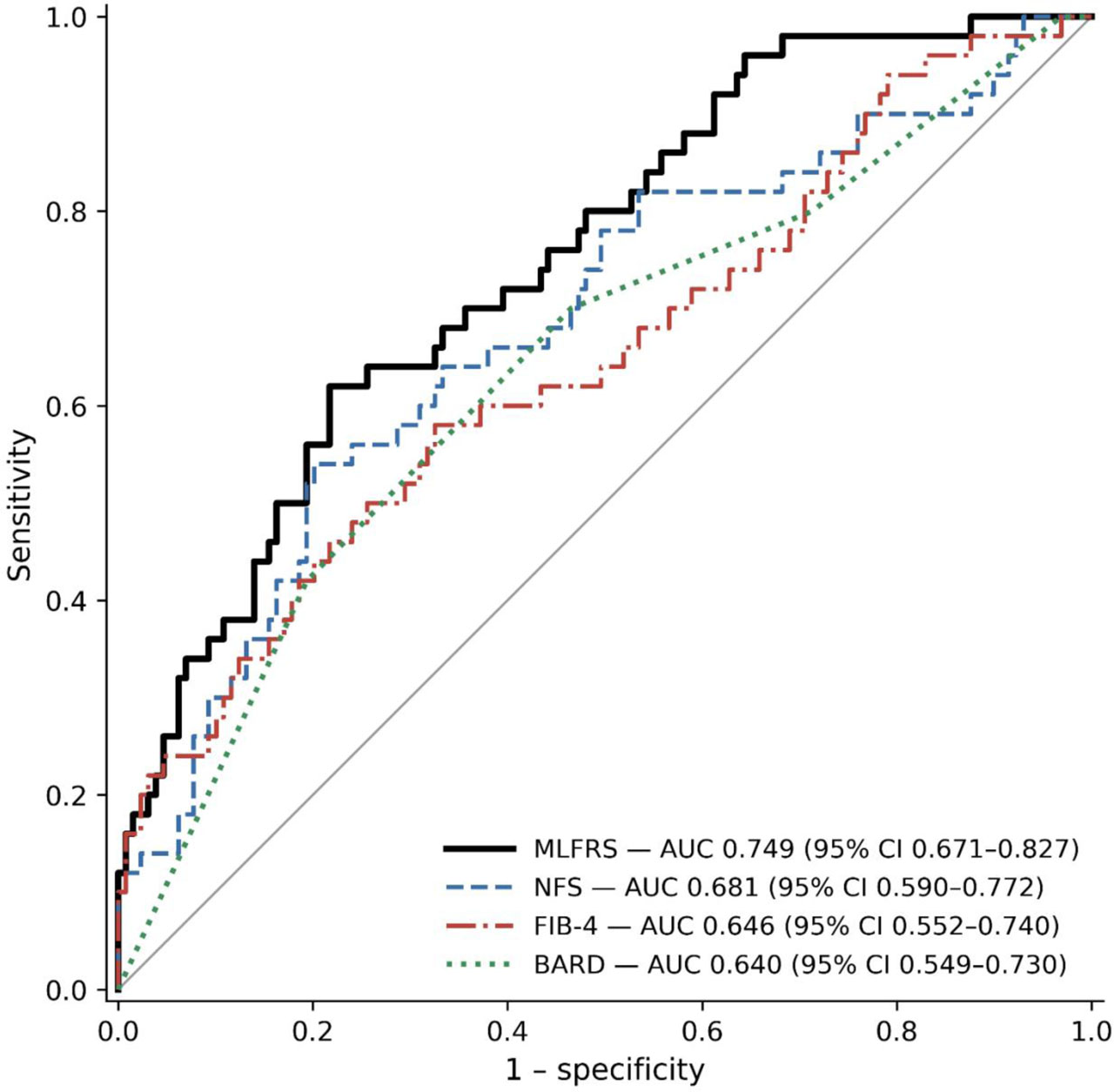
Figure 1.
Receiver operating characteristic curves of MLFRS, NFS, FIB-4 and BARD for VCTE-defined elevated liver stiffness (≥8.0 kPa) in 179 adults with MASLD (50 events).
DISCUSSION
Non-invasive prediction of fibrosis in MASLD remains under-studied. Wu et al. found FIB-4 and NFS superior to BARD and APRI [6], and Theofilis et al. found NFS superior to FIB-4 [7]. Shaheen et al. showed that FIB-4 performs substantially worse in diabetes and obesity [8] - the very components of the MASLD definition - and argued for new thresholds, as our data also suggest. An effective test must be non-invasive, affordable and accessible. FIB-4 requires AST, ALT and platelets, and NFS additionally albumin, which is not reimbursed in Polish primary care. MLFRS requires only HbA1c and AST alongside age and BMI, making it the least demanding of the three at the point of care.
A limitation of our study is the fact that the endpoint was VCTE-defined stiffness, which correlates with but is not equivalent to fibrosis stage and is influenced by steatosis, inflammation and obesity [9]. MLFRS predicts an imaging phenotype prompting referral, not fibrosis itself. With 50 events and four predictors, the corrected calibration slope below unity indicates residual overfitting. The MLFRS thresholds were derived in these data and are therefore optimistic. Finally, this single-centre pilot needs external validation.
CONCLUSIONS
Metabolic Liver Fibrosis Risk Score discriminated VCTE-defined elevated liver stiffness better than BARD and FIB-4 and comparably to NFS, using measurements easily available for all physicians. Our proposition appears to be a cost-effective and straightforward prediction option - however, given that it is only a pilot study, additional verification studies are required.