
Table 1
Main characteristics of prognostic scores
| Score (acronym) | Expanded name | Core components (concise) | Conceptual domain | Typical setting / use |
|---|---|---|---|---|
| ARIC AD-HFpEF [11] | ARIC Acute Decompensated HFpEF score | Age; systolic BP; BUN; sodium; hypoxia; heart rate; natriuretic peptides; anemia; underweight | Acute clinical burden / triage | Acute HFpEF admission; 28-day/1-year risk estimate |
| C2HEST [20] | Coronary artery disease; COPD; Hypertension; Elderly; Systolic HF; Thyroid disease | CAD; COPD; hypertension; age ≥75; prior systolic HF; thyroid disease | Comorbidity / systemic burden | Ambulatory HFpEF (TOPCAT) for background risk enrichment |
| CONUT [21][23][26][27][28] | Controlling Nutritional Status | Albumin; total cholesterol; lymphocyte count | Nutrition–inflammation | Older / hospitalized or post-discharge HFpEF |
| GNRI [22][24][27][28] | Geriatric Nutritional Risk Index | Albumin; weight-to-ideal-weight term | Nutrition–inflammation / frailty | Older/frail; hospitalized or ambulatory HFpEF |
| GWTG-HF [10] | Get With The Guidelines–Heart Failure risk score | Age; SBP; BUN; sodium; heart rate; COPD; race | Global clinical risk (mixed-EF derivation) | In-hospital acute HF; post-discharge risk stratification |
| H2FPEF [13][14][15][16][17] | Heavy; Hypertensive; Atrial fibrillation; Pulmonary hypertension; Elder; Filling pressure | BMI ≥30; ≥2 antihypertensives; AF; PASP/PH; age >60; E/e′ | Diagnostic framework repurposed for prognosis | Ambulatory/inpatient HFpEF; useful when stress testing unavailable |
| HFA-PEFF [14][15][17] | Heart Failure Association Pre-test assessment, Echocardiography & NP, Functional testing, Final aetiology | Echo + NP domains; functional testing (step-3) when available | Diagnostic framework repurposed for prognosis | Suspected/confirmed HFpEF; prognostic value highest with complete work-up |
| KCCQ [33] | Kansas City Cardiomyopathy Questionnaire (incl. KCCQ-12) | Patient-reported symptoms, function, quality of life | Patient-reported health status | Ambulatory/chronic HF (incl. HFpEF subsets) for outcome prediction and communication |
| LUS B-lines [19] | Lung ultrasound B-line count | B-line burden at discharge (residual pulmonary congestion) | Congestion physiology | Discharge risk stratification after acute HF (including HFpEF) |
| MAGGIC [9][17] | Meta-Analysis Global Group in Chronic HF risk score | Demographics; clinical status; comorbidities; therapies (standard MAGGIC variables) | Global clinical risk (mixed-EF derivation) | Chronic HF; validated in HFpEF subsets; longitudinal risk |
| MEDIA [18] | MEDIA echocardiographic score | PASP >40; IVC collapsibility <50%; average E/e′ >9; lateral s′ <7 | Echocardiography-only hemodynamic burden | Acute HFpEF and stable outpatient HFpEF |
| mGPS [29] | Modified Glasgow Prognostic Score | C-reactive protein; albumin | Inflammation–nutrition | Ambulatory HFpEF; 12-month outcomes |
| NRS-2002 [30] | Nutritional Risk Screening 2002 | BMI; weight loss; intake reduction; disease severity | Bedside nutrition screening | Acute HFpEF admissions; in-hospital risk (sex-specific effects) |
| SHFM [9] | Seattle Heart Failure Model | Clinical variables; labs; therapies; device therapy (model inputs) | Global clinical risk (mixed-EF derivation) | Chronic HF; comparator in HFpEF validation work |
| TRI [12] | TIMI Risk Index | Heart rate × (age/10)^2 ÷ systolic BP | Ultra-parsimonious acute triage | Acute HFpEF admission; in-hospital mortality triage |
| HALO [31] | HFpEF survivAL hOspitalization (HALO) score | Clinical severity; echocardiographic burden; natriuretic peptide load; prior HF hospitalization count | Multimodal HFpEF event risk (survival + recurrent admissions) | Recently hospitalized HFpEF; post-discharge risk stratification for survival and future admission burden |
| WATCH-DM [32] | WATCH-DM risk score | Age; BMI; BP; fasting glucose; creatinine; HDL-C; QRS; prior MI/CABG | Phenotype-specific (diabetes) | T2DM + HFpEF at discharge; ~1-year mortality |
[i] Abbreviations: AF – atrial fibrillation; BMI – body mass index; BNP – B-type natriuretic peptide; BUN – blood urea nitrogen; CONUT – Controlling Nutritional Status; CRP – C-reactive protein; GNRI – Geriatric Nutritional Risk Index; HALO – HFpEF survivAL hOspitalization; HFpEF – heart failure with preserved ejection fraction; IVC – inferior vena cava; KCCQ – Kansas City Cardiomyopathy Questionnaire; LUS – lung ultrasound; LVEF – left ventricular ejection fraction; mGPS – modified Glasgow Prognostic Score; MLHFQ – Minnesota Living with Heart Failure Questionnaire; NT-proBNP – N-terminal pro–B-type natriuretic peptide; PASP – pulmonary artery systolic pressure; PNI – Prognostic Nutritional Index; TRI – TIMI Risk Index.
Table 2
Practical applicability of clinician-usable HFpEF prognostic tools across settings and phenotypes
| Clinical context | Most feasible instruments | What they primarily capture | When they tend to add value | Key limitations / cautions |
|---|---|---|---|---|
| Acute admission triage (HFpEF) | ARIC AD-HFpEF; GWTG-HF; TRI [10][11][12] | Short-term mortality risk using readily available vitals and labs | Early triage and discharge planning; prioritizing follow-up intensity | GWTG-HF derived in mixed-EF populations; TRI trades physiologic specificity for speed |
| Discharge vulnerability after acute HF | LUS B-lines (± BNP/echo) [19] | Residual pulmonary congestion | Near-term readmission/death risk; decongestion targets before discharge | Requires operator familiarity; cut-points may vary across protocols |
| Ambulatory / longitudinal risk | MAGGIC (± BNP); KCCQ [9][33] | Global clinical burden and patient-reported status | Longitudinal counselling and shared decisions; complements event-focused tools | MAGGIC derived in mixed-EF cohorts; KCCQ evidence often from mixed HF samples |
| Echocardiography-only hemodynamic burden | MEDIA; H2FPEF (resting echo) [16][18] | Filling pressure, pulmonary pressure, venous congestion, longitudinal function | When natriuretic peptides are equivocal or stress testing unavailable | Generalizability depends on echo quality and cohort characteristics (e.g., AF exclusion in MEDIA ambulatory validation) |
| Older / frail or recently hospitalized HFpEF | GNRI; CONUT; mGPS; NRS-2002 [21][22][23][24][29][30] | Frailty-like vulnerability, malnutrition, inflammation | Risk refinement beyond BMI; identifies patients who may benefit from nutritional evaluation and closer follow-up | Definitions and thresholds differ; readmission associations may be less consistent than mortality |
| Phenotype-specific pathways | WATCH-DM (T2DM); C2HEST (comorbidity burden); nutrition indices for rhythm pathway [20][25][32] | Diabetes burden, systemic comorbidity, vulnerability affecting rhythm and recovery | Discharge decisions and surveillance tailored to phenotype | Derived/validated in specific cohorts; may require local adaptation to preserve performance |
| Multimodal HFpEF event risk | HALO; prior HF hospitalization count [31] | Structural/hemodynamic load plus prior events | Higher-risk recurrent admission phenotype | Data requirements (echo + biomarkers + history); external validation still limited |
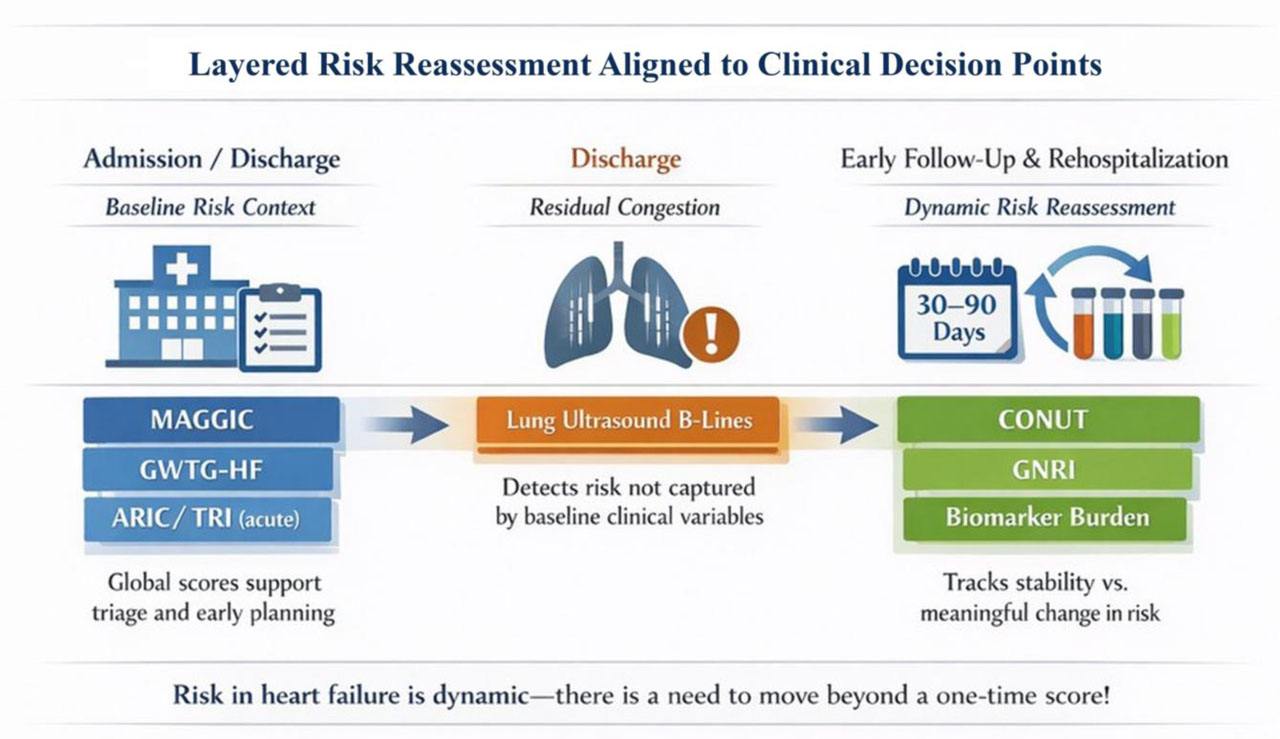
Figure 1.
Layered risk reassessment aligned to clinical decision points.
Supplementary Table 1
HFpEF definitions used across included studies
| Study | HFpEF definition |
|---|---|
| Rich, 2018 [9] | Framingham HF criteria + LVEF >50%. |
| Suzuki, 2018 [10] | LVEF ≥50% (HFpEF subgroup). |
| Thorvaldsen, 2017 [11] | Acute HFpEF hospitalization; LVEF ≥50%. |
| Matsushita, 2025 [12] | Hospitalized HFpEF; LVEF ≥50%. |
| Takahari, 2019 [13] | Suspected/exertional HFpEF; preserved EF (LVEF <50% excluded).a |
| Amanai, 2022 [14] | Symptoms + LVEF >50% + objective elevated filling pressures (exercise E/e′ or PCWP). |
| Barros, 2025 [15] | HFpEF defined per authors’ diagnostic framework (LVEF preserved).a |
| Hwang, 2020 [16] | Hospitalized HFpEF; preserved EF (LVEF <50% excluded). |
| Przewłocka-Kośmala, 2022 [17] | Dyspnea + LVEF ≥50% + diastolic dysfunction (sinus rhythm). |
| Coiro, 2023 [18] | Guideline-defined HFpEF; LVEF ≥50%. |
| Palazzuoli, 2018 [19] | LVEF ≥50%. |
| Liang, 2021 [20] | TOPCAT criteria: LVEF ≥45% + HF hospitalization or elevated natriuretic peptides. |
| Chien, 2019 [21] | Acute HF cohort; preserved EF (LVEF <50% excluded). |
| Nishi, 2019 [22] | Hospitalized HFpEF; LVEF ≥50%. |
| Chen, 2023 [23] | HFpEF cohort; preserved EF (LVEF <50% excluded).a |
| Minamisawa, 2019 [24] | TOPCAT criteria: LVEF ≥45% + HF hospitalization or elevated natriuretic peptides. |
| Zhang, 2025 [25] | ESC 2021 HFpEF criteria; additionally H2FPEF >5. |
| Kitao, 2025 [26] | Framingham HF + LVEF ≥50% + BNP/NT-proBNP threshold. |
| Sunaga, 2022 [27] | Framingham HF + LVEF ≥50% + BNP/NT-proBNP threshold. |
| Lu, 2025 [28] | PARAGON-HF criteria: LVEF ≥45% + elevated natriuretic peptides + structural criteria. |
| Bolat, 2020 [29] | ESC-based: symptoms/signs + LVEF ≥50% + NP + ≥1 echo criterion. |
| Czapla, 2025 [30] | HFpEF diagnosis per ESC 2016 guideline (criteria not restated).a |
| Schrutka, 2022 [31] | Symptoms/signs + LVEF ≥50% + diastolic dysfunction + NT-proBNP threshold. |
| Iwakura, 2024 [32] | Acute HFpEF hospitalization; LVEF ≥50%. |
| Yee, 2019 [33] | EF ≥50% (HFpEF) vs EF ≤40% (HFrEF comparator). |
Note:
a HFpEF definition not fully restated in the article text; summarized from the authors’ stated diagnostic framework, guideline reference, or inclusion/exclusion criteria.
Abbreviations: HFpEF – heart failure with preserved ejection fraction; LVEF – left ventricular ejection fraction; NP – natriuretic peptides; BNP – B-type natriuretic peptide; NT-proBNP – N-terminal pro–B-type natriuretic peptide; PCWP – pulmonary capillary wedge pressure; NR – not reported in the original article.
Supplementary Table 2
Mortality outcomes: prognostic performance of clinician-usable scores in HFpEF cohorts
| Study | Score | Setting / cohort | Study type | Population (HFpEF vs mixed-EF) | Mortality endpoint | Follow-up | Discrimination | Effect estimate (unit) | Keynote |
|---|---|---|---|---|---|---|---|---|---|
| Acute admissions: in-hospital and early mortality | |||||||||
| Czapla 2025 [30] | NRS-2002 | Hospitalized HFpEF (in-hospital) | Observational screening study | Hospitalized HFpEF | In-hospital mortality | Index hospitalization | NR | Not quantified (model-based odds/probabilities reported; no conventional OR/HR for NRS-2002 provided). | Sex-stratified signal; screening tool rather than HFpEF-specific score |
| Matsushita 2025 [12] | TRI | Acute HFpEF registry (in-hospital) | Development / validation in registry | Acute HFpEF registry | In-hospital mortality | Index hospitalization | AUC: 0.66 (95% CI, 0.65–0.68). | HR 1.021 per TRI unit (95% CI, 1.014–1.028). | Ultra-low input burden; intended for rapid triage |
| Thorvaldsen 2017 [11] | ARIC AD-HFpEF | Acute HFpEF admissions (community surveillance) | Derivation + validation (acute setting) | HFpEF admissions (community surveillance) | All-cause mortality | 28-day and 1-year | AUC derivation: 0.76 (28-day); 0.72 (1-year). Validation: 0.73 (28-day); 0.71 (1-year). | NR | HFpEF-oriented derivation for acute setting |
| Hospitalized or post-discharge cohorts: medium-to-long-term mortality | |||||||||
| Hwang 2020 [16] | H2FPEF | Hospitalized HFpEF (long-term follow-up) | Prognostic validation | Hospitalized HFpEF | All-cause mortality | 5 years | NR | Adjusted HR 1.053 per 1-point H2FPEF increase (95% CI, 1.008–1.101). | Prognostic gradient may reflect severity phenotype captured by the diagnostic score |
| Iwakura 2024 [32] | WATCH-DM | Post-discharge HFpEF with T2DM | Phenotype-specific validation | T2DM + HFpEF after hospitalization | All-cause death | Median 386 days | AUC: 0.64. | Adjusted HR 1.102 per 1-point WATCH-DM increase (95% CI, 1.009–1.203). | Diabetes-focused discharge tool; comparator performance similar to general scores |
| Suzuki 2018 [10] | GWTG-HF | Post-discharge chronic HF (mixed-EF; includes HFpEF) | Validation in post-discharge cohort | Chronic HF after hospitalization (includes HFpEF) | All-cause and cardiac death | Mean 965.8 days | C-stat (95% CI): 0.687 (0.649–0.725) for all-cause death; improved to 0.772 (0.739–0.805) with BNP. | HFpEF subgroup: HR 1.568 per 10-point GWTG-HF increase for all-cause death (95% CI, 1.207–2.023). | Mixed-EF derivation; post-discharge prognostic value in HFpEF subsets |
| Trial cohorts | |||||||||
| Lu 2025 [28] | CONUT; GNRI | Trial cohort (PARAG ON-HF) | Post-hoc trial analysis (trajectory) | PARAGO N-HF HFpEF | CV death | Median 2.9 years | NR | Adjusted HR 1.97 for all-cause death with any abnormal CONUT and/or GNRI (95% CI, 1.65–2.36). | Trajectory-based risk refinement; post-discharge change adds information |
| Minamisawa 2019 [24] | GNRI | Trial cohort (TOPCAT) | Post-hoc trial analysis | TOPCAT-Americas HFpEF | All-cause death; CV outcomes | Median 2.9 years | NR | HR 1.34–2.06 (by outcome) | Large trial cohort; supports GNRI as baseline risk layer |
| Diagnostic evaluation cohorts | |||||||||
| Przewłocka-Kośmala 2022 [17] | H2FPEF | Suspected HFpEF diagnostic cohort (exercise testing) | Head-to-head comparison | Suspected HFpEF with exertional dyspnea (sinus rhythm only) | CV death | Median 48 months | Harrell’s C: 0.644 | NR | Exercise (step-3) data improved stratification for HFA-PEFF |
| Przewłocka-Kośmala 2022 [17] | HFA-PEFF (Step 2) | Suspected HFpEF diagnostic cohort (exercise testing) | Head-to-head comparison | Suspected HFpEF with exertional dyspnea (sinus rhythm only) | CV death | Median 48 months | Harrell’s C: 0.638 | NR | Exercise (step-3) data improved stratification for HFA-PEFF |
| Przewłocka-Kośmala 2022 [17] | HFA-PEFF (Step 3) | Suspected HFpEF diagnostic cohort (exercise testing) | Head-to-head comparison | Suspected HFpEF with exertional dyspnea (sinus rhythm only) | CV death | Median 48 months | Harrell’s C: 0.715 | NR | Exercise (step-3) data improved stratification for HFA-PEFF |
| Przewłocka-Kośmala 2022 [17] | MAGGIC | Suspected HFpEF diagnostic cohort (exercise testing) | Head-to-head comparison | Suspected HFpEF with exertional dyspnea (sinus rhythm only) | CV death | Median 48 months | Harrell’s C: 0.637 | NR | Exercise (step-3) data improved stratification for HFA-PEFF |
| Ambulatory and mixed inpatient/outpatient cohorts | |||||||||
| Bolat 2020 [29] | mGPS (± NT-proBNP) | Ambulatory HFpEF cohort | Observational prognostic study | Ambulatory HFpEF | All-cause death | 12 months | AUC 0.759; 0.822 with NT-proBNP | OR 2.42 (mGPS 1) and 3.84 (mGPS 2) vs mGPS 0 | Inflammation plus nutrition may complement natriuretic peptides |
| Coiro 2023 [18] | MEDIA | Hospitalized and ambulatory HFpEF cohorts | Validation across cohorts | Hospitalized HFpEF and stable outpatient HFpEF | All-cause death | Up to 2 years (hospitalized cohort); shorter in ambulatory cohort | Not quantified (qualitative statement only: reported as moderate discrimination; no AUC/C-index provided) | Adjusted HR 2.10 (high vs low score; 95% CI NR) | AF excluded in ambulatory cohort for diastolic validity; limits generalizability |
| Mixed-EF cohorts: HFpEF subset analyses | |||||||||
| Rich 2018 [9] | MAGGIC (± BNP); SHFM (comparison) | Chronic HF cohort (mixed-EF); HFpEF subset | External validation / comparison | HFpEF subset validation within broader HF cohorts | All-cause mortality | Mean 3.6 years | C-statistic for all-cause mortality: 0.74 (95% CI 0.68–0.80) | NR | Mixed-EF derivation; HFpEF use relies on validation rather than HFpEF-only derivation |
| Yee 2019 [33] | KCCQ | Chronic HF cohort (mixed-EF; includes HFpEF subset) | Validation / prognostic association | Mixed HF (includes HFpEF subset) | Death/LVAD/transplant | Up to 2 years | C-index: 0.702 (95% CI, 0.666–0.738) | Adjusted HR 0.894 per 5-point KCCQ increase (95% CI, 0.864–0.924) | Patient-reported health status predicts outcomes and may aid shared decisions |
| Yee 2019 [33] | MLHFQ | Chronic HF cohort (mixed-EF; includes HFpEF subset) | Validation / prognostic association | Mixed HF (includes HFpEF subset) | Death/LVAD/transplant | Up to 2 years | C-index: 0.658 (95% CI, 0.621–0.695) | Adjusted HR 1.077 per 5-point MLHFQ increase (95% CI, 1.045–1.109) | Patient-reported health status predicts outcomes and may aid shared decisions |
| Other HFpEF cohorts | |||||||||
| Chen 2023 [23] | CONUT; GNRI; PNI | Older adults with HFpEF | Comparative prognostic study | Older adults with HFpEF | All-cause death | 1 year | AUC (all-cause mortality): 0.789 (95% CI, 0.739–0.834). | Cox regression (continuous): CONUT score HR 1.555 (95% CI, 1.419–1.705); GNRI HR 0.949 (95% CI, 0.927–0.971); PNI HR 0.862 (95% CI, 0.824–0.902). | Comparative nutrition indices; mortality associations clearer than readmission |
| Nishi 2019 [22] | GNRI | HFpEF cohort (setting not specified) | Observational prognostic study | HFpEF | All-cause death | Median 503.5 days | AUROC: GNRI 0.75; albumin 0.71; GNRI+albumin 0.80. | Adjusted HR 3.075 for high GNRI risk (95% CI, 1.244–7.600). | Nutrition-frailty signal prominent in older HFpEF |
[i] Abbreviations: AUC – area under the receiver operating characteristic curve; CI – confidence interval; HR – hazard ratio; OR – odds ratio; NR – not reported in the original article; Not quantified – qualitative statement without a numeric estimate; Not extractable – estimates reported only by categories/trajectories without a single summary effect.
Supplementary Table 3
Heart-failure hospitalization and composite outcomes-prognostic performance of clinician-usable scores in HFpEF cohorts
| Study | Score | Setting / cohort | Study type | Population | Hospitalization endpoint | Follow-up | Discrimination | Effect estimate (unit) | Keynote |
|---|---|---|---|---|---|---|---|---|---|
| Trial cohorts and stable ambulatory risk | |||||||||
| Coiro 2023 [18] | MEDIA | Hospitalized and ambulatory HFpEF cohorts | Validation across cohorts | Hospitalized and ambulatory HFpEF | HF hospitalization (ambulatory) and composites | Variable by cohort | NR | Adjusted HR 3.39 for HF hospitalization (ambulatory cohort; 95% CI NR). | Echo-only tool; AF excluded in ambulatory cohort |
| Liang 2021 [20] | C2HEST | Trial cohort (TOPCAT) | Post-hoc trial analysis | TOPCAT HFpEF | HF hospitalization; all-cause hospitalization | Median 3.07 years | Time-dependent AUC (5y): HF hospitalization 0.621 (95% CI, 0.577–0.665); all-cause hospitalization 0.638 (95% CI, 0.606–0.670). | Adjusted HR per 1-point C2HEST increase: HF hospitalization 1.14 (95% CI, 1.01–1.29); any hospitalization 1.22 (95% CI, 1.14–1.29). | Originally AF-focused; here used for broader risk enrichment |
| Lu 2025 [28] | CONUT; GNRI (baseline and change) | Trial cohort (PARAGON-HF) | Post-hoc trial analysis (trajectory) | PARAGON-HF HFpEF | HF hospitalization | Median 2.9 years | NR | Not extractable (trajectory-specific HRs reported; no single summary effect estimate) | Trajectory-based approach aligns with longitudinal risk refinement |
| Rich 2018 [9] | MAGGIC (± BNP) | Chronic HF cohort (mixed-EF); HFpEF subset | External validation | HFpEF validation subset | Composite: HF hospitalization or death | Mean 3.6 years | C-stat (95% CI): 0.64 (0.58–0.69) | HR 1.8 per 1-SD increase in MAGGIC for composite CV hospitalization or death (95% CI, 1.6–2.1). | Mixed-EF derivation; composite endpoint definitions vary across cohorts |
| Diagnostic evaluation and prospective HFpEF cohorts | |||||||||
| Barros 2025 [15] | H2FPEF | Prospective HFpEF cohort | Prospective comparison / validation | Prospective HFpEF cohort | HF hospitalization; composite events | 2–3 years | AUC: 0.637 (95% CI, 0.518–0.756) | HR 2.316 for H2FPEF >3 vs ≤3 (95% CI, 0.973–5.513); p=0.058. | Stress testing limited; feasibility influences comparative performance |
| Barros 2025 [15] | HFA-PEFF | Prospective HFpEF cohort | Prospective comparison / validation | Prospective HFpEF cohort | HF hospitalization; composite events | 2–3 years | AUC: 0.572 (95% CI, 0.448–0.696) | NR | Stress testing limited; feasibility influences comparative performance |
| Przewłocka-Kośmala 2022 [17] | MAGGIC; H2FPEF; HFA-PEFF | Suspected HFpEF diagnostic cohort (exercise testing) | Head-to-head comparison | Suspected HFpEF with exertional dyspnea | HF hospitalization | Median 48 months | c-index range 0.637–0.715 | NR | Exercise testing (step-3) improved prognostic stratification |
| Hospitalized or post-discharge cohorts: readmission and composite events | |||||||||
| Chen 2023 [23] | CONUT; GNRI; PNI | Older adults with HFpEF | Observational prognostic study | Older HFpEF | HF readmission | 1 year | NR | Non-significant association (p≥0.05; effect estimate not provided) | Readmission links may be weaker than mortality associations in some cohorts |
| Chien 2019 [21] | GNRI; CONUT; PNI; albumin | Acute HFpEF | Head-to-head comparison | Acute HFpEF | HF rehospitalization | Median 1255 days | NR | Not extractable (index-specific HRs reported; no single summary effect estimate) | Nutrition indices compared head-to-head in acute HFpEF |
| Hwang 2020 [16] | H2FPEF | Hospitalized HFpEF (long-term follow-up) | Prognostic validation | Hospitalized HFpEF | Composite: HF hospitalization or all-cause death | 5 years | NR | HR 1.05 per 1-point increase | Diagnostic score may capture severity of presentation |
| Kitao 2025 [26] | CONUT (trajectory) | Acute HFpEF registry (PURSUIT-HFpEF) | Trajectory analysis (registry) | Acute HFpEF (PURSUIT-HFpEF) | HF readmission and death | Mean 482 days | NR | Abnormal CONUT at 1 year: adjusted HR 2.87 (95% CI, 1.32–6.22). CONUT normalization: adjusted HR 0.40 (95% CI, 0.23–0.67). | Serial change adds information beyond baseline score |
| Palazzuoli 2018 [19] | LUS B-lines (± BNP, echo) | Acute HF (mixed-EF) at discharge | Observational prognostic study | Acute HF (HFrEF and HFpEF) | Composite: 6-month readmission or death | 6 months | AUC (death/HF rehospitalization): 0.83 (95% CI, 0.77–0.90). | Multivariable HR 1.16 per additional B-line at discharge (95% CI, 1.11–1.21). | Discharge congestion may outperform admission-only measures Youden cut-point: 22 B-lines at discharge. |
| Sunaga 2022 [27] | GNRI; CONUT; PNI (change during stay) | Hospitalized HFpEF | Change-based prognostic analysis | Hospitalized HFpEF | HF hospitalization and death | Median 421 days | NR | Not quantified (directionally consistent associations; no single summary numeric estimate) | Emphasizes in-hospital change rather than baseline alone |
[i] Abbreviations: AUC – area under the receiver operating characteristic curve; CI – confidence interval; HFH – heart failure hospitalization; HR – hazard ratio; IR – incidence rate; NR – not reported in the original article; Not quantified – qualitative statement without a numeric estimate; Not extractable – estimates reported only by categories/trajectories without a single summary effect.