
Table 1
Baseline Characteristics of Patients with HF with EF > 45%, Stratified by NYHA Class
| Variable (Units), Mean (SD) or Median (IQR) | Overall Population (n = 116) | G1 (NYHA I, n = 48) | G2 (NYHA II, n = 37) | G3 (NYHA III–IV, n = 31) |
|---|---|---|---|---|
| Age (years), mean (SD) | 59.76 (13.5) | 53.17 (11.2) | 64.38 (12.8) | 64.77 (13.9) |
| Female sex, n (%) | 48 (41.4%) | 20 (41.7%) | 16 (43.2%) | 12 (38.7%) |
| BMI (kg/m2), median (IQR) | 29.39 (25.59–34.55) | 29.07 (25.65–34.22) | 29.39 (25.59–34.55) | 30.93 (23.18–35.32) |
| CKD, n (%) | 43 (37%) | 14 (29%) | 14 (38%) | 15 (48%) |
| Total Cholesterol (mg/dL), median (IQR) | 245 (200–275) | 238 (195–278) | 250 (200–275) | 245 (210–276) |
| Diabetes, n (%) | 87 (75.0%) | 36 (75.0%) | 28 (75.7%) | 23 (74.2%) |
| Beta-blockers, n (%) | 79 (68%) | 31 (65%) | 26 (70%) | 22 (71%) |
| ACE/ARBs, n (%) | 72 (62%) | 29 (60%) | 23 (62%) | 20 (65%) |
| Diuretics, n (%) | 60 (52%) | 19 (40%) | 20 (54%) | 21 (68%) |
| SGLT2 Inhibitors, n (%) | 25 (22%) | 7 (15%) | 9 (24%) | 9 (29%) |
| MRAs, n (%) | 32 (28%) | 10 (20%) | 11 (30%) | 11 (35%) |
| NT-proBNP (pg/mL), median (IQR) | 446 (303–819) | 318 (207–454) | 500 (320–737) | 716 (483–947) |
| E/A Ratio, median (IQR) | 1.2 (0.9–1.8) | 0.9 (0.8–1.2) | 1.3 (1.0–1.6) | 1.8 (1.4–2.2) |
| E/e’ Ratio, median (IQR) | 12 (9–16) | 9 (8–11) | 13 (10–15) | 16 (14–18) |
| GLS (%), mean (SD) | −17.16 (2.8) | −18.54 (2.9) | −17.05 (2.5) | −15.48 (2.1) |
| LAS (%), median (IQR) | 26 (19–41) | 35 (27–44) | 25 (19–29) | 21 (17–27) |
| LVEF (%), mean (SD) | 51.91 (4.5) | 55.83 (4.2) | 50.00 (3.8) | 48.71 (3.2) |
| TETRA (ng/mL), median (IQR) | 34.0 (21.5–55.3) | 48.9 (34.4–64.0) | 33.2 (21.5–51.2) | 27.6 (18.9–37.1) |
[i] SD = Standard Deviation; IQR = Interquartile Range; BMI = Body Mass Index; CKD = Chronic Kidney Disease; SGLT2 = Sodium-Glucose Cotransporter-2; MRA = Mineralocorticoid Receptor Antagonist; LAS = Left Atrial Reservoir Strain; GLS = Global Longitudinal Strain; LVEF = Left Ventricular Ejection Fraction; TETRA = Tetranectin.
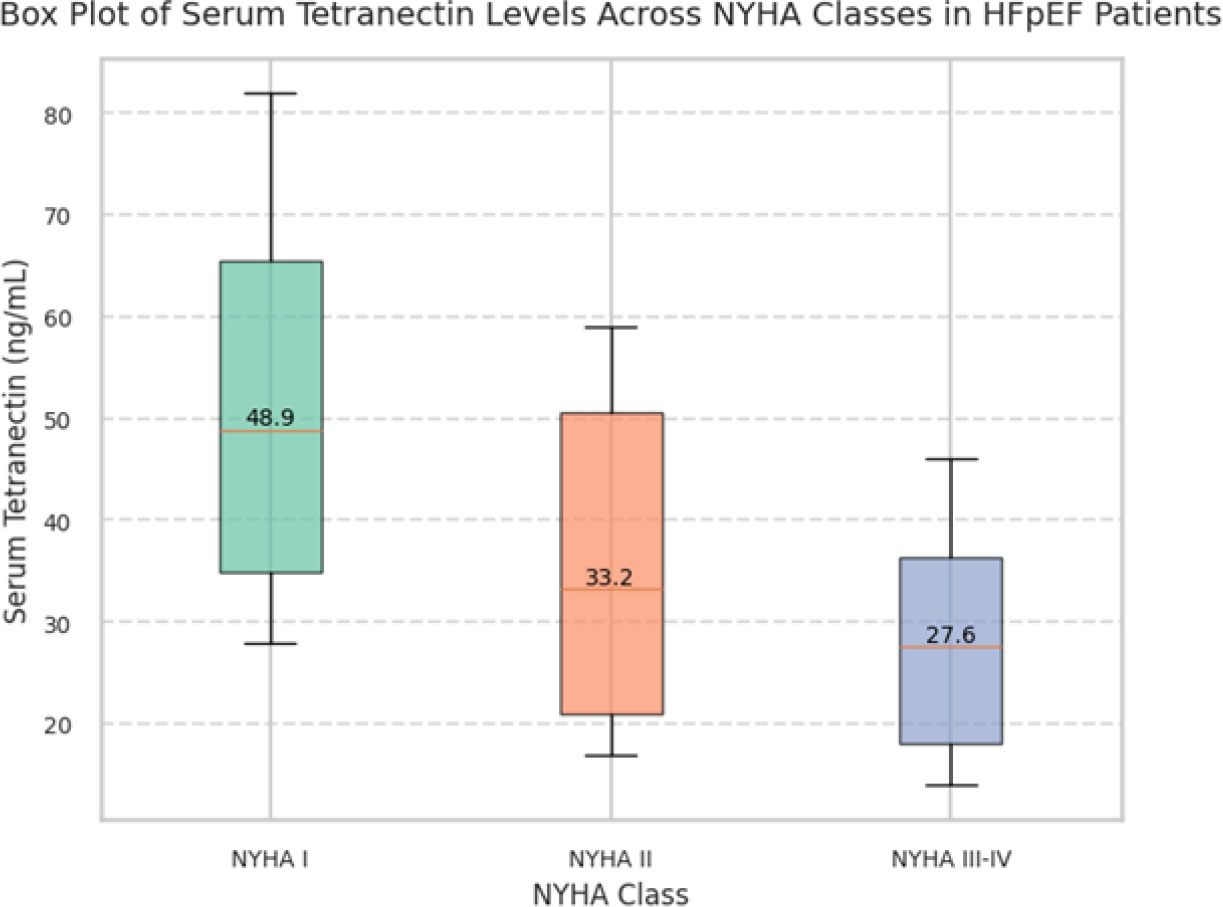
Figure 1.
Distribution of Serum Tetranectin by NYHA Class.
Table 2
Effect Sizes (Cohen’s d) for Pairwise Comparisons of TETRA Levels Across NYHA Classes
| Comparison | TETRA (Cohen’s d) |
|---|---|
| G1 vs. G2 | 2.43 |
| G1 vs. G3 | 3.19 |
| G2 vs. G3 | 1.96 |
Table 3
Group Differences in Clinical and Echocardiographic Variables Across NYHA Classes
| Variable (Units) | Test Statistic (F or H) | p-value |
|---|---|---|
| Age (years) | F = 12.547 | <0.001 |
| NT-proBNP (pg/mL) | H = 58.324 | <0.001 |
| E/e’ Ratio | H = 45.872 | 0.003 |
| LAVI (mL/m2) | H = 39.214 | 0.025 |
| LAS (%) | H = 42.135 | <0.001 |
| GLS (%) | F = 8.976 | 0.009 |
| LVEF (%) | F = 10.342 | 0.017 |
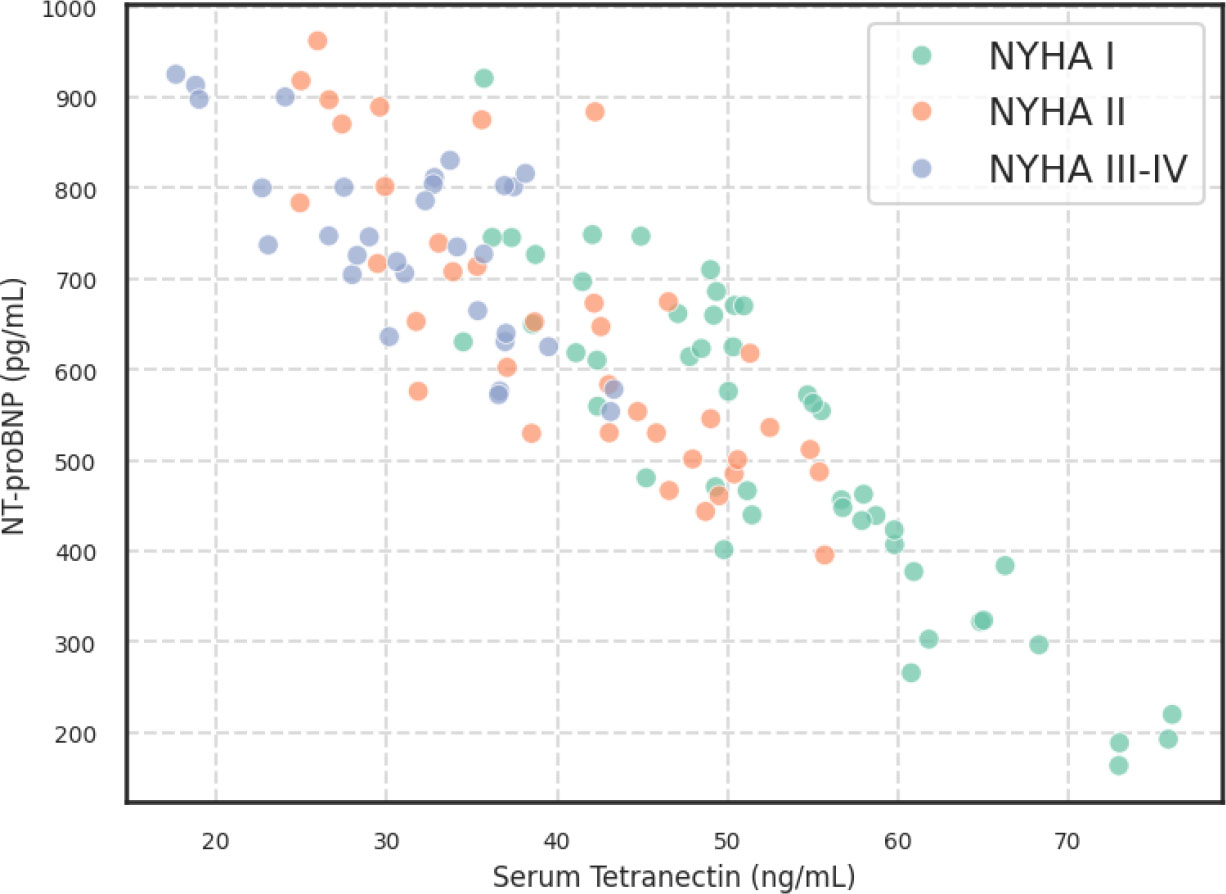
Figure 2.
Scatter Plot with Regression Line Illustrating the Relationship Between Serum Tetranectin and NT-proBNP in HF with EF > 45% Patients.
Table 4
Spearman’s Rank Correlations Between TETRA and Clinical/Echocardiographic Variables
| Variable | Spearman’s rho | p-value |
|---|---|---|
| NT-proBNP (pg/mL) | −0.66 | <0.001 |
| E/e’ Ratio | −0.58 | 0.003 |
| LAVI (mL/m2) | −0.52 | 0.010 |
| LAS (%) | 0.55 | 0.005 |
| GLS (%) | 0.48 | 0.024 |
| LVEF (%) | 0.45 | 0.038 |
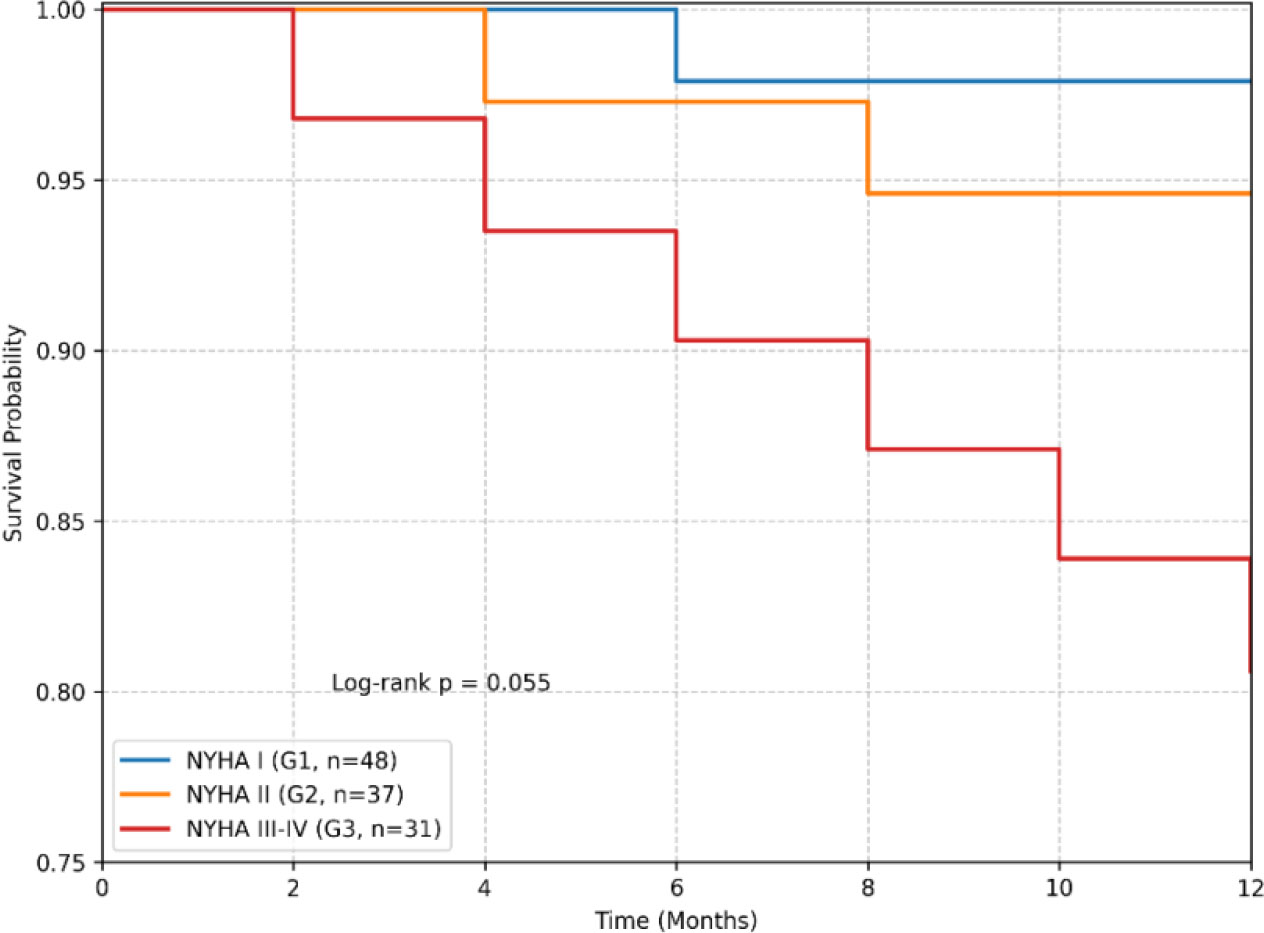
Figure 3.
Kaplain-Meier Curves by NYHA Class in HFpEF Patients.