
INTRODUCTION
Inflammatory bowel diseases (IBDs) are a collection of chronic inflammatory disorders that affect the gastrointestinal tract and are characterized by periods of remission and relapse. Crohn’s disease (CD) and ulcerative colitis (UC) are the two primary forms of IBD. The pathogenesis of IBD is not well understood; however, comprehensive epidemiologic and genetic studies indicate that IBD is the result of intricate interactions between genetic, immunological, and environmental factors [1].
IBD has experienced an enormous rise in prevalence among the general population, particularly in childhood, and is now being reported in an increasing number of older individuals and the elderly over the past century. An affected family member is the most significant risk factor for developing IBD. The concordance rate between dizygotic twins is 4%, while it is 50% in monozygotic twins. However, the majority of patients with IBD do not have a family member who is affected [2, 3].
UC is defined by recurrent episodes of inflammation that are restricted to the mucosal layer of the colon. Initially, it frequently affects the rectum, and it may progress proximally and continuously to encompass other sections of the colon [4].
A non-invasive procedure known as anorectal manometry quantifies and evaluates various aspects of the intricate and multifactorial mechanisms that regulate defecation and continence. This method is employed to assess the pressure of anal sphincters, the sensation of the rectum, and the integrity of neural reflexes that are essential for a typical bowel movement. Conventional catheters or high-resolution catheters may be implemented to execute anorectal manometry. Conventional catheters are equipped with solid-state, air-charged, or water-perfused sensors, while high-resolution catheters utilize 3-dimensional high-resolution anorectal manometry or high-resolution manometry [5, 6].
This study aimed to evaluate the prevalence of defecatory disorders in patients with quiescent UC through the use of high-resolution anorectal manometry.
MATERIAL AND METHODS
STUDY DESIGN AND SELECTION OF ENROLLED PATIENTS
This was a prospective cross-sectional study on a cohort of 50 patients; aged 19 to 76 years old, of both genders, who have documented disease remission or mild activity clinically and by colonoscopy for the last 6 months and who had persistent defecatory disorder symptoms (Constipation, faecal incontinence, urgency, rectal pain, and/or sense of incomplete evacuation). Disease activity was assessed clinically & endoscopically by Mayo score: the most widely used although it doesn’t include the evaluation of bowel urgency.
The study was conducted from 01/12/2022 to 01/5/2024 in accordance with the Good Clinical Practice guidelines and Declaration of Helsinki after obtaining approval of the local Ethics Committee and the Institutional Review Board, Faculty of Medicine (IRB number 0107464), Alexandria University. An informed, written consent was obtained from all patients prior to their enrollment.
Key exclusion criteria for the studied patients were patients who had moderate and severe activity, patients with IBS, a history of anorectal stricturing or fistulizing disease, and prior surgery involving the anorectum.
A complete detailed history of the patients was recorded including symptoms of gastrointestinal diseases such as abdominal pain, diarrhoea, rectal bleeding, extraintestinal manifestations of UC (e.g., joint pain), and symptoms of defecatory disorders (faecal incontinence, urgency, rectal pain, and/or sense of incomplete evacuation). Also, they were subjected to a thorough clinical assessment including abdominal examination with stress on tenderness, organomegaly or palpable mass, and perianal and Digital rectal examination (DRE). Clinical evaluation was routinely carried out at the relevant specialized clinics at Alexandria University Hospitals, Alexandria, Egypt and National Liver Institute Hospital, Menoufia, Egypt. Only after exclusion of the key excluded causes, the patients were enrolled. Laboratory investigations including complete blood picture (CBC), erythrocyte sedimentation rate (ESR), quantitative C-reactive protein (CRP), and faecal calprotectin were done. All included subjects were subjected to diagnostic colonoscopy (Olympus CF-Q160, Olympus Corp., Tokyo, Japan) to ensure remission or mild activity for the last 3–6 months based on the Mayo score [7].
A high-resolution anorectal manometry (HRAM) was performed to evaluate anal sphincter function, recto-anal coordination during simulated defecation, rectal sensory function, and recto-anal reflex activity (Solar GI HRAM, Laborie MMS®, Netherlands).
Because HRAM was a very safe procedure, fasting was unnecessary, but a light breakfast was advised at least 2 hours before the procedure. The usual morning medications were taken with a small cup of water at least 2 hours before the test. The patient was advised to refrain from consuming caffeine or using topical lidocaine on the day of the procedure. After DRE, an enema was administered if stool was detected (at least 30 minutes before the catheter was inserted). The patient was dressed in a hospital gown. The patient was positioned in the left lateral position, with the knees and hips bent at a 90-degree angle, and the catheter was gently inserted into the rectum with lubrication. The catheter’s dorsal aspect was aligned with that of the patient.
STEPS OF HRAM TESTS
Stabilization phase: three minutes of stabilization was observed following catheter insertion and before test maneuvers to allow the anal tone to return to its baseline.
Rest phase: measures basal anal tone at rest (recorded for more than 60 seconds with no reported measurements). The qualitative description of ultraslow waves, if present, was reported, in addition to a quantitative measurement of anal resting pressure.
Short squeeze phase: to record anal pressure during a voluntary effort to contract the anus/pelvic floor. Three squeezes were executed, each lasting 5 seconds, with 30-second recovery intervals. The analysis was conducted for the most qualitatively normal attempt.
Long (endurance) squeeze: to record anal pressure during sustained voluntary effort over 30 seconds. Quantitative measurement of anal squeeze pressure was reported (maximum incremental pressure).
The primary objective was to describe fatigue over time, as opposed to purely contractile ability, as measured during the short squeeze phase. A single endurance squeeze was executed, followed by a 60-second recovery interval. The maneuver that measures recto-anal pressure changes during cough was reported as a quantitative measurement of endurance squeeze pressure. This maneuver assesses the reflex increase in anal sphincter pressure during an abrupt change in intra-rectal (surrogate of intra-abdominal/intra-pelvic) pressure.
Two single coughs were executed, with a 30-second recovery interval between maneuvers. The analysis was conducted using the most successful attempt, which was defined as the attempt that resulted in the greatest increase in rectal pressure. The maximum pressure change was recorded during the quantitative measurement of both rectal pressure and anal pressure during coughing. The anal and rectal pressure changes during simulated defecation were measured by this maneuver. Three pushes were executed, each lasting 15 seconds, with 30-second intervals between maneuvers for recovery.
The analysis was conducted using the most qualitatively normal attempt. Quantitative measurements of the rectal and anal pressure change during push were reported, as well as the rectal sensory test, which evaluates rectal sensitivity to gradual distension using the balloon attached to the catheter tip. The balloon volume was quantitatively measured for each of the three patient-reported sensory thresholds: first constant sensation volume (FCSV), desire to defecate volume (DDV), and maximum tolerated volume (MTV). Assessment of HRAM test results was done according to London classification using the IAPWG protocol. The following were the resulting diagnoses for each component of the classification:
A) Disorder of the recto-anal inhibitory reflex (RAIR):
Which included either RAIR not elicited, recto-anal are flexia, or a ‘negative/normal’ study: No disorder of the RAIR.
B) Disorders of anal tone and contractility:
− Anal hypertension: defined as the anal resting pressure exceeding the upper limit of normal (ULN).
− Combined anal hypotension/hypo-contractility: defined when both the anal resting pressure and anal squeeze pressure were below the lower limit of normal (LLN).
− Anal hypotension with normal contractility: defined as anal resting pressure below the LLN and normal anal squeeze pressure.
− Anal normotension with hypo-contractility: defined as normal anal resting pressure and the anal squeeze pressure below the LLN.
− A negative/normal study: defined when no disorder of anal tone or contractility was reported.
C) Disorders of recto-anal co-ordination:
Initially, we evaluated the results of the balloon expulsion test, followed by the rectal pressure and the anal pressure. The following disorders were reported as follows:
− Abnormal expulsion with normal recto-anal coordination: the balloon expulsion test was abnormal, with a normal increase in rectal pressure and a normal decrease in anal pressure during the push.
− Abnormal expulsion with dyssynergia: the balloon expulsion test was abnormal with normal rectal pressure increase but no normal decrease in anal pressure during push.
− Abnormal expulsion with poor propulsion: the balloon expulsion test was abnormal with no normal rectal pressure increase but with a normal decrease in anal pressure during push.
− Abnormal expulsion with poor propulsion and dyssynergia: the balloon expulsion test was abnormal with no normal rectal pressure increase and with no normal decrease in anal pressure during push.
− Normal expulsion with abnormal recto-anal coordination: if the balloon expulsion test was normal with any abnormal pattern of recto-anal coordination.
− A ‘negative/normal’ study: No disorder of recto-anal coordination.
D) Disorders of rectal sensation:
We assessed three sensory parameters; FCSV, DDV; and MTV. The following abnormalities were reported as follows:
− Rectal hyposensitivity: two or more out of the three previous sensory parameters exceeding the threshold of ULN.
− Borderline rectal hyposensitivity: one out of the three previous sensory parameters exceeding the threshold of ULN.
− Rectal hypersensitivity: one out of the three previous sensory parameters was below the threshold of LLN.
− A ‘negative/normal’ study: No disorder of rectal sensation.
STATISTICAL ANALYSIS OF THE DATA
SPSS v28 (IBM©, Armonk, NY, USA) was employed to conduct statistical analysis. The normality of data distribution was assessed. Data were expressed as mean ± SD or median and interquartile range (IQR) as appropriate. The unpaired student t-test was employed to analyze the quantitative parametric data, while the Whitney test was employed to analyze non-parametric data. The Chi-square test and Fisher’s exact test were used as appropriate. Statistical significance was defined as a two-tailed P value that was less than 0.05.
The study was conducted in accordance with Good Clinical Practice guidelines and declaration of Helsinki after local ethical committee approval by the Institutional Review Board (IRB number 0107464), Faculty of Medicine, Alexandria University.
RESULTS
The baseline clinico-laboratory data are shown in Table 1. Male gender represented 40% of patients. 41 (82.0%) patients were nonsmokers, and (8.0%) patients were smokers. Abdominal pain was absent in 38 (76.0%) patients. Bleeding per rectum was absent from 43 (86.0%) patients. 9 (18%) patients had extra-intestinal manifestations [3 (6.0%) patients with peripheral arthralgia, 3 (6.0%) patients with bilateral sacroiliitis, 2 (4.0%) patients with episcleritis, 1 (2.0%) patient with primary sclerosing cholangitis]. As per DRE, 1 (2.0%) patient had perianal tenderness, 8 (16.0%) patients had skin tags, and 1 (2.0%) patient had tight anal verge. The mean value of CRP was 5.01 ± 5.01mg/dl, ESR was 14.24 ± 8.88mm/h first hour, and the faecal calprotectin was with mean ± SD 48.85 ± 29.37μg/g.
Table 1
Baseline characteristics of the study population (n = 50)
| Age (years) Mean ± SD. | 37.60 ± 12.58 |
| Male gender (n, %) | 20 (40.0) |
| Smoking status (n, %) | |
| Non-smoker | 41 (82.0) |
| Ex-smoker | 5 (10.0) |
| Smoker | 4 (8.0) |
| BMI (kg/m2) | |
| Mean ± SD. | 26.91 ± 4.88 |
| Underweight <18.5 | 1 (2.0) |
| Normal <18.5 – <25 | 17 (34.0) |
| Overweight 25 – <30 | 20 (40.0) |
| Obese ≥30 | 12 (24.0) |
| Symptomatology | |
| Abdominal pain (n, %) | |
| No | 38 (76.0) |
| Mild | 9 (18.0) |
| Moderate | 3 (6.0) |
| Diarrhea | 6 (12.0) |
| Bleeding per rectum (n, %) | |
| No | 43 (86.0) |
| Minimal | 4 (8.0) |
| Mild | 3 (6.0) |
| Clinical examination | |
| Abdominal tenderness (n, %) | |
| No | 41 (82.0) |
| Mild | 9 (18.0) |
| Organomegaly (n, %) | 2 (4.0) |
| Palpable masses (n, %) | 0 (0.0) |
| Peri-anal and DRE (n, %) | |
| Normal | 40 (80.0) |
| Tenderness | 1 (2.0) |
| Skin Tags | 8 (16.0) |
| Tight anal verge | 1 (2.0) |
| Extra-intestinal disease (n, %) | |
| PSC | 1 (2.0) |
| Peripheral arthralgia | 3 (6.0) |
| Episcleritis | 2 (4.0) |
| Bilateral sacroiliitis | 3 (6.0) |
| Laboratory investigations: Mean ± SD. | |
| Hemoglobin (g/dl) | 12.32 ± 1.80 |
| Platelet (×103/μl) | 282.0 ± 104.5 |
| WBCs (×103/μl) | 7.74 ± 2.69 |
| CRP | 5.01 ± 5.01 |
| ESR (mm/h) 1st hour | 14.24 ± 8.88 |
| Fecal calprotectin (μg/g) | 48.85 ± 29.37 |
| Chef defecatory complaint (n, %) | |
| Constipation | 28 (56.0) |
| Fecal incontinence | 10 (20.0) |
| Urgency | 15 (30.0) |
| Incomplete evacuation | 31 (62.0) |
| Proctalgia | 17 (34.0) |
PREVALENCE OF DEFECATORY DISORDERS
We observed an overlapping between the symptoms, 31 (62.0%) patients complained of a sense of incomplete evacuation, 28 (56.0%) cases had constipation, 17 (34.0%) cases had proctalgia, 15 (30.0%) cases had urgency, and 10 (20.0%) cases had faecal incontinence.
Anorectal manometry study (Table 2, Figures 1 and 2) showed that 47 (94.0%) patients had no disorder of RAIR, 3 (6.0%) had recto-anal areflexia, 42 (84.0%) patients had no disorder of anal contractility, 40 (80.0%) patients had no disorder, 6 (12.0%) patients had hypertension, 4 (8.0%) patients had hypotension, 43 (86.0%) patients had no disorder of recto-anal co-ordination, 4 (8.0%) patients had abnormal expulsion with normal recto-anal coordination, 3 (6.0%) patients had poor propulsion &dyssynergia, 23 (46.0%) patients had no disorder of rectal sensation, 22 (44.0%) patients had rectal hyposensitivity, 3 (6.0%) patients had borderline rectal hyposensitivity, and 2 (4.0%) patients had rectal hypersensitivity.
Table 2
Anorectal manometry finding of the study population (n=50)
| RAIR | N (%) |
| No disorder | 47 (94.0) |
| Recto-anal areflexia | 3 (6.0) |
| Anal contractility | |
| No disorder | 42 (84.0) |
| Hypo contractility | 8 (16.0) |
| Anal tone | |
| No disorder | 40 (80.0) |
| Hypotension | 4 (8.0) |
| Hypertension | 6 (12.0) |
| Recto-anal co-ordination | |
| No disorder | 43 (86.0) |
| Poor propulsion &dyssynergia | 3 (6.0) |
| Abnormal expulsion with normal recto-anal coordination | 4 (8.0) |
| Rectal sensation | |
| No disorder | 23 (46.0) |
| Borderline rectal hyposensitivity | 3 (6.0) |
| Rectal hyposensitivity | 22 (44.0) |
| Rectal hypersensitivity | 2 (4.0) |
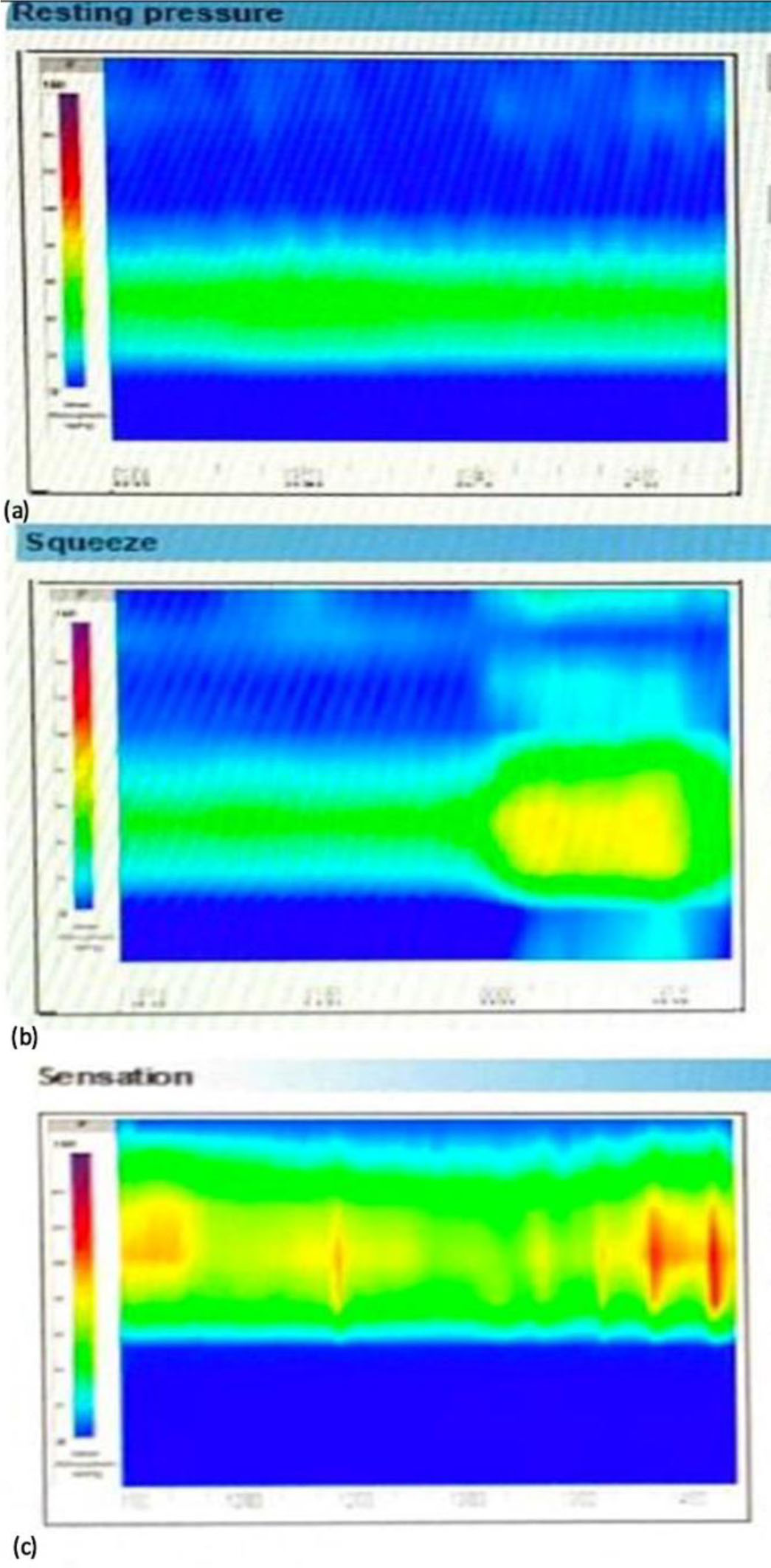
Figure 1.
High resolution anorectal manometry showing (a, b) combined anal hypotension and hypo-contractility, (c) Rectal hyposensitivity.
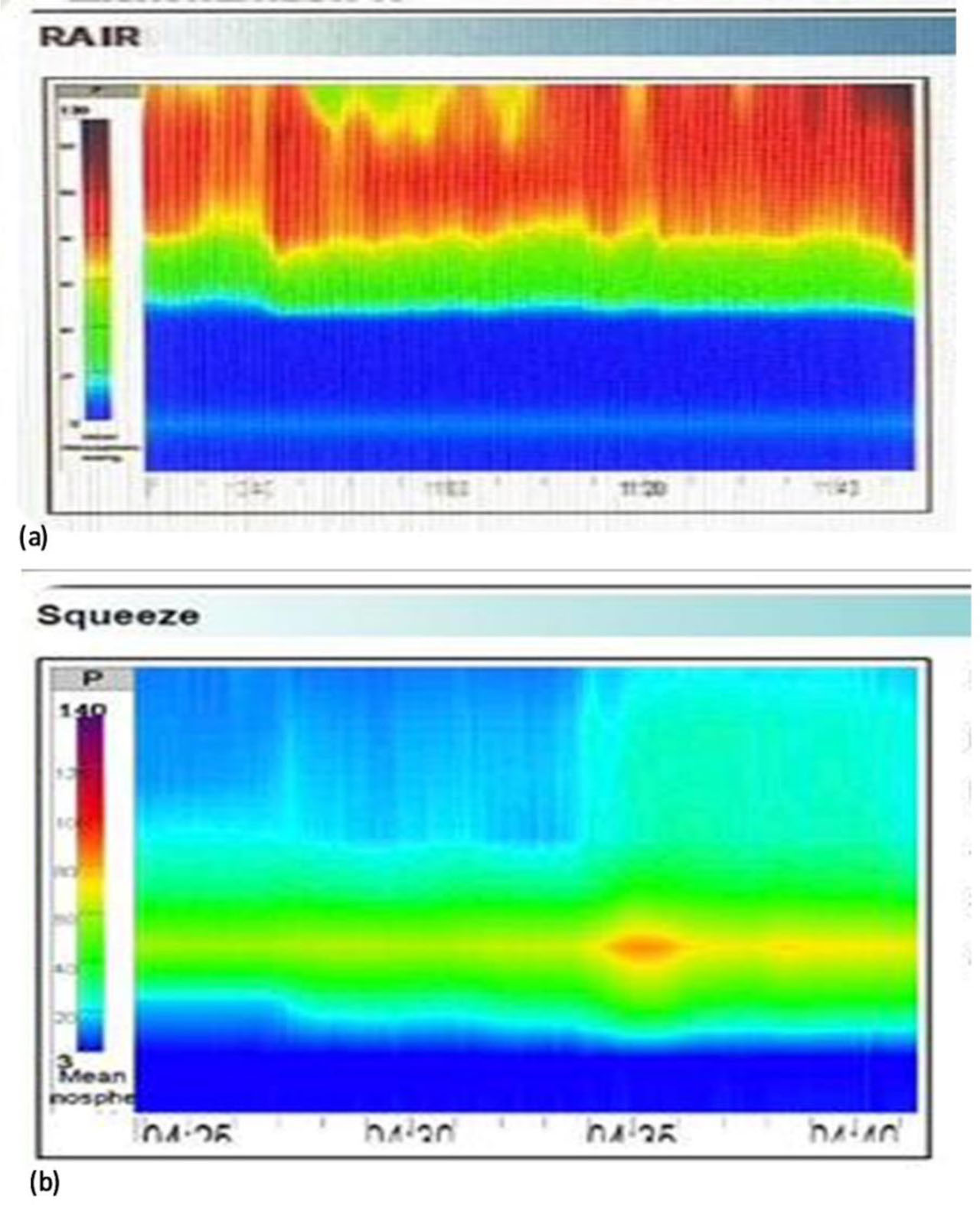
Figure 2.
High resolution anorectal manometry showing (a) recto-anal areflexia [PAIR not elicited], (b) anal normotension with hypo-contractility.
Table 3 shows the most prevalent manometric findings in 31 patients who complained of a sense of incomplete evacuation were rectal hyposensitivity which was reported in 14 (45.2%) patients and anal hypo-contractility which was reported in 5 (16.1%) patients, 28 patients suffered from constipation was rectal hyposensitivity that was reported in 18 (64.3%) patients, 17 patients complained of proctalgia was anal hypertension that was reported in 6 (35.3%) patients, 15 patients complained of urgency was rectal hyposensitivity which was reported in 4 (26.7%) patients and 10 patients complained of faecal incontinence were rectal hyposensitivity which was reported in 5 (50.0%) patients, anal hypo-contractility, and anal hypotension which were reported in 3 (30.0%) patients.
Table 3
Relation between Anorectal manometry finding and Defecatory disorders (n = 50)
| Defecatory disorders | Anorectal manometry finding | ||||||||
|---|---|---|---|---|---|---|---|---|---|
| RAIR | Anal contractility | Anal tone | Rectoanal co-ordination | Rectal sensation | |||||
| Recto anal areflexia | Hypo contractility | Hypotension | Hypertension | Poor propulsion & dyssynergia | Abnormal expulsion with normal recto-anal coordination | Borderline rectal hyposensitivity | Rectal hyposensitivity | Rectal hypersensitivity | |
| Constipation n=28 | 2 (7.1) | 3 (10.7) | 1 (3.6) | 5 (17.9) | 3 (10.7) | 3 (10.7) | 1 (3.6) | 18 (64.3) | 0 (0.0) |
| Fecal incontinence n= 10 | 1 (10) | 3 (30.0) | 3 (30.0) | 0 (0.0) | 0 (0.0) | 1 (10.0) | 0 (0.0) | 5 (50.0) | 2 (20.0) |
| Urgency n= 15 | 1 (6.7) | 3 (20.0) | 2 (13.3) | 3 (20.0) | 3 (20.0) | 0 (0.0) | 0 (0.0) | 4 (26.7) | 2 (13.3) |
| Incomplete evacuation n= 31 | 1 (3.2) | 5 (16.1) | 1 (3.2) | 3 (9.7) | 3 (9.7) | 3 (9.7) | 3 (9.7) | 14 (45.2) | 0 (0.0) |
| Proctalgian= 17 | 1 (5.9) | 1 (5.9) | 0 (0.0) | 6 (35.3) | 3 (17.6) | 2 (11.8) | 1 (5.9) | 6 (35.3) | 2 (11.8) |
There was a statistically significant difference in the relation between the duration of the disease and faecal incontinence (P= 0.008), but no significant differences were observed in the connection between the UC extension and the treatment used. Regarding constipation, urgency, incomplete evacuation, and proctalgia defecatory disorders; it had no statistical significance with the duration of the disease, the UC extension, and the treatment used. A non-significant difference was observed regarding the relation between the disorder of RAIR, and anal contractility with the duration of the disease, the UC extension, and the treatment used. A non-significant difference was observed regarding the relation between the disorder of anal tone, recto-anal coordination, and rectal sensation with the duration of the disease, the UC extension, and the treatment used.
DISCUSSION
In the current study, the prevalence of sense of incomplete evacuation was 62%, as was reported in thirty-one of the studied UC patients (31/50) that had no statistical significant difference as regard UC extension (p=0.357), duration of the disease (p=0.310), or the treatment used (p=0.185). The most prevalent manometric findings were rectal hyposensitivity, which was reported in fourteen patients (45.2%), and anal hypo-contractility, which was reported in five patients (16.1%). The prevalence of constipation is 56% as was reported in twenty-eight of the studied UC patients (28/50). It has no statistical significance with UC extension (p=0.311), duration of the disease (p=0.929) or the treatment used (p=0.396). The most prevalent abnormal anorectal manometric finding in those patients was rectal hyposensitivity, which was reported in eighteen patients (18/28) (64.3%).
Gonzàlez et al. conducted a study that evaluated 9 UC patients in remission but with persistent anorectal symptoms that are not associated with the disease’s severity or the number of years of evolution; the most common symptom was tenesmus (55.6%), which is consistent with the current findings. Hyposensitivity and diminished rectal capacity were observed in patients [8]. The Yagi study demonstrated that the prevalence of constipation in 290 Japanese UC patients is not correlated with the extent of the disease, the duration of UC, clinical remission, or mucosal healing. The prevalence of constipation was 10.0%, 5.8%, 15.7%, 11.8%, and 25.6% among the age groups of <40, 40–49 years, 50–59 years, 60–69 years, and >70 years, respectively [9]. Contrary to the current results, the James et al. study reported that proximal constipation is common in UC patients, and its risk increases in female gender, left-sided colitis, and concurrent active disease, but not age, disease duration or therapy [10]. This could be explained by the difference between inclusion criteria as this study included active UC patients, while our study included quiescent UC patients.
In the current study, the prevalence of proctalgia was 34% as was reported in seventeen of the studied UC patients (17/50). It had no statistical significance with UC extension (p=0.584), duration of the disease (p=0.596) or the treatment used (p=0.333). The most prevalent abnormal anorectal manometric finding in those patients was anal hypertension, which was reported in 6 patients (6/17) (35.3%). Farid et al. conducted a study that aligns with the current findings involving patients who reported anal pain that was exacerbated by defecation and was not alleviated by analgesics or local anesthetics, and who did not have any underlying anal pathology. The patients were evaluated using anorectal manometry. The patient group exhibited a significantly higher mean resting anal pressure (MRAP) (114.6±7.4 mmHg) than the control group (72.5±6.6 mmHg, P <0.001) [11].
Contrary to the current findings, Gravina et al. conducted a study that compared anorectal function in active UC and after remission using high-resolution anorectal manometry. The results indicated that UC patients exhibited similar anal sphincter function values as healthy volunteers [8]. The differences between the results could be explained by the absence of anal pain complaints in patients involved in the study by Gravina et al. Choi et al. conducted a study that demonstrated that perianal diseases are not uncommon in patients with UC, even though the clinical course of these diseases is not severe. However, in the multivariate analyses, the development of perianal sepsis was significantly associated with male sex and extensive disease [12]. The difference between the two studies may be attributed to the fact that the Choi study included a greater number of patients, irrespective of their level of activity.
In the current study, the prevalence of fecal urgency was 30% of the UC studied patients (15/50). It has no statistical significance with UC extension (p=0.737), duration of the disease (p=0.089) or the treatment used (p=0.296). The most prevalent abnormal anorectal manometric finding in those patients was rectal hyposensitivity, which was reported in four patients (4/15) (26.7%). The prevalence of fecal incontinence was 20% of studied UC patients (10/50). It has a statistical significance with the duration of the disease (p=0.008), but it has no significant relation to UC extension (p=0.122), nor to the treatment used (p=0.408). The most prevalent anorectal manometry findings were rectal hyposensitivity, which was reported in five patients (50%), anal hypo-contractility, which was reported in three patients (30%) and anal hypotension, which was reported in three patients (30%).
Hibi et al. conducted a non-interventional analysis of responses from participants with UC who had regularly visited a medical provider. Their findings were consistent with the current findings, including the fact that 43.5% of participants experienced bowel urgency and 48.6% of participants who experienced bowel incontinence reported that UC had a significant impact on their daily lives [13]. Even though the prevalence of bowel urgency and bowel incontinence was associated with higher stool frequency and rectal bleeding scores, they continued to be present in patients who did not possess frequent stools or rectal bleeding.
Rangan et al. conducted a study that employed anorectal manometry to evaluate a total of 103 patients and reported that they experienced fecal urgency, which is in contrast to the current findings. These patients were significantly more likely to meet the criteria for irritable bowel syndrome and ultimately reported that fecal urgency was associated with rectal hypersensitivity in those with diarrhea, but not in those without diarrhea [14]. The difference between the results of the Rangan study and the current study may be attributed to the fact that the patients in the former complained exclusively of fecal urgency, without any other defecatory disorders. In contrast, the current study showed overlapping symptoms of defecatory disorders, and none of the patients included in the study complained of fecal urgency alone.
Vasant et al. reported that the prevalence of fecal incontinence in UC is high, even in remission, and is associated with significant psychological distress, symptom burden, and impaired quality of life, despite the numerous advancements in UC therapies [15]. Contrary to the current findings, Hanayama et al., conducted a study that demonstrated that fecal incontinence was significantly positively associated with total colitis with active stage in Japanese patients with UC, while other disease extents were not associated with it, irrespective of disease activity [16]. This may be attributed to the distinction in inclusion criteria, as the active UC patients in this study were distinct from the quiescent UC patients in our study. We admit the current study has some limitations; relatively small sample size, the investigation was conducted in a single facility. The duration of patient follow-up was relatively brief. However, we consider the investigation of defecatory disorders among quiescent UC, trying to address a gap in knowledge, as a strength point.
CONCLUSION
UC patients still experience defecatory disorders even at the quiescent stage, and this could be explained by long-term neuromuscular effect of prolonged inflammation. HR-ARM is proposed to assess anal tone and contractility, recto-anal co-ordination and rectal sensation. Head-to-head studies with larger numbers of patients are required to extend and validate the prior results. Moreover, confirmation of our findings in different ethnic populations is required. Also, more researches should be done to determine the long-term neuromuscular sequelae of prolonged inflammation in IBD patients. Furthermore in the future research, follow up of the patients after physiotherapy or biofeedback is recommended.
Notes
Acknowledgements
No grant was received. No other financial support was received for this study.
All authors in this study participated in a good selection of cases, instructive supervision, continuous guidance, valuable suggestions and good instructions.