
Table 1
ENDA, Blumenthal and Schrüfer strategies, classification by risk class and corresponding recommendations
| Risk class | Clinical presentation | Recommendations | |
|---|---|---|---|
| ENDA |
| SCARs, generalised bullous FDE, severe MPE, linear IgA bullous dermatosis, systemic vasculitides, organ involvement/cytopenia, penicillin-induced autoimmune disease | avoid using Penicillins/Cephalosporins OR use non-BL antibiotics by microbial coverage OR use, upon graded challenge, Aztreonam, Carbapenems, 3rd/4th/5th generation Cephalosporins |
| anaphylaxis, hypotension, laryngeal oedema, bronchospasm, urticaria or angioedema, generalised angioedema | avoid using Penicillins/Cephalosporins OR use non-BL antibiotics by microbial coverage OR use, upon graded challenge, Aztreonam, Carbapenems, 3rd/4th/5th generation Cephalosporins | |
| NIR: contact dermatitis, systemic contact dermatitis, local reaction (i.m. administration), exfoliative palmar dermatitis, FDE, delayed urticaria, mild or moderate MPE, symmetrical drug-related intertriginous and flexural exanthema (SDRIFE) OR IR: isolated generalised pruritus which did not require treatment, isolated digestive symptoms, localised urticaria OR unknown reactions | avoid using Penicillins/Cephalosporins OR use full-dose Aztreonam, Carbapenems, 3rd/4th/5th generation Cephalosporins OR use non-BL antibiotics by microbial coverage | |
| Blumenthal |
| Stevens-Johnsons syndrome, Toxic Epidermal Necrolysis, Acute interstitial Nephritis, Drug Rash Eosinophilia with Systemic Symptoms (DRESS), haemolytic anaemia | avoid using Penicillins/Cephalosporins, and Carbapenems AND use alternative agents by microbial coverage; |
| anaphylaxis, angioedema, wheezing, laryngeal oedema, hypotension, hives/urticaria OR unknown reactions with no further details available from patient/proxy | avoid using the penicillin subclass OR use 3rd/4th/5th generation Cephalosporins by test dose procedure OR use alternative agent by microbial coverage OR use Aztreonam or Carbapenems | |
| MPE, or minor rash (not hives), EHR mention but patient denies, unknown reaction, but patient denies mucosal involvement, skin desquamation, organ involvement, or need for medical evaluation | use full dose Cephalosporins OR use Penicillin by test dose procedure OR use Carbapenems | |
| Schrüfer |
| chronology of up to 30 minutes from exposure to reaction and a semiology of urticaria or anaphylaxis. signs and symptoms of anaphylaxis occurrence during general anaesthesia mucous membrane erosions/skin bullae hepatic or renal involvement or cytopenia | If answer is Yes/Uncertain – USE ALTERNATIVE ANTIBIOTIC |
| measles-like rash or MPE occurring during or within one week of penicillin exposure? | If answer is Yes – USE ALTERNATIVE ANTIBIOTIC (as for high-risk subjects) | |
| acute urticaria with or without angioedema during penicillin exposure which reoccurs for several days after treatment is stopped? | If answer is Yes – DELABEL | |
| skin symptoms such as urticaria and MPE only developed during or immediately after stopping penicillin exposure occurring during childhood or adolescence (less than 16 years)? | If answer is Yes – DELABEL | |
| symptoms reported are not compatible with a hypersensitivity reaction – gastrointestinal symptoms, cephalea, palpitation? chronology between exposure and symptom onset not suggestive of hypersensitivity – urticaria >2 days after the last dose; MPE >7 days after the last dose? | If answer is Yes – DELABEL |
[i] BL – beta-lactam, EHR – electronic health records, FDE – fixed drug eruption, MPE – maculopapular exanthema, SCAR – severe cutaneous adverse drug reaction, IR- immediate reactions, NIR – non-immediate reactions. Adapted after Ghiordanescu et al. Comparative Performance of 4 Penicillin-Allergy Prediction Strategies in a Large Cohort. The Journal of Allergy and Clinical Immunology: In Practice. Published online July 2024:S2213219824007438. doi:10.1016/j.jaip.2024.07.012
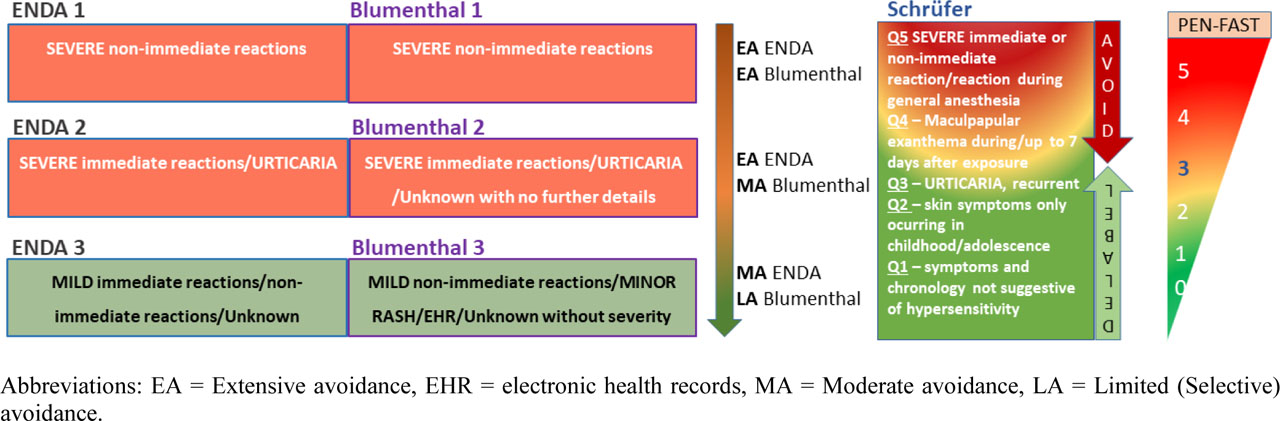
Figure 1.
Comparative Overview of the ENDA, Blumenthal, Schrüfer, and PEN-FAST Strategies. Red colour indicates high-risk, yellow represents medium-risk, and green signifies low-risk. The Schrüfer strategy does not specifically define risk classes but recommends delabeling in subjects with affirmative answer to questions 1–3 (graphically associated with green colour) while it recommends avoidance in subjects with affirmative answers to question 5 (graphically associated with red colour). Question 4 appears highligthed in yellow in the original publication. The PEN-FAST scores 4–5 are high-risk (50%), 3 is moderate-risk (20%), 1–2 are low-risk (5%), 0 is very-low-risk of positive penicillin test (<1%). The suggested cutt-of for delabeling is 3. Adapted after Ghiordanescu et al. Comparative Performance of 4 Penicillin-Allergy Prediction Strategies in a Large Cohort. The Journal of Allergy and Clinical Immunology: In Practice. Published online July 2024:S2213219824007438. doi:10.1016/j.jaip.2024.07.012
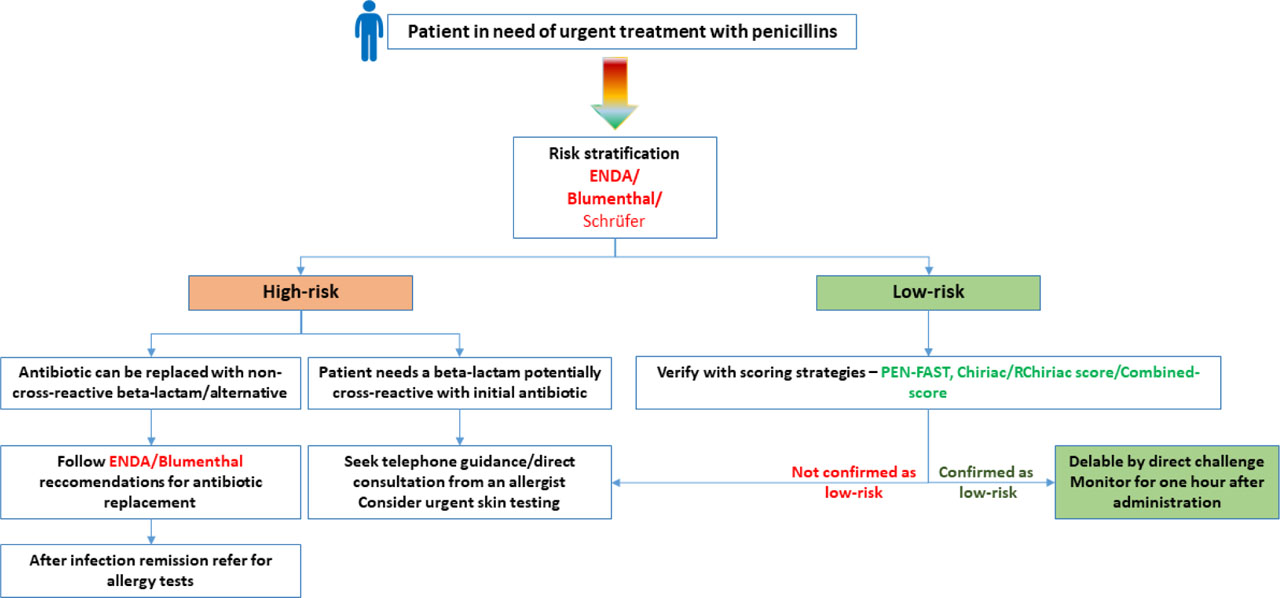
Figure 2.
Suggested pathway for the management of patients labeled as allergic to penicillins in non-allergist settings.