
Table 1
Demographic data and APACHE IIa scores on admission.
| Septic critically ill patients (n = 50) | 58.80 ± 19.74 |
|---|---|
| Age, years (mean ± SD) | 58.80 ± 19.74 |
| Gender (male) | 31 (61%) |
| Weight, kg (mean ± SD) | 84.19 ± 22.64 |
| APACHE II score (units, mean ± SD) | 21.68 ± 4.9 |
Table 2
Laboratory and clinical data of the 50 study group patients (mean ± SD).
| TIME1** | TIME2** | p value* | |
|---|---|---|---|
| Mean arterial blood pressure (mmHg) | 94.53 ± 14.84 | 88.21 ± 13.62 | 0.06 |
| Heart rate (beat/min) | 105.48 ±19.38 | 108.05 ± 20.50 | 0.06 |
| Urine output per hour (mL) | 147.56 ± 28.1 | 87.53 ± 15.8 | <0.001 |
| Minute-to-minute urine flow ratea (mL/hour) | 146.65 ± 117.30 | 106.65±72.0 | <0.001 |
| Urine flow rate variability (mean, mL) | 5.18 ± 9.40 | 2.63 ± 3.35 | <0.001 |
| Hemoglobin (g\dL) | 9.43 ± 1.16 | 9.03 ± 0.12 | 0.2 |
| White blood cell count (k/ mm3) | 9.9 ± 3.4 | 15.9±1.45 | 0.01 |
| Bicarbonate arterial blood (mEq/L) | 26.3 ± 4.35 | 20.3 ± 1.35 | 0.03 |
| pH arterial blood | 7.41 ± 0.01 | 7.31 ± 0.03 | 0.06 |
| Arterial blood lactate (mmol/L) | 1.19 ± 0.70 | 2.5 ± 1.4 | 0.04 |
| Urea (mg/dL) | 54 ± 15.5 | 74 ± 7.2 | 0.06 |
| Creatinine (mg/dL) | 0.8 ± 0.03 | 0.9 ± 0.1 | 0.08 |
| Body temperature (°C) | 36.08 ± 0.05 | 38.98 ± 0.05 | 0.03 |
** TIME1 – vital signs during the 3 hours following admission to the ICU; TIME2 – vital signs 9 hours after the septic event.
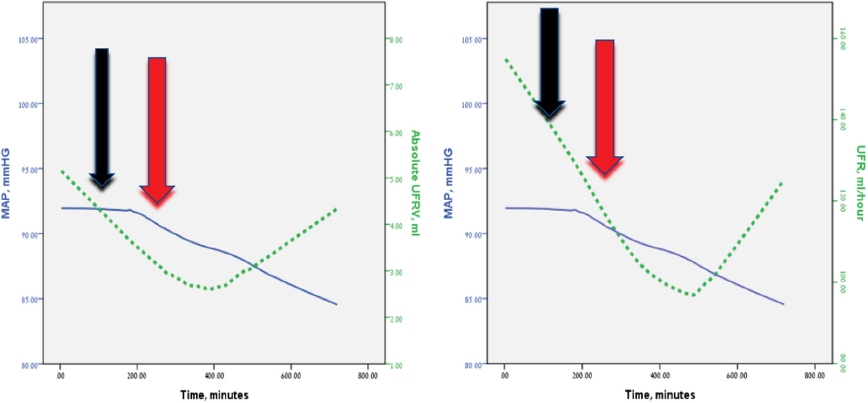
Figure 1
Correlation of urine flow rate variability (UFRV) (A) and urine flow rate (UFR) (B) with mean arterial pressure (MAP) at the time of new septic events (black arrows) and following initial fluid resuscitation (red arrows). Note that the UFRV and the UFR decreased progressively in parallel with the falling MAP and rose again after the administration of fluids