
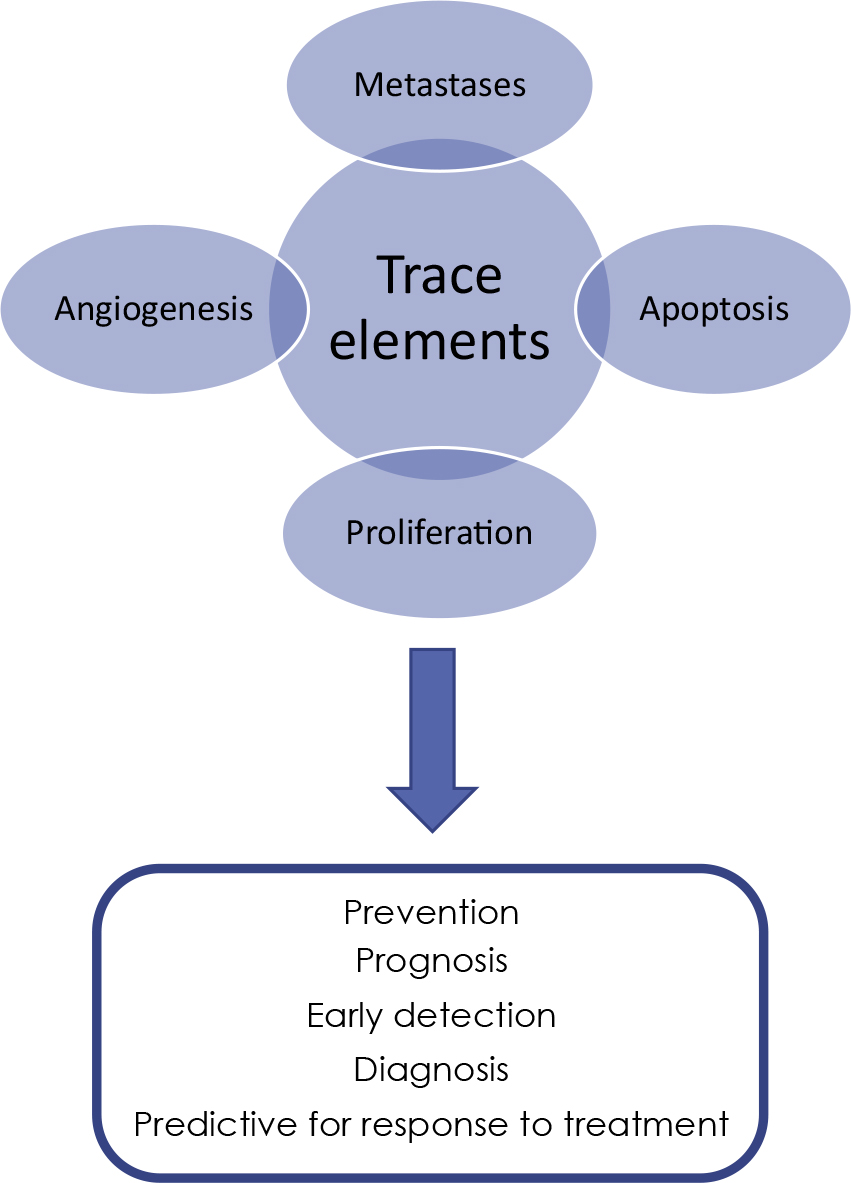
FIGURE 1.
Potential roles of trace elements in oncology
TABLE 1.
Overview of the data on the clinical impact of trace elements in gastrointestinal (GI) cancers
| Author, year of publication, Ref | GI cancer type | Clinical study | Trace elements and analytical methods | Summary of main findings |
|---|---|---|---|---|
| Lossow et al., 202121 | Colorectal | Retrospective | Se, Cu, Fe, Zn ICP-MS, SRXRF | Elevated Cu and low Zn serum concentrations in four cancer types (CRC, lung, prostate, breast) studied. Analysis of Cu and Zn could contribute to an early cancer diagnosis. |
| Yang et al., 2021,22 | Liver, gastric, colorectal | Prospective, closed | Cu, Zn, Fe, Se ICP-MS | OXs exists in the occurrence and development of cancer, related to the changes of trace element concentrations. |
| Stepien et al., 201723 | Colorectal | Prospective, closed | Cu, Zn XRF | Cu/Zn ratio may be associated with increased CRC risk, particularly within two years of diagnosis, and could serve as an early indicator of CRC development. Zn showed a potential protective effect, especially in women. |
| Baszuk et al., 202124 | Colorectal | Retrospective | Cu ICP-MS | A high blood Cu level (>900 μg/L) is associated with a significantly increased risk of colorectal cancer in the Polish population. Cu concentrations has the potential as a marker for identifying of patients for further surveillance with colonoscopy. |
| Nawi et al., 201925 | Colorectal | Retrospective | Ca, Cu, Mg, Mn, Se, Si, Zn, Co, S, Cd, Cr, Cu, Mg, Mn, Pb AAS | Serum concentrations of Ca, Cu, Mg, Mn, Se, Si, and Zn were lower in CRC patients, whereas Co and S the levels were higher. Concentrations of Cd, Cr, Cu, Mg, Mn, Pb and Zn were elevated in patients with metastasis. |
| Lener et al., 201626 | Pancreatic cancer | Prospective, closed | Se, Cu ICP-MS | Low Se and elevated Cu levels may contribute to PC development, higher Se concentrations are associated with longer survival in affected patients. |
| Yanjun et al., 202427 | Pancreatic cancer | Prospective, closed | Cu, Fe, Zn, Mn ICP-MS | High concentration levels of Cu may increase the risk of PC. Fe can promote ferroptosis, Excessive Fe levels may elevate PC risk. High Zn intake is associated with a reduced risk of PC and can inhibit tumour growth. Mn contributes to anti-PC effects primarily by promoting ferroptosis and suppressing excessive cell proliferation. |
| Türkdoğan et al., 202228 | Oesophageal, gastric, colorectal | Prospective, closed | Cd, Co, Cu, Fe, Mg, Mn, Pb, Zn, Ni FAAS | Cd, Co, Ni, Fe, and Mn were significantly lower in cancer patients compared to healthy controls. Serum Zn levels were lower in cancer patients, the difference was not statistically significant. No significant differences were observed for Cu, Mg, Pb, and Zn between cancer patients and controls. |
| Kocak et al., 202529 | Oesophageal squamous cell carcinoma | Prospective, closed | Al, Cr, Mn, Fe, Co, Cu, Zn, Se, Sb, Hg Pb ICP-MS | Significant increases in Cu, and Fe levels, as well as total oxidant status, alongside a marked decrease in Se levels in cancerous tissues. |
| Yan et al., 202430 | Hepatocellular cancer, gastric cancer | Prospective, closed | As, Cd, Co, Cr, Cu, Fe, Mn, Ni, Pb, Se, Zn ICP-MS | Tissue concentrations of As, Cd, Co, Cr, Cu, Fe, Mn, Ni, Pb, Se, and Zn in patients with liver cancer were significantly lower than those in healthy controls. Patients with gastric cancer exhibited lower levels of Cd, Co, Cr, Mn, Ni, and Zn, but higher levels of Cu and Se compared to the controls. Patients with liver and gastric cancers who had poorly differentiated tumours and positive lymph node metastases showed lower levels of trace elements. |
| Gupta et al., 200531 | Gallbladder cancer | Prospective, closed | Cu, Zn FAAS | Mean serum Zn levels, biliary and tissue Zn levels were significantly lower in gallbladder carcinoma patients comparing to patients with cholelithiasis, and healthy controls. Mean serum Cu levels, biliary and tissue Cu levels were significantly higher in gallbladder carcinoma patients comparing to those with cholelithiasis, and healthy controls. Serum Cu/Zn ratio showed a gradual and significant increase, rising from healthy controls to patients with cholelithiasis and patients with carcinoma of the gallbladder. Biliary and tissue Cu/Zn ratios were significantly higher in gallbladder carcinoma patients than in patients with cholelithiasis. |
| Basu et al., 201332 | Biliary tract cancers | Prospective, closed | Se, Zn, Cu, Mg, Cd, Cr, Pb, Ni FAAS | Se and Zn levels were significantly reduced, and Cu levels were significantly higher in serum, bile, and gallbladder tissue from gallbladder carcinoma patients. Pb, Cd, Cr and Ni levels were increased in serum and bile of these patients. |
| Stepien et al., 201733 | Hepatocellular cancer, biliary tract cancers | Prospective, closed | Cu, Zn XRF | Zn may play a role in preventing liver cancer development. An inverse association between pre-diagnostic Zn levels, but not Cu levels, and the risk of HCC is shown. An imbalance of Cu relative to Zn, indicated by a higher Cu/Zn ratio, was positively associated with HCC risk. |
| Reberšek et al., 202434 | Biliary tract cancers | Prospective, ongoing | Cu, Zn, Fe, se, Mn ICP-MS | Serum levels of trace elements, their proportion of free Cu and Cu-Cp, and its isotopic fractionation (Cu65/Cu63) are being investigated as potential predictive biomarkers of response to systemic therapy. |
| Kozlica et al., 202535 | Biliary tract cancers | Retrospective - prospective | Cu, Cu-Cp ICP-MS | Analytical methodologies for studying metabolic disorders affecting Cu metabolism. Accurate interpretation of disease states related to Cu disorders and detailed information obtained through advanced analytical techniques. Immunological assays, ultrafiltration procedures, and speciation techniques based on ICP-MS including Cu isotopic analysis for identification of metabolic abnormalities in different diseases and types of cancer, including BTCs. |
[i] Al = aluminium; As = arsenic, AAS = atomic absorption spectrometry; BTCs = biliary tract cancers; Ca = calcium; Cd = cadmium; Cr = chromium; Co = cobalt; CRC = colorectal cancer; Cu-Cp = copper bound ceruloplasmin; Cu = copper; FAAS = flame atomic absorption spectrometry; HCC = hepatocellular cancer; Hg = mercury; ICP-MS = inductively coupled plasma mass spectrometry; Fe = iron-Fe; Mg = magnesium; Mn = manganese; Ni = nickel; OxS = oxidative stress; Pb = lead; PC = pancreatic cancer; Sb = antimuon; SE = selenium; Si = silicon; SRXRF = synchrotron radiation based X-ray fluorescence; XRF = X-ray fluorescence; Zn = zinc-Zn