
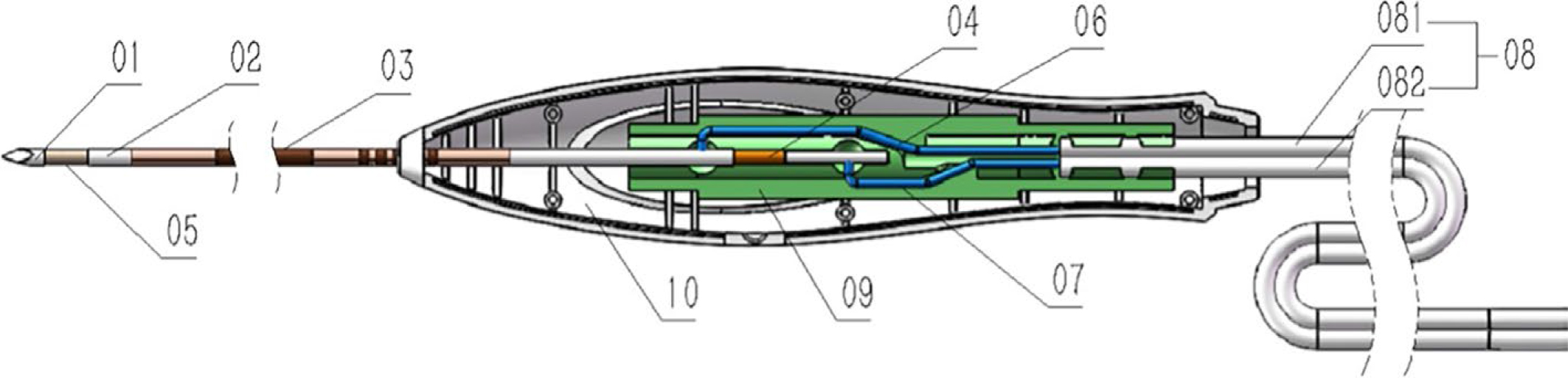
FIGURE 1.
Schematic of the bipolar IRE needle electrode device 01. Front electrode needle; 02. Rear electrode needle tube; 03. Outer insulating tube; 04. Inner insulating tube; 05. Insulating spacer ring; 06. Rear electrode adapter wire; 07. Front electrode adapter wire; 08. Parallel double-strand cable; 09. Needle tube fixing component; 10. Handle housing.
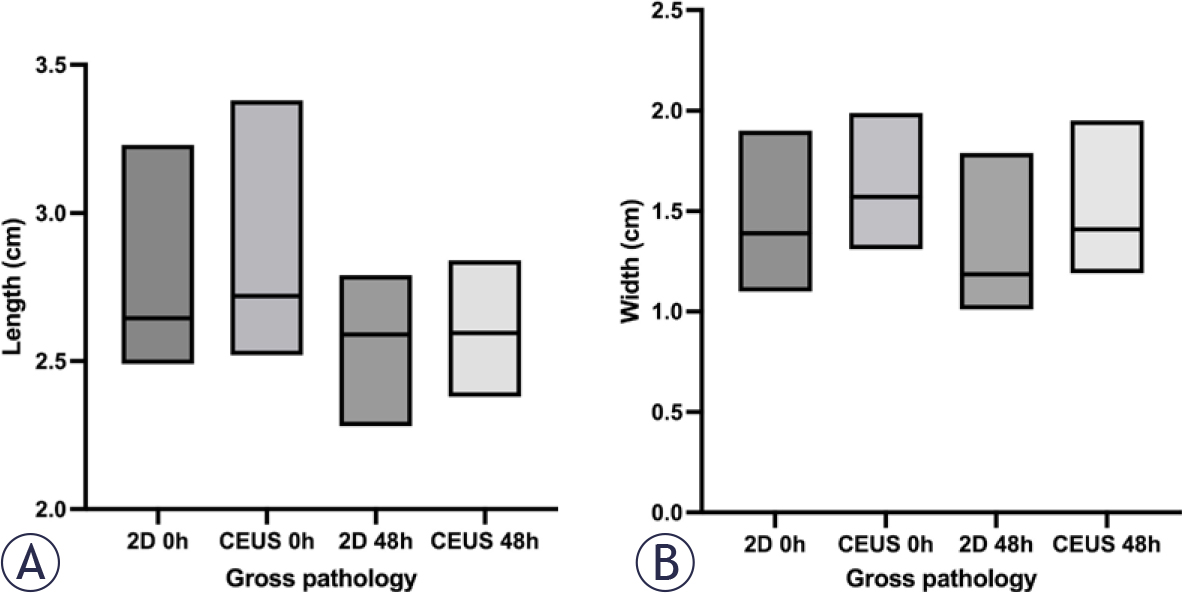
FIGURE 2.
(A) Comparison of measurements of the length of the ablation zone (cm) by ultrasound, CEUS, and Gross Pathology. (B) Comparison of measurements of the width of ablation by ultrasound, CEUS, and Gross Pathology 2D 0 h: Immediately after irreversible electroporation by two dimensional ultrasound; 2D 48 h: 4 8h after irreversible electroporation by two dimensional ultrasound; CEUS 0h: Immediately after irreversible electroporation by CEUS; CEUS 48 h: 48 h after irreversible electroporation by CEUS.
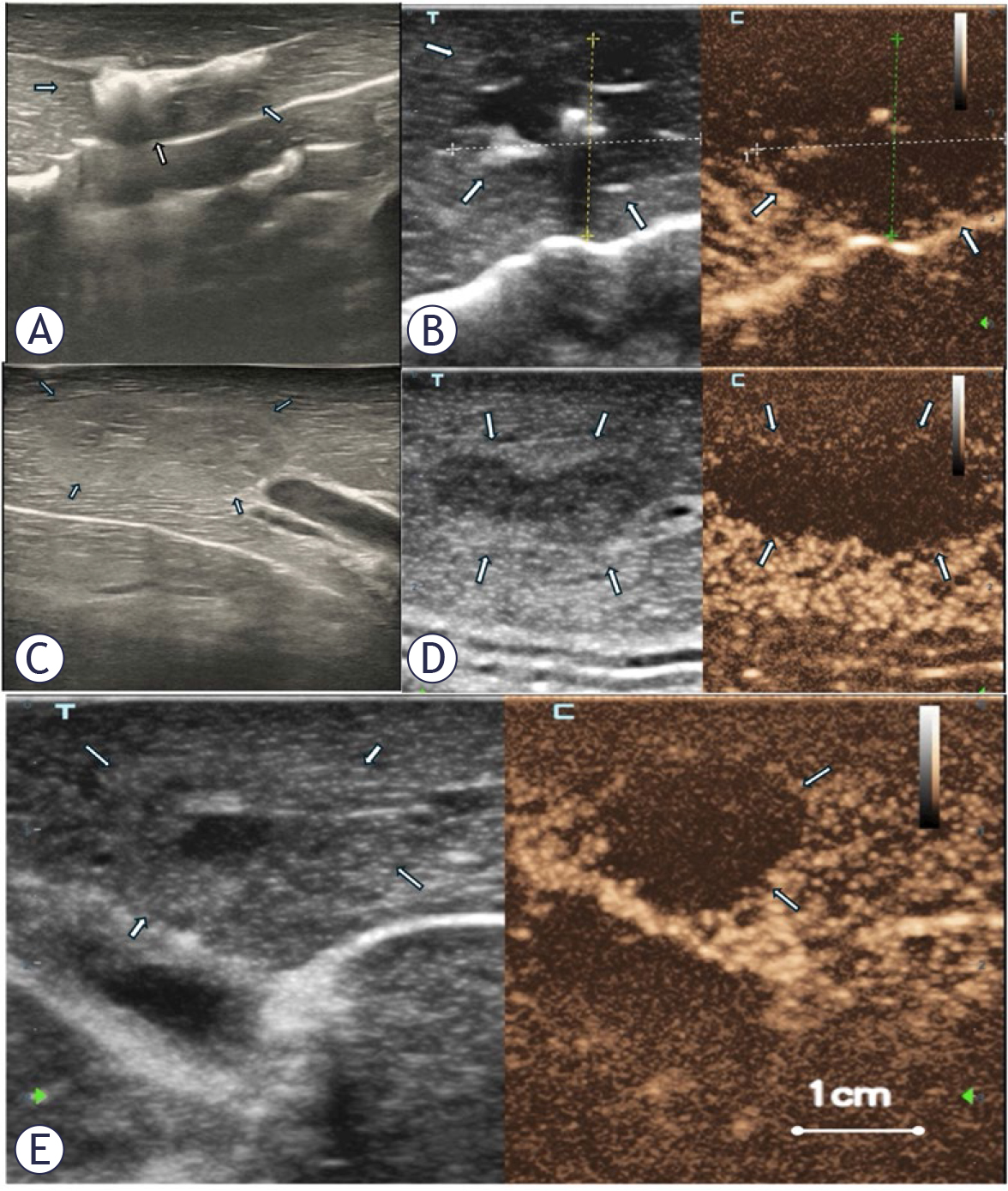
FIGURE 3.
Ultrasound and CEUS findings after irreversible electroporation ablation. A scan obtained during ablation (A) confirms that the position of the electrode is appropriate. Scan obtained immediately after irreversible electroporation application (B) showing a hypoechoic ablative zone with well-demarcated margins surrounding the electrode. It appears as an avascular area in the arterial phase immediately after ablation. Scan obtained 48 h after irreversible electroporation (C) showing that the echogenicity of the central ablation zone increases, whereas the surrounding area is a ring-shaped hyperechoic band. Long axis view (D) and short axis view (E) showing that the ablation zone appears as a hypo-enhanced area in the arterial phase, and there is internal enhancement within the ablation zone 48 h after irreversible electroporation ablation.
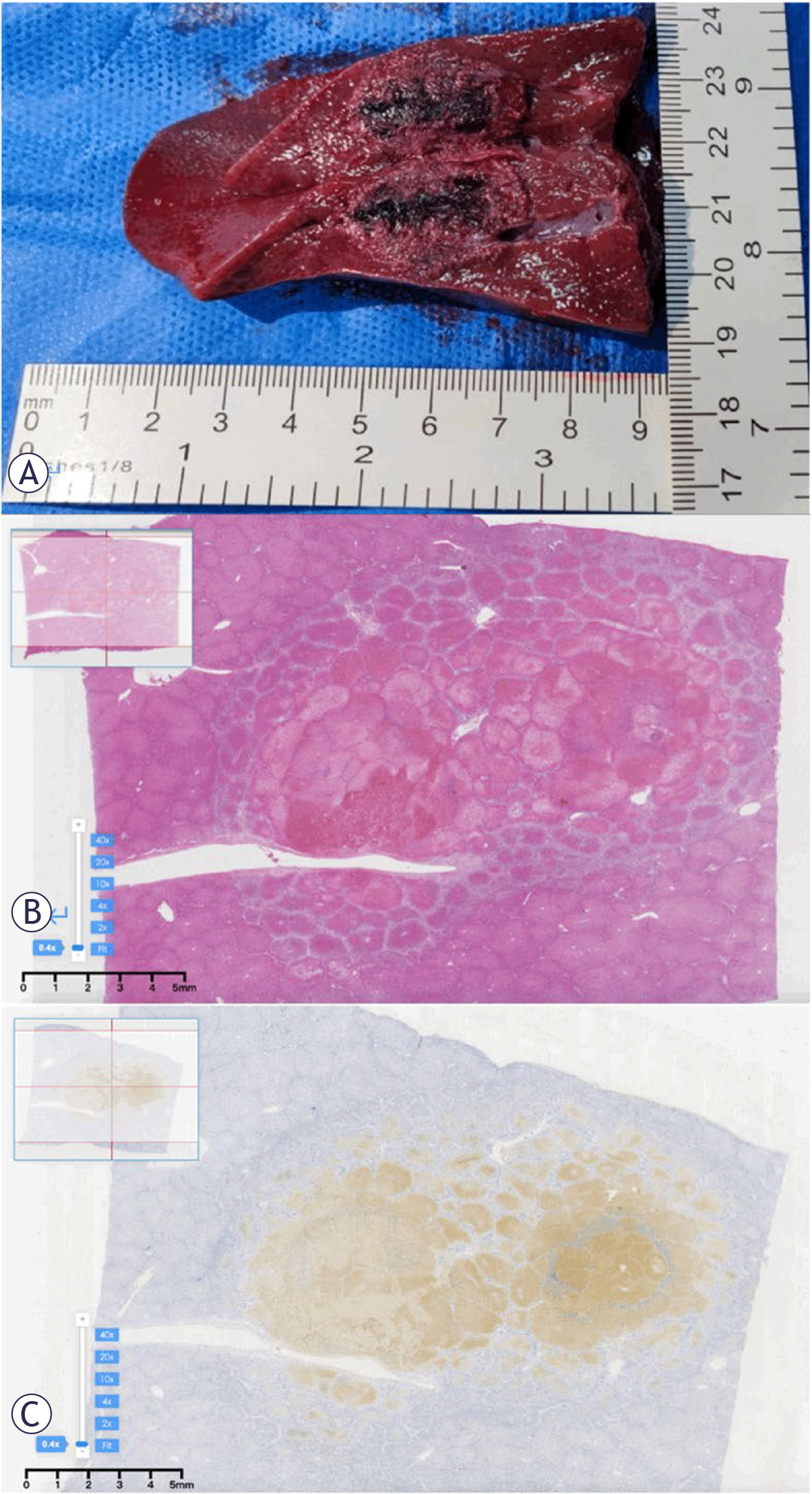
FIGURE 4.
Gross specimen and histopathology of tissue zones of irreversible electroporation-ablated lesion. (A) Cut gross specimen. (B) Photomicrograph of a specimen from specimens obtained 48 h after irreversible electroporation. (C) Representative TUNEL staining of the irreversible electroporation ablation zone showing extensive TUNEL-positive cells.
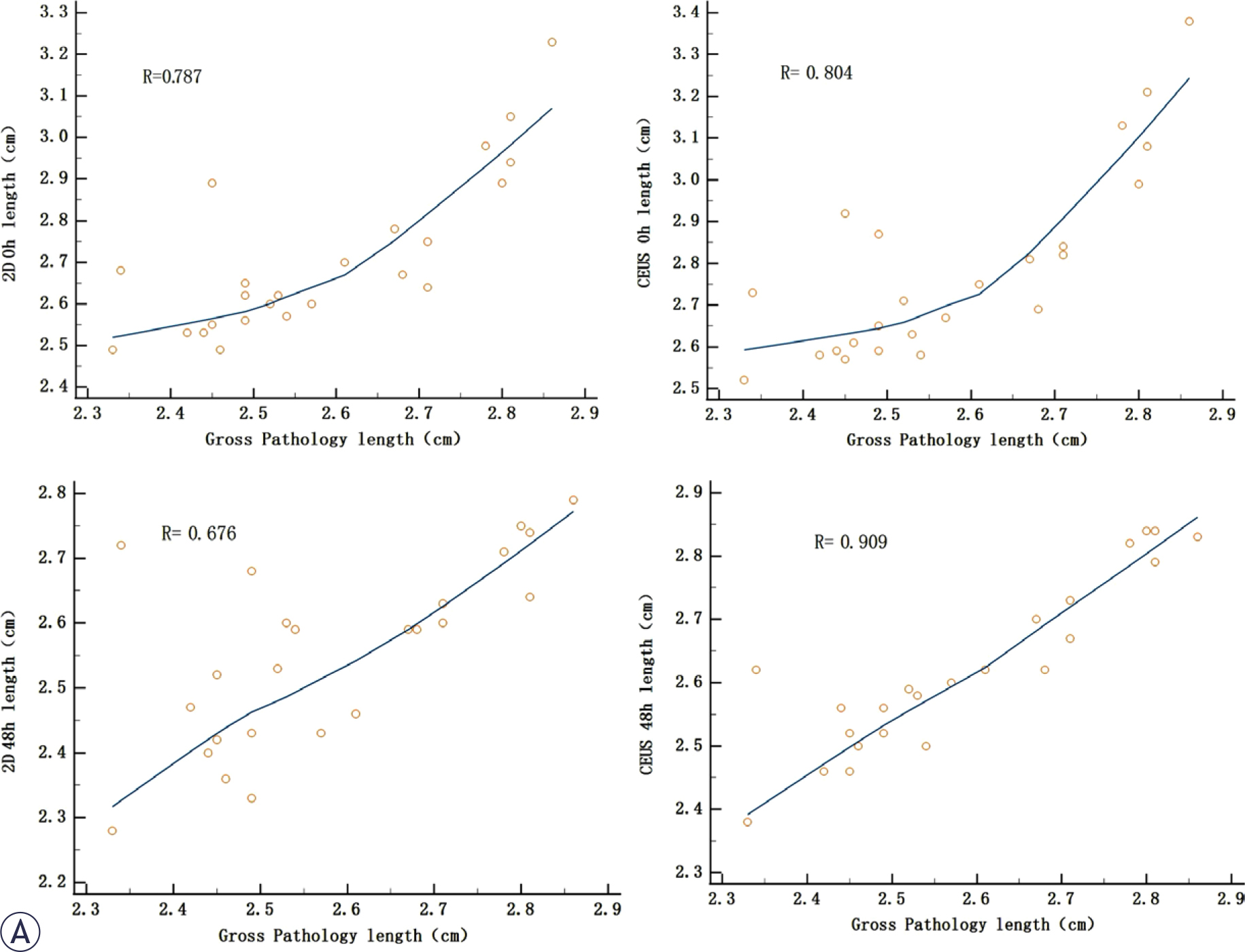
FIGURE 5.
Dimension of the ablation zone on Gross Pathology versus the ablation area measurement on ultrasound and CEUS. (A) Correlation between the length of the ablation area with gross pathology.
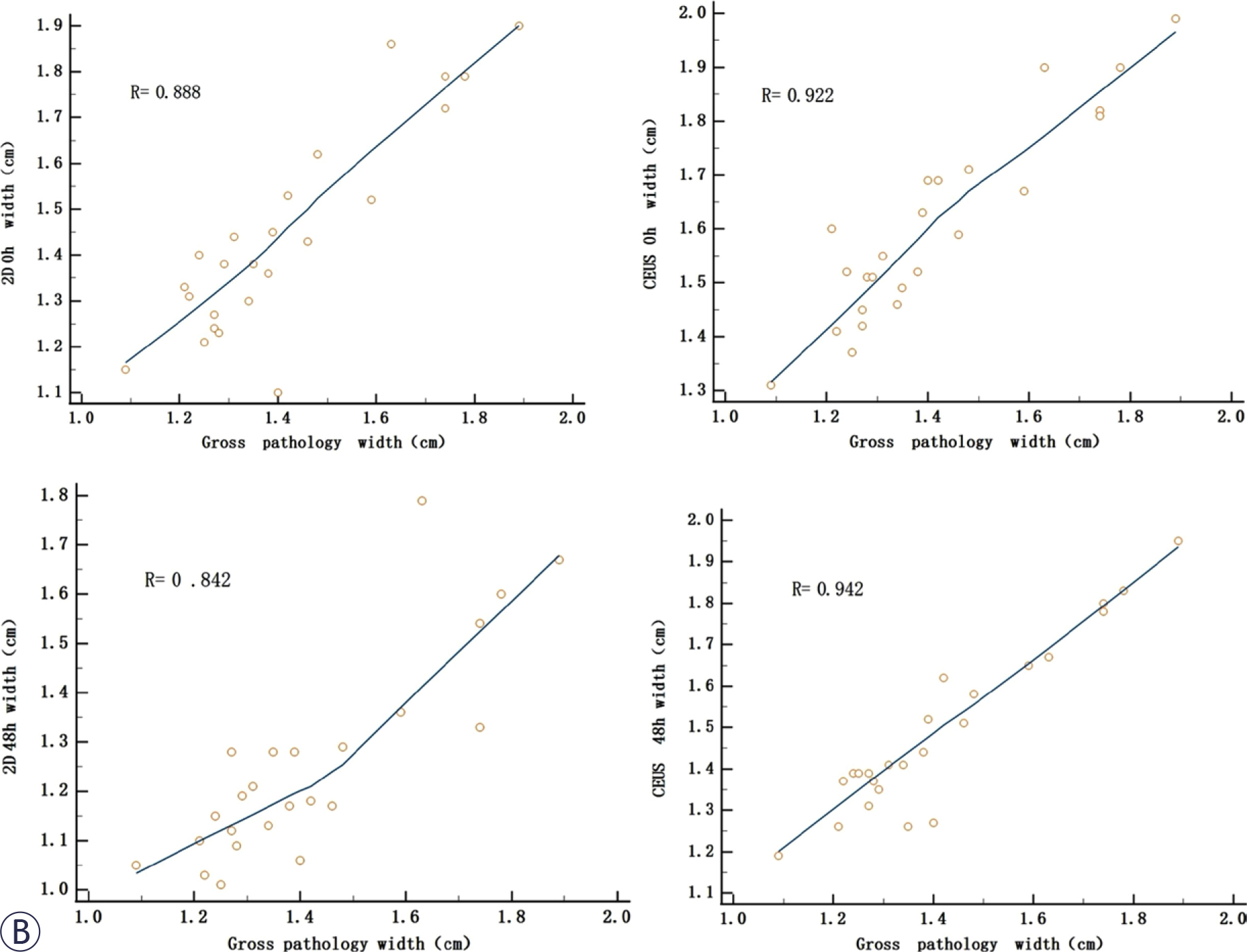
FIGURE 5.
Dimension of the ablation zone on Gross Pathology versus the ablation area measurement on ultrasound and CEUS. (B) Correlation between the width of the ablation area with gross pathology.