
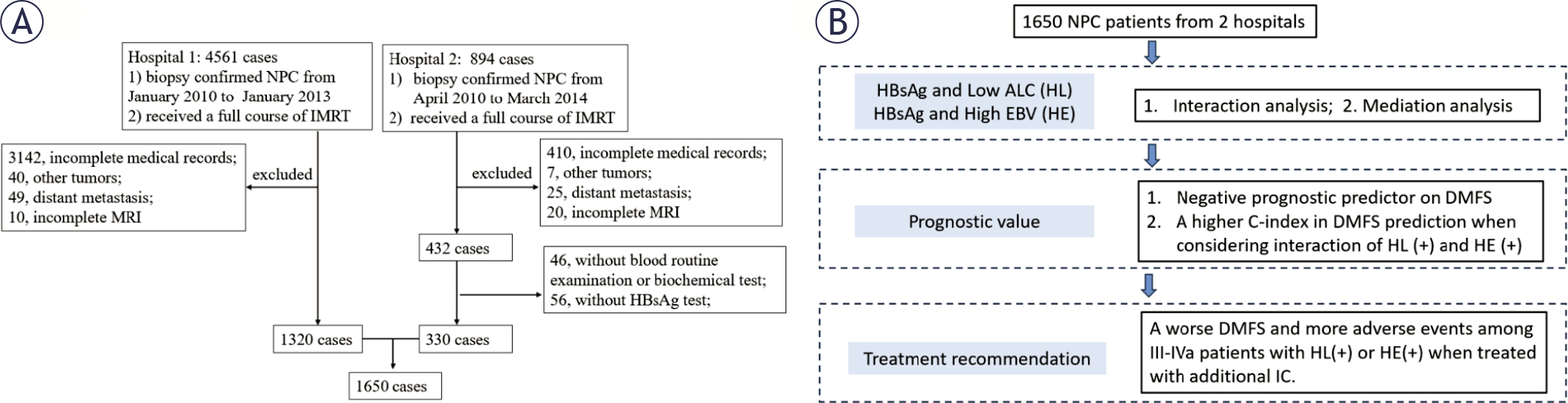
Figure 1.
Patient enrolment and study flowchart. (A) Patient enrolment flowchart from the two hospitals. (B) Statistical analysis flowchart.
Note 1. The time involved in the exclusion criteria is set at the time before treatment. As all enrolled patients in Hospital 1 had data from routine blood examinations, biochemical tests, and HBsAg tests, no other patients were further excluded from Hospital 1.
Note 2. Complete MRI included scanning of the nasopharynx and neck regions, which can be used for restaging assessment of the 8th TNM staging system.
Note 3. Low ALC indicated an absolute lymphocyte count ≤ 1.9 ×10⁹/L. High EBV indicated plasma EBV DNA level > 4 ×10³ copies/mL.
ALC = absolute lymphocyte count; HBsAg = hepatitis B surface antigen; HE = interaction between HBsAg (+) and high EBV; HL = interaction between HBsAg (+) and low ALC; IC = induction chemotherapy; MRI = magnetic resonance imaging; OS = overall survival; non_IC = treated without induction chemotherapy; + = positive; - = negative
Table 1.
Basic patient characteristics and univariate analysis
| Variables | Total | HBsAg (-) | HBsAg (+) | Chi-square | DMFS | |
|---|---|---|---|---|---|---|
| (n = 1650) | (n = 1365) | (n = 285) | P value | 5-year | Log-Rank P | |
| Age group | < 0.001 | 0.548 | ||||
| ≤ 45 | 821 (49.8%) | 651 (47.7%) | 170 (59.6%) | 87.06 | ||
| > 45 | 829 (50.2%) | 714 (52.3%) | 115 (40.4%) | 85.87 | ||
| Sex | 0.035 | 0.424 | ||||
| Male | 1221 (74.0%) | 996 (73.0%) | 225 (78.9%) | 86.05 | ||
| Female | 429 (26.0%) | 369 (27.0%) | 60 (21.1%) | 87.64 | ||
| Plasma EBV DNA load (copies/ml) | 0.536 | < 0.001 | ||||
| ≤ 4×10³ | 1071 (64.9%) | 891 (65.3%) | 180 (63.2%) | 90.49 | ||
| > 4×10³ | 579 (35.1%) | 474 (34.7%) | 105 (36.8%) | 78.83 | ||
| Histologic typea | 0.391 | 0.463 | ||||
| WHO type 1/2 | 63 (3.8%) | 55 (4.0%) | 8 (2.8%) | 82.71 | ||
| WHO type 3 | 1587 (96.2%) | 1310 (96.0%) | 277 (97.2%) | 86.63 | ||
| T stageb | 0.186 | < 0.001 | ||||
| T1 | 415 (25.2%) | 350 (25.6%) | 65 (22.8%) | 93.54 | ||
| T2 | 201 (12.2%) | 172 (12.6%) | 29 (10.2%) | 85.97 | ||
| T3 | 649 (39.3%) | 521 (38.2%) | 128 (44.9%) | 86.49 | ||
| T4 | 385 (23.3%) | 322 (23.6%) | 63 (22.1%) | 78.71 | ||
| N stageb | 0.962 | < 0.001 | ||||
| N0 | 331 (20.1%) | 272 (19.9%) | 59 (20.7%) | 95.22 | ||
| N1 | 934 (56.6%) | 774 (56.7%) | 160 (56.1%) | 87.63 | ||
| N2 | 277 (16.8%) | 231 (16.9%) | 46 (16.1%) | 79.05 | ||
| N3 | 108 (6.5%) | 88 (6.4%) | 20 (7.0%) | 66.79 | ||
| Stageb | 0.590 | < 0.001 | ||||
| I | 139 (8.4%) | 119 (8.7%) | 20 (7.0%) | 97.55 | ||
| II | 361 (21.9%) | 302 (22.1%) | 59 (20.7%) | 93.05 | ||
| III | 677 (41%) | 551 (40.4%) | 126 (44.2%) | 86.81 | ||
| IVa | 473 (28.7%) | 393 (28.8%) | 80 (28.1%) | 77.13 | ||
| IC treatment | 0.188 | < 0.001 | ||||
| non_IC | 809 (49.0%) | 659 (48.3%) | 150 (52.6%) | 90.10 | ||
| IC | 841 (51.0%) | 706 (51.7%) | 135 (47.4%) | 82.91 | ||
| HBsAg status | < 0.001 | 0.612 | ||||
| HBsAg (-) | 1365 (82.7%) | 1365 (100.0%) | 0 | 86.60 | ||
| HBsAg (+) | 285 (17.3%) | 0 | 285 (100.0%) | 85.87 | ||
| ALCc (109/L) | 1650 (100%) | 1.9 (1.5–2.3) | 1.9 (1.5–2.4) | 0.514 | - | 0.663 |
| ALC group (109/L) | 0.694 | 0.223 | ||||
| > 1.9 | 742 (45.0%) | 617 (45.2%) | 125 (43.9%) | 160 (56.1%) | 87.58 | |
| ≤ 1.9 | 908 (55.0%) | 748 (54.8%) | 85.55 | |||
| ALTc (U/L) | 1650 (100.0%) | 19.9 (16–24.9) | 24 (18.9–34) | < 0.001 | - | 0.256 |
| ASTc (U/L) | 1650 (100.0%) | 20 (16.2–26) | 24.2 (20–36.5) | < 0.001 | - | 0.273 |
Table 2.
Consideration of interaction effect of HL and HE in distant-metastasis-free survival (DMFS) prediction
| Variables | DMFS | Variables | DMFS | ||
|---|---|---|---|---|---|
| HR (95% CI) | P | HR (95% CI) | P | ||
| Step 1: Without interaction item | Step 2: Interaction consideration | ||||
| NA | HBsAg (+) × Low ALC (HL) | 2.56 (1.14–5.76) | 0.023 | ||
| NA | HBsAg (+) × High EBV (HE) | 2.16 (1.02–4.58) | 0.044 | ||
| HBsAg (-/+) | 1.12 (0.79–1.6) | 0.524 | HBsAg (-/+) | 0.38 (0.17–0.88) | 0.024 |
| NA | ALC (≤ 1.9 vs. > 1.9)* | 0.94 (0.69–1.27) | 0.692 | ||
| EBV (≤ 4 vs > 4)# | 1.56 (1.16–2.08) | 0.003 | EBV (≤ 4 vs. > 4)# | 1.34 (0.97–1.84) | 0.075 |
| T stage | T stage | ||||
| T1 | 1 (reference) | T1 | 1 (reference) | ||
| T2 | 1.61 (0.94–2.76) | 0.084 | T2 | 1.66 (0.97–2.84) | 0.066 |
| T3 | 1.62 (1.04–2.52) | 0.032 | T3 | 1.62 (1.04–2.52) | 0.034 |
| T4 | 2.62 (1.67–4.1) | < 0.001 | T4 | 2.63 (1.68,4.13) | < 0.001 |
| N stage | N stage | ||||
| N0 | 1 (reference) | N0 | 1 (reference) | ||
| N1 | 2.01 (1.18–3.43) | 0.010 | N1 | 2.01 (1.18–3.43) | 0.010 |
| N2 | 3.25 (1.83–5.8) | < 0.001 | N2 | 3.34 (1.87–5.95) | < 0.001 |
| N3 | 5.09 (2.69–9.61) | < 0.001 | N3 | 5.28 (2.8–9.97) | < 0.001 |
1 ALC = absolute lymphocyte count; CI = confidence interval; DMFS = distant metastasis-free survival; EBV = pre-treatment plasma EBV = Epstein-Barr virus DNA levels; HBsAg = hepatitis B surface antigen; HE = interaction between HBsAg (+) and high EBV; HL = interaction between HBsAg (+) and low ALC; HR = hazard ratio; NA = not applicable; + = positive; - = negative
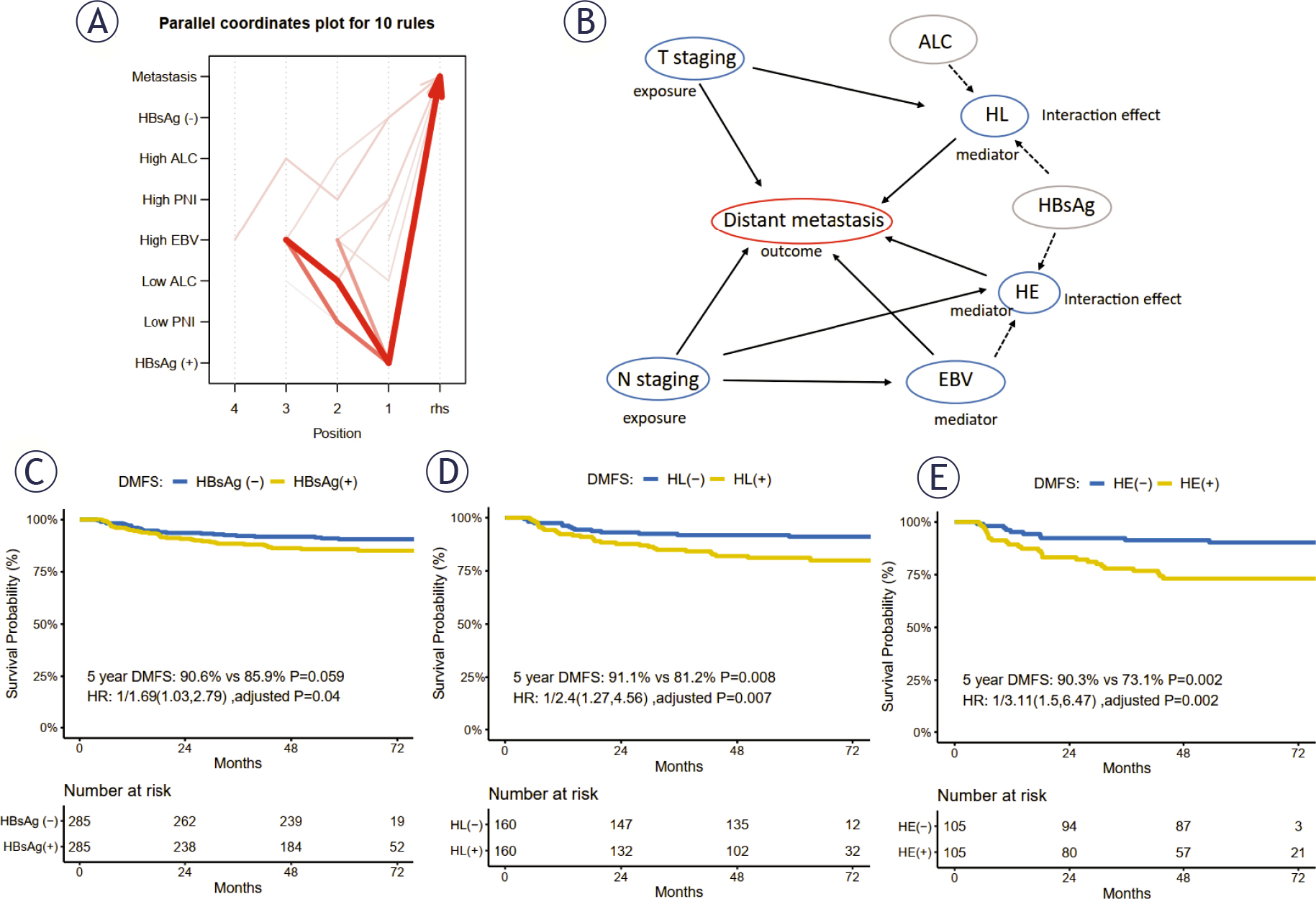
Figure 2.
Association rules, directed acyclic graph, and prognostic value of HBsAg, EBV, and ALC on DMFS. (A) The top 10 association rules related to HBsAg (+) demonstrated strong associations among high EBV, low ALC, and HBsAg (+) with distant metastasis in patients with NPC. (B) The directed acyclic graph (DAG) shows the associations among variables. Significant interactions were observed between HBsAg and plasma EBV DNA load, HBsAg, and ALC, defined as HE and HL. In the mediation analysis, EBV and HE mediated the effect of N staging on distant metastasis, and HL mediated the effect of T staging on distant metastasis. After 1:1 random matched analysis (C–E), HBsAg (+), HL (+), and HE (+) were the independent adverse prognosticators of DMFS in patients with NPC.
Note 1. The width of the curves represents the occurrence frequency of each association rule. X-axis: the number of the position indicates the number of variables involved in the rule. Rhs was set as distant metastasis. The plasma EBV DNA load classification is divided by the cut-off of 4 ×10³ copies/mL. The classification of ALC and PNI is divided by the cut-off with its median value. The original rules are presented in Supplementary Table 1.
Note 2. Supplementary Tables 2 and 4 show the interaction and mediation analyses, respectively.
Note 3. The 1:1 random matched survival analyses were performed with the match factors of T and N stages, plasma EBV DNA, and age group. The P values were calculated using a log-rank test.
ALC = absolute lymphocyte count; DMFS = distant metastasis-free survival; EBV = pre-treatment plasma EBV DNA level; HBsAg = hepatitis B surface antigen; HE = interaction between HBsAg (+) and high EBV; HL = interaction between HBsAg (+) and low ALC; lhs = left-hand side; PNI = prognostic nutritional index; rhs = right-hand side; WBC = white blood cell; +, positive; -, negative
Table 3.
The changes in the hazard ratio of tumor staging when HL and HE are considered as mediators in the multivariate Cox regression model on distant-metastasis-free survival (DMFS)
| Mediator | Exposure | Unadjusted for mediator | Adjusted for mediator | Mediation proportion % | |||
|---|---|---|---|---|---|---|---|
| HR (95%CI) | P | HR (95% CI) | P | HR (95%CI) | P | ||
| HL (+) | T stage | ||||||
| T1-2 | 1 (Reference) | 0.004 | 1 (Reference) | 0.006 | |||
| T3-4 | 1.59 (1.16-2.18) | 1.56 (1.14-2.15) | 7.58 (0.538-26) | 0.032 | |||
| EBV | N stage | ||||||
| N0-1 | 1 (Reference) | < 0.001 | 1 (Reference) | < 0.001 | |||
| N1-2 | 2.35 (1.78-3.11) | 2.01 (1.51-2.69) | 19.3 (7.28-36) | 0.004 | |||
| HE (+) | N stage | ||||||
| N0-1 | 1 (Reference) | < 0.001 | 1 (Reference) | < 0.001 | |||
| N1-2 | 2.01 (1.51-2.69) | 2.05 (1.53-2.74) | 5.39 (0.37-14.0) | 0.032 | |||
1 The mediation associations were: T stage (exposure) →HL (+) (mediator) →distant metastasis (outcome); N stage (exposure) →EBV (mediator) →distant metastasis (outcome); N stage (exposure) →HL (+) (mediator) →distant metastasis (outcome). ‘Unadjusted for mediator’ indicates that the item of the mediator and its related variable were not involved in the multivariate analysis. ‘Adjusted for mediator’ indicates that the mediator item and its related variable were considered in the multivariate analysis. Mediation proportion (%) represents the proportion of the effect of the mediator on DMFS to the total effect of exposure on DMFS.
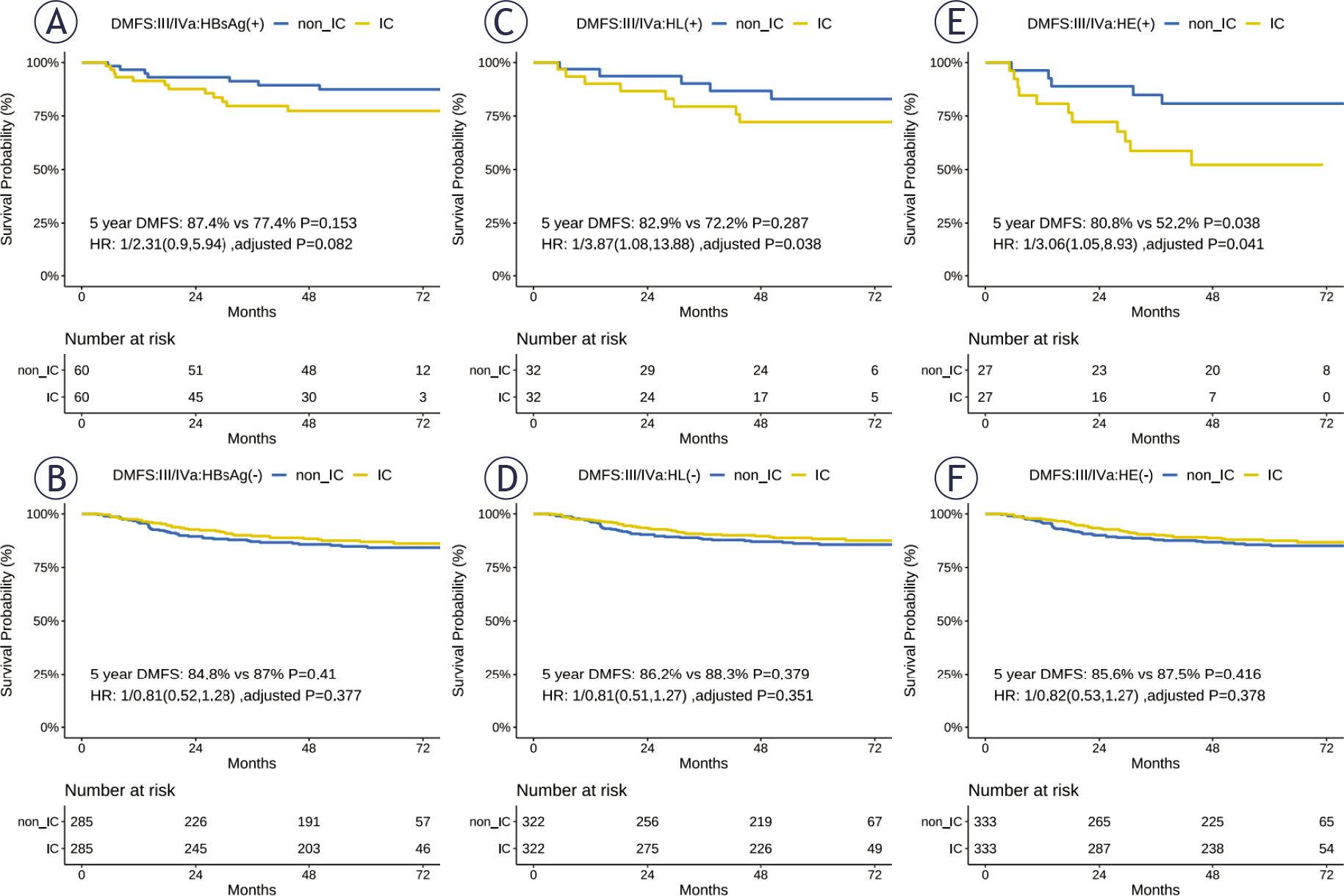
FIGURE 3.
The 5-year DMFS among patients treated with and without induction chemotherapy.
Note 1. The 1:1 random matched survival analysis was performed among stage III–IVa patients, with the match factors of T and N stages, plasma EBV DNA, and age group. The P values were calculated using a log-rank test.
DMFS = distant metastasis-free survival; HBsAg = hepatitis B surface antigen; HE = interaction between HBsAg (+) and high EBV; HL = interactions between HBsAg (+) and low ALC; IC = induction chemotherapy; non_IC = treated without induction chemotherapy; + = positive; - = negative