
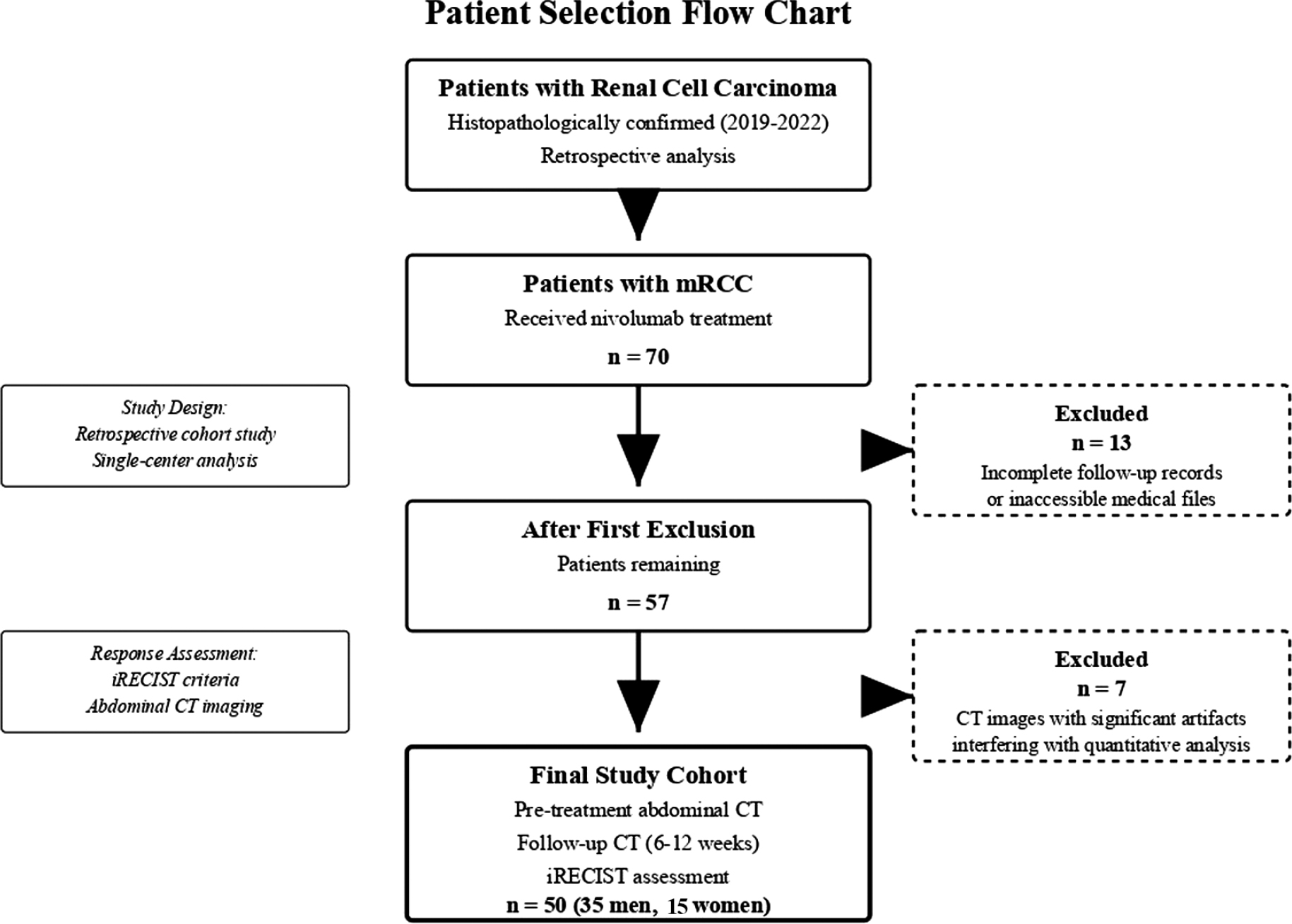
FIGURE 1.
Patient selection flow chart for the retrospective analysis of nivolumab treatment in metastatic renal cell carcinoma.
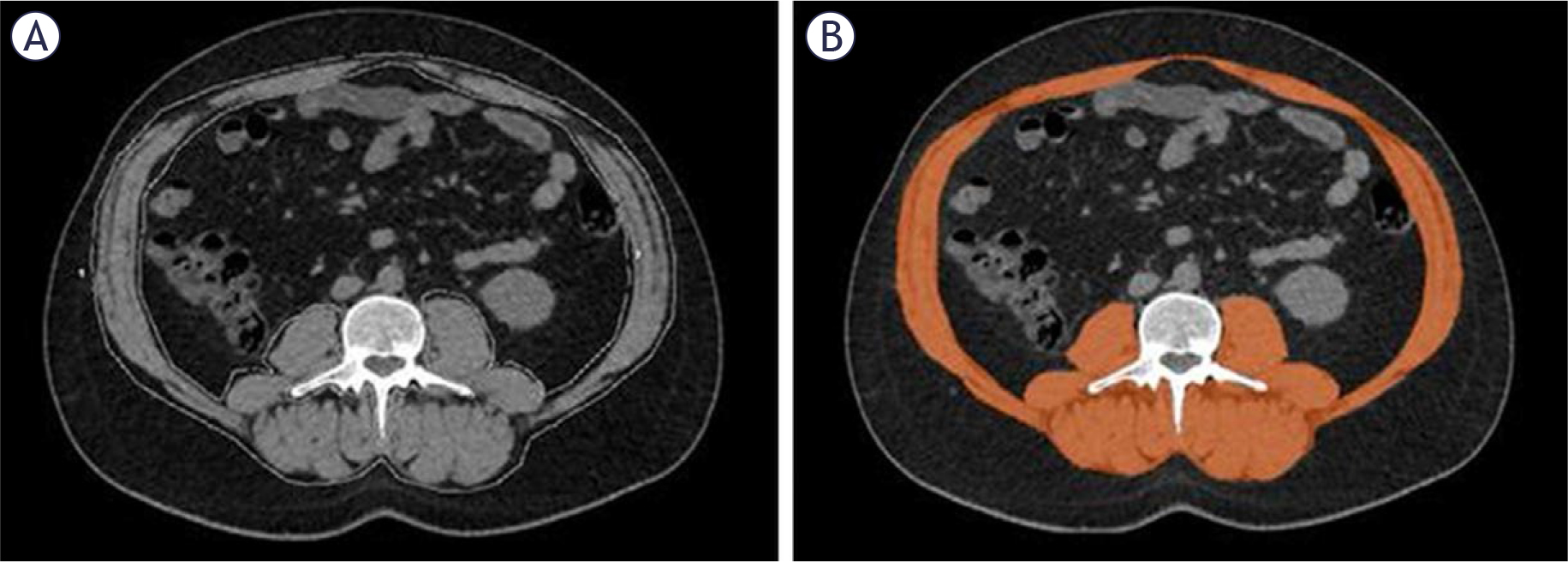
FIGURE 2.
Axial computed tomography images at the level of the third lumbar vertebra. (A) Unprocessed image used for skeletal muscle area analysis. (B) Skeletal muscle areas (highlighted in orange) were manually segmented based on a Hounsfield unit (HU) threshold range of -29 to +150 to quantify muscle tissue area.
Table 1.
Comparison of clinical characteristics and survival outcomes by baseline muscle mass status
| Feature | Low buscle mass present (n = 30) | Low muscle mass absent (n = 20) | p-value |
|---|---|---|---|
| Patients, n (%) | 30 (60) | 20 (40) | - |
| Age, mean ± SD | 60 ± 10.5 | 57.7 ± 9.9 | 0.382 |
| Sex (men / women) | 25 / 5 | 10 / 10 | 0.013* |
| IMDC score (favorable / intermediate / poor) | 23 / 2 / 2 | 13 / 3 / 2 | 0.541 |
| Objective treatment response (Yes / No) | 2 / 28 | 6 / 14 | 0.027* |
| Overall Survival, Months (95% CI) | 20 (8.1–31.9) | NR | < 0.001* |
| Progression-Free Survival, Months (95% CI) | 8.8 (5.7–11.9) | 30.2 (13.1–47.4) | 0.004* |
Table 2.
Association of change in skeletal muscle index with clinical and survival outcomes
| Variable | ΔSMI Negative (n = 25) | ΔSMI Positive (n = 25) | p-value |
|---|---|---|---|
| Age, mean ± SD | 61.0 ± 10.1 | 57.1 ± 10.1 | 0.180 |
| Sex (men/ women) | 18 / 7 | 17 / 8 | 0.758 |
| IMDC score (favorable / intermediate / poor) | 18 / 1 /3 | 18 / 4 / 1 | 0.249 |
| Presence of multiple metastases, n (%) | 19 (76) | 11 (44) | 0.021* |
| Baseline low muscle mass, n (%) | 19 (76) | 11 (44) | 0.021* |
| Objective treatment response (Yes / No) | 1 / 24 | 7 / 18 | 0.021* |
| Overall survival, months (95% CI) | 15.8 (0–37.0) | NR | 0.027* |
| Progression-free survival, months (95% CI) | 8.1 (1.6–14.6) | 30.2 (11.5–49.0) | 0.005* |
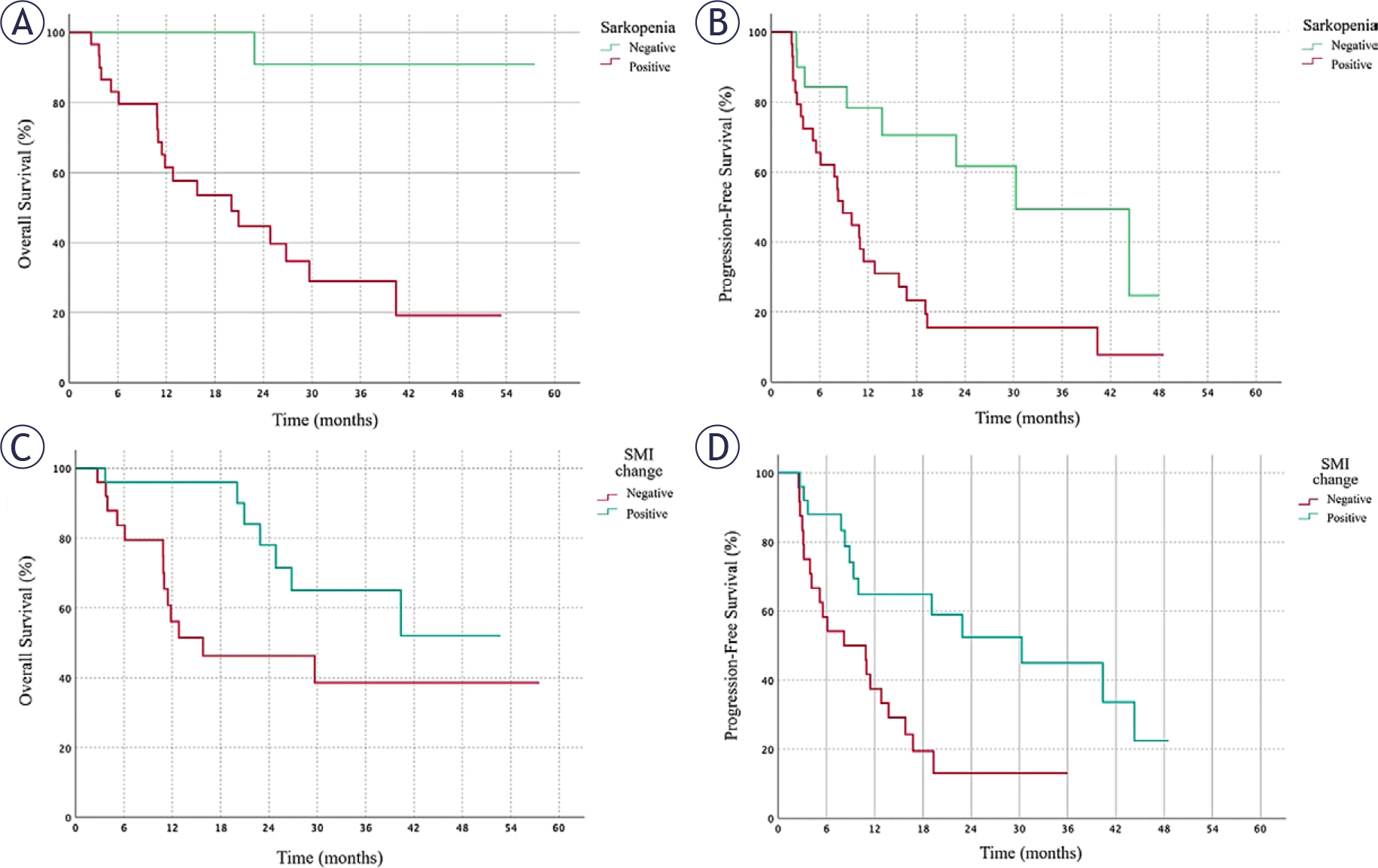
FIGURE 3.
Kaplan-Meier survival curves illustrating overall survival (OS) and progression-free survival (PFS) in patients with metastatic renal cell carcinoma stratified by muscle mass status and skeletal muscle index (SMI) change. (A) OS was significantly shorter in patients with low muscle mass compared to those normal muscle mass group (HR: 35.00; 95% CI: 3.22-381.69; p = 0.003). (B) PFS was significantly shorter in patients with low muscle mass than in normal muscle mass group (HR: 12.50; 95% CI: 2.10-73.91; p = 0.004). (C) Patients with a negative ΔSMI had significantly reduced OS compared to those with a positive ΔSMI (HR: 6.10; 95% CI: 1.46-25.47; p = 0.013). (D) A negative ΔSMI was associated with significantly shorter PFS compared to a positive ΔSMI (HR: 4.50; 95% CI: 1.15-17.65; p = 0.031)
CI = confidence interval; HR = hazard ratio; HU = Hounsfield unit; OS = overall survival; PFS = progression-free survival; ΔSMI = change in skeletal muscle index
Table 3.
Cox regression analysis for overall survival
| Variable | Univariate HR (95% CI) | p-value | Multivariate HR (95% CI) | p-value |
|---|---|---|---|---|
| Age | 1.01 (0.96–1.05) | 0.594 | 0.98 (0.92–1.05) | 0.713 |
| Sex (female vs. male) | 0.89 (0.34–2.33) | 0.818 | 0.86 (0.22–3.25) | 0.825 |
| Low muscle masss (present vs. absent) | 17.50 (2.33–131.10) | 0.005* | 35.00 (3.22–381.69) | 0.003* |
| ΔSMI (negative vs. positive) | 2.72 (1.07–6.87) | 0.034* | 6.10 (1.46–25.47) | 0.013* |
| IMDC score (intermediate/poor vs. favorable) | 0.67 (0.15–2.94) | 0.600 | 1.57 (0.26–9.38) | 0.621 |
| Multiple metastases (present vs. absent) | 3.11 (1.12–8.64) | 0.029* | 5.21 (1.00–27.10) | 0.050* |
| Histologic subtype (non-clear cell vs. clear cell) | 0.85 (0.11–6.40) | 0.877 | 0.68 (0.04–9.56) | 0.779 |
| Lymph node metastasis (present vs. absent) | 0.82 (0.34–1.98) | 0.665 | 0.31 (0.07–1.22) | 0.094 |
| Lung metastasis (present vs. absent) | 1.26 (0.51–3.09) | 0.614 | 0.27 (0.05–1.39) | 0.118 |
| Liver metastasis (present vs. absent) | 1.78 (0.71–4.49) | 0.216 | 0.94 (0.24–3.67) | 0.940 |
Table 4.
Cox regression analysis for progression-free survival
| Variable | Univariate HR (95% CI) | p-value | Multivariate HR (95% CI) | p-value |
|---|---|---|---|---|
| Age | 0.99 (0.96–1.03) | 0.647 | 0.98 (0.93–1.03) | 0.437 |
| Sex (female vs. male) | 0.87 (0.38–2.00) | 0.739 | 1.00 (0.33–3.05) | 0.994 |
| Low muscle mass (present vs. absent) | 4.17 (1.91–9.10) | < 0.001* | 4.98 (1.99–12.42) | < 0.001* |
| ΔSMI (Negative vs. Positive) | 3.52 (1.50–8.26) | 0.004* | 6.42 (2.18–18.91) | 0.001* |
| IMDC score (intermediate/poor vs. favorable) | 1.13 (0.33–3.84) | 0.849 | 2.12 (0.48–9.30) | 0.321 |
| Multiple metastases (present vs. absent) | 2.53 (1.07–5.97) | 0.035* | 1.97 (0.59–6.63) | 0.267 |
| Histologic subtype (non-clear cell vs. clear cell) | 0.95 (0.18–5.01) | 0.950 | 1.39 (0.15–12.92) | 0.771 |
| Lymph node metastasis (present vs. absent) | 0.76 (0.34–1.70) | 0.510 | 0.52 (0.17–1.63) | 0.264 |
| Lung metastasis (present vs. absent) | 1.18 (0.52–2.67) | 0.692 | 0.59 (0.18–1.89) | 0.374 |
| Liver metastasis (present vs. absent) | 1.33 (0.62–2.88) | 0.466 | 0.89 (0.30–2.66) | 0.839 |