
TABLE 1.
Baseline characteristics of 30 patients with recurrent or metastatic nasopharyngeal carcinoma treated with anlotinib monotherapy
| Characteristics | No. of patients (%) |
|---|---|
| Age (years) | |
| Median (55) | |
| Range (35–76) | |
| Sex | |
| Male | 25 (83.3) |
| Female | 5 (16.6) |
| ECOG status | |
| 0-1 | 24 (80.0) |
| 2 | 6 (20.0) |
| Disease stagea at diagnosis | |
| Stage II | 2 (6.7) |
| Stage III | 9 (30.0) |
| Stage IV | 19 (63.3) |
| Disease status when starting anlotinib therapy | |
| Local recurrence | 10 (33.3) |
| Metastatic diseaseb | 13 (43.3) |
| Both | 7 (23.3) |
| Metastatic sites | |
| Liver | 11 (36.7) |
| Lung | 10 (33.3) |
| Bone | 10 (33.3) |
| Distant lymph node | 8 (26.7) |
| Number of prior systemic therapy lines | |
| 0 | 8 (26.7) |
| 1 | 13 (43.3) |
| ≥ 2 | 9 (30.0) |
| Platinum-refractory diseasec | |
| Yes | 16 (53.3) |
| No | 14 (46.7) |
| Anlotinib starting dose | |
| 12 mg | 21 (70.0) |
| 10 mg | 9 (30.0) |
| RT for recurrent/metastatic lesions | |
| Yes | 3 (10.0) |
| No | 27 (90.0) |
| Surgical treatment for recurrent lesions | |
| Yes | 2 (6.7) |
| No | 28 (93.3) |
| Immunotherapy before anlotinib | |
| Yes | 3 (10.0) |
| No | 27 (90.0) |
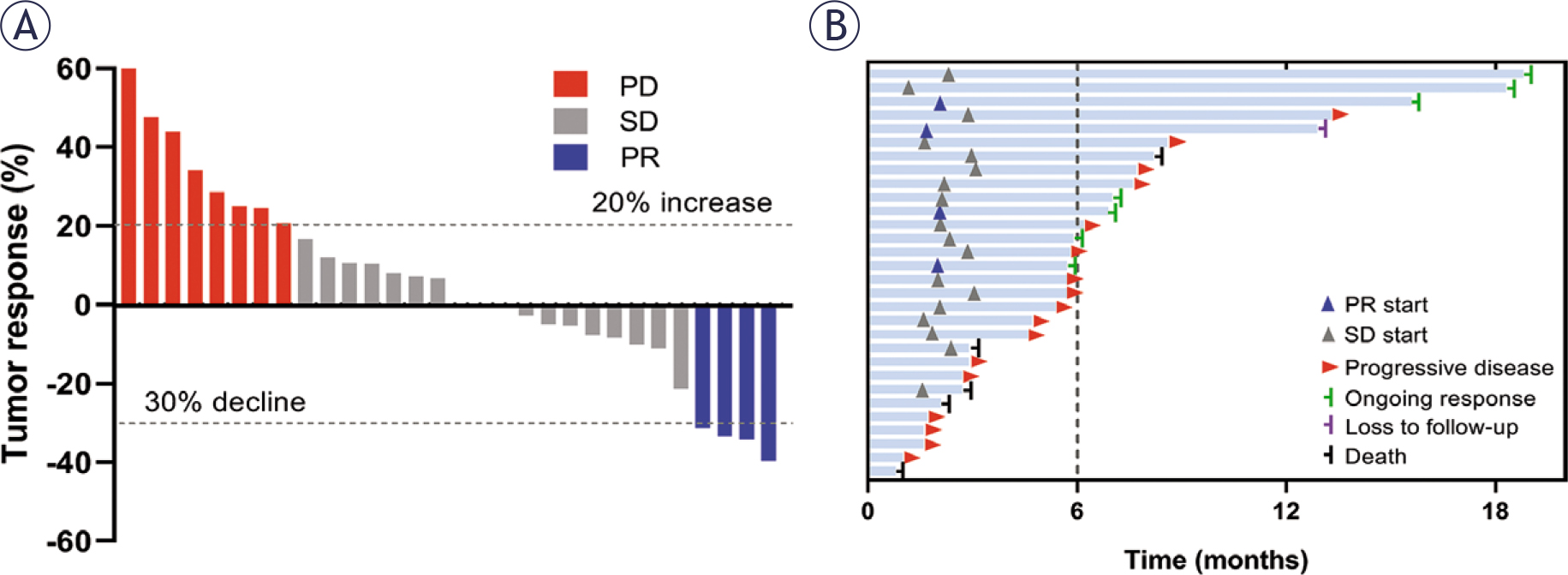
FIGURE 1.
Treatment efficacy of anlotinib in patients with recurrent or metastatic nasopharyngeal carcinoma. (A) Waterfall plot shows the maximum change in target lesion diameter relative to baseline in each patient, following RECIST criteria, Version 1.1. (B) Swimmer’s plot shows the duration of response for each patient.
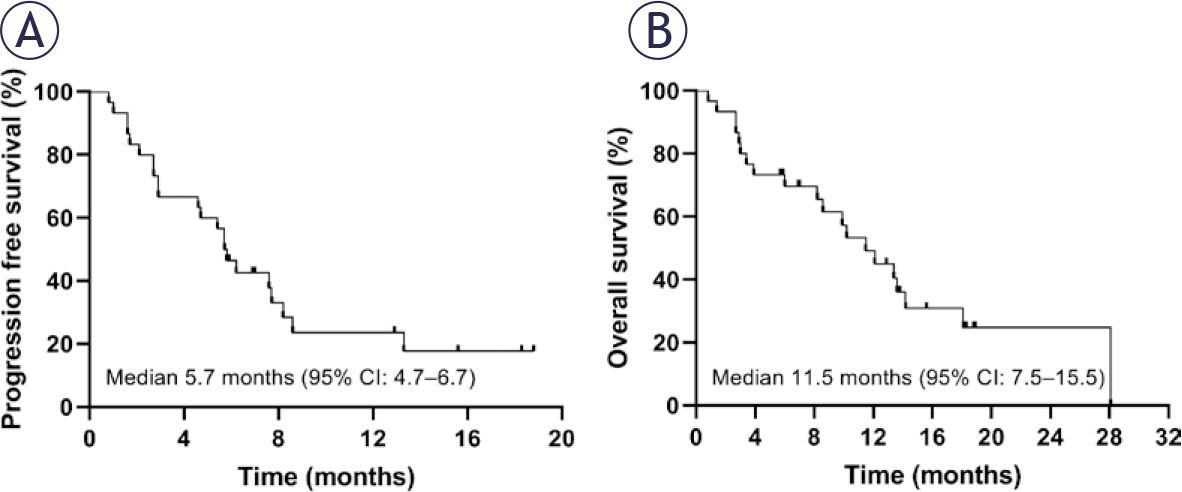
FIGURE 2.
Survival curves for the 30 patients under anlotinib monotherapy in this study. (A) Progression-free survival and (B) overall survival.
TABLE 2.
Most common adverse reactions due to anlotinib treatment (incidence > 5%)
| Adverse reaction | All grades | Grade 1 | Grade 2 | Grade 3 | Grade 4 |
|---|---|---|---|---|---|
| n (%) | |||||
| Hand-foot syndrome | 15 (50.0) | 6 (20.0) | 5 (16.7) | 4 (13.3) | 0 |
| Hypertension | 12 (40.0) | 8 (26.7) | 3 (10.0) | 1 (3.3) | 0 |
| Oral mucositis | 11 (36.7) | 5 (16.7) | 2 (6.7) | 4 (13.3) | 0 |
| Hypothyroidism | 9 (30.0) | 7 (23.3) | 2 (6.7) | 0 | 0 |
| Fatigue | 8 (26.7) | 5 (16.7) | 3 (10.0) | 0 | 0 |
| Proteinuria | 5 (16.7) | 5 (16.7) | 0 | 0 | 0 |
| Positive urinary occult blood | 4 (13.3) | 4 (13.3) | 0 | 0 | 0 |
| Leukopenia | 3 (10.0) | 3 (10.0) | 0 | 0 | 0 |
| Nasal bleeding | 3 (10.0) | 0 | 0 | 3 (10.0) | 0 |
| Arthralgia | 2 (6.7) | 0 | 1 (3.3) | 1 (3.3) | 0 |