
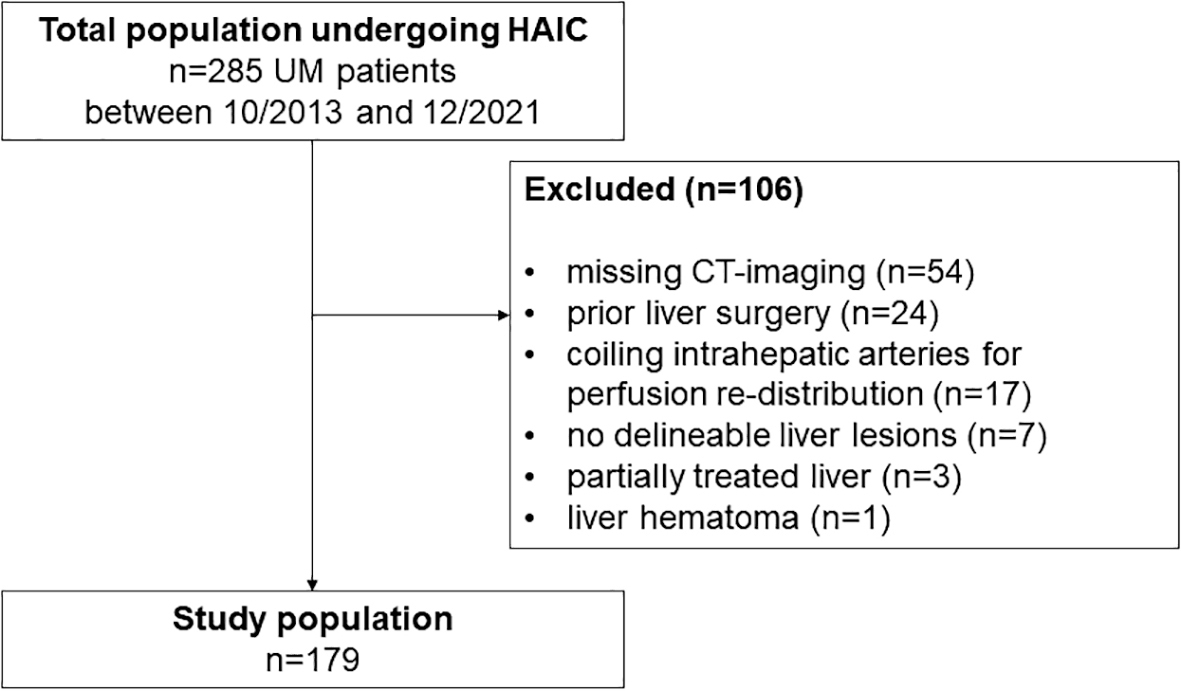
FIGURE 1.
Flowchart of analyzed study population with exclusion criteria.
HAIC = hepatic artery infusion therapy
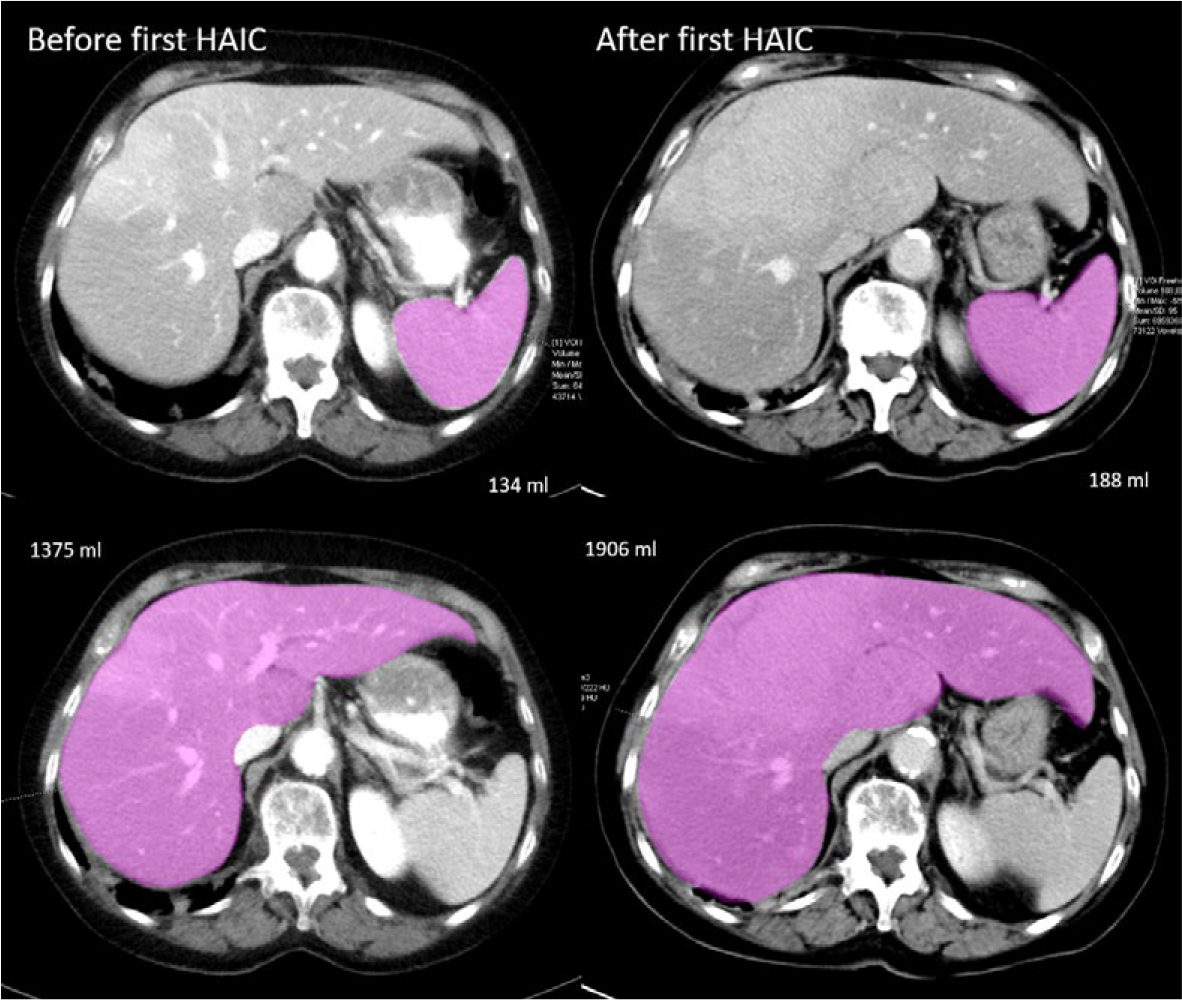
FIGURE 2.
71-year old women with uveal melanoma and liver metastases. Axial CT image examples of volumetry of liver and spleen four days before and 44 days after first hepatic artery infusion therapy (HAIC). Liver and spleen volume increased by 39% after first HAIC.
TABLE 1.
Patient characteristics
| All patients (n = 179) | Splenomegaly (n = 25) | No Splenomegaly (n = 154) | p-value | |
|---|---|---|---|---|
| Age (mean/SD) | 64.8 years, 11.0 years | 61.9 years, 12.5 years | 65.0 years, 10.7 years | 0.2 |
| Gender (female/male) | 95 (53 %) / 84 (47 %) | 4 (16 %) / 21 (84 %) | 91 (59 %) / 63 (41 %) | |
| Number of HAIC per patient | 5 (3–10) | 5 (3–11) | 5 (3–9) | 0.8 |
| Spleen | ||||
| Volume before first HAIC | 205 ml (150–263 ml) | 362 ml (347–407 ml) | 186 ml (142–237 ml) | < 0.0001 |
| Volume after first HAIC | 213 ml (155–279 ml) | 385 ml (345–430 ml) | 200 ml (151–241 ml) | < 0.0001 |
| Volume change | +4.0 % (-4.0 – +12.0%) | + 6.5 % (-5.8 – +11.5%) | +3.6 % (-3.4 – +12.2%) | 0.8 |
| Liver | ||||
| Volume before first HAIC | 1731 ml (1426–2228 ml) | 2358 ml (1936–2787 ml) | 1637 ml (1405–2050 ml) | < 0.0001 |
| Volume after first HAIC | 1780 ml (1447–2406 ml) | 2354 (1983–2894 ml) | 1741 ml (1431–2240 ml) | 0.0009 |
| Volume change | +4.0 % (-2.0 – +13.0%) | -0.5 % (-9.4 – +6.9%) | +5.0 % (-1.7 – +13.4%) | 0.04 |
| RECIST 1.1 liver index size change | +2.8 % (-6.5 – +14.3%) | +2.5 % (-3.0 – +10.2%) | +3.3 % (-7.2 – +16.1%) | 0.7 |
| Overall survival | 13.7 months (7.3–21.2 months) | 10.7 months (5.2–19.2 months) | 13.8 months (7.3–21.8 months) | 0.6 |
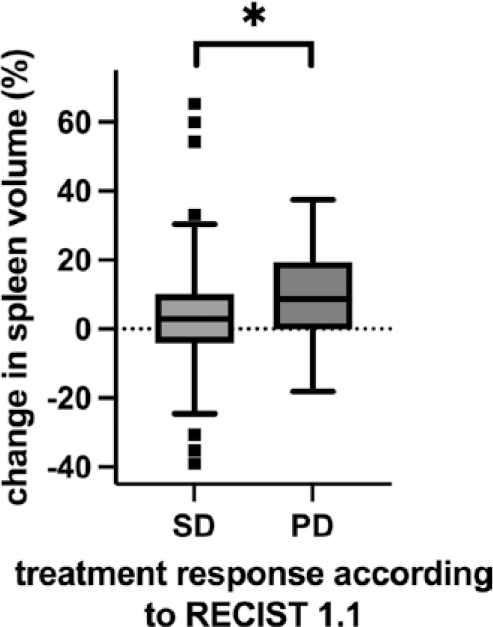
FIGURE 3.
Change in spleen volume dif ferentiated by treatment response according to RECIST 1.1. Points show outliers outside the Tukey whiskers. Asterisks indicate significant differences (p ≤ 0.05).
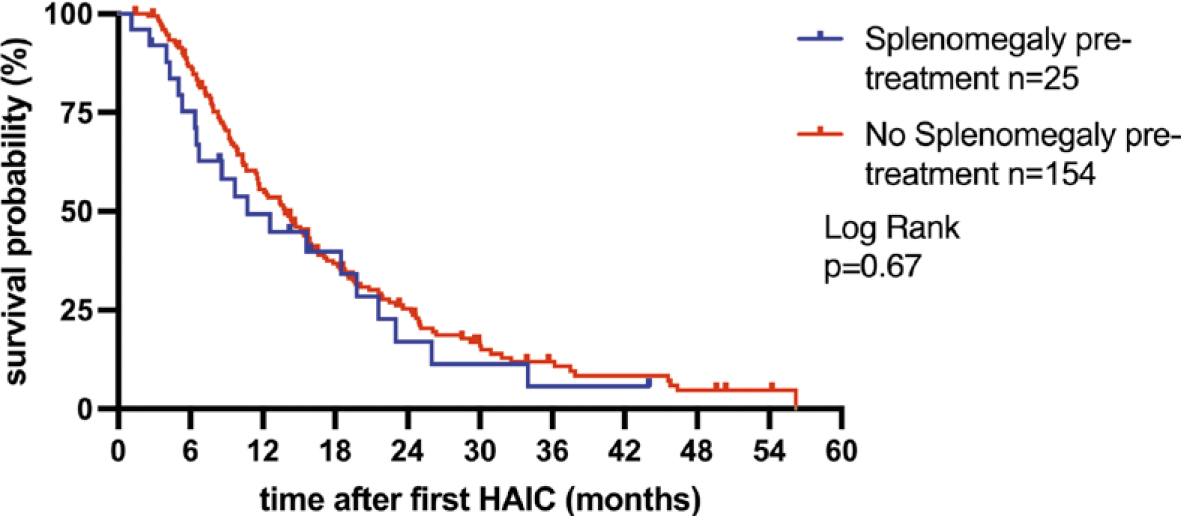
FIGURE 4.
Kaplan-Meier curve shows overall survival (OS) in uveal melanoma (UM) patients with and without splenomegaly before first hepatic artery infusion therapy (HAIC).
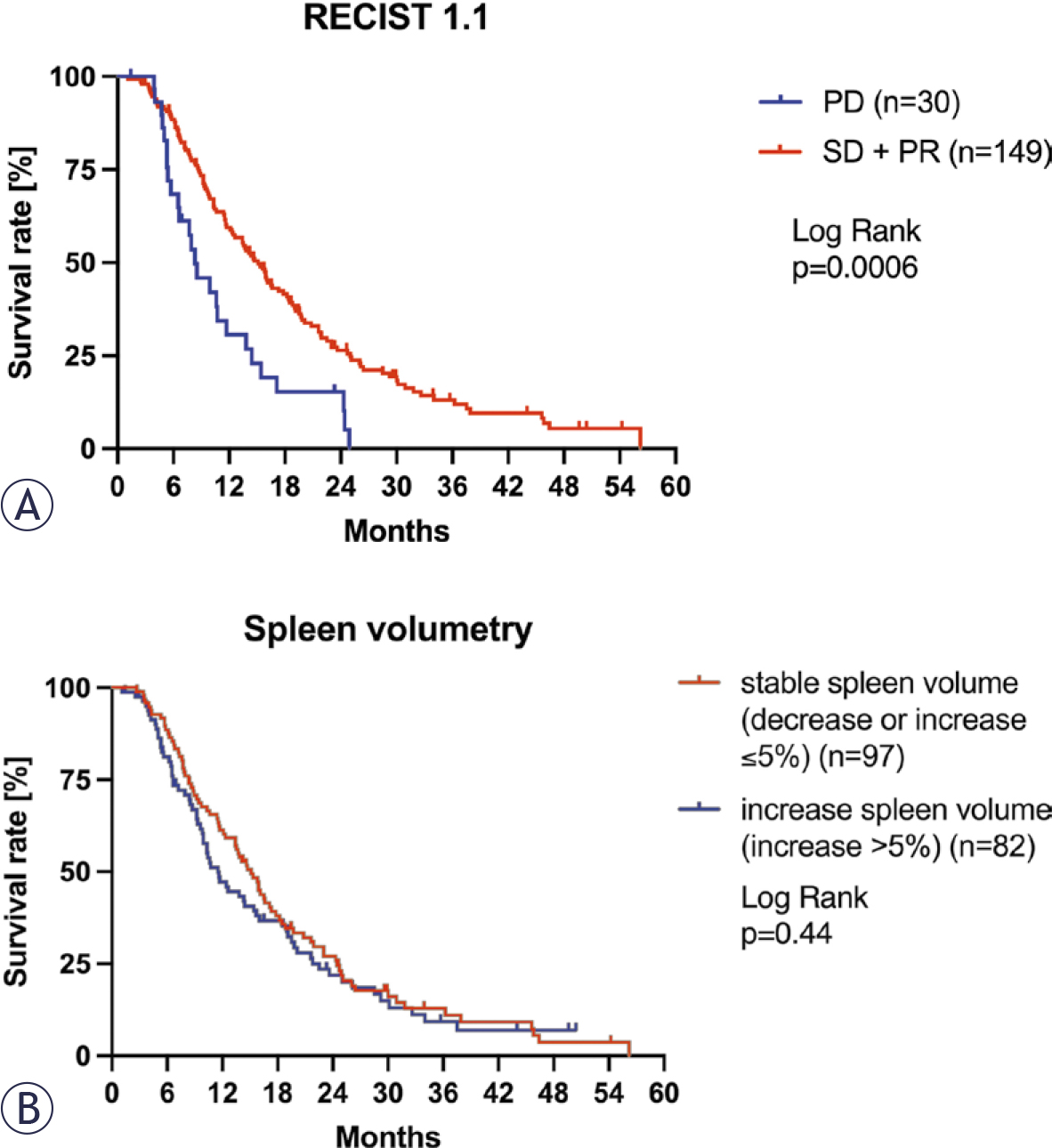
FIGURE 5.
Overall survival of evaluation of treatment response by RECIST 1.1 (A) and spleen volumetry with a threshold of 5% (B) of spleen volume increase of uveal melanoma patients with liver metastases treated by hepatic artery infusion therapy (HAIC). Kaplan-Meier curves show overall survival (OS) separately for patients evaluated as stable disease (SD) + partial response (PR) and (progressive disease) PD. In spleen volumetry, patients with an increase in spleen volume more than 5% were classified as increased spleen volume and with decrease or increase up to 5% as stable spleen volume.
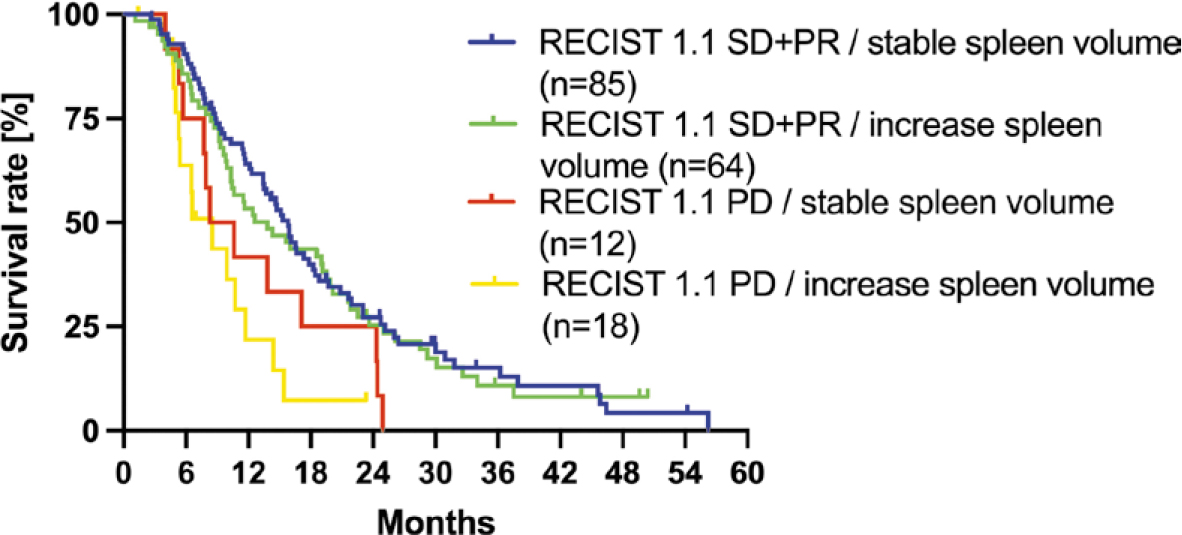
FIGURE 6.
Kaplan-Meier curves for the combined RECIST 1.1 and spleen volumetry evaluation of treatment response with a threshold of 5% increase in spleen volume in uveal melanoma patients with liver metastases treated by HAIC.
PD = progressive disease; PR = partial response; SD = stable disease
TABLE 2.
Median overall survival and accordance of treatment response evaluation by RECIST 1.1 and spleen volumetry with a threshold of 5% increase in spleen volume
| Spleen volumetry | |||
|---|---|---|---|
| RECIST 1.1 criteria | Stable (spleen volume decrease or increase up to max. 5%) | Increase (spleen volume increases more than 5%) | Total |
| SD + PR | 15.8 months (n = 85) | 13.8 months (n = 64) | 15.1 months (n = 149) |
| PD | 9.5 months (n = 12) | 8.5 months (n = 18) | 8.3 months (n = 30) |
| Total | 15.1 months (n = 97) | 11.5 months (n = 82) | 13.8 months (n = 179) |