
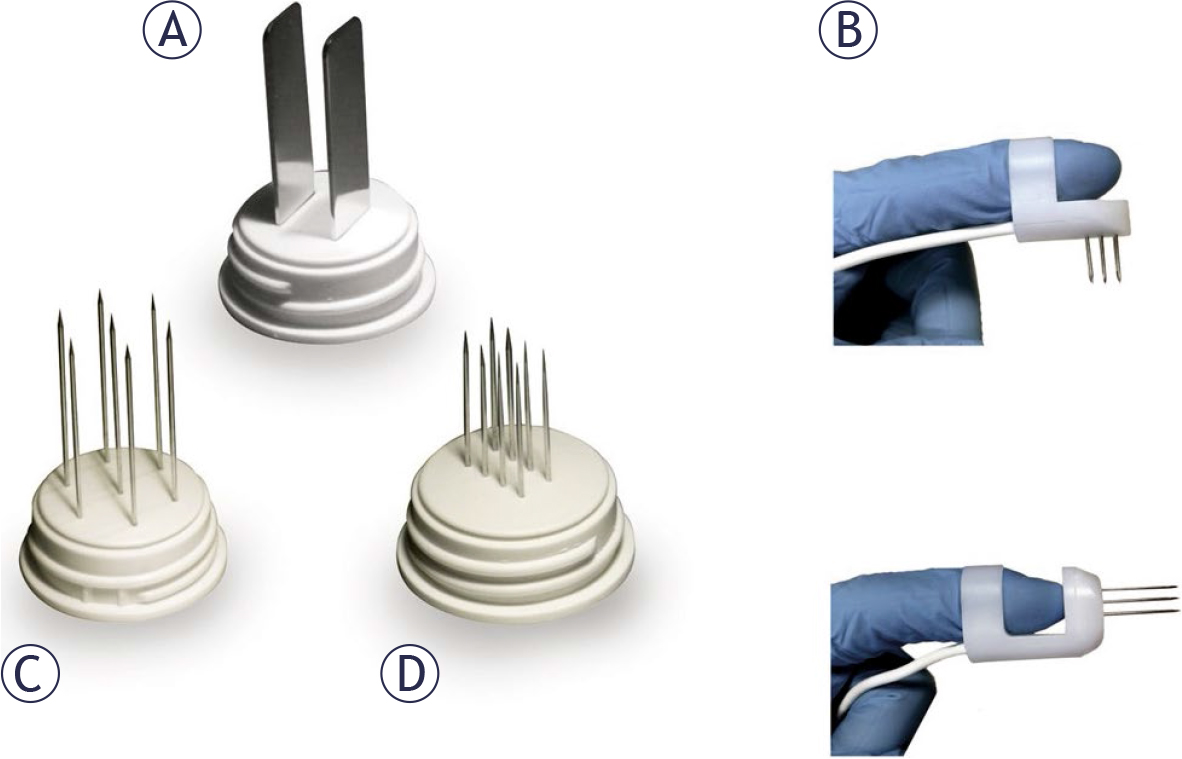
FIGURE 1.
Types of electrodes used. (A) Type I: two plates with a 6 mm gap; (B) type IV: a wearable finger electrode with two parallel rows of needles; (C) type III: a hexagonal array with a 7.3 mm gap; or (D) type II: two parallel rows of needles with a 4 mm gap.
TABLE 1.
Descriptive characteristics of the population
| N | % | |
|---|---|---|
| GENDER | ||
| Males | 80 | 61% |
| Female | 52 | 39% |
| LESIONS’ NUMEROSITY | ||
| Single | 102 | 77% |
| Multiple | 30 | 23% |
| T STAGE | ||
| T1 | 99 | 75% |
| T2 | 11 | 8% |
| T3 | 1 | 1% |
| Tis | 21 | 16% |
| TYPE OF TUMOR | ||
| Primary | 72 | 55% |
| Recurrent | 60 | 45% |
| ULCERATED | ||
| No | 96 | 73% |
| Yes | 36 | 27% |
| LESIONS’ PREIRRADIATION | ||
| Yes | 3 | 2% |
| PREVIOUS TREATMENTS | ||
| Surgery | 52 | 39% |
| Radiotherapy | 2 | 2% |
| Surgery, radiotherapy | 6 | 5% |
| Surgery, other therapies | 1 | 1% |
| Surgery, radiotherapy, other therapies | 2 | 2% |
| No | 69 | 51% |
TABLE 2.
Locations of nodules
| LOCALIZATION | N | % |
|---|---|---|
| Nose | 65 | 41% |
| Ear | 20 | 12% |
| Forehead/temple | 16 | 10% |
| Eye | 16 | 10% |
| Cheek | 6 | 4% |
| Scalp | 5 | 3% |
| Lip | 4 | 3% |
| Chin | 3 | 2% |
| Neck | 1 | 1% |
| Other locations | 22 | 14% |
TABLE 3.
Distribution of patients according to drug delivery and type of anesthesia
| Local drug (IT) | Systemic drug (IV) | |
|---|---|---|
| Local anesthesia | 47 | 53 |
| General anesthesia | 9 | 23 |
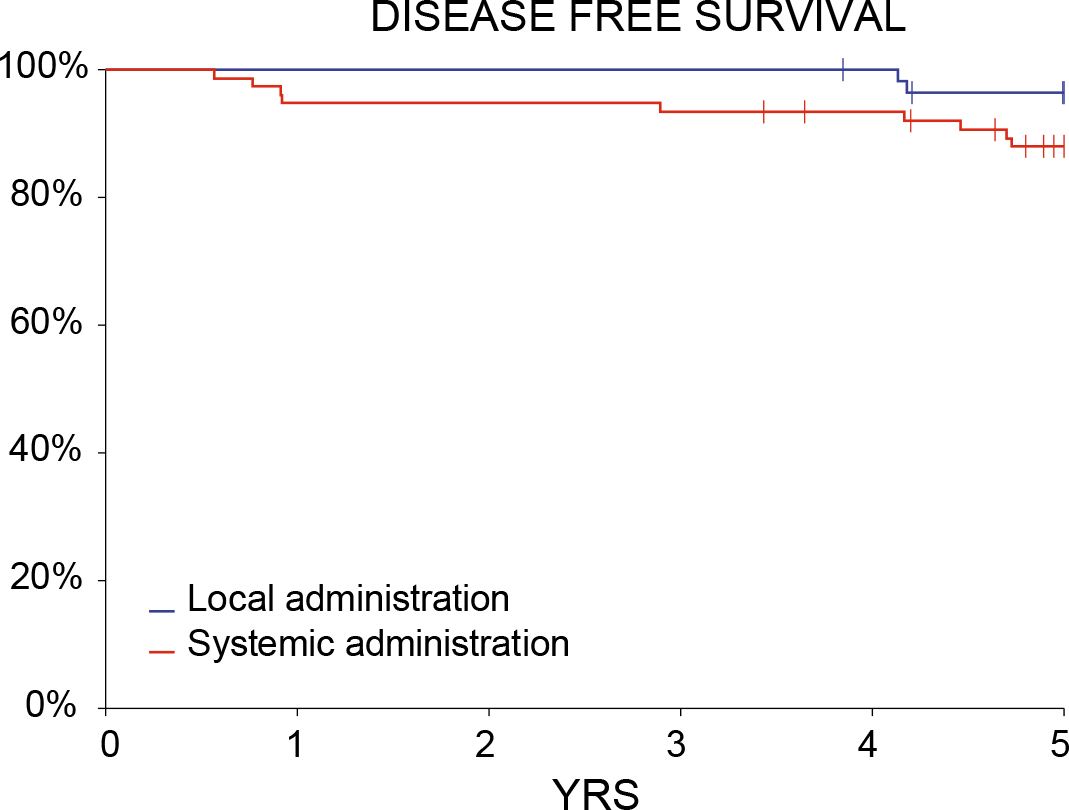
FIGURE 2.
Disease-free survival (DFS) of nodules treated with local (intratumoral, IT) or systemic (intravenous, IV) drug administration.
YRS = years
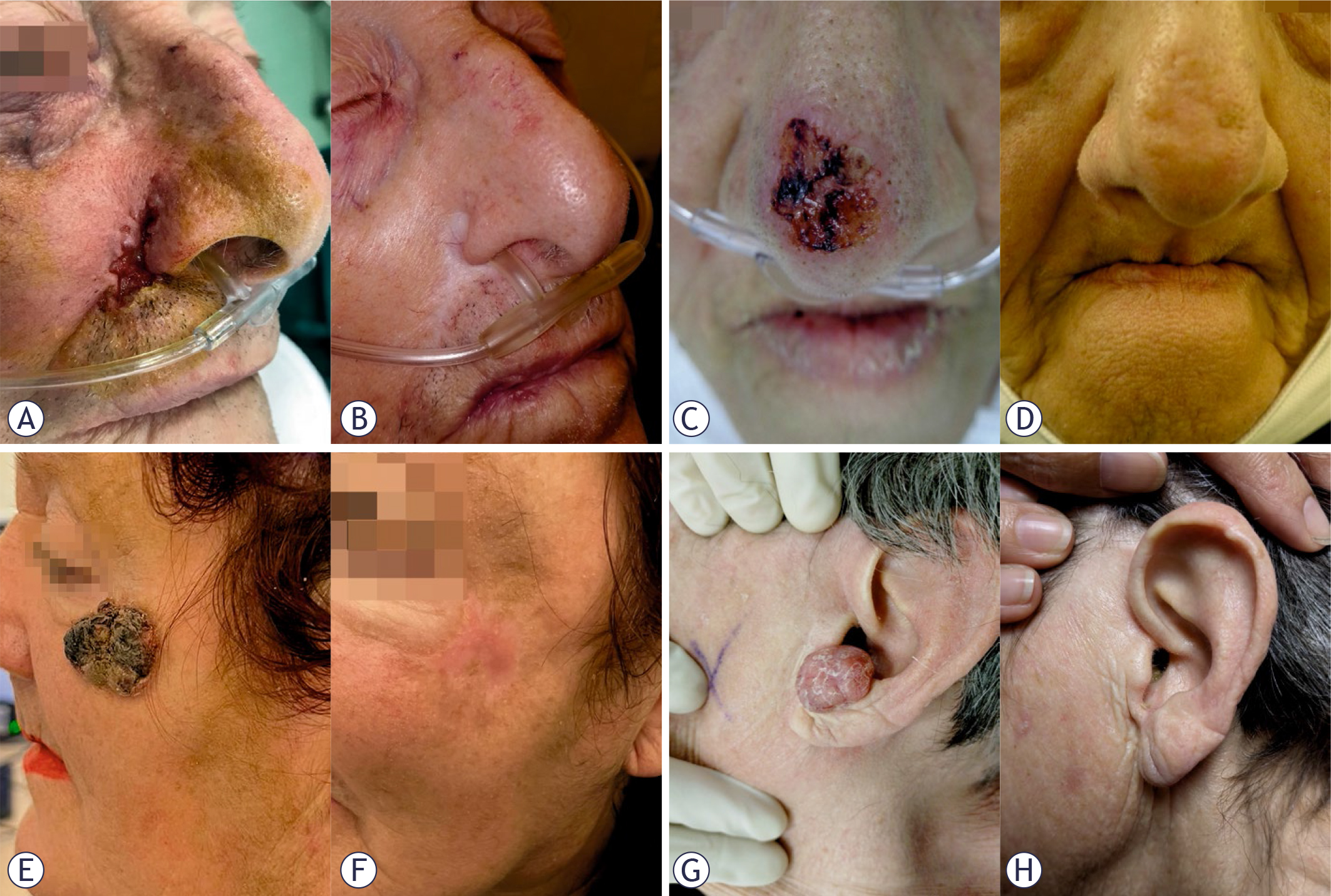
FIGURE 3.
Treatment outcomes of patients treated with intravenous and intratumoral electrochemotherapy (ECT). The outcome is good in larger and smaller basal cell carcinoma (BCC) tumors.
Patient No.1
(A) Recurrent BCC after multiple surgeries in a male, 82 years old patient. ECT performed under sedation and local anesthesia. Intravenous bleomycin 18200 IU. Needle row electrode; 11 pulses. Three cycles of ECT were performed (2 for the first treatment; 1 for recurrence after 2 years).
(B) Result after 5 years of follow-up.
Patient No. 2
(C) Primary BCC in a female, 86 years old patient with multiple severe comorbidities and non-suitable to standard treatments. One ECT session was performed under sedation and local anesthesia. Intralesional Bleomycin 1.5 ml (concentration 1 mg/ml). Needle row electrode; 7 pulses.
(D) Result after 5 years of follow-up.
Patient No. 3
(E) Primary BCC in a female, 69 years old patient. Patient refused standard treatments. One ECT session was performed in general anesthesia with laryngeal mask. Intravenous bleomycin 18200 IU; Hexagonal electrode; 9 pulses. (F) Result after 5 years of follow-up.
Patient No.4
(G) Primary BCC in a female, 88 years old patient with severe comorbidities, Alzheimer’s disease and non-suitable to standard treatments. One ECT session was performed in general anesthesia with laryngeal mask. Intralesional bleomycin 1.5 ml (concentration 1 mg/ml); Finger electrode; 10 pulses. (H) Result after 5 years of follow-up.
TABLE 4.
Symptoms and side effects per patient: comparison between pre-ECT values and 1-month post-ECT values
| Pre-ECT | 1-month post-ECT | |
|---|---|---|
| Nausea | 1 (1%) | 0 (0%) |
| Flu | 0 (0%) | 0 (0%) |
| Suppuration | 1 (1%) | 2 (1%) |
| Hyperpigmentation | 1 (1%) | 10 (8%) |
| Ulceration | 36 (27%) | 14 (11%) |
| Crust | 0 (0%) | 2 (1%) |
| Edema/rush | 0 (0%) | 3 (2%) |
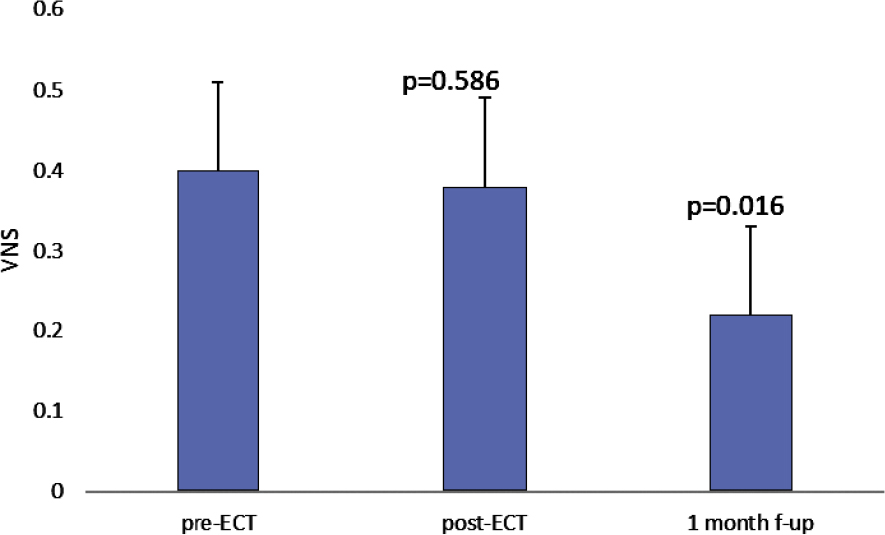
FIGURE 4.
Pain intensity (visual numeric scale, VNS) preelectrochemotherapy (pre-ECT), immediately post-ECT and 1 month after ECT (mean and standard error).
TABLE 5.
Characteristics of the patients who experienced recurrence during the first year of follow-up
| Pt | Age | Primary | Previous therapy | Localization | Size (cm) | Time recurrence (months) | Treatment of the recurrence | Status at 5 years of follow-up |
|---|---|---|---|---|---|---|---|---|
| 1 | 52 | Recurrent | Surgery | Nasal ala | 1.2 | 7 | ECT | NED |
| 2 | 73 | Primary | No | Temporal region | 1.5 | 10 | Surgery | NED |
| 3 | 65 | Recurrent | Surgery | Ear | 1.8 | 11 | ECT, surgery | NED |
| 4 | 52 | Primary | No | Multiple (face) | 3.0 | 11 | ECT | NED |
TABLE 6.
Characteristics of the recurrent patients
| Pt | Age | Primary | Previous therapy | Localization | Size (cm) | Time recurrence (years) | Treatment of the recurrence | Status at 5 years of follow-up |
|---|---|---|---|---|---|---|---|---|
| 1 | 82 | Recurrent | Surgery | Nasal ala | 2.5 | 2.9 | ECT | NED |
| 2 | 60 | Primary | No | Temporal region | 1.8 | 4.1 | Surgery | NED |
| 3 | 89 | Recurrent | No | Nasal ala | 1.7 | 4.7 | No | AWD |
| 4 | 84 | Recurrent | No | Nasolabial fold | 3.0 | 4.7 | RT | AWD |
| 5 | 68 | Primary | Surgery | Tip of the nose | 1.0 | 4.5 | ECT | NED |
| 6 | 74 | Recurrent | Surgery | Nasolabial fold | 1.6 | 4.2 | No | AWD |
| 7 | 72 | Recurrent | Surgery +RT | Scalp | 1.5 | 4.2 | Surgery | NED |
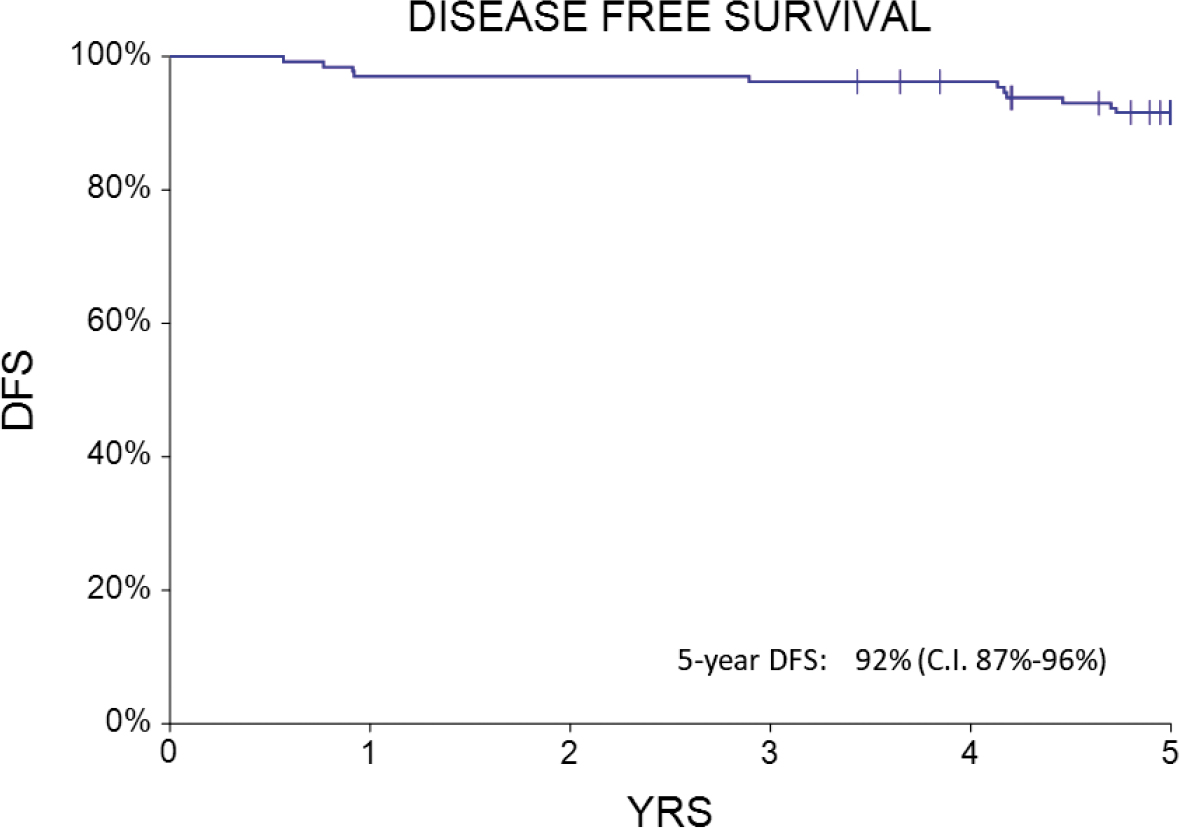
FIGURE 5.
Kaplan-Meier survival curves for the whole population.
DFS = disease free survival
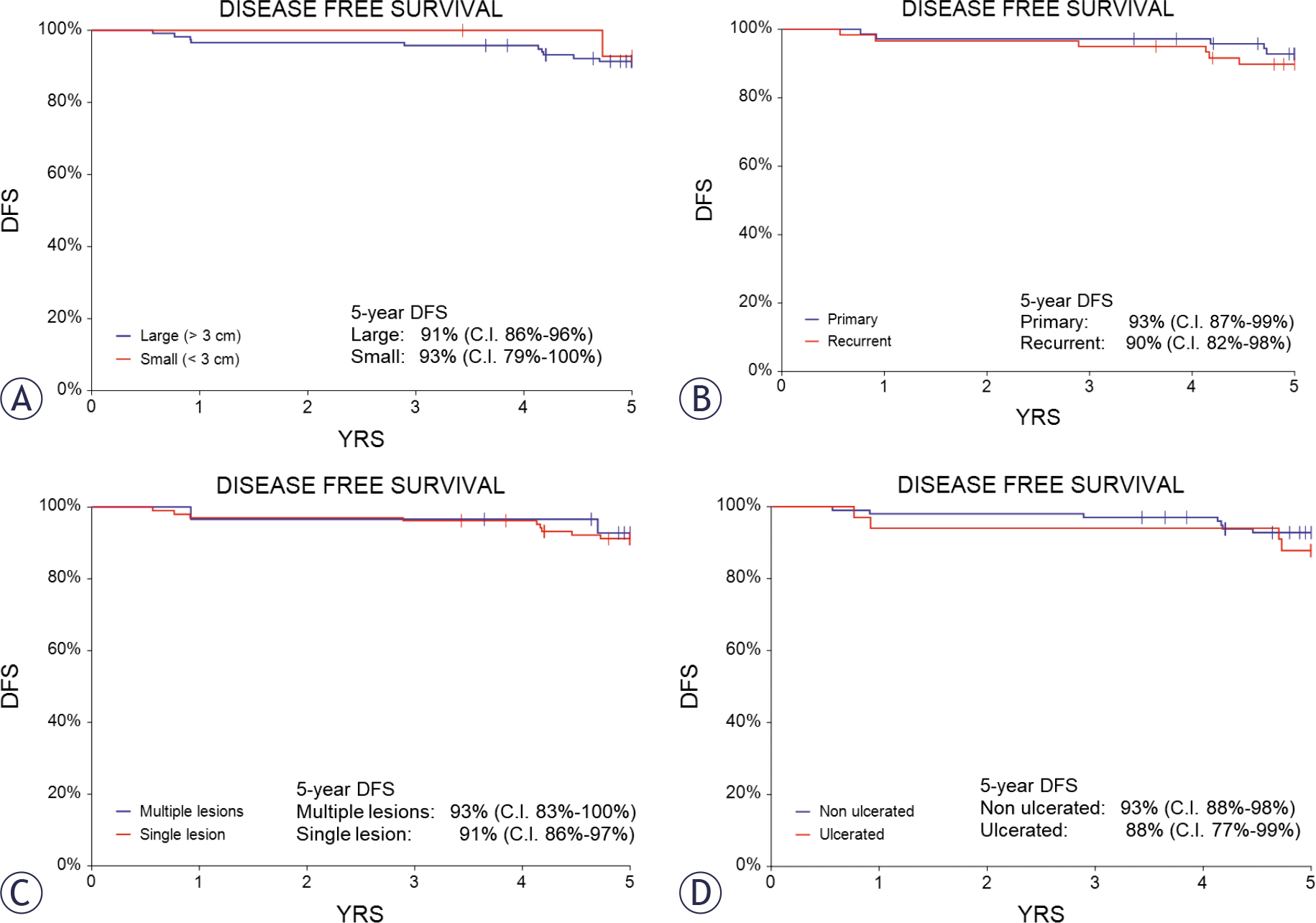
FIGURE 6.
Kaplan-Meier survival (A) of patients with small (< 3 cm) vs large (> 3 cm) lesions (B), patients with primary vs recurrent lesions (C), patients with single vs multiple lesions (D), and patients with ulcerated vs nonulcerated lesions. The differences were not significant.
DFS = disease free survival; YRS = years