
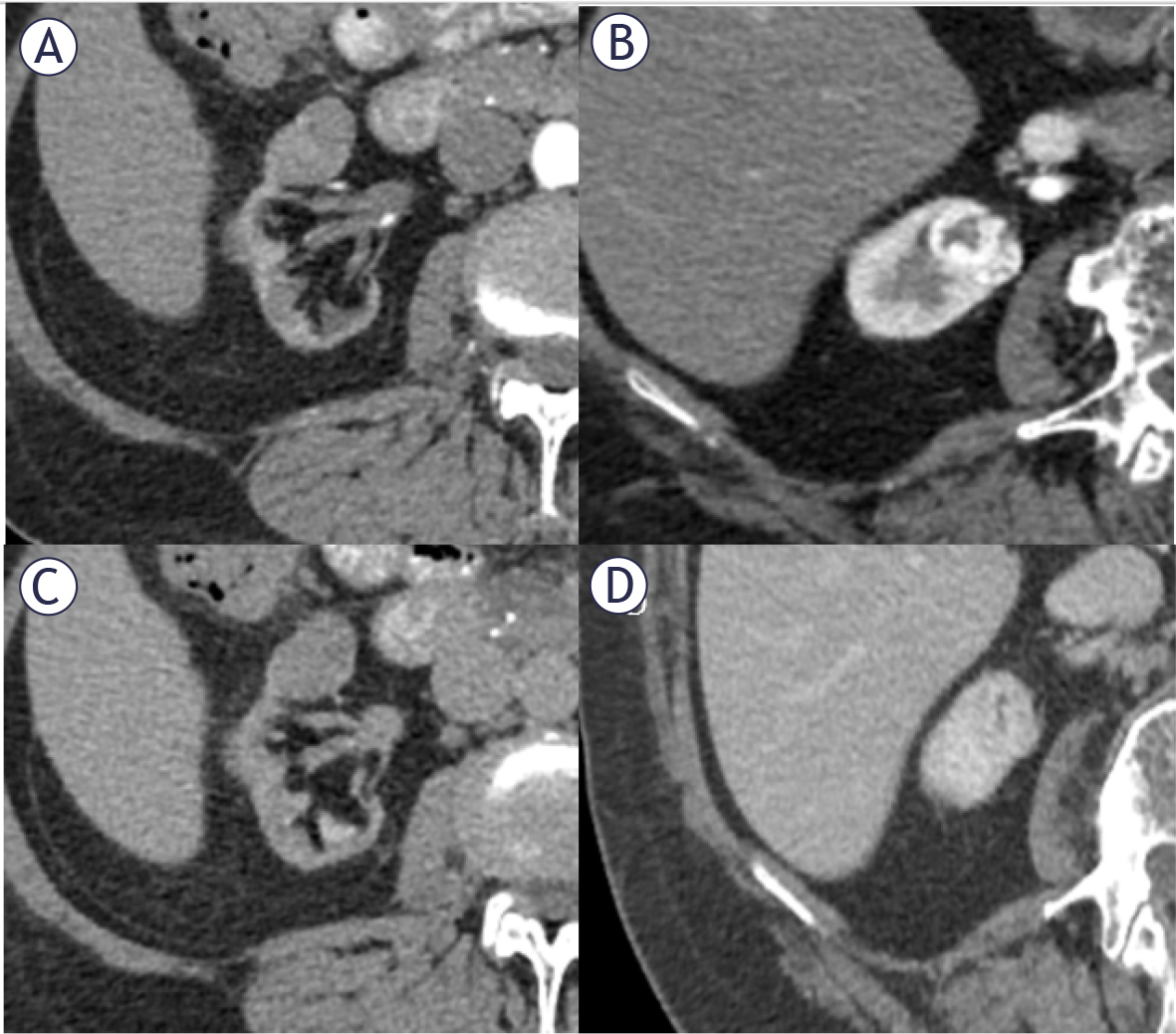
Figure 1.
Axial CT images of two anteriorly localized kidney masses that were subsequently resected and histopathologically verified as benign (A, C) and malignant (B, D) in corticomedullary and nephrogenic phases, respectively.
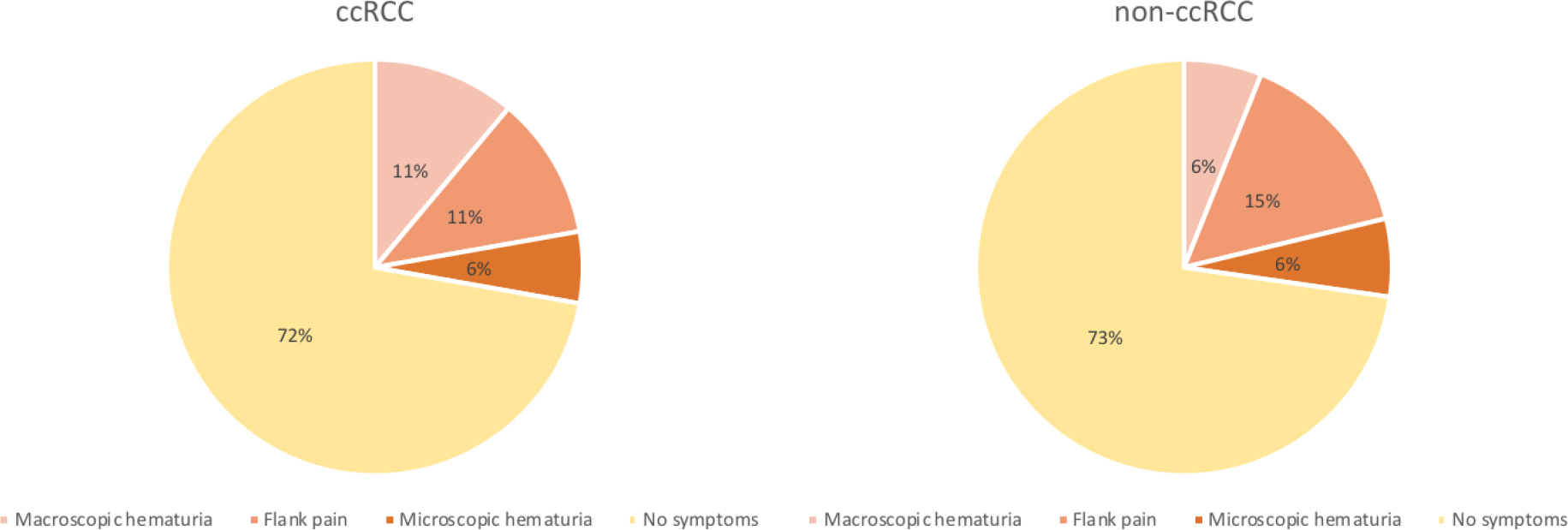
Figure 2.
Prevalence of observed symptoms in patients with ccRCC and non-ccRCC.
ccRCC = clear cell renal cell carcinoma; non-ccRCC = other than clear cell renal cell carcinoma
Table 1.
Differences in risk factors detected in patients with ccRCC vs. patients with other etiologies of indeterminate small renal masses (SRMs)
| Risk factors | ccRCC group (n = 18) | non-ccRCC group (n = 33) | p-value |
|---|---|---|---|
| All risk factors | 17 (94.4%) | 22 (66.7%) | 0.037 |
| Smoking | 11 (61.1%) | 9 (27.3%) | 0.018 |
| Family history of neoplasm | 0 (0%) | 1 (3%) | 1 |
| Genetic syndrome | 0 (0%) | 0 (0%) | 1 |
| Dialysis related cystic disease | 0 (0%) | 0 (0%) | 1 |
| Obesity | 0 (0%) | 3 (9.1%) | 0.544 |
| Hypertension | 14 (77.8%) | 16 (48.5%) | 0.042 |
| Cyclophosphamide treatment | 1 (5.6%) | 1 (3.0%) | 1 |
| Male sex | 6 (33.3%) | 19 (57.6%) | 0.098 |
Table 2.
Differences in CECT parameters in patients with ccRCC and patients with other etiologies of indeterminate small renal masses
| CECT Features | ccRCC (n = 18) | Non-ccRCC (n = 33) | p-value |
|---|---|---|---|
| Anatomical | |||
| Right kidney | 55.6% (10) | 36.4% (13) | 0.268 |
| Left kidney | 44.4% (8) | 60.6% (20) | 0.268 |
| Morphological | |||
| Bean-like shape | 38.9% (7) | 27.3% (9) | 0.393 |
| Ball-like shape | 61.1% (11) | 72.2% (24) | 0.393 |
| Heterogeneous mass | 88.9% (16) | 60.6% (20) | 0.034* |
| Enhancement | |||
| Significant (> 15 HU) | 94.4% (17) | 81.8% (27) | 0.398 |
| Heterogeneous enhancement | 83.3% (15) | 51.5% (17) | 0.025* |
| Washout pattern | 83.3% (15) | 33.3% (11) | < 0.001* |
| Prolonged pattern | 16.7% (3) | 66.7% (22) | < 0.001* |
| Secondary Features | |||
| Tumor-feeding vessels | 33.3% (6) | 3.0% (1) | 0.006* |
| Necrosis area | 44.4% (8) | 21.2% (7) | 0.082 |
| Calcification | 5.6% (1) | 9.1% (3) | 1.000 |
Table 3.
Area under the curve analyses according to selected CECT parameters in the prediction of ccRCC occurrence
| CECT features | AUC | p-value |
|---|---|---|
| Enhancement in corticomedullary phase | 0.752 | 0.003 |
| Difference in enhancement between corticomedullary and native phase | 0.751 | 0.003 |
| Difference in enhancement between corticomedullary and nephrographic phase | 0.828 | < 0.001 |
| Absolute washout - (difference in enhancement between corticomedullary and nephrographic phase/difference in enhancement between corticomedullary and native phase)*100 | 0.842 | < 0.001 |
| Relative washout - (difference in enhancement between corticomedullary and nephrographic phase/enhancement in corticomedullary phase)*100 | 0.850 | < 0.001 |
| Difference in enhancement between nephrographic and native phase | 0.552 | 0.541 |
| Enhancement in nephrographic phase | 0.535 | 0.679 |
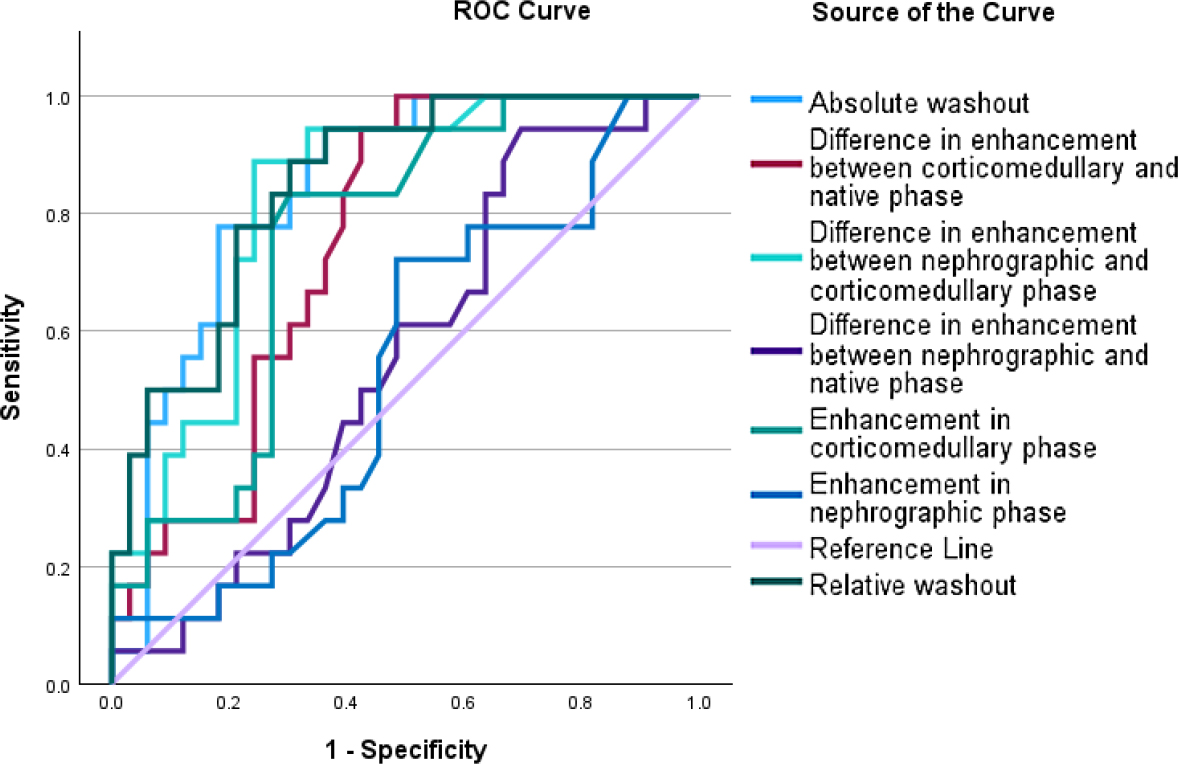
Figure 3.
ROC analysis of the selected CT parameters.
Table 4.
Clinical features and CECT parameters in the prediction of ccRCC occurrence in univariate and multivariate logistic regression analysis
| Tested features | Univariate OR (CI: 95%), p-value | Multivariate OR (CI: 95%), p-value |
|---|---|---|
| Clinical parameter | ||
| Smoking | 4.19 (1.24–14.17), p = 0.02 | 7.50 (1.13–49.88), p = 0.04 |
| Hypertension | 2.92 (0.79–10.76), p = 0.11 | - |
| CECT parameter | ||
| Heterogeneous mass | 5.2 (1.02–26.47), p = 0.05 | - |
| Heterogeneous enhancement | 4.71 (1.14–19.34), p = 0.03 | 4.51 (0.47–43.59), p = 0.19 |
| Washout pattern (at least 20 HU between corticomedullary and nephrographic phases) | 10.0 (2.38–42.01), p = 0.002 | 0.13 (0.01–3.28), p = 0.22 |
| Relative washout - (difference in enhancement between corticomedullary and nephrographic phase/enhancement in corticomedullary phase)*100 | 1.08 (1.03–1.14), p = 0.001 | 1.19 (1.01–1.41), p = 0.04 |
| Enhancement in corticomedullary phase | 1.02 (1.00–1.03), p = 0.014 | 1.03 (0.95–1.12), p = 0.46 |
| Difference in enhancement between corticomedullary and native phase | 1.02 (1.00–1.03), p = 0.019 | 0.98 (0.91–1.06), p = 0.62 |
| Difference in enhancement between nephrographic and corticomedullary phase | 0.95 (0.92–0.98), p = 0.002 | 1.05 (0.95–1.16), p = 0.35 |
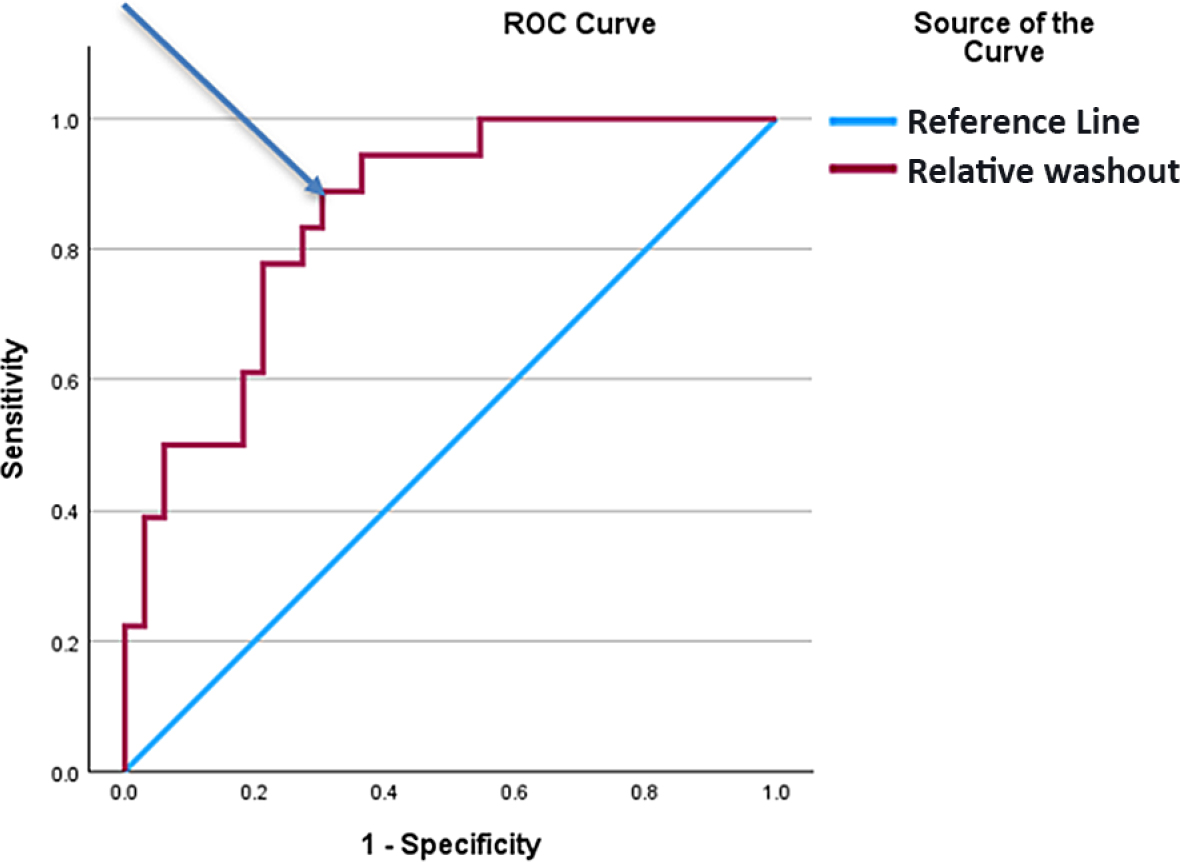
Figure 4.
The cut-off point is determined in the ROC analysis using the Youden index.
Youden index = 0.59; Suggested cut-off: 11.54
Table 5.
Difference in selected novel MRI and CECT parameters between ccRCC and non-ccRCC
| Imaging features | ccRCC group (n = 12) | non-ccRCC group (n = 30) | p-value |
|---|---|---|---|
| MRI parameters | |||
| Intense corticomedullary enhancement | 6 (50.0%) | 14 (46.7%) | 0.529 |
| ADER > 0.99 | 9 (75.0%) | 14 (46.7%) | 0.291 |
| T1 SI ratio <0.73 | 5 (41.7%) | 1 (3.3%) | 0.007 |
| ccLS = 5 | 3 (25.0%) | 0 (0.0%) | 0.024 |
| ccLS = 4/5 | 6 (50.0%) | 11 (36.7%) | 0.590 |
| CECT parameter | |||
| Relative washout > 11.5 | 12 (100.0%) | 10 (33.3%) | < 0.001 |
Table 6.
Specificity, sensitivity, accuracy, positive likelihood ratio, and positive predictive value for selected imaging parameters
| Imaging feature | Sensitivity | Specificity | Accuracy | PLR | PPV |
|---|---|---|---|---|---|
| MRI parameter | |||||
| Intense CM phase enhancement | 50.0 (21.1–78.9)% | 53.3 (34.3–71.7)% | 52.4 (36.4–68.0)% | 1.1 (0.5–2.1) | 30.0 (17.8–45.9)% |
| ADER > 0.99 | 75.0 (42.8–94.5)% | 53.3 (34.3–71.7)% | 59.5 (43.3–74.4)% | 1.6 (1.0–2.7) | 39.1 (28.0–51.5)% |
| T1 SI ratio < 0.73 | 41.7 (15.2–72.3)% | 96.7 (82.8–99.9)% | 81.0 (65.9–91.4)% | 12.5 (1.6–96.1) | 83.3 (39.4–97.5)% |
| ccLS = 5 | 25.0 (5.5–57.2)% | 100.0 (88.4–100.0)% | 78.6 (63.2–89.7)% | - | 100.0 (29.24–100.0)% |
| ccLS = 4/5 | 50.0 (21.1–78.9)% | 63.3 (43.9–80.1)% | 59.5 (43.3–74.4)% | 1.4 (0.7–2.9) | 35.3 (20.7–53.2)% |
| CECT parameter | |||||
| Relative washout > 11.5 | 100.0 (73.5–100.0)% | 66.7 (47.2–82.7)% | 76.2 (60.6–88.0)% | 3.0 (1.8–5.0) | 54.6 (42.0–66.6)% |