
TABLE 1.
Patient and radiotherapy characteristics
| N = 20 | |
|---|---|
| Sex | |
| Female | 8 (40%) |
| Male | 12 (60%) |
| Age (years) | |
| Median (IQR) | 51 (39–60) |
| Tumor site | |
| Lower extremity, proximal | 13 (65%) |
| Lower extremity, distal | 3 (15%) |
| Trunk | 4 (20%) |
| Recurrence | 1 (5%) |
| Chemotherapy | |
| Neoadjuvant | 1 (5%) |
| Adjuvant | 1 (5%) |
| RT modality | |
| 3D conformal | 11 (55%) |
| IMRT | 8 (40%) |
| IMPT | 1 (5%) |
| RT dose | |
| 36 Gy | 3 (15%) |
| 50 Gy | 16 (80%) |
| 56.25 Gy | 1 (5%) |
| IORT | 1 (5%) |
| Brachytherapy | 1 (5%) |
TABLE 2.
Radiographic and pathologic characteristics
| N = 20 | |
|---|---|
| Intratumoral enhancement | |
| Stable | 4 (20%) |
| Decrease | 16 (80%) |
| Peritumoral enhancement | |
| Increase | 1 (5%) |
| Not present | 15 (75%) |
| Decrease | 4 (20%) |
| Peritumoral edema | |
| Increase | 4 (20%) |
| Stable | 5 (25%) |
| Decrease | 11 (55%) |
| Fat | |
| Increase | 11 (55%) |
| Stable | 9 (45%) |
| Biopsy grade | |
| Low | 18 (90%) |
| High | 2 (10%) |
| Margin status | |
| Negative | 18 (90%) |
| Positive | 2 (10%) |
| Greatest pathologic dimension (cm) | |
| Median (IQR) | 9 (7–15) |
| Percentage viable tumor | |
| Median (IQR) | 5 (5–35) |
| Extensive pathologic response | |
| Median (IQR) | 16 (80%) |
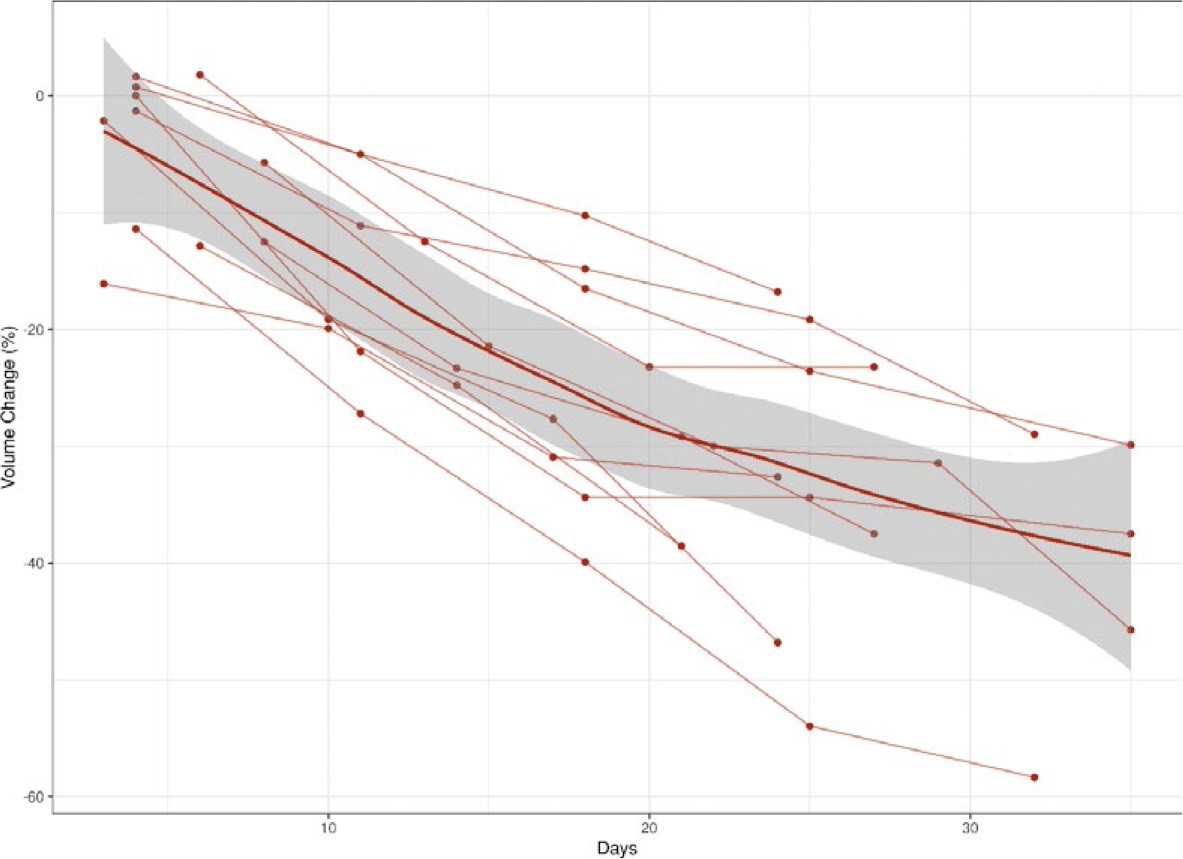
FIGURE 1.
Percentage change in volume during radiotherapy. Dotted lines represent individual tumors. Bold line indicates mean. Gray bar indicates 95% confidence interval.
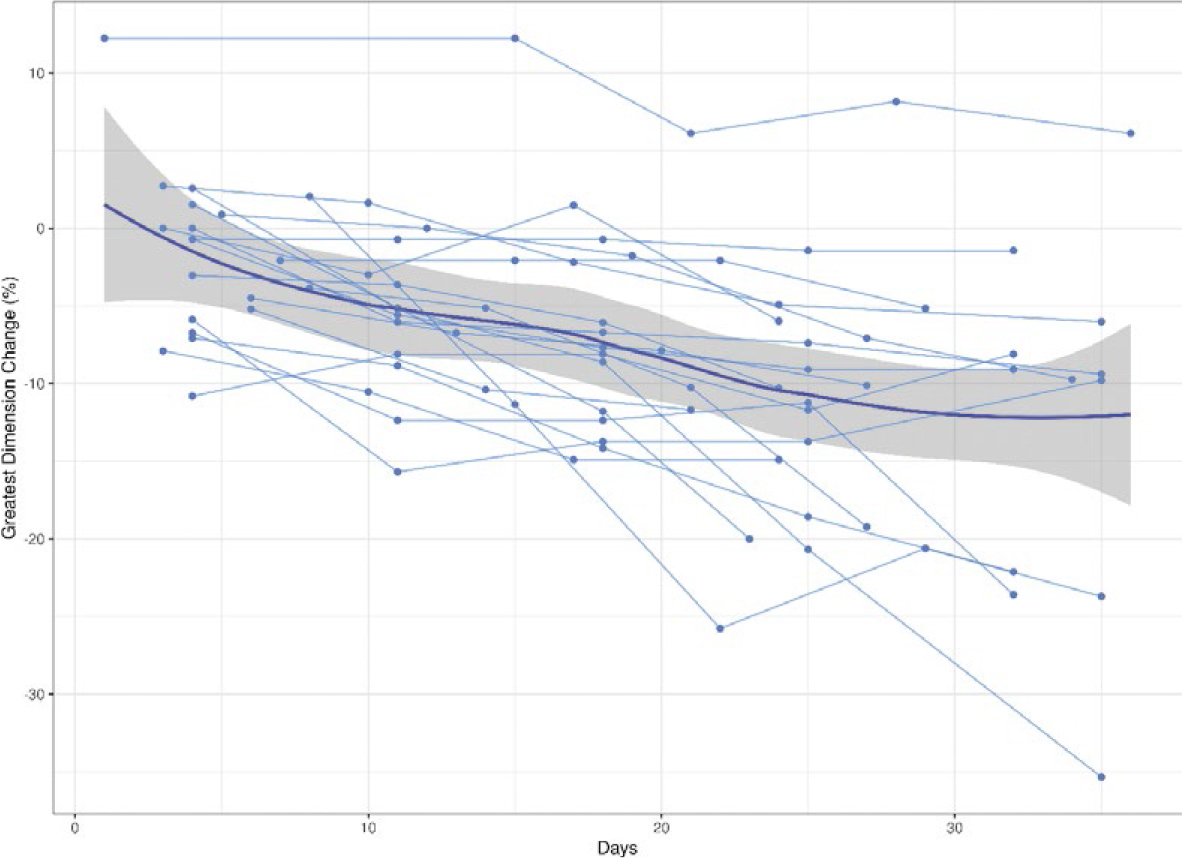
FIGURE 2.
Percentage change in greatest dimension during radiotherapy. Dotted lines represent individual tumors. Bold line indicates mean. Gray bar indicates 95% confidence interval.
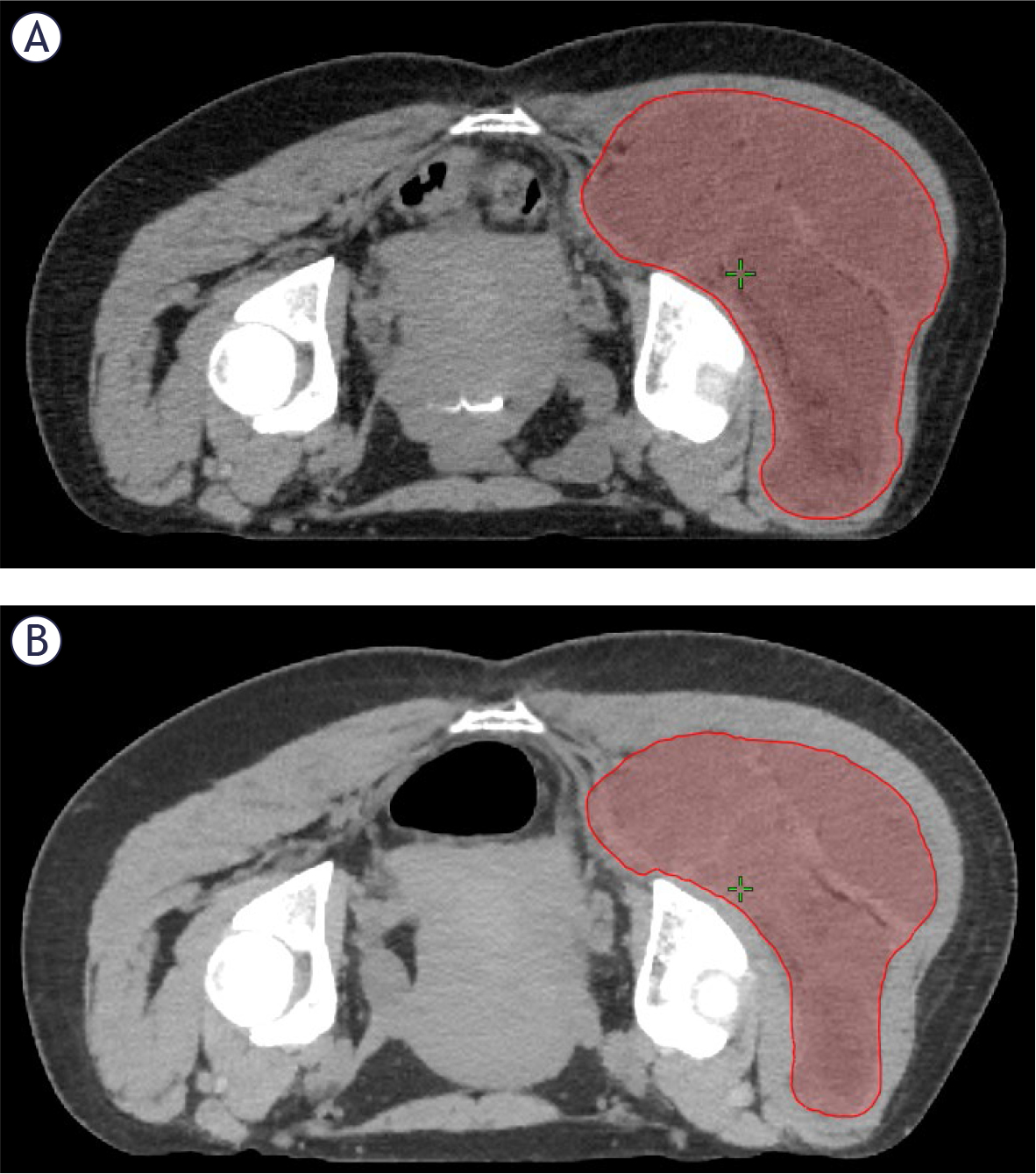
FIGURE 3.
Volumetric change in tumor size from (A) prior to treatment to (B) following 13 fractions in a patient who underwent mid-radiotherapy replanning. Red contour indicates gross tumor volume. The gross tumor volume decreased from 1780 cc prior to treatment to 1287 cc on the replanning scan.
TABLE 3.
Dosimetric comparison of original plan and replan for an individual patient
| Original plan | Replan | |
|---|---|---|
| Soft tissue avoid | ||
| V30Gy(%) | 10.3% | 0.3% |
| Large bowel V45Gy(%) | ||
| V45Gy(%) | 5.4% | 1.5% |
| V50Gy(%) | 1.8% | 0.4% |
| Small bowel | ||
| V30Gy(cc) | 101 cc | 82 cc |
| V45Gy(cc) | 13 cc | 6 cc |
| V50Gy(cc) | 2 cc | 1 cc |
| Rectum | ||
| Mean dose | 23 Gy | 16 Gy |
| Genitalia | ||
| Mean dose | 10 Gy | 6 Gy |