
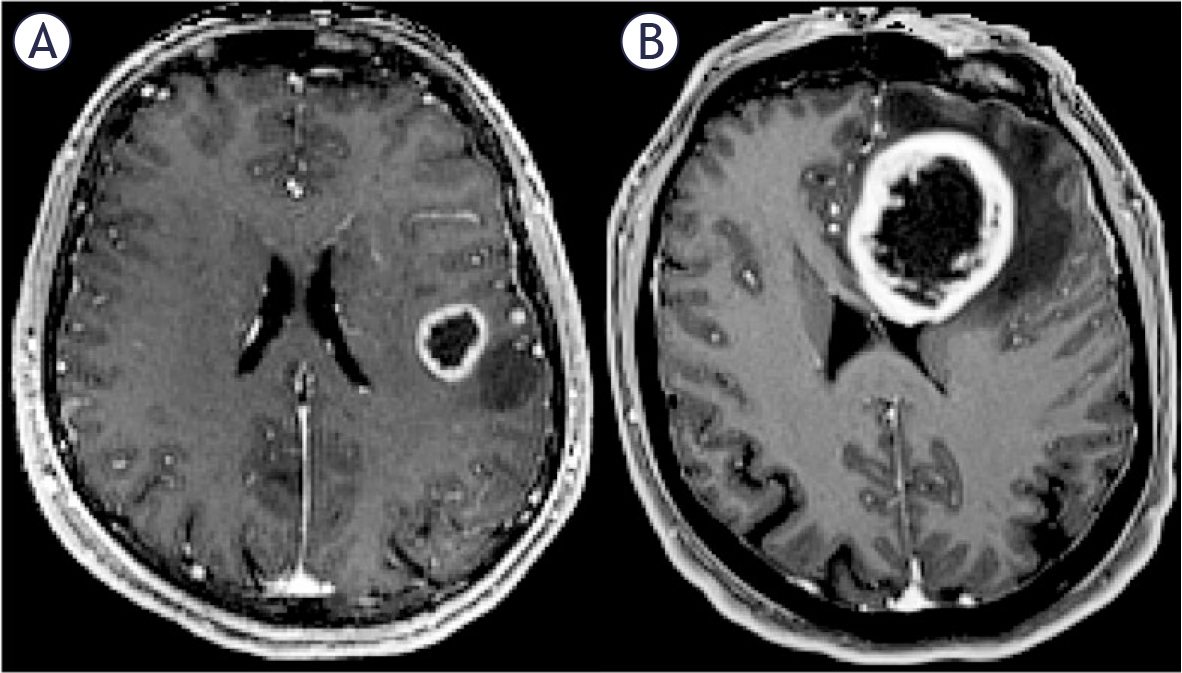
FIGURE 1.
The anatomical relationship between glioblastoma and the subventricular zone (SVZ). (A) Contrast-enhancing tumor lesions that do not contact the SVZ are classified as the SVZ non-contact group. (B) Contrastenhancing tumor lesions that contact the SVZ are classified as the SVZ contact group.
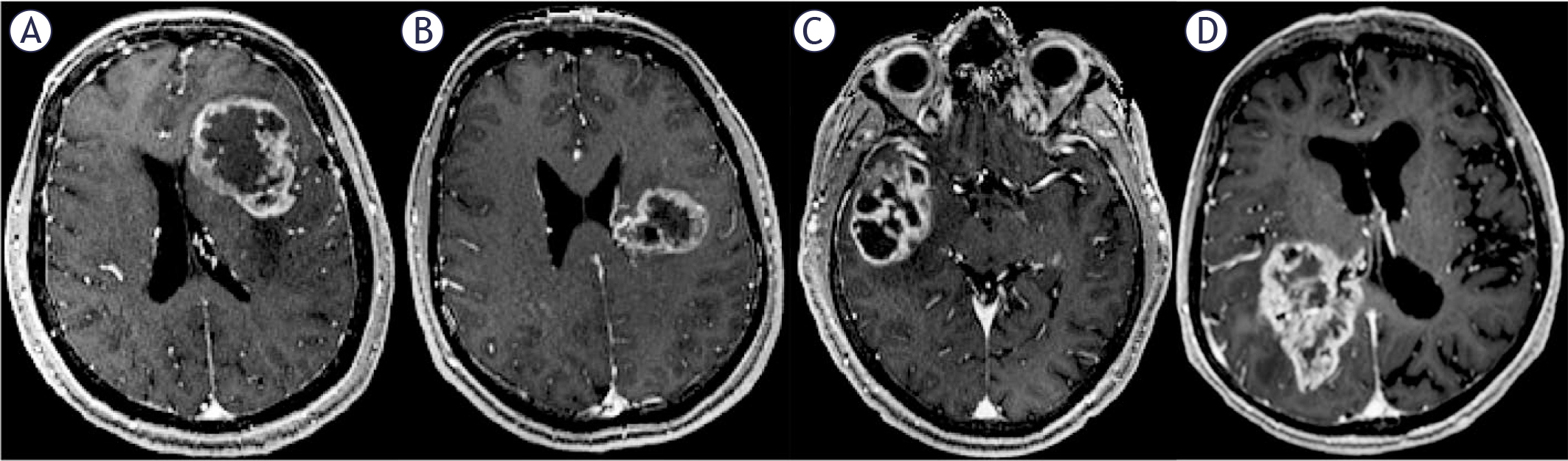
FIGURE 2.
Glioblastomas with SVZ contact are further divided into four groups according to the specific regions of the lateral ventricle contacted. (A) Tumor contacting the frontal horn of the left lateral ventricle. (B) Tumor contacting the body of the left lateral ventricle. (C) Tumor contacting the temporal horn of the right lateral ventricle. (D) Tumor contacting the occipital horn of the right lateral ventricle.
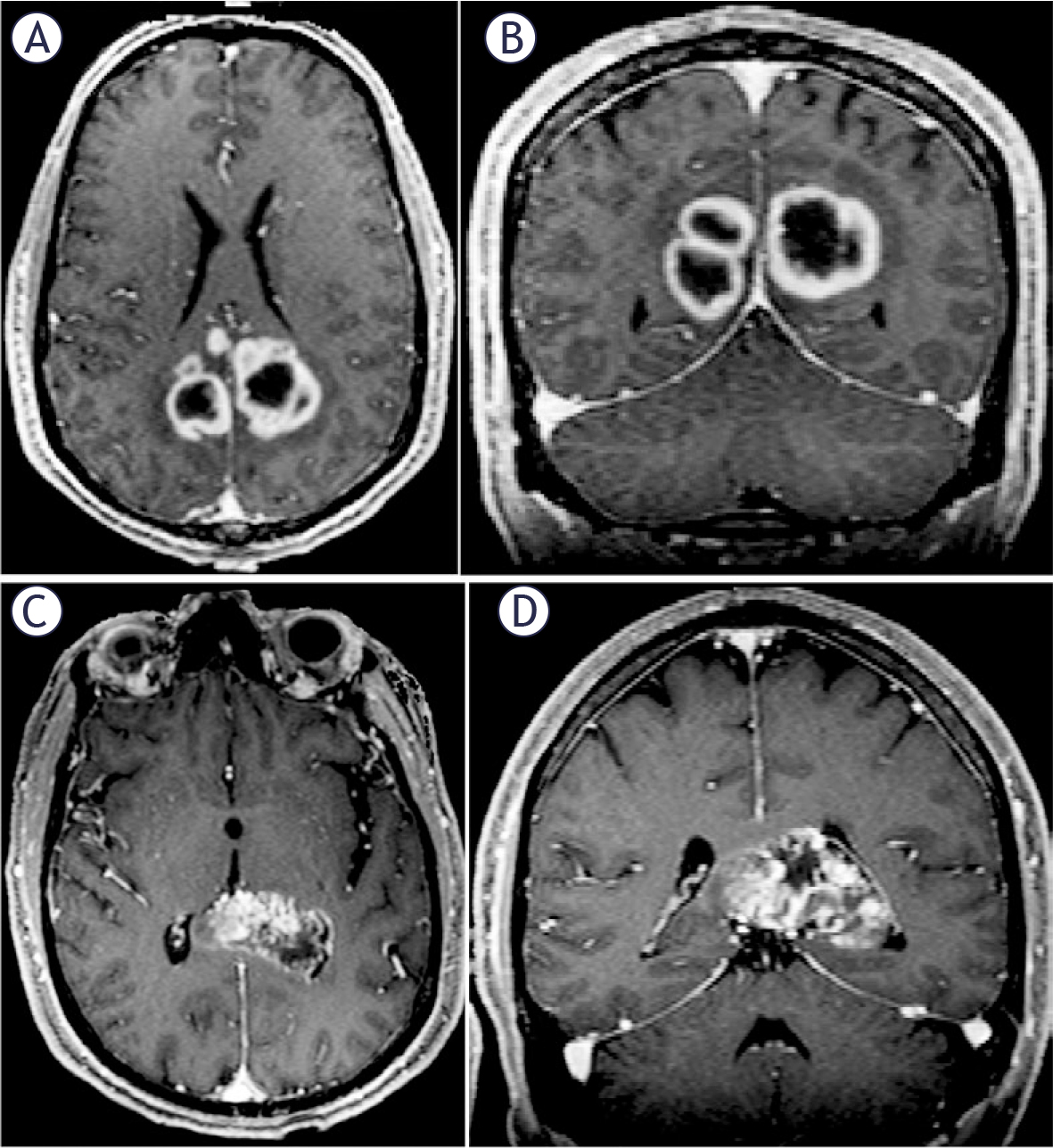
FIGURE 3.
Axial (A) and coronal (B) contrast-enhanced T1-weighted MR images of a GBM patient with multifocal manifestations. Panels (C) and (D) illustrate another GBM patient with a tumor crossing the midline, where the contrast-enhanced lesion extends from the corpus callosum to the contralateral hemisphere.
TABLE 1.
Comparison of clinical and MRI characteristics between the subventricular zone contact and non-contact groups
| Characteristic | SVZ Contact (n = 239) | SVZ Non-contact (n = 132) | p value |
|---|---|---|---|
| Age (year) | 65 ± 11 | 63 ± 10 | 0.085 |
| Gender, n (%) | 0.237 | ||
| Male | 149 (62.3) | 74 (56.1) | |
| Female | 90 (37.7) | 58 (43.9) | |
| OS (month) | 11.0 (5.0–18.0) | 17.5 (12.0–28.5) | < 0.001* |
| Tumor size (cm) | 5.07 ± 1.35 | 3.31 ± 1.12 | < 0.001* |
| Peritumoral edema (cm) | 1.83 (1.02–2.70) | 1.70 (0.55–2.62) | 0.192 |
| Tumor shape/n (%) | 0.016* | ||
| Regularity | 10 (4.2) | 14 (10.6) | |
| Irregularity | 229 (95.8) | 118 (89.4) | |
| Enhancement type/n (%) | 0.030* | ||
| Ring | 15 (6.2) | 17 (12.9) | |
| Non-ring | 224 (93.8) | 115 (87.1) | |
| Enhancement degree/n (%) | 0.386 | ||
| Significant | 212 (88.7) | 113 (85.6) | |
| Non-significant | 27 (11.3) | 19 (14.4) | |
| Cystic lesion/n (%) | 0.004* | ||
| Yes | 83 (34.7) | 27 (20.5) | |
| No | 156 (65.3) | 105 (79.5) | |
| Necrosis/n (%) | 0.011* | ||
| Yes | 237 (99.2) | 125 (94.7) | |
| No | 2 (0.8) | 7 (5.3) | |
| Multifocal lesions (%) | 0.050 | ||
| Yes | 37 (15.5) | 11 (8.3) | |
| No | 202 (84.5) | 121 (91.7) | |
| Crossing the midline (%) | < 0.001* | ||
| Yes | 28 (11.7) | 0 (0.0) | |
| No | 211 (88.3) | 132 (100.0) |
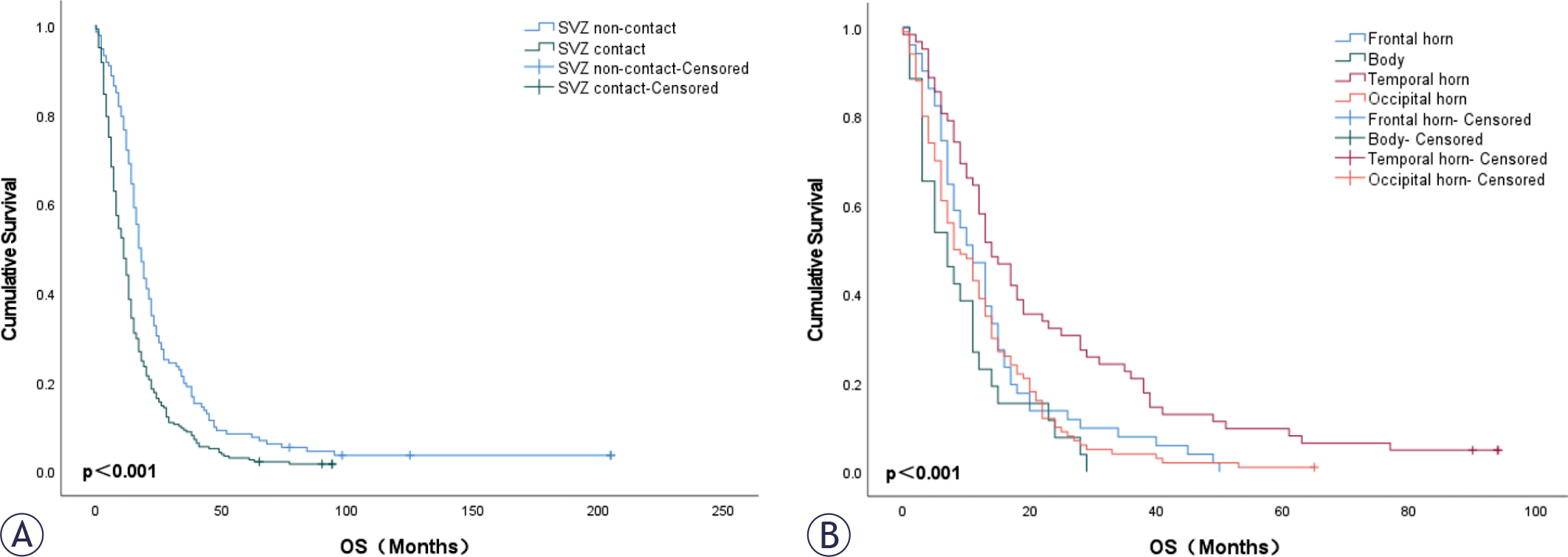
FIGURE 4.
Kaplan-Meier curves for overall survival in glioblastoma: (A) Patients with and without SVZ contact; (B) Patients with tumors contacting specific SVZ regions.
SVZ =subventricular zone
TABLE 2.
Univariate and multivariate Cox regression analyses for overall survival in glioblastoma patients
| Parameter | Univariate analysis | Multivariate analysis | ||||
|---|---|---|---|---|---|---|
| HR | 95% CI | P value | HR | 95% CI | P value | |
| Age | 1.025 | 1.015–1.036 | < 0.001* | 1.024 | 1.014–1.034 | < 0.001* |
| Gender | 1.009 | 0.817–1.247 | 0.933 | |||
| Tumor size | 1.112 | 1.039–1.190 | 0.002* | 1.053 | 0.966–1.148 | 0.239 |
| Peritumoral edema | 0.950 | 0.876–1.029 | 0.207 | |||
| Tumor shape | 0.783 | 0.513–1.195 | 0.257 | |||
| Enhancement type | 0.687 | 0.475–0.993 | 0.046* | 0.771 | 0.532–1.117 | 0.170 |
| Enhancement degree | 1.004 | 0.732–1.377 | 0.980 | |||
| Cystic lesion | 0.904 | 0.722–1.133 | 0.383 | |||
| Necrosis | 1.008 | 0.519–1.956 | 0.982 | |||
| Multifocal lesions | 1.635 | 1.201–2.225 | 0.002* | 1.548 | 1.111–2.158 | 0.010* |
| Crossing the midline | 1.763 | 1.196–2.599 | 0.004* | 1.415 | 0.936–2.138 | 0.099 |
| SVZ contact | 1.650 | 1.326–2.052 | < 0.001* | 1.364 | 1.037–1.794 | 0.027* |