
Figure 1.
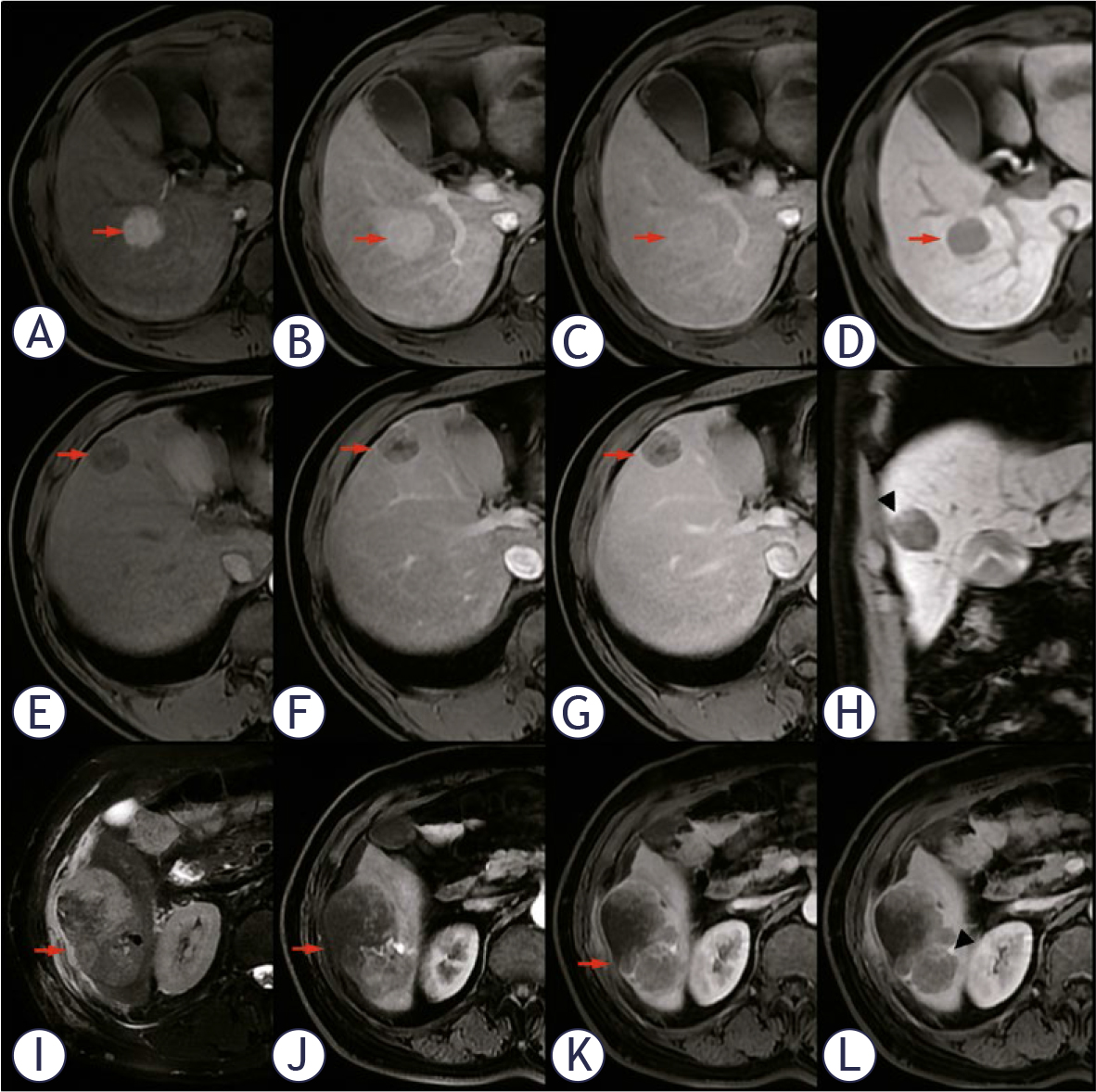
A 34-year-old male with a clearly bounded solitary HCC and M0 status, (A-D) exhibits persistent enhancement in AP, PVP, DP, and a smooth tumor margin (red arrow). A 52-year-old male with HCC and M1 grade, which illustrates a typical no/mini enhancement (red arrow) (E-G). Vague margin is visible at the superior edge of the tumor (black arrowhead) (H). A 65-year-old male who had HCC with M2 status was detected. The mass has a Max/Min-R of 1.59 and heterogeneous moderate hyperintensity on T2WI (I), which displays no or minimal enhancement (red arrow) on AP, PVP, and DP(J-L). The lesion appears as extranodular nodule (black arrowhead) (L).
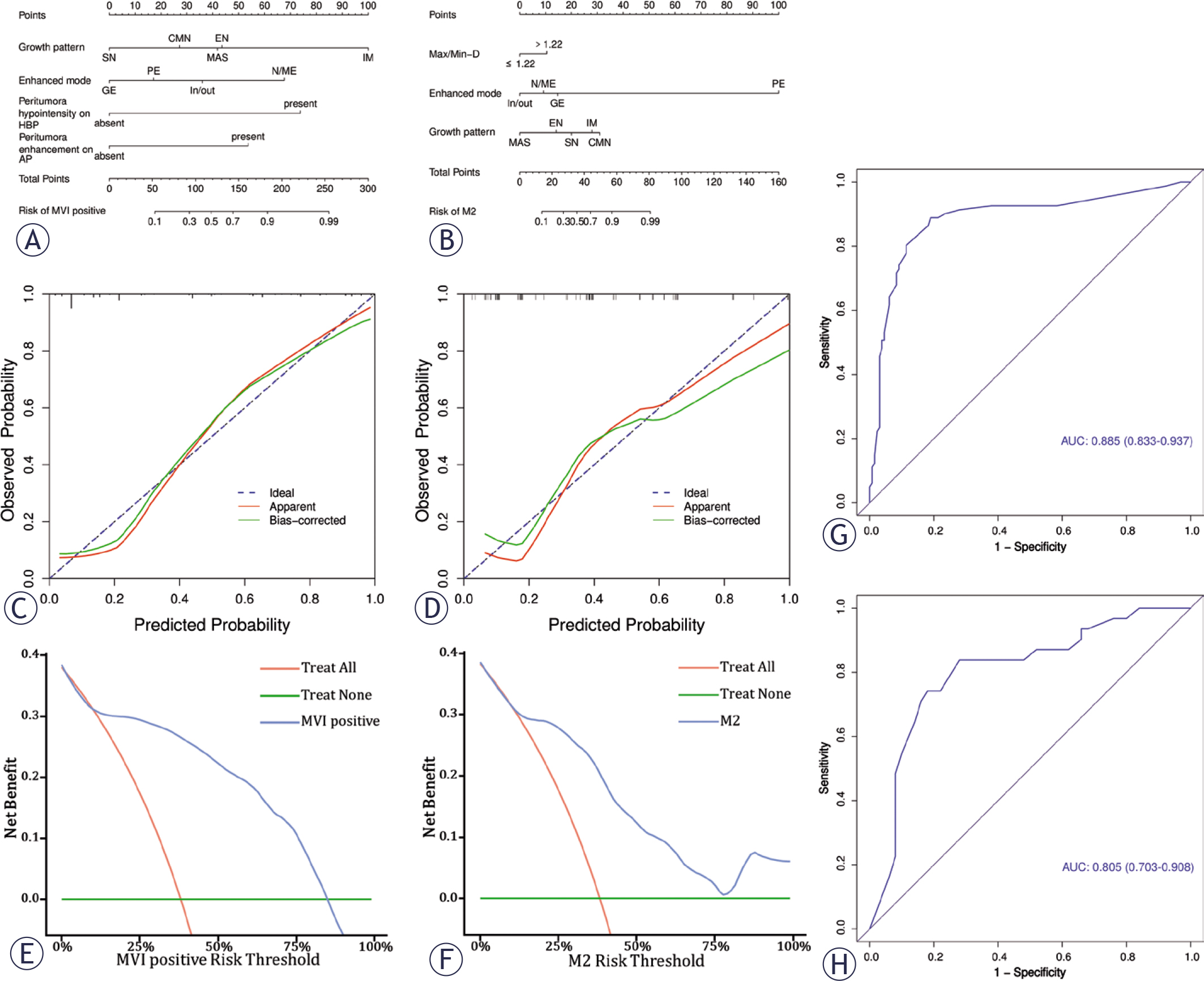
Figure 2.
(A,B) The MVI nomogram was built by incorporating four variables, and among the MVI-positive cases, three variables were used to establish another nomogram for predicting M2 grade. (C,D) Calibration curves of the nomogram in predicting MVI and its M2 grade. X-axis, nomogram-predicted probability of MVI or M2; Y-axis, observed MVI or M2. (E,F) Nomogram model (blue line) outperforms all (red line) and none (horizontal green line) across all reasonable threshold probabilities in predicting MVI and its M2 grade. (G,H) The ROC curves demonstrate the discriminatory ability of the two nomograms of MVI positive and its M2 grade.
TABLE 1.
Univariate and multivariate logistic regression analysis for predicting MVI-positive HCCs
| Variable | Univariable analysis | Multivariable analysis | ||
|---|---|---|---|---|
| Odds ratio (95 % CI) | P-value | Odds ratio (95 % CI) | P-value | |
| Clinical features | ||||
| Age (≥ 57 years) | 1.11 (0.64–1.94) | 0.702 | ||
| Sex (male) | 1.28 (0.60–2.72) | 0.525 | ||
| Etiology (hepatitis B virus) | 1.02 (0.54–1.93) | 0.960 | ||
| AFP (≥ 20ng/mL) | 1.98 (1.12–3.49) | 0.018* | ||
| PIVKA-II lg10 | 1.18 (0.84–1.66) | 0.342 | ||
| Pathological data | ||||
| Edmondson-Steiner (III-IV) | 2.35 (1.05–5.26) | 0.037* | ||
| Satellite nodule | 2.53 (1.43–4.48) | 0.001* | ||
| MRI findings | ||||
| Tumor Max-D (≥ 3.9cm) | 2.14 (1.22–3.77) | 0.008* | ||
| Tumor Min-D (≥ 3.1cm) | 2.04 (1.16–3.59) | 0.014* | ||
| Irregular tumor shape | 4.59 (2.54–8.33) | <0.001* | ||
| Non-smooth tumor margin | 2.93 (1.63–5.27) | <0.001* | ||
| Solitary nodule growth | 0.18 (0.10–0.34) | <0.001* | 0.25 (0.12–0.52) | < 0.001* |
| No/mini enhanced mode | 2.76 (1.31–5.85) | 0.008* | 3.24 (1.19–8.88) | 0.022* |
| Beak sign | 4.07 (2.25–7.38) | <0.001* | ||
| Arterial Rim-enhancement | 2.07 (0.97–4.42) | 0.060 | ||
| Peritumoral enhancement on AP | 5.23 (2.56–10.66) | <0.001* | 5.19 (2.15–12.53) | < 0.001* |
| Peritumoral hypointensity on HBP | 11.26 (5.84–21.68) | <0.001* | 10.74 (5.07–22.75) | < 0.001* |
1 AFP = alpha-fetoprotein; AP = arterial phase; CI = confidence interval; HBP = hepatobiliary phase; MRI = magnetic resonance imaging; MVI = microvascular invasion; OR = odd ratio; PIVKA-II = protein induced by vitamin K absence or antagonist-II; Tumour Max-D = maximum diameter of tumor; Tumour Min-D = minimum diameter of tumor. The asterisked entries indicate P < 0.05.
TABLE 2.
Univariate and multivariate logistic regression analysis for predicting M2 grade
| Variable | Univariable analysis | Multivariable analysis | ||
|---|---|---|---|---|
| Odds ratio (95 % CI) | P-value | Odds ratio (95 % CI) | P-value | |
| Clinical features | ||||
| Age (≥ 58 years) | 1.68 (0.68–4.14) | 0.262 | ||
| Sex (male) | 1.27 (0.35–4.69) | 0.703 | ||
| HBeAg(+) | 0.32 (0.09–1.05) | 0.060 | ||
| AFP lg10 | 1.86 (0.75–4.63) | 0.183 | ||
| PIVKA-II lg10 | 1.09 (0.64–1.88) | 0.745 | ||
| Pathological data | ||||
| Satellite nodule | 0.46 (0.18–1.16) | 0.098 | ||
| MRI findings | ||||
| Tumor Max-D (≥ 4.3cm) | 1.39 (0.56–3.42) | 0.480 | ||
| Tumor Min-D (≥ 3.7cm) | 1.07 (0.44–2.61) | 0.888 | ||
| Max/Min-R (≥ 1.22) | 3.53 (1.38–9.04) | 0.009* | 2.91 (1.07–7.92) | 0.036* |
| Irregular tumor shape | 1.32 (0.52–3.32) | 0.560 | ||
| Non-smooth tumor margin | 3.43 (1.33–8.82) | 0.011* | ||
| Confluent multinodule growth | 3.29 (1.19–9.08) | 0.021* | 3.92 (1.25–12.25) | 0.019* |
| Washin/washout enhanced mode | 0.34 (0.13–0.88) | 0.026* | 0.31 (0.11–0.92) | 0.035* |
| Beak sign | 1.18 (0.48–2.91) | 0.721 | ||
| Arterial Rim-enhancement | 2.15 (0.73–6.34) | 0.167 | ||
| Peritumoral enhancement on AP | 1.99 (0.79–5.01) | 0.143 | ||
| Peritumoral hypointensity on HBP | 1.77 (0.63–4.92) | 0.227 | ||
1 AFP = alpha-fetoprotein; AP = arterial phase; CI = confidence interval; HBP = hepatobiliary phase; MRI: magnetic resonance imaging; MVI = microvascular invasion; Max/Min-R = Tumour Max-D/Tumour Min-D; OR = odd ratio; PIVKA-II = protein induced by vitamin K absence or antagonist-II; Tumour Max-D = maximum diameter of tumor; Tumour Min-D = minimum diameter of tumor. The asterisked entries indicate P < 0.05.