
TABLE 1.
Descriptive characteristics of the patients in the 2 groups
| PATIENTS | i.v. pECT (N = 18) | i.a. pECT (n = 26) | P value | ||
|---|---|---|---|---|---|
| N | % | N | % | ||
| Gender | |||||
| Males | 8 | 44% | 15 | 58% | 0.5406 |
| Females | 10 | 56% | 11 | 42% | |
| Diagnosis | |||||
| Colorectal cancer | 7 | 39% | 10 | 38% | 0.4620 |
| Breast cancer | 4 | 22% | 4 | 15% | |
| Hepato cellular carcinoma | 2 | 11% | 2 | 8% | |
| Cholangio cellular carcinoma | 0 | 0% | 3 | 12% | |
| Ovarian cancer | 2 | 11% | 0 | 0% | |
| Non-small cell lung cancer (NSCLC) | 1 | 6% | 2 | 8% | |
| Anal cancer | 1 | 6% | 0 | 0% | |
| Pancreatic cancer | 0 | 0% | 1 | 4% | |
| Parotis carcinoma | 0 | 0% | 1 | 4% | |
| Neuroendocrine carcinoma | 0 | 0% | 1 | 4% | |
| Uterus carcinoma | 0 | 0% | 1 | 4% | |
| Esophageal carcinoma | 0 | 0% | 1 | 4% | |
| Cancer of unknown primary origin (CUP) | 1 | 6% | 0 | 0% | |
| Liver metastases | |||||
| Synchronous | 8 | 44% | 16 | 62% | 0.5343 |
| Metachronous | 8 | 44% | 8 | 31% | |
| No | 2 | 11% | 2 | 7% | |
| Metastases location other than liver | |||||
| None | 9 | 50% | 17 | 65% | 0.3613 |
| Yes | 9 | 50% | 9 | 35% | |
| Other metastasis’ location | |||||
| Lung | 3 | 17% | 3 | 12% | 0.6025 |
| Bone | 1 | 6% | 2 | 8% | |
| Kidney | 1 | 6% | 1 | 4% | |
| Lung + bone + brain | 1 | 6% | 0 | 0% | |
| Bone + peritoneum | 1 | 6% | 0 | 0% | |
| Pleural + bone | 1 | 6% | 0 | 0% | |
| Retroperineal | 1 | 6% | 0 | 0% | |
| Adrenal gland | 0 | 0% | 1 | 4% | |
| Lymphnode | 0 | 0% | 1 | 4% | |
| Bone + lymphnode | 0 | 0% | 1 | 4% | |
| Previous treatments | |||||
| Systemic therapy | 16 | 89% | 26 | 100% | 0.1617 |
| Liver surgery | 4 | 22% | 12 | 46% | 0.1251 |
| Local treatments | 11 | 61% | 8 | 31% | 0.0657 |
| Type of local treatments | |||||
| TACE | 8 | 43% | 4 | 15% | 0.1529 |
| TACE+RFA | 1 | 6% | 0 | 0% | |
| TACE+CP | 1 | 6% | 0 | 0% | |
| TACE/MWA/CRYOTH | 0 | 0% | 2 | 8% | |
| CRYOTH | 1 | 6% | 0 | 0% | |
| IBT | 0 | 0% | 2 | 8% | |
| Comorbidities | |||||
| Cardiac diseases | 6 | 33% | 7 | 27% | 0.7422 |
| Pulmonary diseases | 3 | 17% | 7 | 27% | 0.4889 |
| Liver diseases | 9 | 50% | 0 | 0% | <0.0001 |
| Number of target lesions per patient | |||||
| 1 | 15 | 83% | 21 | 81% | 1.000 |
| 2 | 3 | 17% | 5 | 19% | |
TABLE 2.
Characteristics of target lesions in the 2 groups
| LESIONS | i.v. pECT (N = 21) | i.a. pEC (N = 31) | P value | ||
|---|---|---|---|---|---|
| N | % | N | % | ||
| Type | |||||
| Hypervascular | 2 | 9.5% | 5 | 16.1% | 0.7664 |
| Intermediate | 14 | 66.7% | 20 | 64.5% | |
| Hypovascular | 5 | 23.8% | 6 | 19.4% | |
| Challenging location* | |||||
| Yes | 19 | 90.5% | 21 | 67.7% | 0.0927 |
| No | 2 | 9.5% | 10 | 32.3% | |
| Vessels or bile ducts surrounding the metastases | |||||
| Distant (> 10 mm) | 4 | 19.0% | 8 | 25.8% | 0.5389 |
| Close (1 mm to 10 mm) | 6 | 28.6% | 5 | 16.1% | |
| Adjacent (< 1 mm) | 11 | 52.4% | 18 | 58.1% | |
| Previous local treatments on the lesion | |||||
| Yes | 7 | 33.3% | 8 | 25.8% | 0.7559 |
| No | 14 | 66.7% | 23 | 74.2% | |
| Type of local treatments on the lesion | |||||
| TACE (transarterial chemoembolization) | 6 | 28.6% | 4 | 12.9% | 0.1474 |
| CP (chemoperfusion) | 1 | 4.8% | 0 | 0.0% | |
| IBT (interstitial brachytherapy) | 0 | 0.0% | 2 | 6.5% | |
| TACE/MWA/CRYOTH | 0 | 0.0% | 2 | 6.5% | |
| Technical success | |||||
| Yes | 20 | 95.2% | 31 | 100.0% | 0.2199 |
| No | 1 | 4.8% | 0 | 0.0% | |
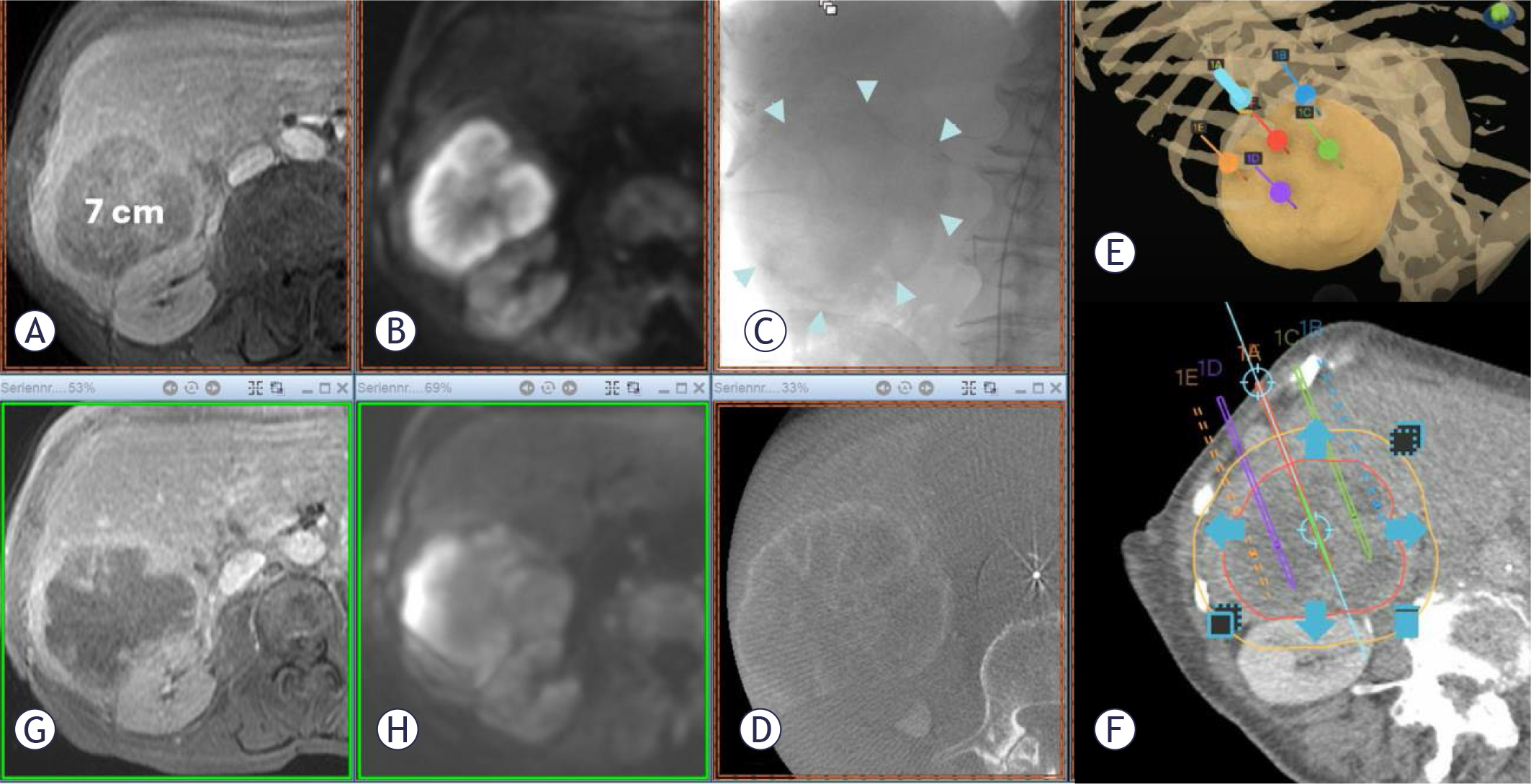
FIGURE 1.
(A) Transverse contrast-enhanced T1w MR image of a pancreatic carcinoma metastasis with a maximum diameter of 7 cm in segments V/VI and VII, which no longer responds to systemic chemotherapy and is growing rapidly and progressively. (B) Corresponding slice to A in diffusion imaging. (C) Complete contrast of the metastasis in 2D angiography. (D) Documentation of complete contrast coverage of the metastasis in cone beam CT. (E). Stereotactic navigation (CAS-One® IR) of the electrodes for electroporation. (F). Parallel planning of the electrodes in the tumor to achieve homogeneous electroporation. (G). The transverse contrast-enhanced T1w MR image of the metastasis one month after the electrochemotherapy (ECT) procedure demonstrates the complete loss of perfusion in the entire metastasis. (H) Corresponding slice to G in diffusion imaging.
TABLE 3.
Response to percutaneous electrochemotherapy (pECT) treatment in the 2 groups
| RESPONSE | i.v. pECT (N = 21) | i.a. pECT (N = 31) | P value | P value | ||
|---|---|---|---|---|---|---|
| N | % | N | % | Overall distribution | CR vs. non CR | |
| CR | 13 | 61.9% | 25 | 80.6% | 0.3454 | 0.1349 |
| PR | 5 | 23.8% | 4 | 12.9% | ||
| SD | 1 | 4.8% | 0 | 0.0% | ||
| PD | 0 | 0.0% | 1 | 3.2% | ||
| Lost to follow up | 2 | 9.5% | 1 | 3.2% | ||
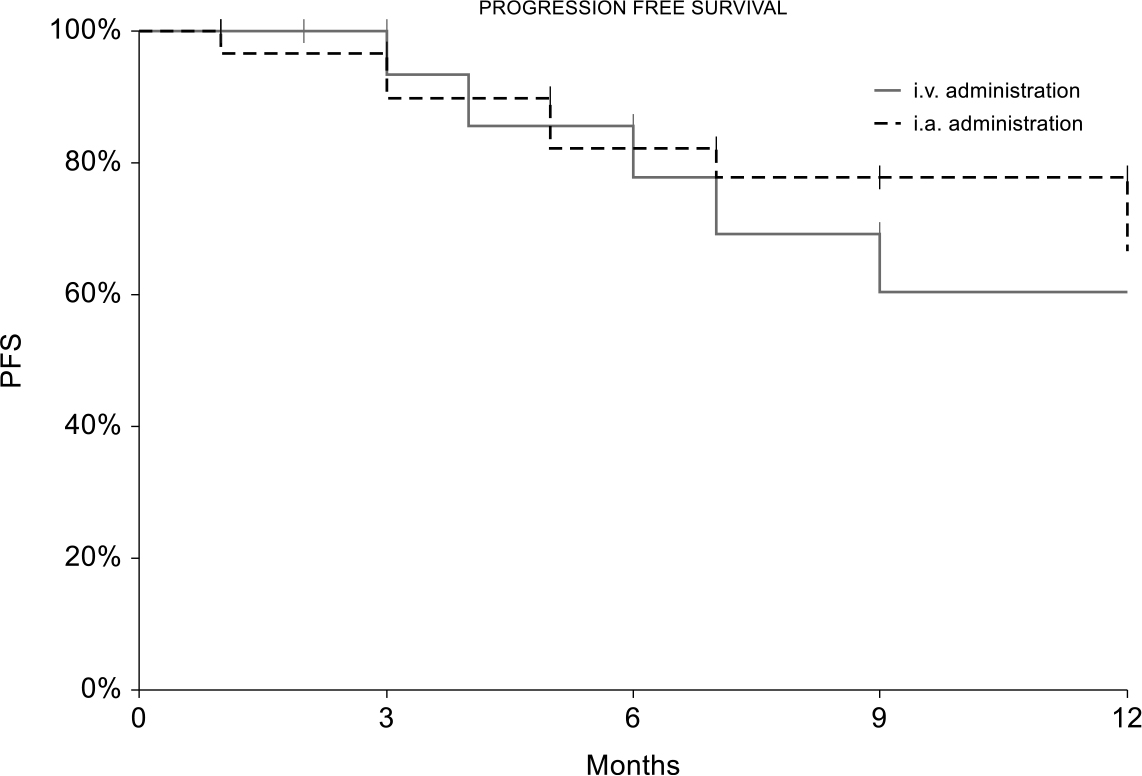
FIGURE 2.
Progression free survival in the 2 groups during the 18-month follow-up period.