
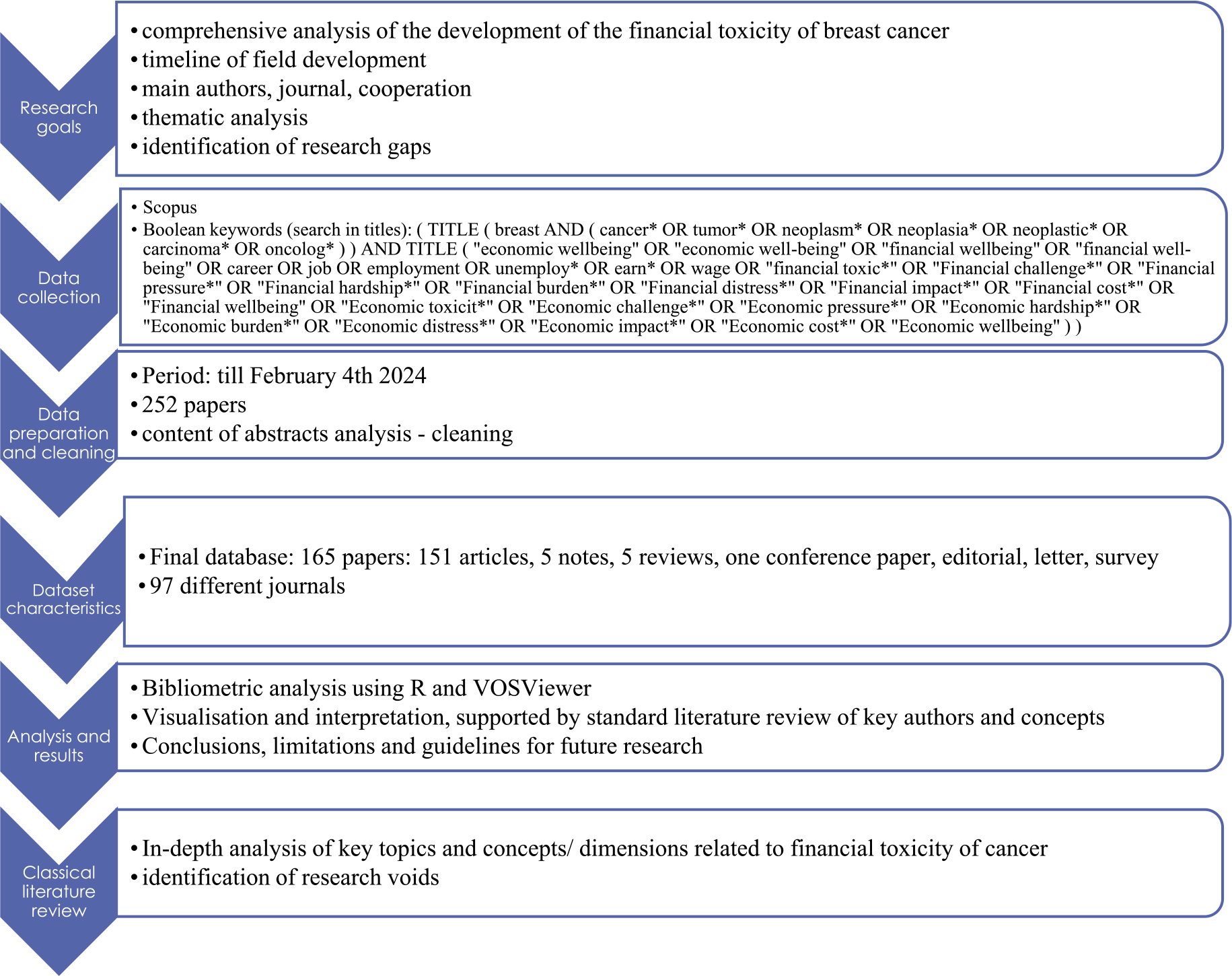
FIGURE 1.
Step-by-step research approach summary (based on ref.16).
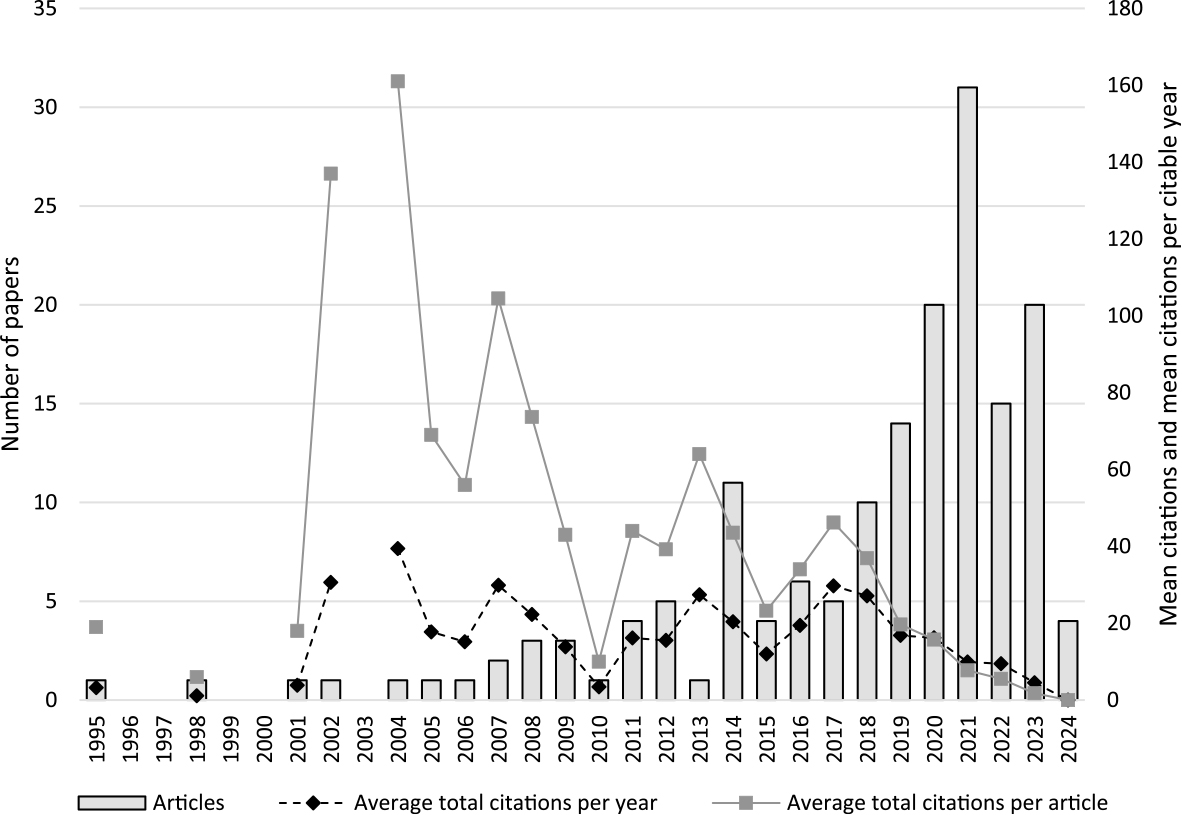
FIGURE 2.
Published number of papers by year (left axis) and mean citations per paper and mean citations per citable year (right axis).
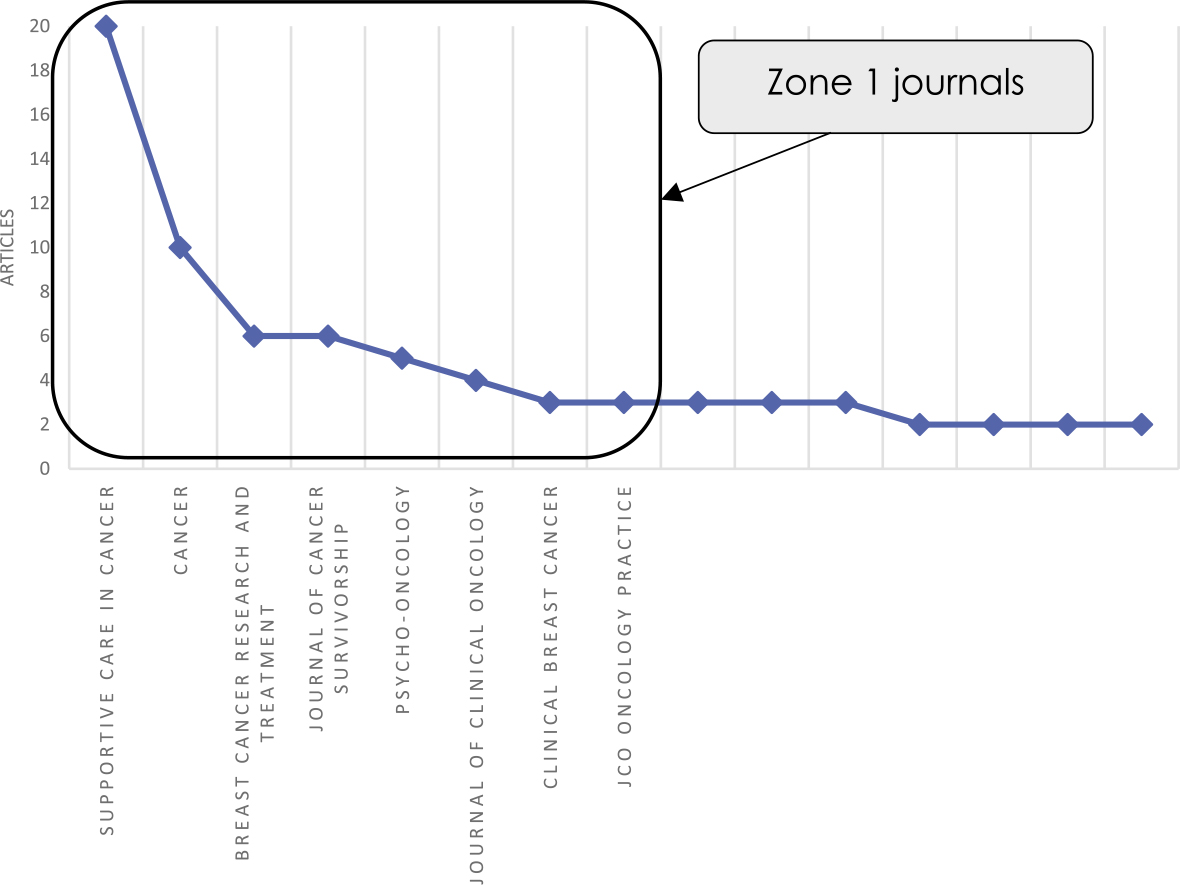
FIGURE 3.
Bradford law with Zone 1 journals.
TABLE 1.
A list of authors with at least 4 published papers in the investigated set of literature
| Authors | Articles | Articles Fractionalized* | No of documents (in % of all) |
|---|---|---|---|
| HAWLEY ST31–33 | 7 | 0.919 | 4.2 |
| OFFODILE AC10,34,35 | 7 | 0.774 | 4.2 |
| WHEELER SB36,38 | 7 | 0.868 | 4.2 |
| BRADLEY CJ29,39,40 | 6 | 1.569 | 3.6 |
| JAGSI R31,32,41 | 6 | 0.701 | 3.6 |
| ASAAD M10,34,35 | 5 | 0.549 | 3 |
| BOUKOVALAS S10,34,35 | 5 | 0.549 | 3 |
| KATZ SJ31–33 | 5 | 0.576 | 3 |
| AZUERO A46 | 4 | 0.522 | 2.4 |
| CHAN A64–67 | 4 | 0.342 | 2.4 |
| COOPER B64–67 | 4 | 0.342 | 2.4 |
| GORDON L45 | 4 | 0.501 | 2.4 |
| HAMILTON AS31,32 | 4 | 0.476 | 2.4 |
| KOCZWARA B64–67 | 4 | 0.342 | 2.4 |
| MIASKOWSKI C64–67 | 4 | 0.342 | 2.4 |
TABLE 2.
A list of 10 most cited papers in the investigated set of literature (only the first author is listed in case of multiple authors)*
| Paper | DOI/PMID | Total citations | TC per year | Normalized TC |
|---|---|---|---|---|
| Jagsi et al., 2014, J Clin Oncol31 | 10.1200/JCO.2013.53.0956 | 206 | 18.73 | 4.73 |
| Arozullah et al., 2004, J Support Oncol28 | PMID: 15328826 | 161 | 7.67 | 1.00 |
| Bradley et al., 2002, J Health Econ29 | 10.1016/S0167-6296(02)00059-0 | 137 | 5.96 | 1.00 |
| Bradley et al., 2007, Cancer Invest39 | 10.1080/07357900601130664 | 117 | 6.50 | 1.12 |
| Lauzier et al., 2008, J Natl Cancer Inst44 | 10.1093/jnci/djn028 | 111 | 6.53 | 1.51 |
| Jagsi et al., 2018, Cancer32 | 10.1002/cncr.31532 | 104 | 14.86 | 2.82 |
| Meneses et al., 2012, Gynecol Oncol46 | 10.1016/j.ygyno.2011.11.038 | 94 | 7.23 | 2.40 |
| Gordon L et al, 2007, Psycho-Oncology45 | 10.1002/pon.1182 | 92 | 5.11 | 0.88 |
| Greenup et al, 2019, J Oncol Pract37 | 10.1200/JOP.18.00796 | 81 | 13.50 | 4.12 |
| Wheeler et al., 2018, J Clin Oncol36 | 10.1200/JCO.2017.77.6310 | 81 | 11.57 | 2.20 |
TABLE 3.
Thematic map of (financial) toxicity of breast cancer with most common author keywords for each of the themes and selected references
| Key term(s) | Other key terms* | Selected papers (No. of reference) | |
|---|---|---|---|
| T1: Breast cancer (neoplasms), employment, financial toxicity | Quality of life, return to work, (cancer) survivor(ship), treatment, financial burden / stress, fatigue, chemotherapy, mental health, caregivers, social support, disability, occupation, burnout complaints | 29, 33, 39 | |
| Motor themes | T2: Metastatic breast cancer | Prevalence, healthcare use, healthcare utilization, healthcare costs, advanced breast cancer, adverse effects, administrative claims, breast cancer costs | 48, 49 |
| T3: COVID-19 | Depression, job loss, access to healthcare, breast cancer survivors, cognition, anxiety, autonomy | 50, 51 | |
| Basic themes | T1 Economic burden | Cost(s), oncology, lymphedema, rehabilitation, breast neoplasm, cost-effectiveness, recurrence, screening, cost of illness, cancer, resource utilization, healthcare use | 52–54 |
| Emerging or declining themes | T1: Coping strategies | Breast cancer, healthcare, costs, regional, ethnic differences | 55, 56 |
| Niche themes | T1: Reasonable accommodations | Sick leave, assessment and planning | 57, 58 |
TABLE 4.
A systematization of (financial) toxicity of breast cancer at the level of the individual (left column) and research gap (right column)
| Type of financial burden/burden | Coverage in the literature and research gap |
|---|---|
| 1. Medical costs | Weaker coverage, survey based, depends on social security system, more relevant for private-insurance based system (e.g. US) |
| Treatment expenses | |
| Hospitalization costs | |
| 2. Non-medical costs | Weaker coverage, survey based, depends on social security system, more relevant for private-insurance based system (e.g. US) |
| Travel expenses | |
| Accommodation costs | |
| Other | |
| 3. Out-of-pocket costs | Weak coverage, survey based |
| Deductibles and co-payments | |
| Prescription drug costs* | |
| 4. Loss of income | Well-documented employment impacts, income impacts, less focus on occupational change |
| Changed work hours | |
| Job loss | |
| Change in occupation | |
| Loss/change in income | |
| 5. Insurance-related costs | Weak coverage, depends on social security system, but has broader relevance for other non-medical insurances (life, travel, etc.) |
| 6. Impact on finances and assets: | Weak coverage |
| Debt accumulation | |
| Asset depletion | |
| 7. Psychosocial impact: Stress and anxiety | Well-documented, focus on stress, anxiety, less focus on quality of life as a whole |
| Stress and anxiety | |
| Quality of life | |
| 8. Long-term financial consequences | Increasing interest on recurrence, screening |
| Survivorship costs | |
| Cancer recurrence | |
| 9. Geographical coverage | Vast body of evidence for the US, poorer coverage for EU/European context |
| US | |
| Europe |