
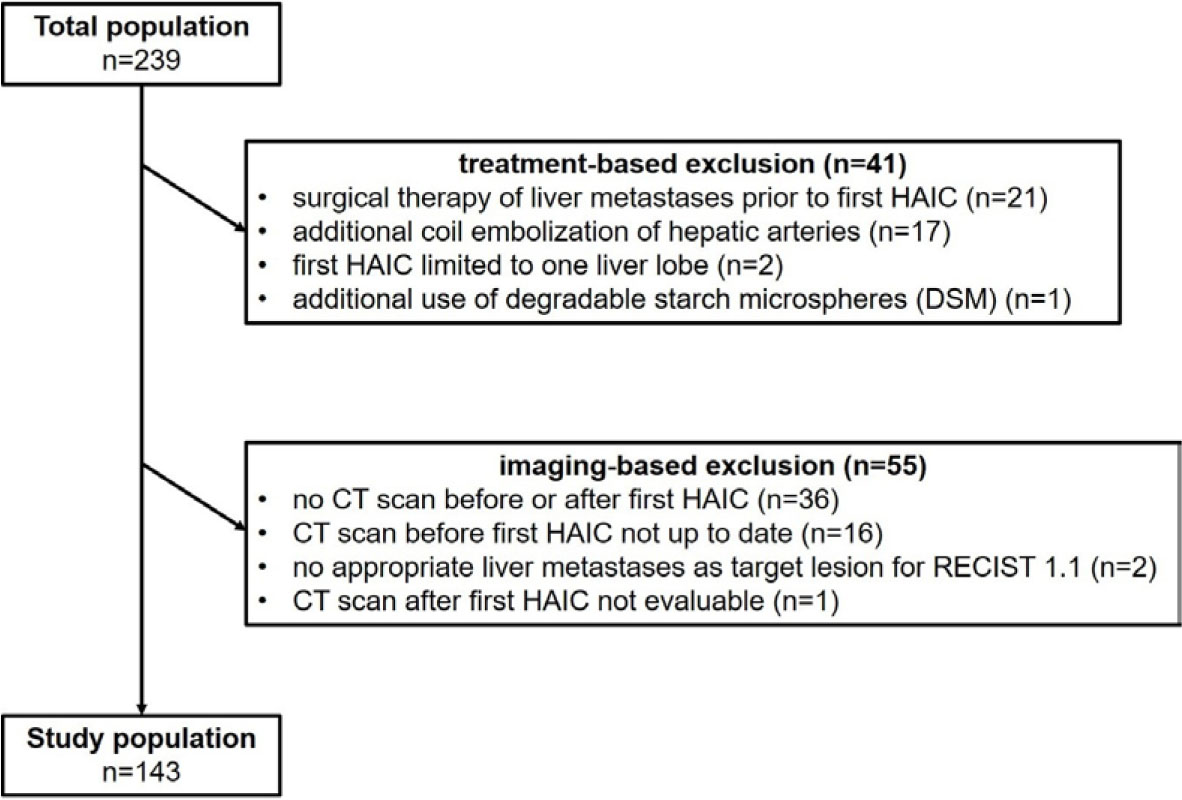
FIGURE 1.
Flowchart of analyzed study population with exclusion criteria.
HAIC = hepatic arterial infusion chemotherapy
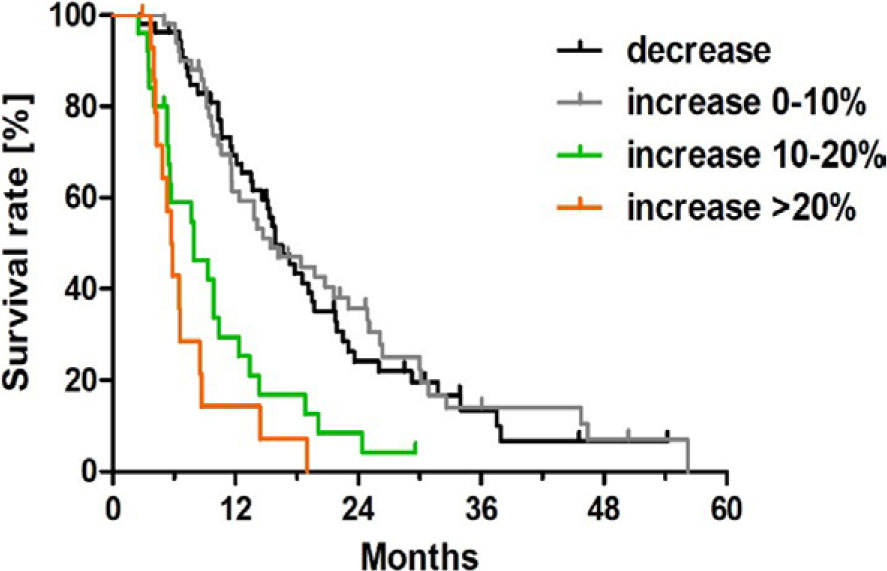
FIGURE 2.
Kaplan-Meier curves of overall survival differentiated by change in liver volume of patients with uveal melanoma with liver metastases after first hepatic artery infusion chemotherapy.
TABLE 1.
Comparison of median overall survival (mOS) differentiated by different changes in liver volume before and after first hepatic artery infusion chemotherapy
| Liver volume change | Log-rank (Mantel-Cox) test | |||||||
|---|---|---|---|---|---|---|---|---|
| Increase 0–10% | Increase 10–20% | Increase > 20% | ||||||
| N | mOS [months] | Chi-square | p | Chi-square | p | Chi-square | p | |
| Decrease | 53 | 15.9 | 0.1 | 0.7852 | 14.2 | 0.0002 | 32.3 | < 0.0001 |
| Increase 0–10% | 50 | 15.4 | 15.8 | < 0.0001 | 33.4 | < 0.0001 | ||
| Increase 10–20% | 25 | 7.9 | 1.9 | 0.162 | ||||
| Increase > 20% | 15 | 5.7 | ||||||
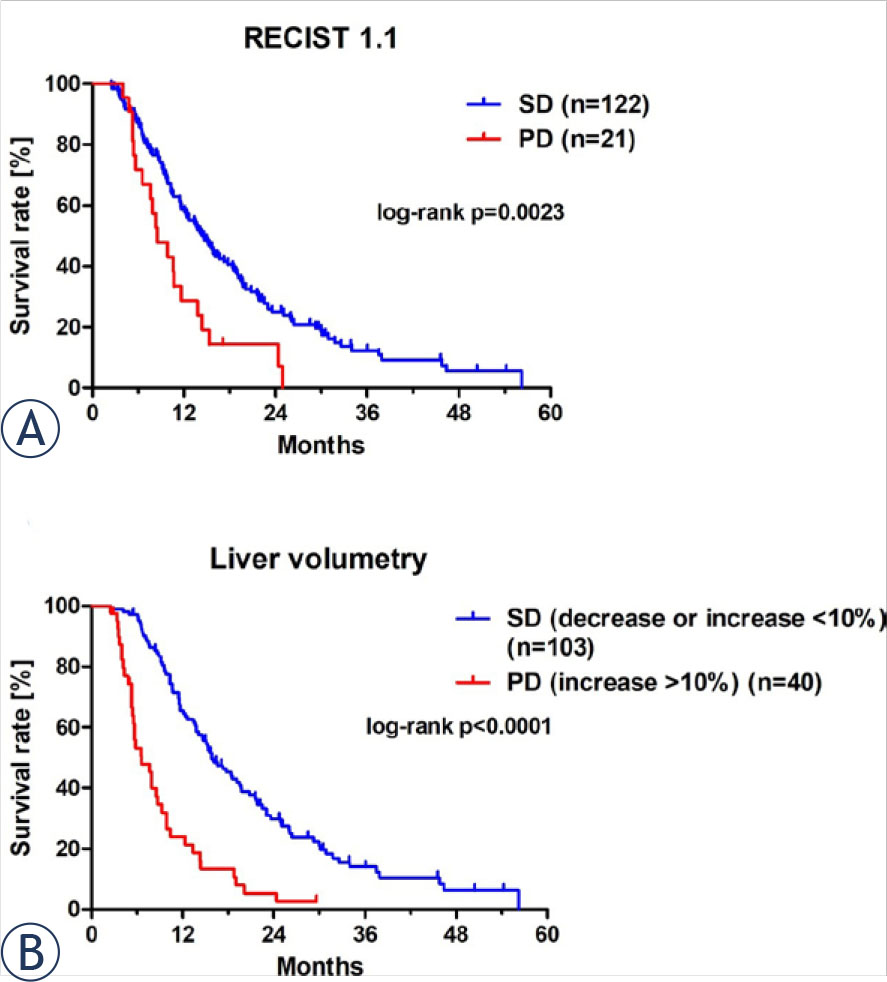
FIGURE 3.
Overall survival of evaluation of treatment response by RECIST 1.1 (A) and liver volumetry with a threshold of 10% (B) of liver volume increase of uveal melanoma patients with liver metastases treated by hepatic artery infusion chemotherapy. Kaplan-Meier curves show overall survival separately for patients evaluated as stable disease (SD) and progressive disease (PD). In liver volumetry, patients with an increase in liver volume more than 10% were classified as PD and with decrease or increase below 10% as SD. RECIST 1.1 criteria as published.19
TABLE 2.
Results of evaluation of treatment response to hepatic artery infusion chemotherapy (HAIC) by RECIST 1.1 and liver volumetry
| Before first HAIC | After first HAIC | p-value | |
|---|---|---|---|
| RECIST 1.1a | |||
| (Sum of) longest diameter(s) of target lesion(s) [mm] | |||
| Total study cohort (n = 143) | 48.6 (IQR 36.3–69.2) | 50.8 (IQR 35.3–76.5) | 0.0008 |
| SD (n = 122) | 47.7 (IQR 36.2–70.5) | 48.0 (IQR 34.5–71.1) | 0.3485 |
| PD (n = 21) | 55.2 (IQR 34.3–68.9) | 73.0 (IQR 46.5–85.3) | < 0.0001 |
| Liver volumetry | |||
| Total liver volume [ml] | |||
| Total study cohort (n = 143) | 1735 (IQR 1431–2189) | 1780 (IQR 1461–2329) | < 0.0001 |
| SD (liver volume decreases or increases up to max. 10%) (n=103) | 1678 (IQR 1426–2176) | 1714 (IQR 1430–2151) | 0.6691 |
| PD (liver volume increases more than 10%) (n=40) | 1903 (IQR 1481–2529) | 2203 (IQR 1692–2946) | <0.0001 |
a RECIST 1.1 criteria as published.19 Values are given as median and interquartile range (IQR).
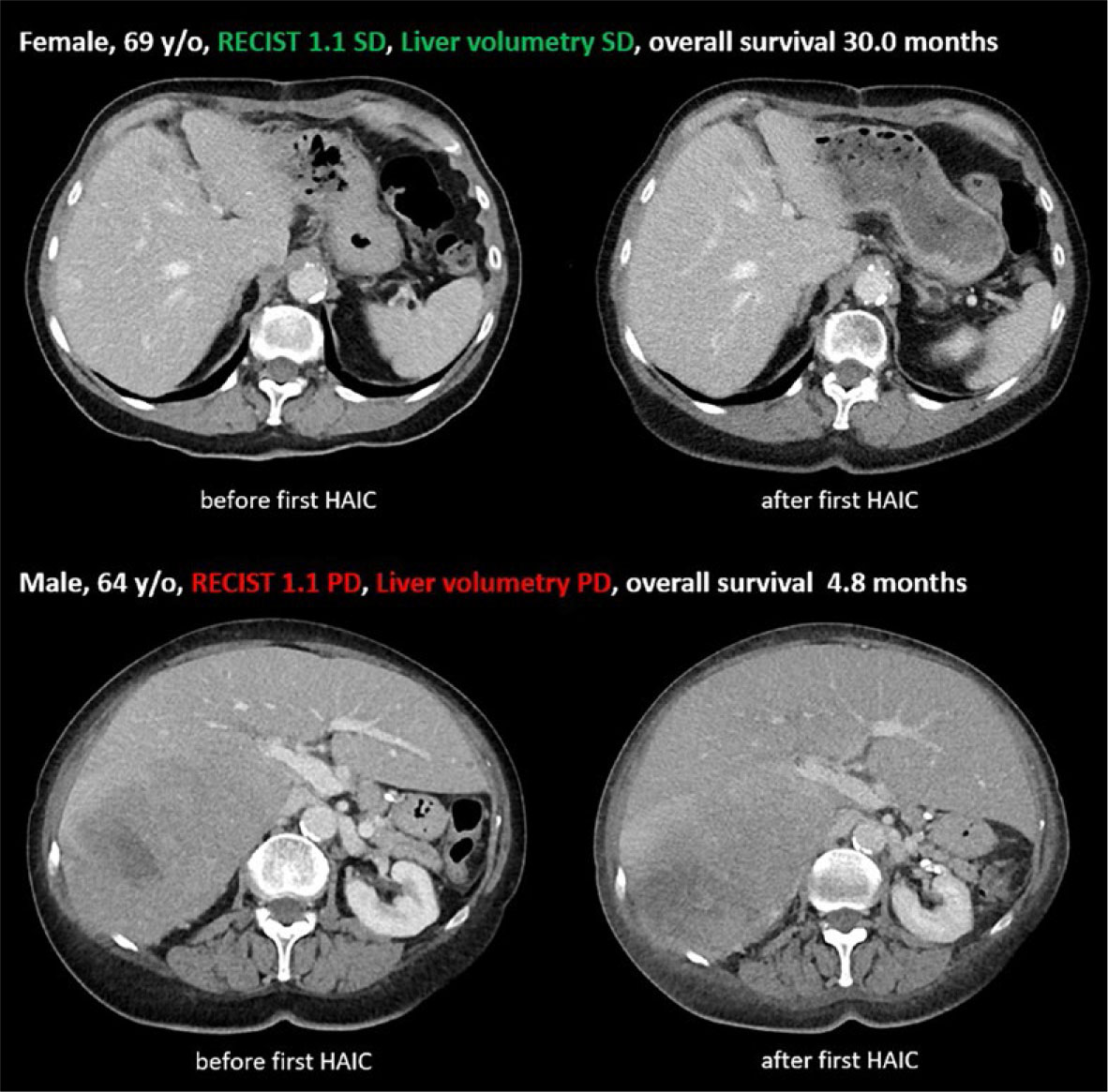
FIGURE 4.
Image examples of CT examinations in portal venous phase before and after first hepatic artery infusion chemotherapy (HAIC) for two patients with evaluations according to RECIST 1.1 and liver volumetry (LV) as stable disease (SD) and progressive disease (PD). Liver metastases are marked with arrows.
TABLE 3.
Median overall survival and accordance of treatment response evaluation by RECIST 1.1 and liver volumetry with a threshold of 10% increase in liver volume
| Liver volumetry | |||
|---|---|---|---|
| SD (Liver volume decreases or increases up to max. 10%) | PD (Liver volume increases more than 10%) | Total | |
| RECIST 1.1 criteria | |||
| SD | 16.6 months (n = 95) | 6.6 months (n = 27) | 14.6 months (n = 122) |
| PD | 12.8 months (n = 8) | 7.7 months (n = 13) | 8.5 months (n = 21) |
| Total | 15.9 months (n = 103) | 6.6 months (n = 40) | 12.6 months (n = 143) |
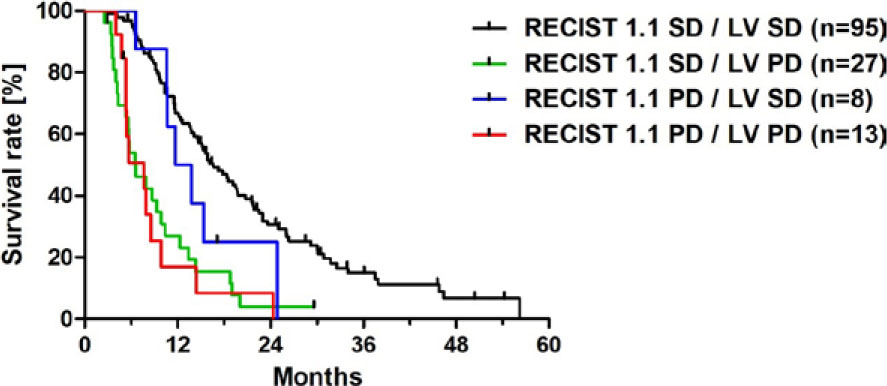
FIGURE 5.
Kaplan-Meier curves for the combined RECIST 1.1 and liver volumetry (LV) evaluation of treatment response with a threshold of 10% increase in liver volume in uveal melanoma patients with liver metastases treated by hepatic artery infusion chemotherapy.
PD = progressive disease; SD = stable disease.
TABLE 4.
Univariate and multivariate Cox proportional hazards regression model of evaluation of treatment response to hepatic artery infusion chemotherapy by RECIST 1.1 and liver volumetry
| Analysis | Univariate | Multivariate | |||||||
|---|---|---|---|---|---|---|---|---|---|
| Covariate | Category | n | Median OS (95% CI) | HR (95% CI) | p | HR (95% CI) | p | ||
| RECIST 1.1a | SD | 122 | 14.6 (11.9–17.3) | Reference | Reference | ||||
| PD | 21 | 8.5 (5.5–11.5) | 2.11 | 1.29–3.45 | 0.003 | 1.19 | 0.92–1.55 | 0.184 | |
| Liver volumetry | SD (liver volume decreases or increases up to max. 10%) | 103 | 15.9 (12.7–19.1) | Reference | Reference | ||||
| PD (liver volume increases more than 10%) | 40 | 6.6 (4.4–8.8) | 1.84 | 1.51–2.26 | <0.001 | 1.77 | 1.43–2.19 | < 0.001 | |
a RECIST 1.1 criteria as published.19