
TABLE 1.
Baseline patient's demographic, clinical, laboratory and imaging characteristics
| Sex, number of patients (%) | |
|---|---|
| Male/female | 28 (90.3)/3 (9.7) |
| Age, years | |
| Mean ± SD | 70.6 ± 6.7 |
| Cirrhosis, n. (%) | |
| Yes/No | 30 (96.8)/1 (3.2) |
| Cirrhosis aetiology, n. (%) | |
| Ethylic | 21 (67.7) |
| NASH | 4 (12.9) |
| Hemochromatosis | 2 (6.5) |
| HBV | 1 (3,2) |
| HCV | 1 (3,2) |
| Cryptogenic | 1 (3,2) |
| Portal hypertension, n. (%) | |
| Yes/No | 21 (67.7)/10 (32.3) |
| Ascites, n. (%) | |
| Yes/No | 10 (32.3)/21(67.7) |
| Laboratory characteristics | |
| GGT, median (range) [μkat/L] | 1.72 (0.24–14.83) |
| AST, mean ± SD [μkat/L] | 0.80 ± 0.26 |
| ALT, mean ± SD [μkat/L] | 0.71 ± 0.39 |
| Total bilirubin, mean ± SD [μmol/L] | 25.03 ± 15.9 |
| Albumin, mean ± SD [g/L] | 40.90 ± 5.00 |
| AFP, median (range) [kU/L] | 5.3 (1–4062.5) |
| Child-Pugh score (n = 30) | |
| Mean points ± SD | 5.8 ± 1.0 |
| Child-Pugh class (n = 30) | |
| A/B, n (%) | 23 (76.7)/7 (23.3) |
| Imaging characteristics | |
| Number of lesions, mean ± SD [mm] | 3.1 ± 2.1 |
| Diameter of largest lesion, mean ± SD [mm] | 44.8 ± 23.0 |
| Cumulative diameter of lesions, mean ± SD [mm] | 75.7 ± 39.8 |
| Unilobar disease, n (%) | 16 (51.6) |
| Bilobar disease, n (%) | 15 (48.4) |
| LVEF (%) | |
| Mean ± SD | 64.1 ± 8.7 |
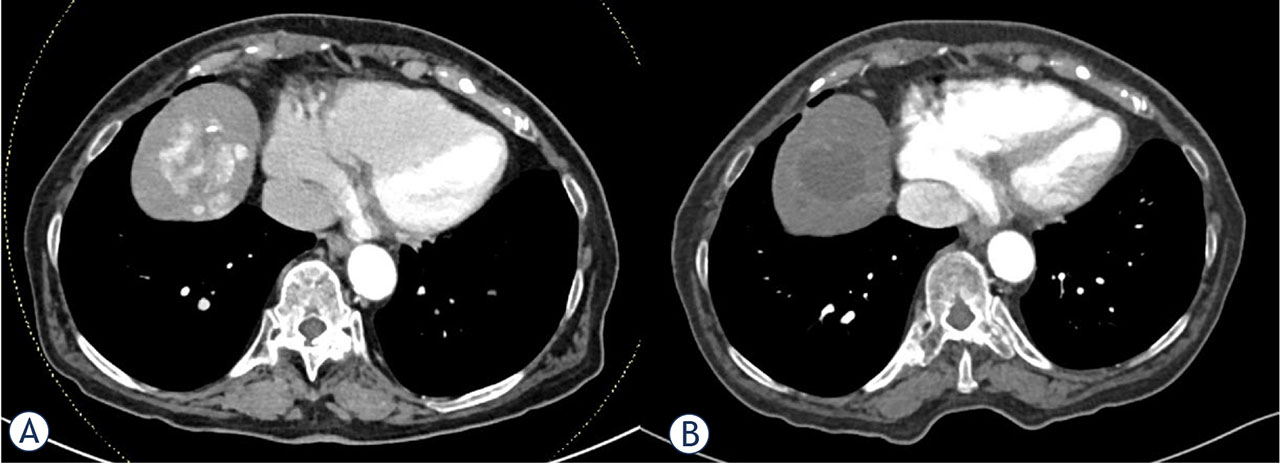
FIGURE 1.
CT slices showing a mRECIST partial response to idarubicin-loaded drug-eluting microspheres (DEMIDA) - transarterial chemoembolization (TACE) in the VIII. segment of cirrhotic liver. (A) Baseline CT showing multifocal hepatocellular carcinoma (HCC). The diameter of the largest tumour was 38 mm; (B) Only minimally enhancing largest target lesion at the first treatment response evaluation, the diameter of viable lesion was 4 mm.
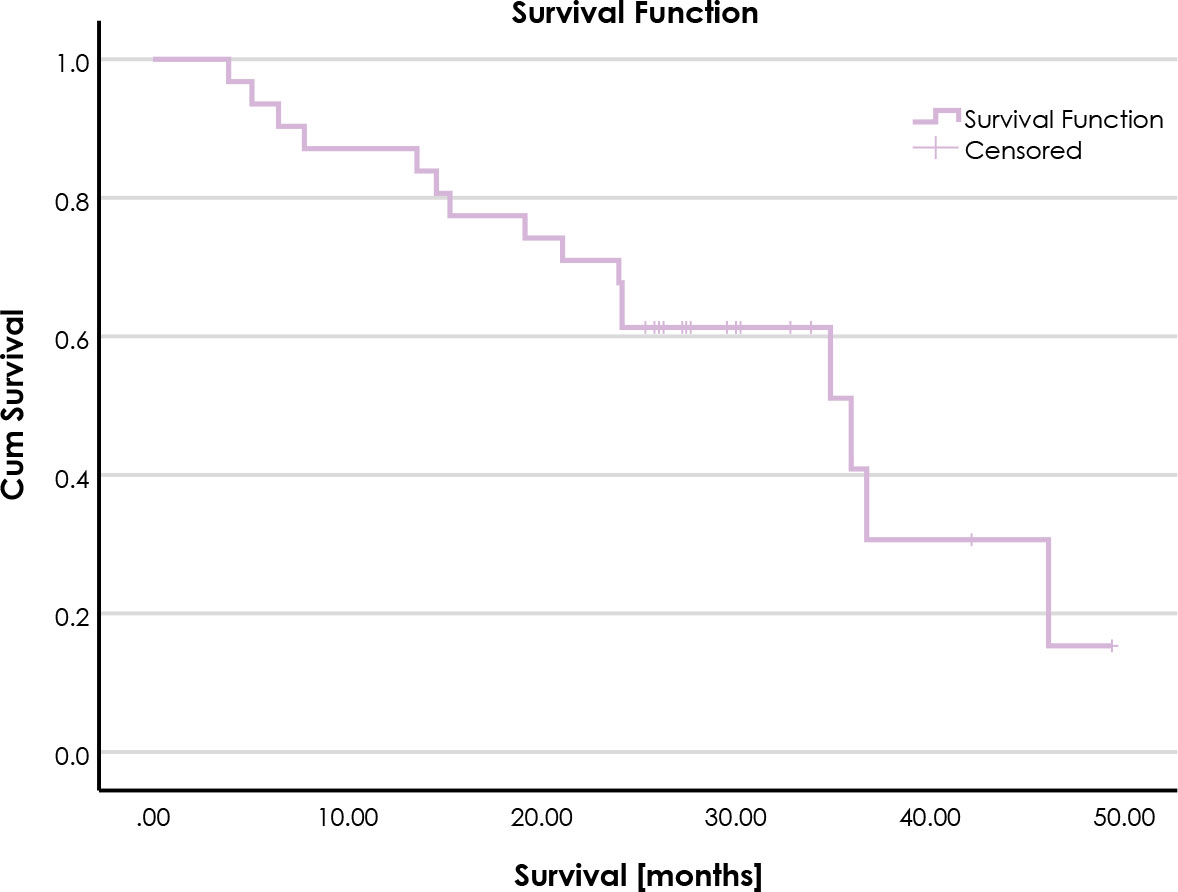
FIGURE 2.
Kaplan-Meier curve for overall survival.
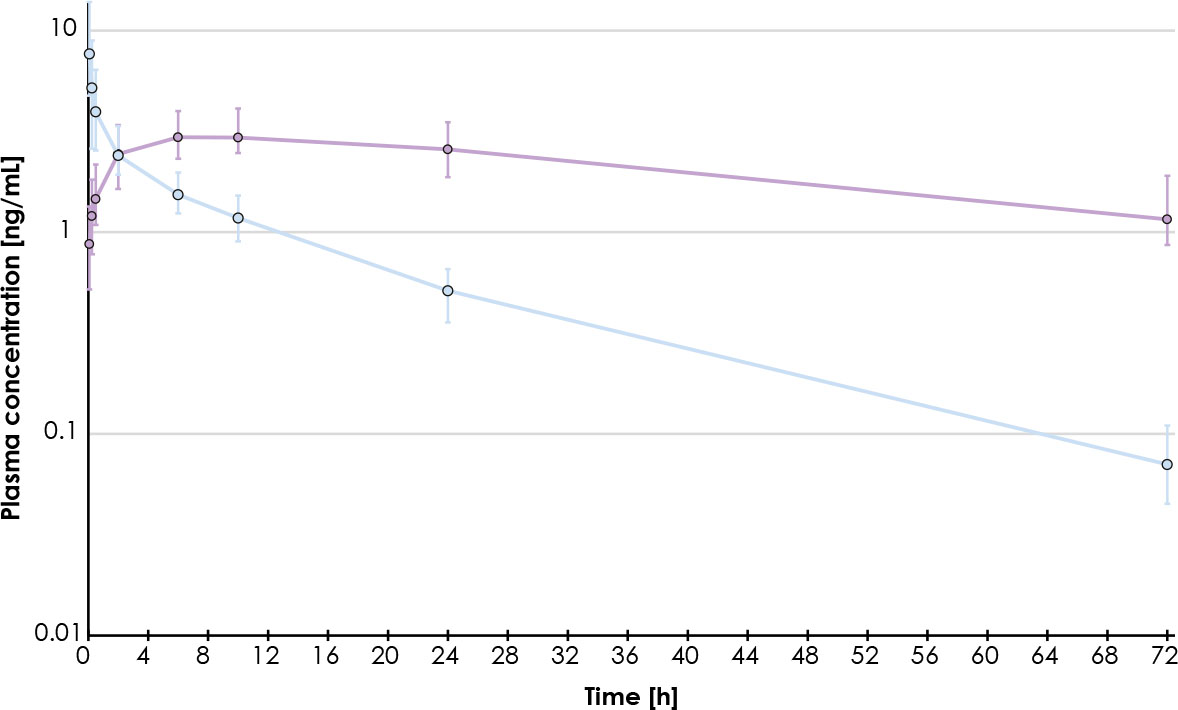
FIGURE 3.
Geometric mean plasma concentration profiles for idarubicin (blue) and idarubicinol (purple) (n = 31). Error bars indicate first and third quartiles of plasma concentrations.
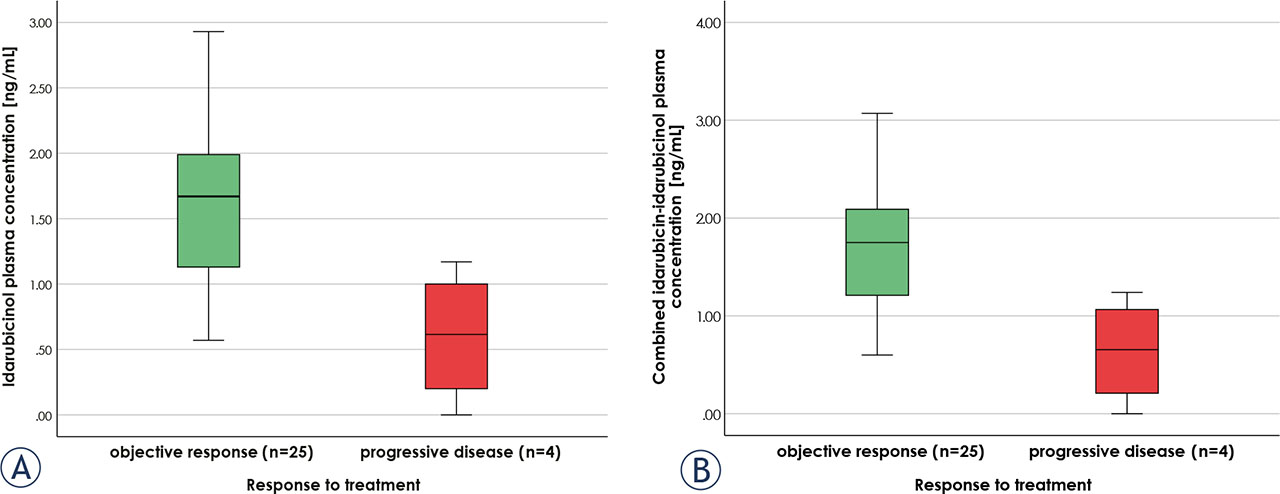
FIGURE 4.
Idarubicinol (A) and combined idarubicin-idarubicinol (B) plasma concentrations at 72 hours post-procedure in patients with objective response to treatment or progressive disease (n = 29).