
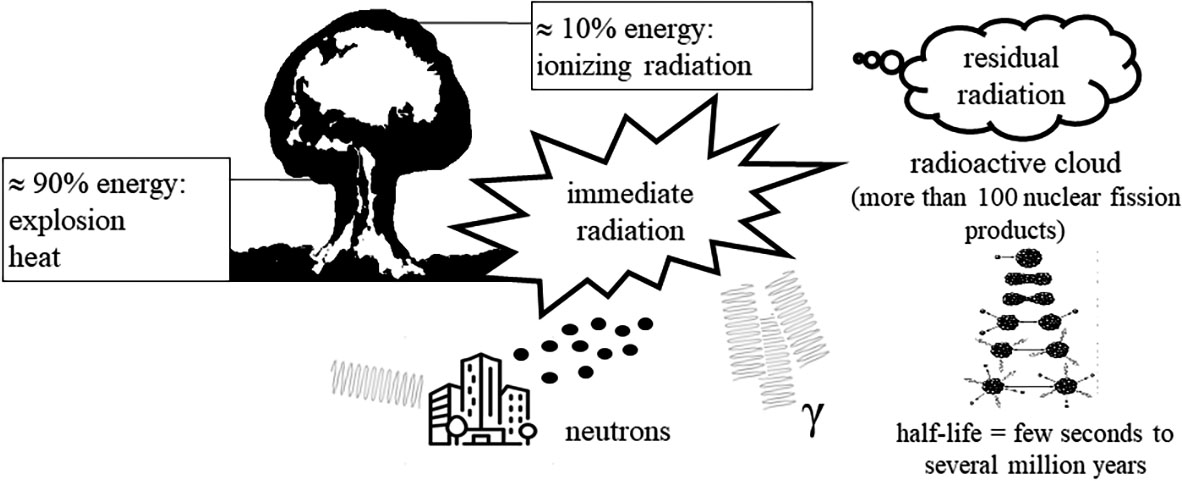
FIGURE 1.
Sources of ionizing radiation during a nuclear accident.
TABLE 1.
Differences in exposure to iodine-131 in medicine and during nuclear accident
| Parameter | In medicine | In nuclear accident |
|---|---|---|
| Radioactivity | High | Low |
| Average received dose (Gy) | > 100 | < 10 |
| Effects | Deterministic | Stochastic |
| The source | Controlled production in a nuclear reactor | Uncontrolled release during a nuclear accident (nuclear reactor, nuclear bomb) |
| Form | Capsule Solution | Radioactive cloud |
| Body intake | Ingestion Intravenously | Ingestion Inhalation |
TABLE 2.
Influential factors on the risk of harmful effects from iodine-131 in nuclear accidents
| Parameter | Higher risk | Lower risk |
|---|---|---|
| Exposure | Late public notification Accompanying accident (earthquake, fire …) Exposed workers | Early public notification Preventing contaminated food and water intake Indoor sheltering |
| Received dose (Gy) | > 0.05 | < 0.05 |
| Age | Children (especially < 5) Exposure in utero | Adults |
| Iodine intake before exposure | Deficient | Sufficient |
| Thyroid blocking (KI tablets) | No blocking Inappropriate timing | Appropriate timing (less than 24 hours before and up to 2 hours after exposure) |
| Pre-existent thyroid disease | Iodine deficiency disorders No pre-existent thyroid disease | After thyroidectomy Hormone replacement therapy for other reasons |
| Medical surveillance | No surveillance | Close surveillance in high-risk individuals |