Have a personal or library account? Click to login
Analysis of magnetic resonance contrast agent entrapment following reversible electroporation in vitro Cover

Analysis of magnetic resonance contrast agent entrapment following reversible electroporation in vitro

Open Access
|Sep 2024

Figures & Tables

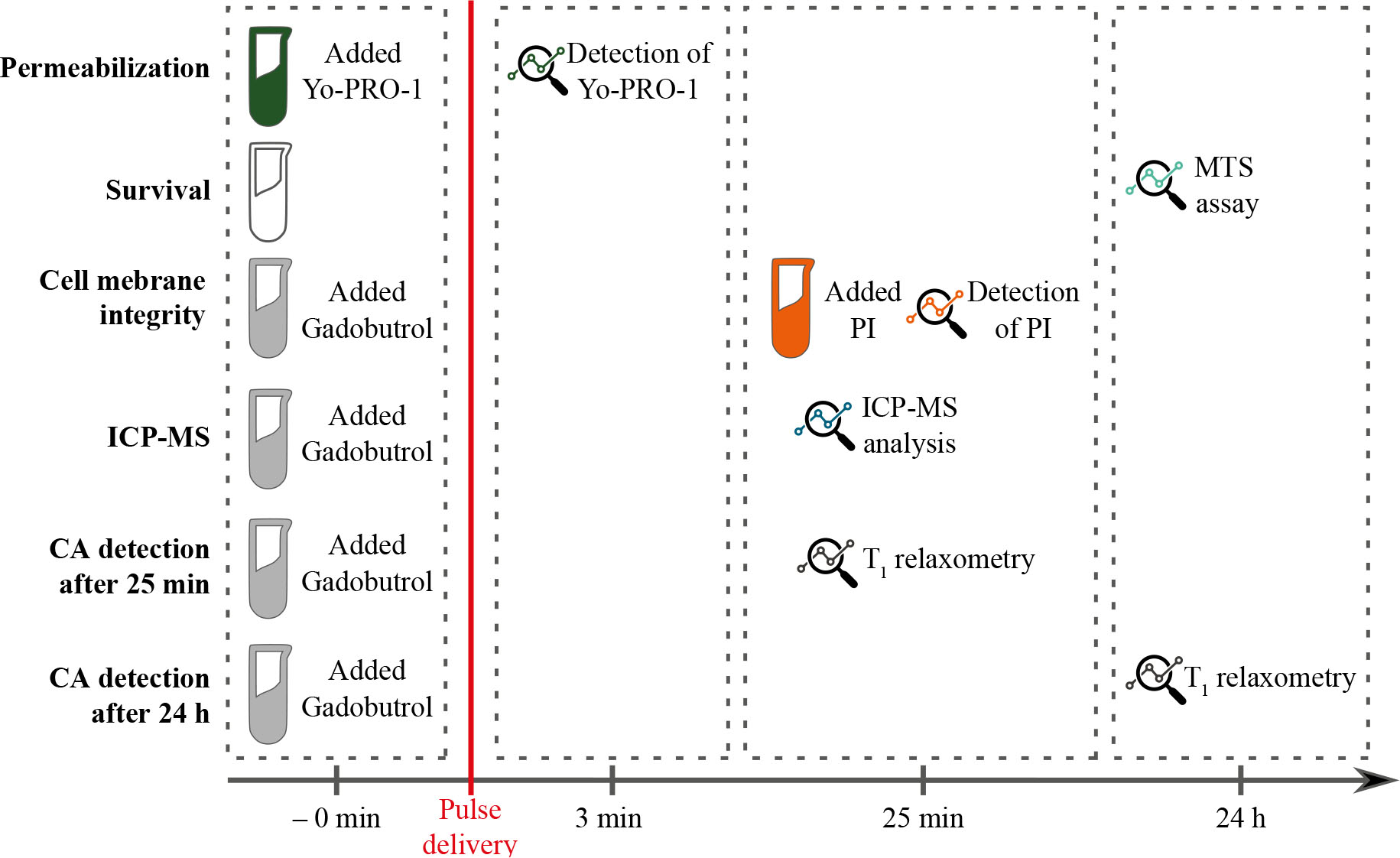
FIGURE 1.

An overview of the time sequence of experiments. Red line represents a moment of pulse delivery. For cell membrane integrity, inductively coupled plasma mass spectrometry (ICP-MS), and Gadolinium-based contrast agent (CA) detection experiments gadobutrol was added to cell suspension prior to pulse delivery. Analyses were performed at different time points as indicated in the figure.PI = Propidium iodide

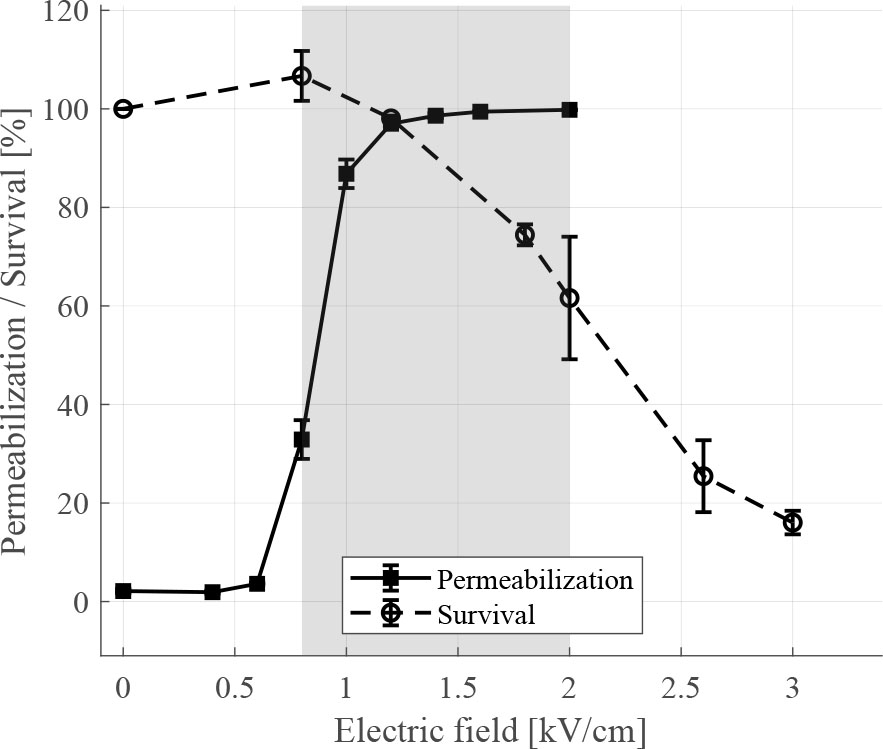
FIGURE 2.

Cell membrane permeabilization (solid black line) and cell survival (dashed black line) of Chinese hamster ovary (CHO) cells in relation to applied electric field. Cell membrane permeabilization and cell survival experiments were performed using YO-PRO-1 dye and by assessing metabolic activity of cells using MTS assay, respectively. Each data point presents a mean ± standard deviation (vertical bars) of 3 repetitions. For permeabilization results gating was set according to sham control without applied electric field. Survival results are normalized to the control sample without applied electric field. Area shaded in gray represents range of electric fields which predominantly cause reversible electroporation of cells.
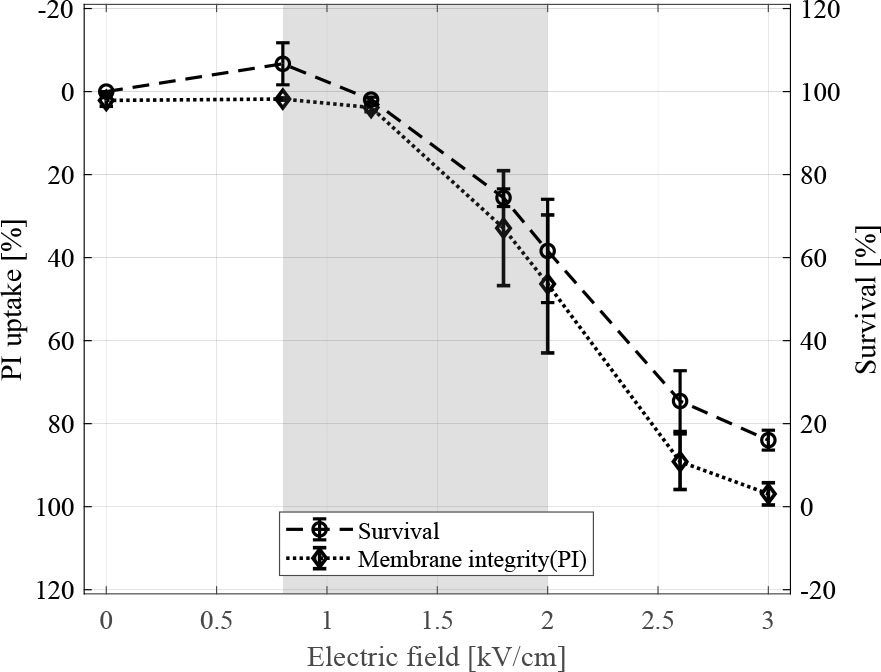
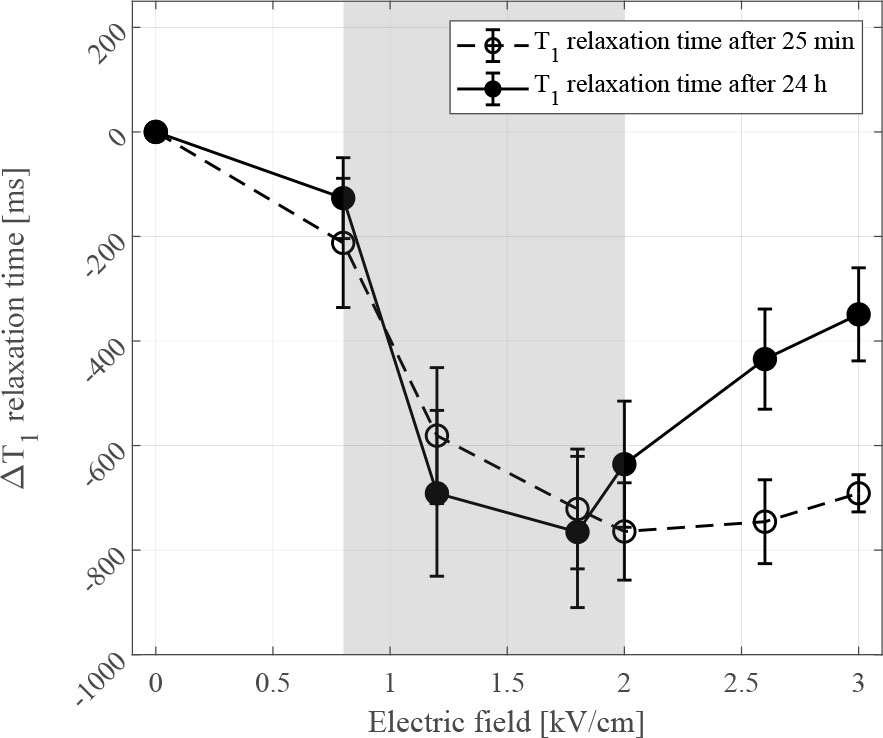
FIGURE 3.

Cell membrane integrity experiment determined by adding propidium iodide dye 25 min after pulse delivery and cell survival determined by MTS assay 24 h after pulse delivery in relation to applied electric field. Each data point presents a mean ± standard deviation (vertical bars) of 3 repetitions. For cell membrane integrity results gating was set according to sham control without applied electric field. Survival results are normalized to the control sample without applied electric field and with added 22 μM of gadobutrol. Note the reversed (upside -down) scale of propidium iodide (PI) uptake for easier comparison. Area shaded in gray represents range of electric fields which predominantly cause reversible electroporation of cells.

FIGURE 4.

Change in T1 relaxation times obtained from CHO cells 25 mins (dashed line) and 24 h (solid line) after pulse delivery. Each data point presents a mean ± standard deviation (vertical bars) of 3 repetitions. Comparison of T1 relaxation times obtained 25 mins and 24 h after electroporation (EP) is normalized to control sample, i.e. cell suspension with added 22 μM gadobutrol and without exposure to an electric field. Asterisks (*) indicate statistically significant differences (p < 0.05) between T1 relaxation time curves obtained 25 min and 24 h after pulse delivery. Area shaded in gray represents a range of electric fields which predominantly cause reversible electroporation of cells.
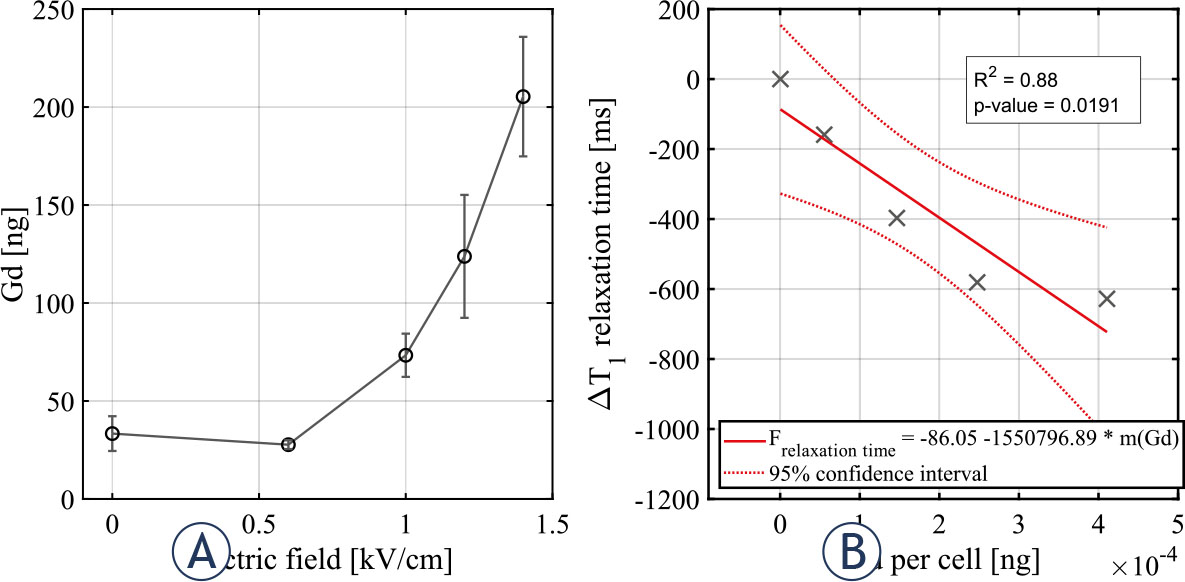

FIGURE 5.

Mass of gadolinium per cell in relation to applied electric field 25 min after pulse delivery. Each data point presents a mean ± standard deviation (vertical bars) of 3 repetitions (A). Linear regression fitting of T1 relaxation time in relation to mass of gadolinium per cell. Each symbol represents a point extrapolated from T1 relaxometry results 25 min after pulse delivery (B).

Parameters of electric pulses used in experiments

ExperimentU [V]E [kV/cm]Single pulse duration [μs]Pulse repetition rate [1/s]Number of pulses [/]
Permeabilization120–4000.6–2.010018
ICP-MS120–2800.6–1.410018
Cell survival160–6000.8–3.010018
Cell membrane integrity160–6000.8–3.010018
CA detection experiments160–6000.8–3.010018
DOI: https://doi.org/10.2478/raon-2024-0047 | Journal eISSN: 1581-3207 | Journal ISSN: 1318-2099
Language: English
Page range: 406 - 415
Submitted on: Jul 31, 2024
|
Accepted on: Aug 9, 2024
|
Published on: Sep 15, 2024
In partnership with: Paradigm Publishing Services
Publication frequency: 4 issues per year

© 2024 Marko Strucic, Damijan Miklavcic, Zala Vidic, Maria Scuderi, Igor Sersa, Matej Kranjc, published by Association of Radiology and Oncology
This work is licensed under the Creative Commons Attribution 4.0 License.