
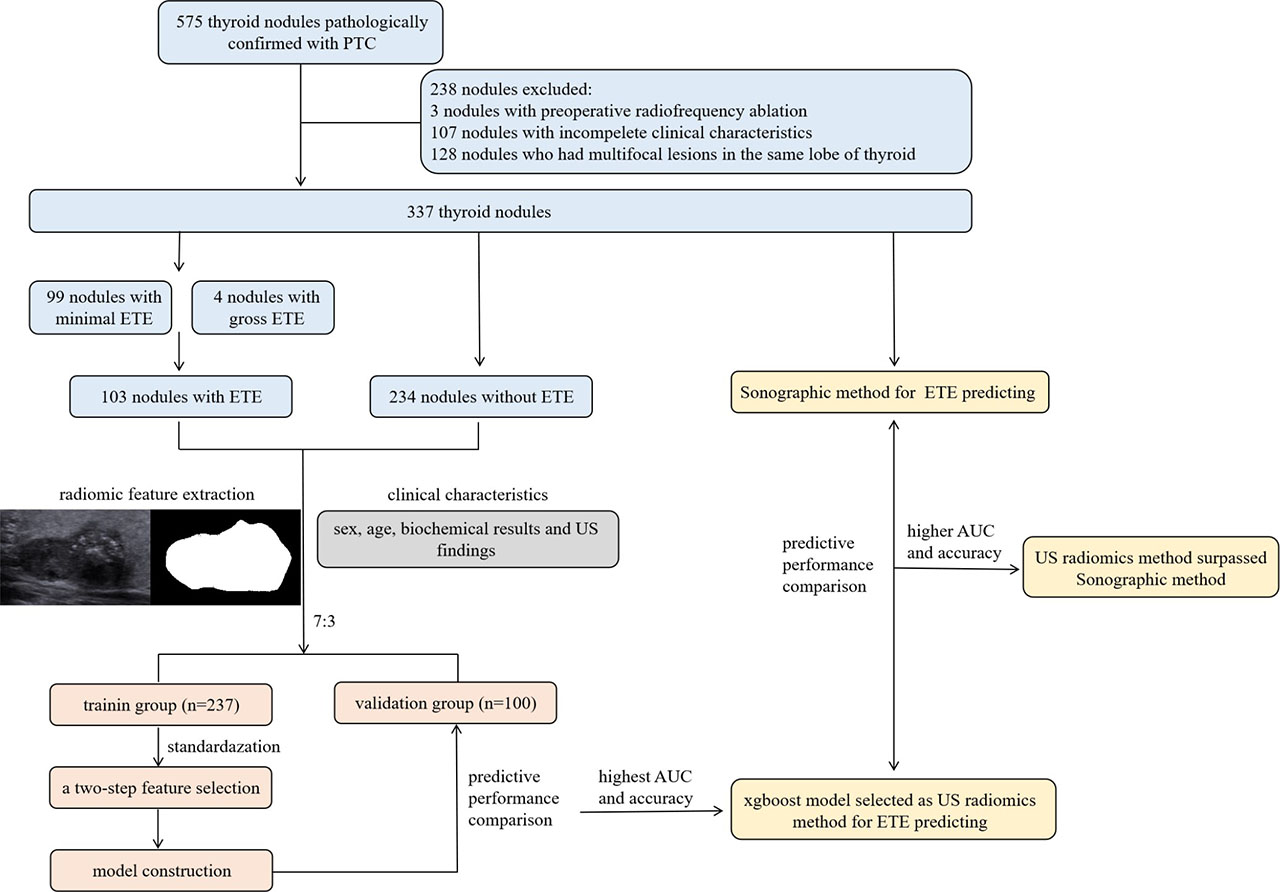
Figure 1.
The flowchart for this retrospective study.
AUC = area under the curve; ETE = extrathyroidal extension; PTC = papillary thyroid carcinoma; US = ultrasonic; xgboost = the extreme gradient boosting
Table 1.
Characteristics of nodules in training and validation groups
| Characteristics | Training group (n = 237) | Validation group (n = 100) | p-value |
|---|---|---|---|
| Sex | 0.708 | ||
| Male | 64 (27.00) | 29 (29.00) | |
| Female | 173 (73.00) | 71 (71.00) | |
| Age (years)a | 45.97 ± 11.92 | 46.70 ± 11.64 | 0.606 |
| Size (mm) | 9.69 ± 6.08 | 10.62 ± 7.60 | 0.550 |
| WBC (×10^9/L) | 5.96 ± 1.52 | 6.12 ± 1.45 | 0.241 |
| NEUT (×10^9/L) | 3.65 ± 1.26 | 3.75 ± 1.18 | 0.326 |
| LYM (×10^9/L) | 1.89 ± 0.56 | 1.91 ± 0.62 | 0.716 |
| HB (g/L) | 138.39 ± 16.01 | 141.70 ± 15.13 | 0.094 |
| RBC (×10^12/L) | 4.69 ± 0.46 | 4.70 ± 0.45 | 0.752 |
| PLT (×10^9/L) | 252.85 ± 58.65 | 255.70 ± 64.90 | 0.656 |
| ALT (U/L) | 23.50 ± 19.98 | 24.15 ± 18.41 | 0.280 |
| AST (U/L) | 21.53 ± 7.86 | 21.48 ± 7.68 | 0.696 |
| ALB (g/L) | 45.15 ± 3.19 | 44.93 ± 3.01 | 0.473 |
| BUN (mmol/L) | 4.83 ± 1.27 | 4.93 ± 1.29 | 0.391 |
| CREA (umol/L) | 58.14 ± 13.36 | 57.54 ± 12.82 | 0.489 |
| UA (umol/L) | 315.27 ± 82.01 | 325.80 ± 86.12 | 0.261 |
| Ca (mmol/L) | 2.40 ± 0.11 | 2.41 ± 0.10 | 0.460 |
| TT3 (ng/ml) | 1.10 ± 0.31 | 1.09 ± 0.18 | 0.828 |
| TT4 (μg/dl) | 8.32 ± 1.72 | 8.09 ± 1.62 | 0.329 |
| FT3 (pg/ml) | 3.36 ± 1.16 | 3.33 ± 0.41 | 0.346 |
| FT4 (ng/dl) | 1.30 ± 0.26 | 1.29 ± 0.20 | 0.829 |
| TSH (μIU/ml) | 1.66 ± 0.99 | 1.96 ± 1.38 | 0.090 |
| ANTITGAB (IU/ml) | 122.12 ± 325.06 | 114.13 ± 349.18 | 0.335 |
| ANTITPOAB (IU/ml) | 41.11 ± 101.64 | 52.08 ± 124.91 | 0.912 |
| TG (ng/ml) | 36.10 ± 72.10 | 42.00 ± 84.61 | 0.886 |
| Urinary leukocyteb | 0.412 | ||
| Negative | 188 (79.32) | 87 (87.00) | |
| Positive 1+ | 19 (8.02) | 5 (5.00) | |
| Positive 2+ | 17 (7.17) | 3 (3.00) | |
| Positive 3+ | 10 (4.22) | 3 (3.00) | |
| Positive 4+ | 10 (4.22) | 2 (2.00) | |
| URBCb | 0.144 | ||
| Negative | 208 (87.76) | 89 (89.00) | |
| Positive 1+ | 21 (8.86) | 6 (6.00) | |
| Positive 2+ | 6 (2.53) | 1 (1.00) | |
| Positive 3+ | 0 (0) | 2 (2.00) | |
| Positive 4+ | 2 (0.84) | 2 (2.00) | |
| Urinary proteinb | 0.524 | ||
| Negative | 145 (61.18) | 64 (64.00) | |
| Positive 1+ | 63 (26.58) | 28 (28.00) | |
| Positive 2+ | 29 (12.24) | 8 (8.00) | |
| Compositionb | 1.000 | ||
| Predominately cystic | 2 (0.84) | 0 (0) | |
| Predominately solid | 235 (99.16) | 100 (100.00) | |
| Solid | 0 (0) | 0 (0) | |
| Echogenicityb | 0.966 | ||
| Hyperechoic or isoechoic | 8 (3.38) | 3 (3.00) | |
| Hypoechoic | 191 (80.59) | 82 (82.00) | |
| Markedly hypoechoic | 38 (16.03) | 15 (15.00) | |
| Shapeb | 0.974 | ||
| Wider-than-tall | 100 (42.19) | 42 (42.00) | |
| Taller-than-wide | 137 (57.81) | 58 (58.00) | |
| Marginb | 0.083 | ||
| Smooth or ill-defined | 143 (60.34) | 54 (54.00) | |
| Lobulated or irregular | 70 (29.54) | 27 (27.00) | |
| Extrathyroidal extension | 24 (10.13) | 19 (19.00) | |
| Echogenic focib | 0.465 | ||
| No calcification | 68 (28.69) | 20 (20.00) | |
| Macrocalcifications | 63 (26.58) | 23 (23.00) | |
| Peripheral calcifications | 6 (2.53) | 2 (2.00) | |
| Microcalcifications | 147 (62.03) | 72 (72.00) | |
| TI-RADS classificationb | 1.000 | ||
| III | 1 (0.42) | 0 (0) | |
| IV | 19 (8.02) | 8 (8.00) | |
| V | 216 (91.14) | 92 (92.00) | |
| ETE | 0.910 | ||
| Negative | 165 (69.62) | 69 (69.00) | |
| Positive | 72 (30.38) | 31 (31.00) |
[i] Continuous variables were presented with Mean ± SD and were calculated by Mann-Whitney U test. Data marked with a were calculated by Student's t-test. Categorical variables were presented with number and percentage (percentage in parentheses) and were calculated by Chi-square analysis. Data marked with b were calculated by Fisher exact test.
[ii] ALB = albumin; ALT = alamine aminotransferase; ANTITGAB = anti-thyroglobulin antibodies; ANTITPOAB = anti-thyroid peroxidase antibody; AST = asparate aminotransferase; BUN = blood urea nitrogen; Ca = calcium ion; CREA = creatinine; ETE = extrathyroidal extension; FT3 = free triiodothyronine 3; FT4 = free triiodothyronine 4; HB = hemoglobin; LYM = lymphocyte; NEUT = neutrophil; PLT = platelets; RBC = red blood cell; SD = standard deviation; TG = thyroglobulin; TI-RADS = Thyroid Imaging Reporting and Data System; TSH = thyroid stimulating hormone; TT3 = total triiodothyronine 3; TT4 = total triiodothyronine 4; UA = uric acid; URBC = urinary red blood cell; WBC = white blood cell
Table 2.
Comparison of predictive performance for models and sonographic method for extrathyroidal extension predicting
| Model | Accuracy (95% CI) | Sensitivity | Specificity | PPV | NPV | AUC | p-value |
|---|---|---|---|---|---|---|---|
| xgboost | 0.77(0.6751–0.8483) | 0.6774 | 0.8116 | 0.6176 | 0.8485 | 0.813 | - |
| RF | 0.73(0.6320–0.8139) | 0.3548 | 0.8986 | 0.6111 | 0.7561 | 0.741 | 0.000006 |
| GBM | 0.75(0.6534–0.8312) | 0.5164 | 0.8551 | 0.6154 | 0.7973 | 0.737 | 0.000012 |
| binary LR | 0.74(0.6427–0.8226) | 0.6774 | 0.7681 | 0.5676 | 0.8413 | 0.730 | 0.000237 |
| NB | 0.55(0.4473–0.6497) | 0.9355 | 0.3768 | 0.4028 | 0.9286 | 0.656 | 0.000000 |
| DT | 0.68(0.5792–0.7698) | 0.3871 | 0.8116 | 0.4800 | 0.7467 | 0.634 | 0.000000 |
| adaboost | 0.71(0.6107–0.7964) | 0.3548 | 0.8696 | 0.5500 | 0.7500 | 0.612 | 0.000000 |
| SVM | 0.70(0.6002–0.7876) | 0.2903 | 0.8841 | 0.5294 | 0.7349 | 0.567 | 0.000000 |
| KNN | 0.69(0.5897–0.7787) | 0.1935 | 0.9130 | 0.5000 | 0.7159 | 0.553 | < 2.2x10^-16 |
| Sonographic method | 0.70(0.6514–0.7515) | 0.5349 | 0.7279 | 0.2233 | 0.9145 | 0.569 | < 2.2x10^-16 |
[i] adaboost = adaptive boosting; AUC = area under the curve; CI = confidence interval; DT = decision tree; ETE = extrathyroidal extension; GBM = gradient boosting machine; KNN = k nearest neighbour; LR = logistics regression; NB = naivebayes; NPV = negative predictive value; PPV = positive predictive value; RF = randomforest; SVM = support vector machine; xgboost = the extreme gradient boosting
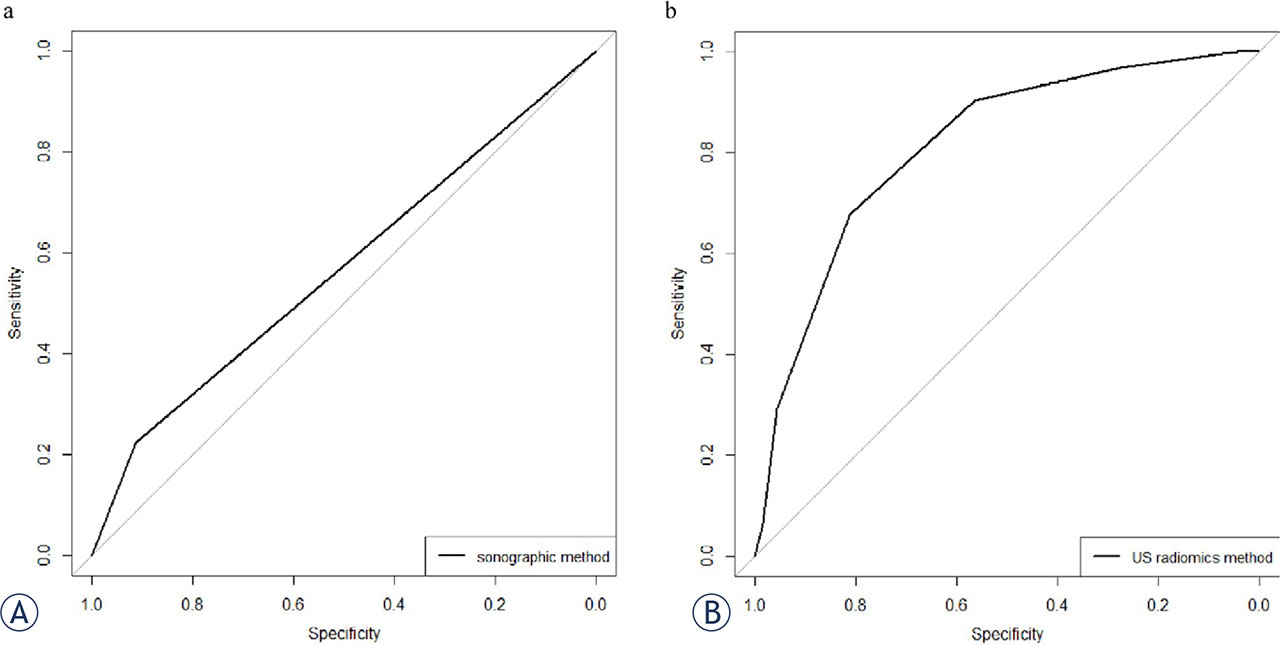
Figure 2.
The ROC curves of sonographic method and US radiomics method for ETE predicting. (A) The ROC curve of sonographic method in all nodules. (B) The ROC curve of US radiomics method in validation group.
ETE = extrathyroidal extension; ROC = the receiver operating characteristic; US = ultrasonic
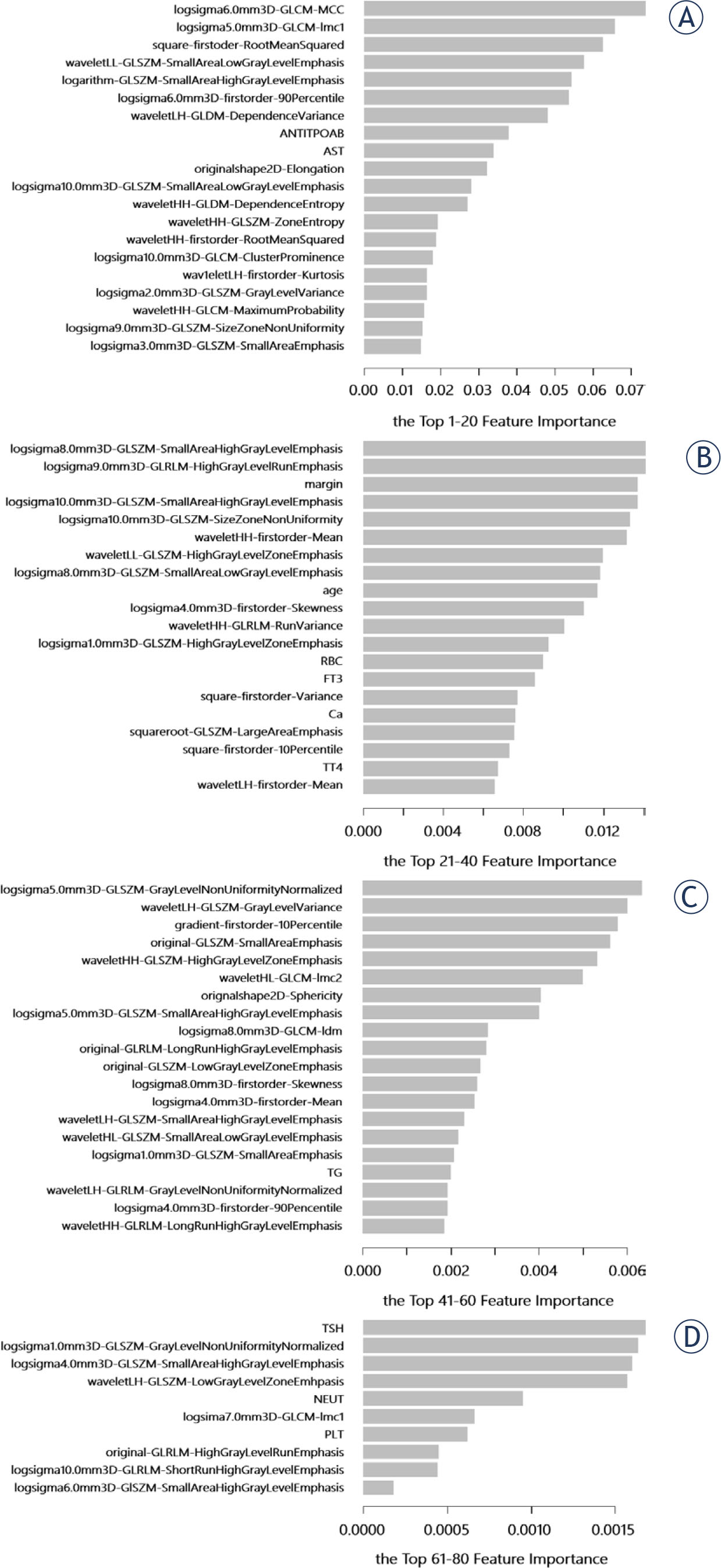
Figure 3.
The image of feature importance for xgboost model. (A-D) the top 1–20, top 21–40, top 41–60 and top 61–80 feature importance of xgboost model.
xgboost=the extreme gradient boosting; GLSZM=Gray-level size-zone matrix; GLCM=gray-level co-occurrence matrix; GLDM=gray-level dependence matrix; GLRLM=gray-level runlength matrix; LH=low-pass/high-pass; LL=low-pass/low-pass; HH=high-pass/high-pass; HL=high-pass/low-pass; ANTITPOAB=anti-thyroid peroxidase antibody; AST=asparate aminotransferase; RBC=red blood cell; FT3=free triiodothyronine 3; Ca=calcium ion; TT4=total triiodothyronine 4; TG=thyroglobulin; TSH=thyroid stimulating hormone; NEUT=neutrophil; PLT=platelets.
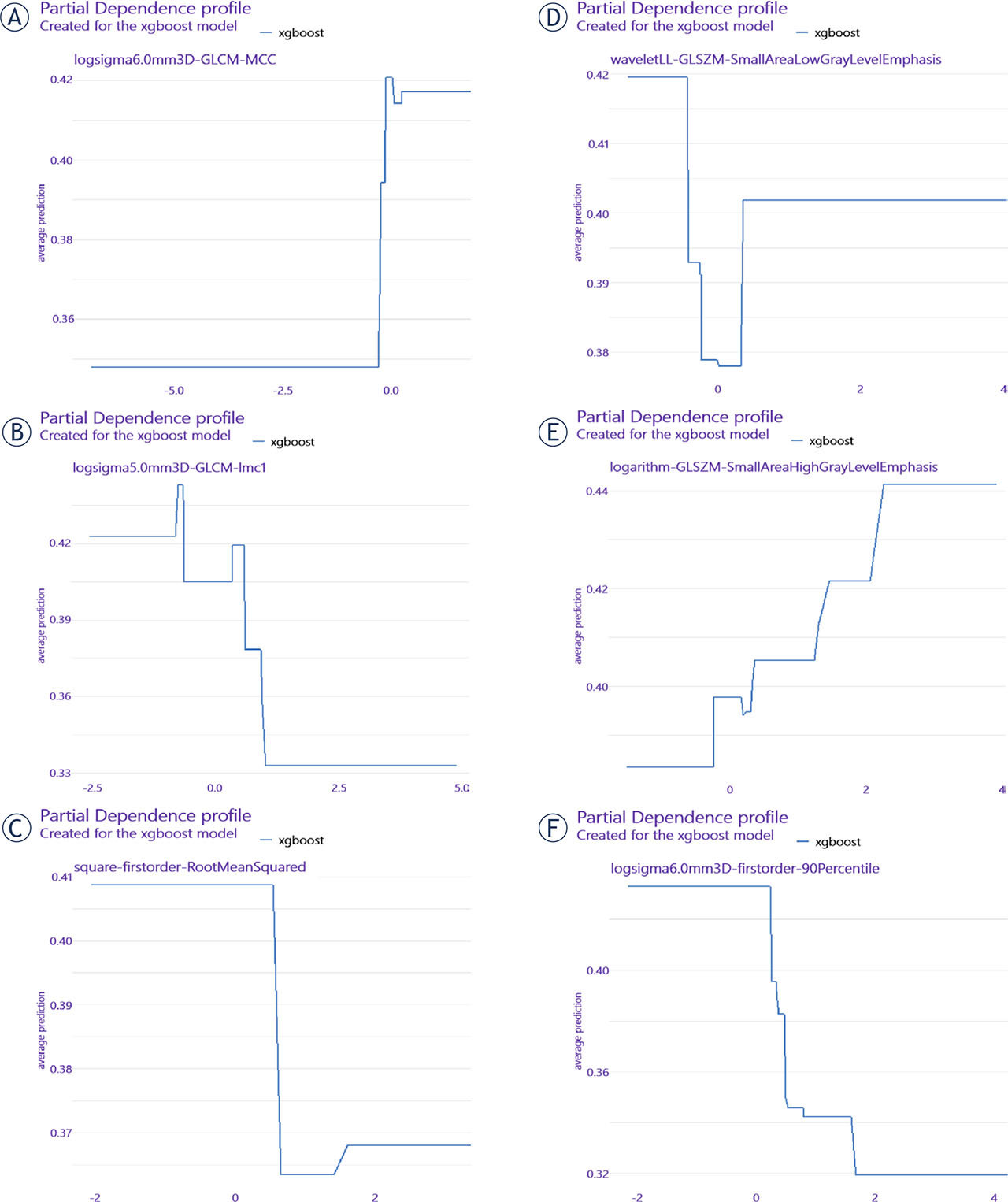
Figure 4.
Partial dependence profile of the top-6 important features in xgboost model. (A-F) Partial dependence profile of logsigma6.0mm3D-GLCM-MCC, logsigma5.0mm3D-GLCM-Imc1, square-firstorder-RootMeanSquared, waveletLL-GLSZM-SmallAreaLowGrayLevelEmphasis, logarithm-GLSZM-SmallAreaHighGrayLevelEmphasis and logsigma6.0mm3D-firstorder-90Percentile in xgboost model in training group. xgboost, the extreme gradient boosting; GLSZM, Gray-level size-zone matrix; GLCM, gray-level co-occurrence matrix; LL, low-pass/low-pass.