
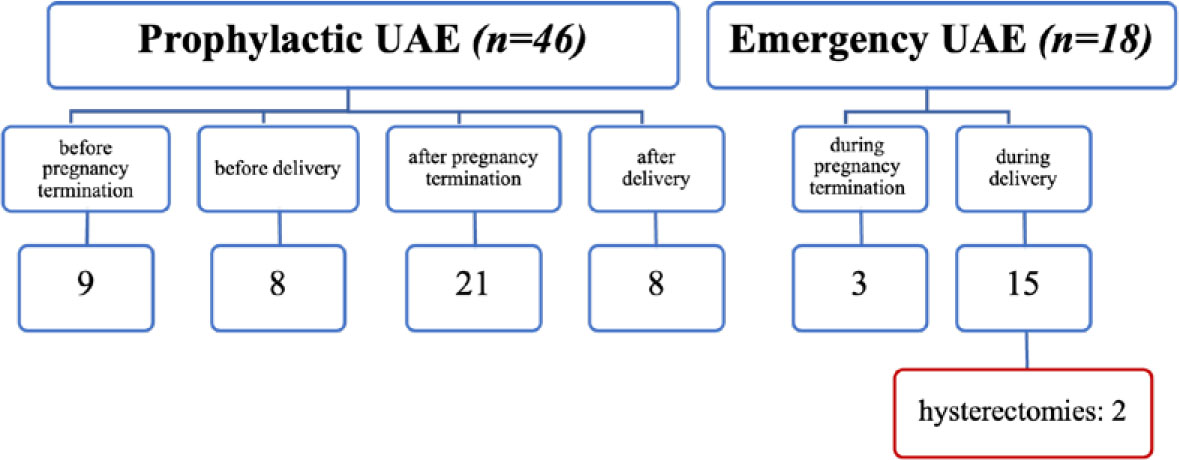
Figure 1.
Patient distribution for prophylactic and emergency uterine artery embolization (UAE).
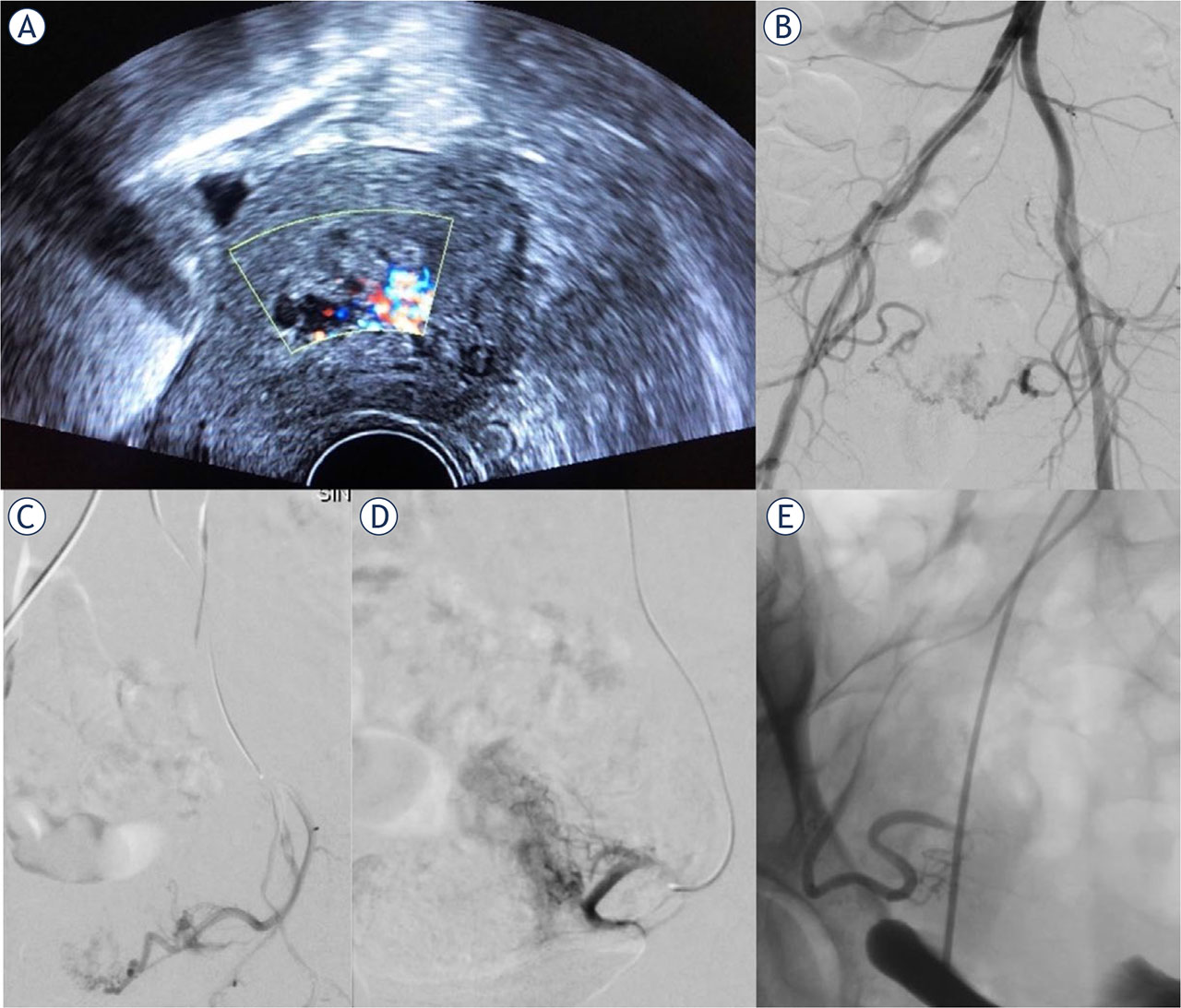
Figure 2.
(A) Transvaginal ultrasonography in a 34-year-old female with vaginal bleeding after spontaneous termination of pregnancy at 12 weeks of gestation. Color Doppler ultrasound showed a 45 x 30 mm mass in the uterus with increased vascularity suggestive of retained products of conception. (B) Pelvic arteriogram demonstrating numerous spiral arteries in the uterus fed by both right and left uterine arteries, confirming the diagnosis of RPOC. (C) Left uterine arteriogram in the same patient before prophylactic embolization with absorbable gelatin sponge particles showing numerous spiral arteries. Postembolization left (D) and right (E) uterine arteriogram demonstrating successful embolization. Subsequently, surgical resection of retained products of conception was successfully performed.
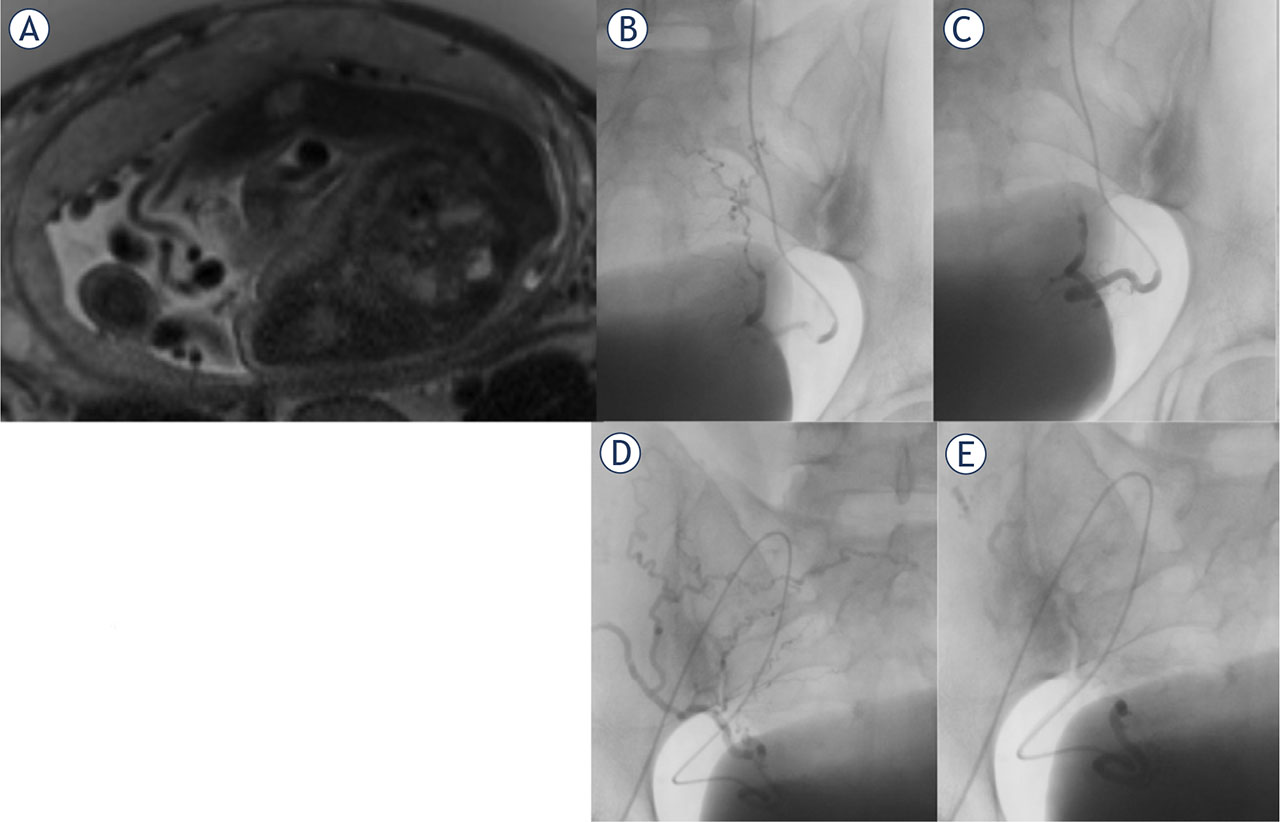
Figure 3.
(A) Abdominal magnetic resonance imaging in a 35-year-old woman with singleton pregnancy at the 33rd week of gestation with suspected placenta accrete. The placenta covers the whole anterior part of the uterine wall. On T2-weighted MR images, there is marked thinning of the myometrium at the placental-myometrial interface, with MRI signs of placenta accrete and placenta increta. On the left cranial part of the junction, there is suspected placental invasion through the entire uterine wall, suspicious for placenta percreta. (B-E) Selective uterine angiography and embolization following delivery in the same 35-year-old woman with placenta accrete. Left (B) and right (D) uterine angiogram confirming the diagnosis of RPOC with numerous voluminous spiral arteries before prophylactic embolization. Left (C) and right (E) post-embolization angiogram after successful selective uterine artery embolization with absorbable gelatin sponge particles to reduce vascularity prior to surgical removal. After embolization, the placental tissue was successfully resected, and hysterectomy was prevented.
Table 1.
Clinical overview of the prophylactic uterine artery embolization (UAE) group
| PROPHYLACTIC UAE | Number of cases | Intervention | Blood loss during gynecological procedure | Hysterectomy |
|---|---|---|---|---|
| BEFORE PREGNANCY TERMINATION | ||||
| Fetal anomalies accompanied by placental abnormalities | 5 | Embolization → pregnancy termination | 300 –400 mL(median 300 mL) | 0 |
| Cervical pregnancy | 4 | Embolization → pregnancy termination | 100 –400 mL (median 250 mL) | 0 |
| BEFORE DELIVERY | ||||
| Placental abnormalities with or without fetal anomalies | 8 | Embolization → vaginal/cesarean delivery | 200 –1,800 mL (median 400 mL) | 0 |
| AFTER PREGNANCY TERMINATION | ||||
| Retained products of conception (RPOC) | 21 | Embolization → surgical removal of RPOC | 100 – 400 mL | 0 |
| AFTER DELIVERY | ||||
| Retained products of conception RPOC | 8 | Embolization → surgical removal of RPOC | 100 – 500 mL | 0 |
Table 2.
Clinical overview of the emergency uterine artery embolization (UAE) group
| EMERGENCY UAE | Number of cases | Intervention | Blood loss during gynecological procedure | Hysterectomy |
|---|---|---|---|---|
| DURING PREGNANCY TERMINATION | ||||
| Hemorrhage | 3 | Pregnancy termination → hemorrhage → embolization | 2x 300 mL 1x 1,000 mL | 0 |
| DURING DELIVERY | ||||
| Uterine atony | 10 | Hemorrhage after vaginal/Cesarean delivery → intrauterine balloon tamponade → embolization | 8x < 1,000 mL 1x > 2,000 mL 1x > 3,000 mL | 2 |
| Placental abnormalities | 5 | Hemorrhage after vaginal/Cesarean delivery → intrauterine balloon tamponade → embolization | < 800 mL | 0 |