
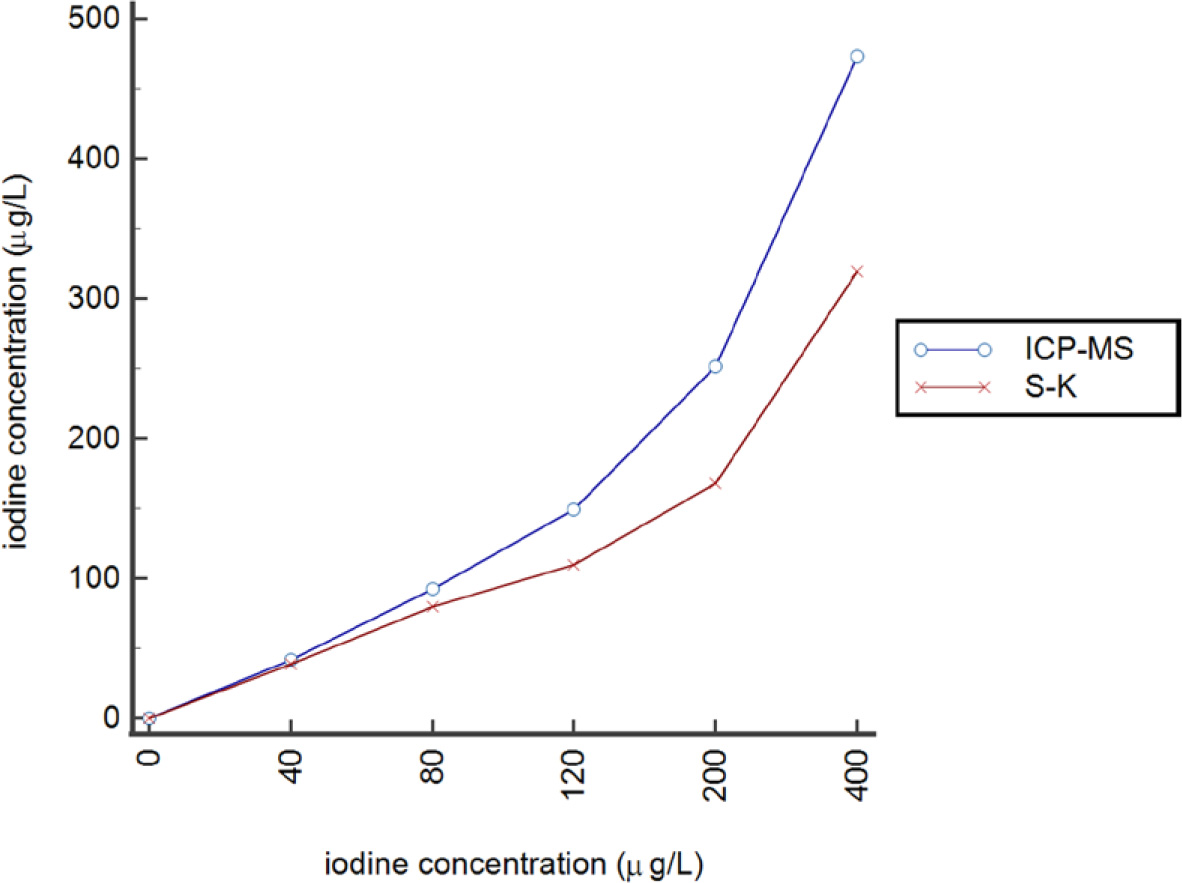
FIGURE 1.
Comparison of measurements of artificial saliva standards (ASS) by two different methods, inductively coupled plasma mass spectrometry (ICP-MS) and Sandell-Kolthoff method (S-K) using ammonium peroxydisulfate on microplate.
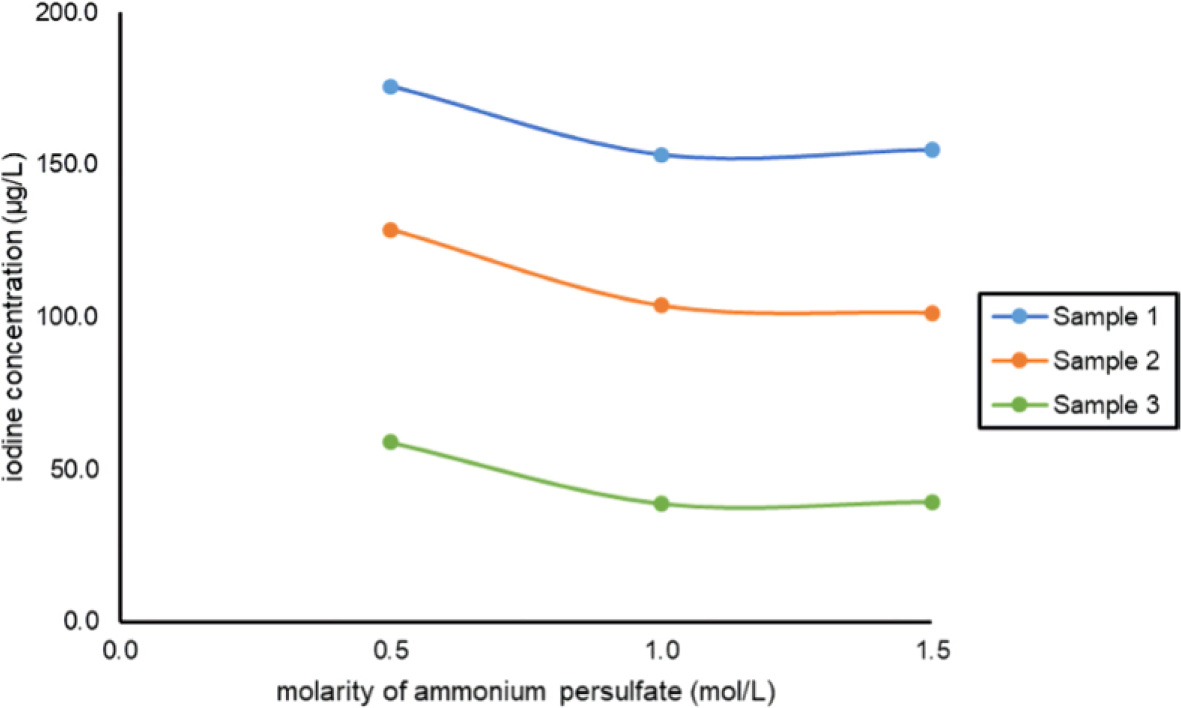
FIGURE 2.
Comparison of different ammonium peroxydisulfate concentrations and their influence on the determined salivary iodine concentration. Comparison between 0.5 and 1.5 mol/L, as well as between 0.5 and 1.0 mol/L for all three samples showed significantly different values (P<0.001) for all three samples, whereas P values for samples 1, 2, and 3, showed no difference between 1.0 and 1.5 mol/L. The corresponding P values were 0.275, 0.085, and 0.761, respectively.
TABLE 1.
Coefficients of variation (CV [%]) for intra- and inter-assay for 4 different iodine concentrations for salivary iodine concentration (SLIC)
| Level | Target value, μg/L | Number of measurements | Intra-assay imprecision, % | Number of measurements | Inter-assay imprecision, % |
|---|---|---|---|---|---|
| 1 | 20 | 40 | 18.4 | 198 | 20.7 |
| 2 | 100 | 40 | 5.1 | 192 | 6.7 |
| 3 | 350 | 40 | 2.8 | 121 | 4.3 |
| Pooled sample | 165 | 40 | 5.7 | 80 | 5.1 |
TABLE 2.
Dilutions of 4 saliva samples with deionised water. Each sample was measured 8 times and results are presented as mean measured concentration (SD). Recoveries are expressed as the percentages of mean measured amount of iodine over expected amount of iodine after dilution
| Dilution | Measured (M) μg/L (SD) | Expected (E) μg/L | M/E % | |
|---|---|---|---|---|
| Sample 1 | Non-diluted | 105.7 (1.3) | / | / |
| 1:2 | 56.9 (1.3) | 52.9 | 107.7 | |
| 1:4 | 28.8 (2.0) | 26.4 | 109 | |
| Sample 2 | Non-diluted | 35.6 (1.0) | / | / |
| 1:2 | 19.2 (1.4) | 17.8 | 108.2 | |
| Sample 3 | Non-diluted | 76.7 (1.3) | / | / |
| 1:2 | 40.2 (1.7) | 38.4 | 104.8 | |
| 1:4 | 17.3 (1.2) | 19.2 | 90.3 | |
| Pooled sample | Non-diluted | 165.1 (5.4) | / | / |
| 1:2 | 65.0 (3.6) | 61.9 | 105.0 | |
| 1:4 | 33.8 (1.7) | 31.0 | 109.1 | |
| 1:8 | 17.2 (1.6) | 15.5 | 111.1 |
TABLE 3.
Recoveries of 6 different saliva samples spiked with 19.6, 38.5, 74.1, and 193.5 mg/L of stock solutions of potassium thiocyanate and of caffeine to saliva samples. Recoveries are expressed as percentages of observed amount of iodine over expected amount of iodine after thiocyanate or caffeine stock solutions added to samples. Each sample was measured 8 times and results are presented as mean salivary iodine concentration (SLIC) (SD) and as the mean percentage recovery (range) of iodine at each concentration level
| Thiocyanate | Caffeine | |||
|---|---|---|---|---|
| SLIC, μg/L (SD) | Recovery, % (range) | SLIC, μg/L (SD) | Recovery, % (range) | |
| Sample 1 | 34.7 (3.0) | 97.9 (97.3–100.5) | 29.1 (1.0) | 93.2 (90.7–96.3) |
| Sample 2 | 86.0 (7.4) | 101.2 (99.0–102.8) | 73.0 (1.6) | 99.3 (97.0–100.9) |
| Sample 3 | 90.7 (3.7) | 102.4 (99.0–105.0) | 75.2 (1.9) | 96.1 (92.0–100.4) |
| Sample 4 | 109.0 (3.9) | 109.0 (95.9–104.9) | 101.3 (3.8) | 96.3 (94.1–99.0) |
| Sample 5 | 143.0 (2.2) | 106.2 (103.8–108.7) | 142.1 (2.5) | 98.7 (96.1–105.3) |
| Sample 6 | 150.6 (3.3) | 102.4 (98.2–107.7) | 152.8 (3.0) | 99.3 (97.3–101.3) |
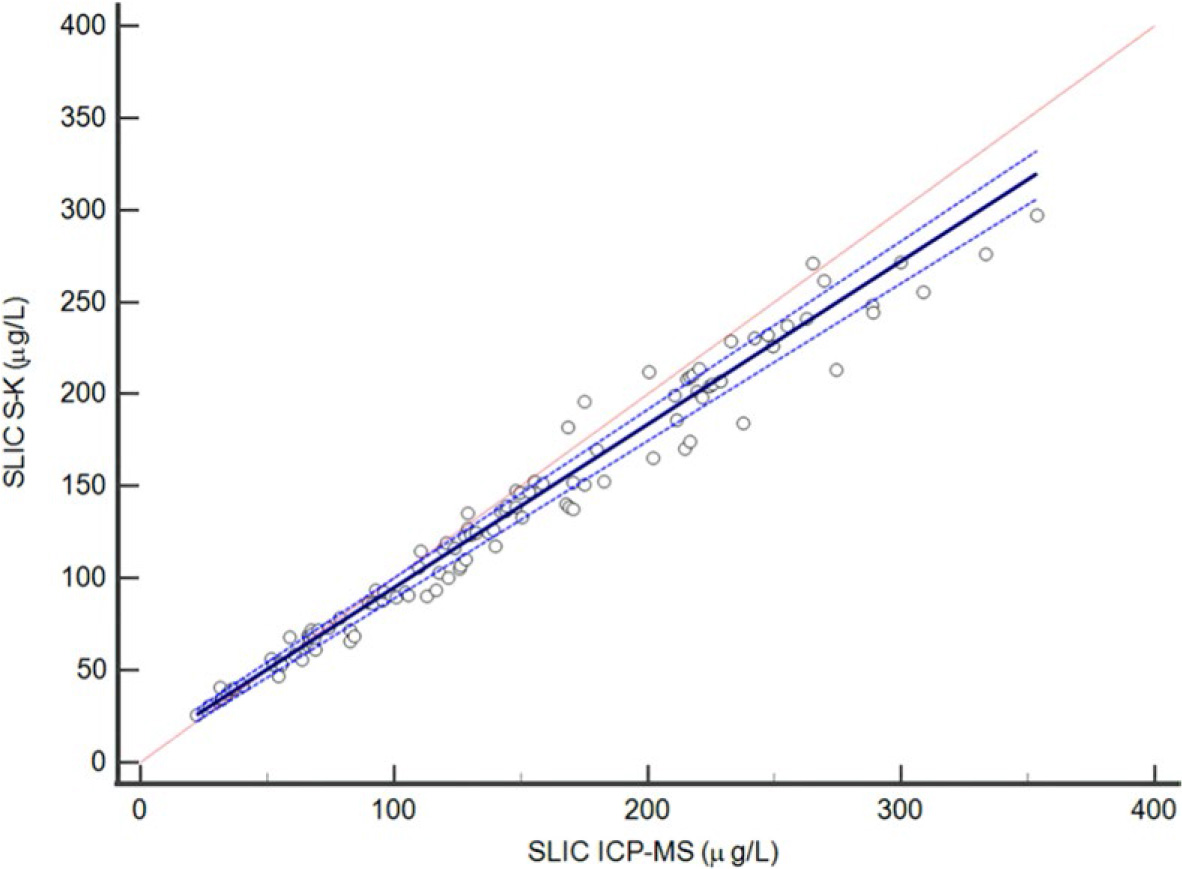
FIGURE 3.
Comparison of salivary iodine concentration (SLIC) determined by the Sandell-Kolthoff (S-K) method using ammonium peroxydisulfate on microplate and by the Inductively Coupled Plasma Mass Spectrometry (ICP-MS) using Passing-Bablock regression. The solid line shows the regression line, dashed lines show 95% confidence interval (CI) for the regression line, and dotted line shows the identity line Y = X. The sample size is N = 110. The regression equation is Y = 0.89*X+6.2. The slope is 0.89 (95% CI, 0.86−0.92), and the intercept is 6.2 (95% CI, 3.3−8.6). The Cusum test for linearity showed no significant deviation from linearity (P = 0.89).
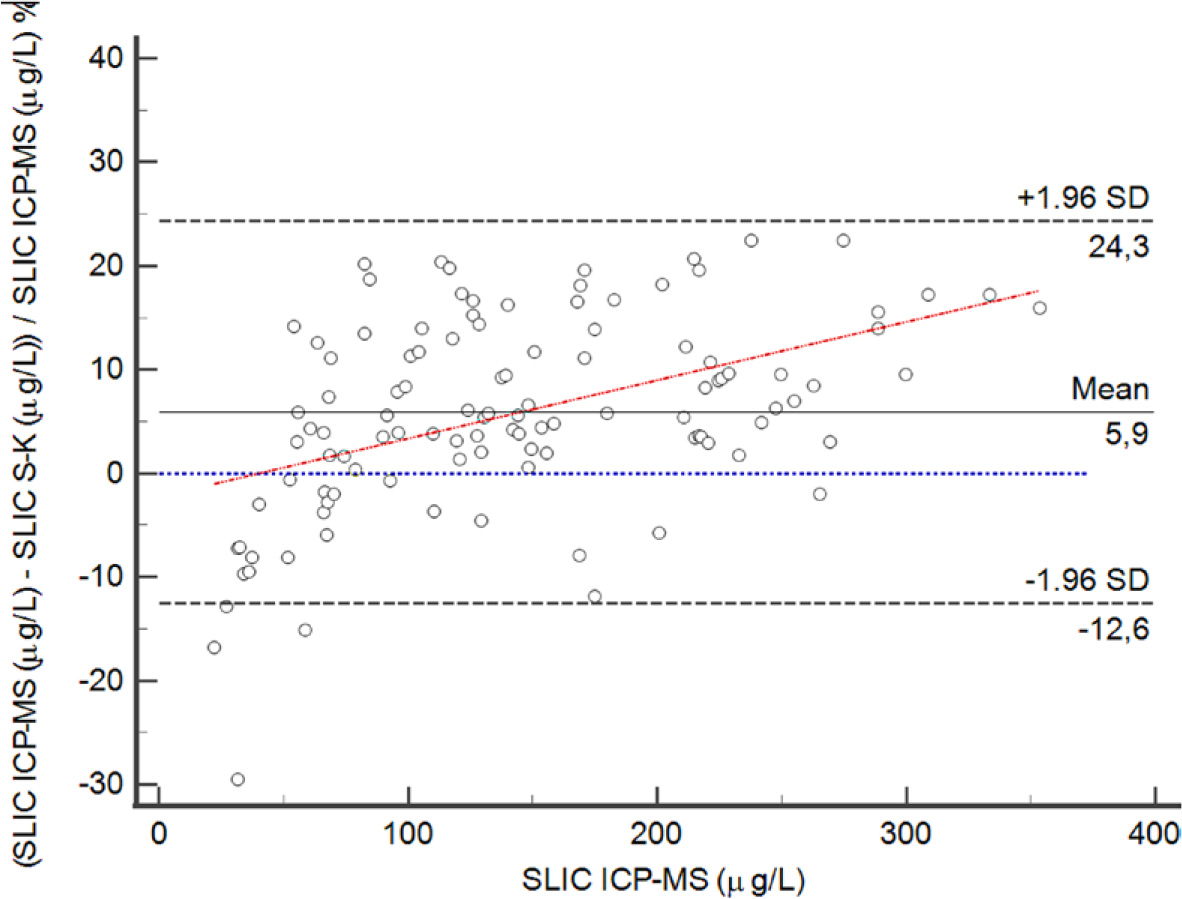
FIGURE 4.
Bland-Altman plot of comparison of salivary iodine concentration (SLIC) determined by the Sandell-Kolthoff method (S-K) and by the Inductively Coupled Plasma Mass Spectrometry (ICP-MS). Differences between the methods are plotted against the ICP-MS method, which is a gold standard method. Sample size is N = 110. Horizontal lines represent the mean SLIC by ICP-MS, zero difference, and 95% confidence interval limits of agreement, which are defined as mean difference plus/minus 1.96 times the standard deviation (SD) of the differences. The mean shows a positive bias of 5.9%.