
TABLE 1.
Overview of cancer epidemiology across four CEE countries in 2020 (data extracted from GLOBOCAN 202025 and the European Cancer Information System34)
| Characteristics | Bulgaria | Croatia | Serbia | Slovenia |
|---|---|---|---|---|
| Total population | 6 948 445 | 4 105 268 | 8 737 370 | 2 078 932 |
| Number of new cancer cases (all cancer sites) | 36 451 | 26 092 | 49 043 | 14 180 |
| Incidence age-standardized rate per 100 000 | 100 | 120.3 | 145.3 | 121.2 |
| Number of new BC cases in 2020, both sexes, all ages | 4061 | 2894 | 6724a | 1410 |
| BC new cases – rank across all types of cancers | 3 | 2 | 2 | 3 |
| 5-year prevalence, all ages (per 100 000) | 425.45 | 523.4 | 549.32 | 560.03 |
| Mortality age-standardized rate per 100 000 | 36.3 | 32.8 | 50.9 | 32.3 |
| Number of BC deaths | 1533 | 832 | 2342 | 405 |
| BC deaths – rank across all types of cancers | 3 | 3 | 2 | 5 |
| Mortality-to-incidence ratiob | 0.36 | 0.27 | 0.35 | 0.27 |
TABLE 2.
Status of reimbursement for anticancer drugs used for treatment of HER2-negative mBC in Bulgaria, Croatia, Serbia, and Slovenia, including the year of reimbursement of at least one representative of the class
| Treatment | Bulgariaa | Croatia | Serbiac | Sloveniad |
|---|---|---|---|---|
| CDK4/6 inhibitors | 2018 | 2018 | 2022 | 2018 |
| Alpelisib | 2023 | 2021 | 2023 | 2021 |
| PARP inhibitors | 2023 | 2022 | 2021 | 2021 |
| Sacituzumab govitecan | 2023 | 2022 | ||
| Trastuzumab deruxtecan | 2022 | 2023 | ||
| Atezolizumab nab-paclitaxel | 2022 | 2021 | 2020 | |
| Pembrolizumab | 2023b | 2022 | 2023 | |
| Everolimus | By >10 years | 2021 | 2010 | |
| Fulvestrant | By >10 years | By >10 years | 2019 | 2004 |
| Aromatase inhibitors | By >10 years | By >10 years | 2008 | By >20 years |
Green = reimbursed; orange = not reimbursed, but available through early access programs or out-of-pocket expenses; red = not reimbursed; CDK4/6 = cyclin-dependent kinase 4 and 6; HER2 = human epidermal growth factor receptor 2; mBC = metastatic breast cancer; PARP = poly(adenosine diphosphate ribose) polymerase;
a In Bulgaria, PARP inhibitors are available in early breast cancer and BRCA-positive tumors after lack of complete response in the neoadjuvant setting. In the metastatic setting, PARP inhibitors have been reimbursed since 2019, everolimus is reimbursed in metastatic estrogen receptor-positive (ER+) BC, and aromatase inhibitors are reimbursed in ER+ BC;
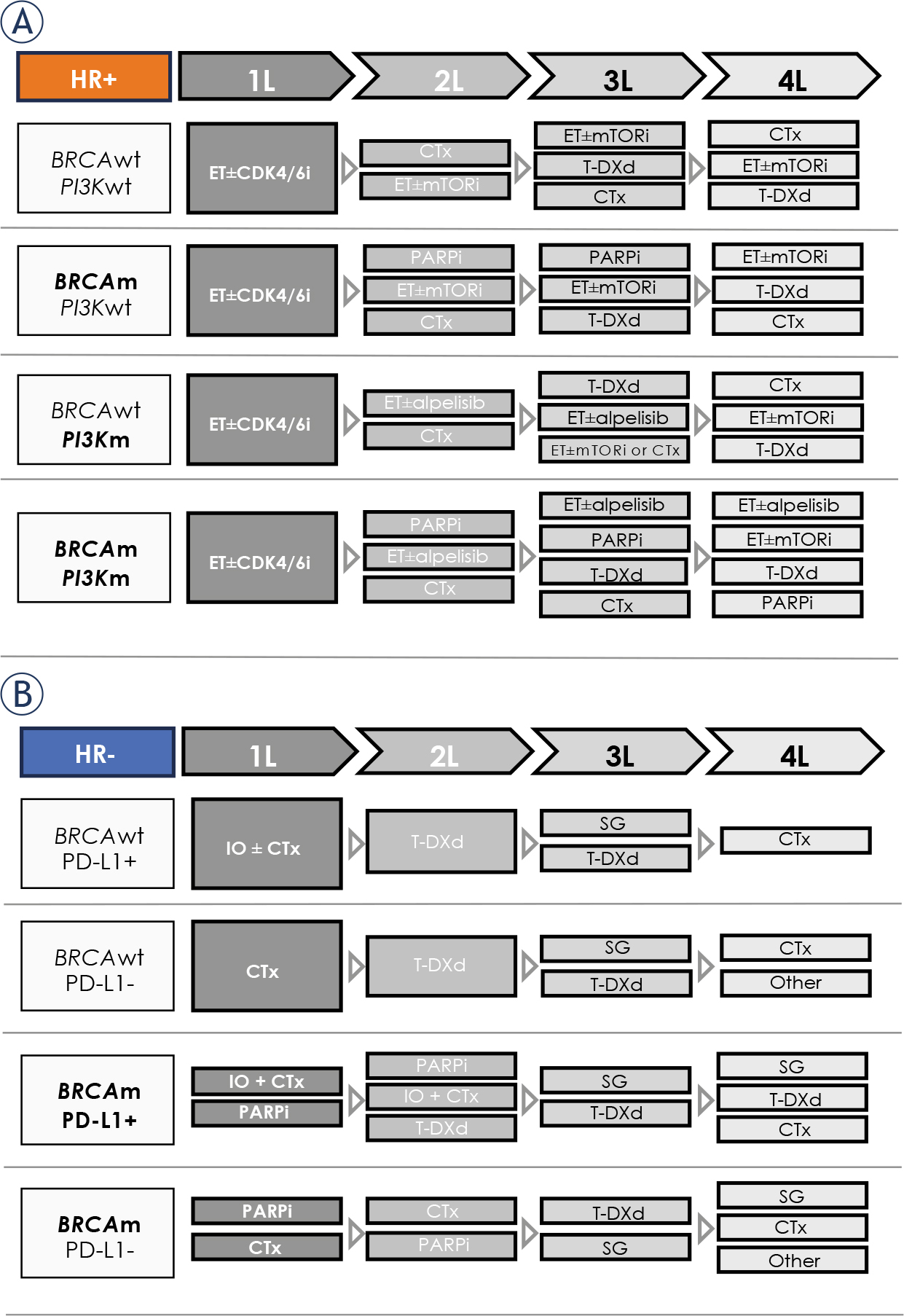
FIGURE 1.
Algorithms for HER2-low mBC in light of evolving treatment paradigms, according to the HR status and other actionable targets: (A) HR+ and (B) HR−. The ideal scenario considers availability of all treatments in all lines and unrestricted treatment access. 1L/2L/3L/4L = first/second/third/fourth line; BRCAm = BReast CAncer gene mutations; BRCAwt = BReast CAncer gene wild type; CDK4/6i = cyclin-dependent kinase 4/6 inhibitor; CTx = chemotherapy; ET = endocrine therapy; HER2 = human epidermal growth factor receptor 2; HR = hormone receptor; IO = immunotherapy; mBC = metastatic breast cancer; mTORi = mammalian target of rapamycin inhibitor; PARPi = poly(adenosine diphosphate ribose) polymerase inhibitor; PD-L1 = programmed death-ligand 1; PI3Km = phosphatidylinositol 3-kinases mutations; PIK3wt = phosphatidylinositol 3-kinases wild type; SG = sacituzumab govitecan; T-DXd = trastuzumab deruxtecan. Treatment in 2L, 3L, 4L, and further lines is based on: previous therapy received; duration of response to previous treatment; patient’s preferences, condition, and comorbidities; toxicities of previous therapies; presumed benefit of further lines of therapy; and treatment availability. Per current approved label, trastuzumab deruxtecan as monotherapy is indicated for the treatment of adult patients with unresectable or metastatic HER2-low breast cancer who have received prior chemotherapy in the metastatic setting or developed disease recurrence during or within 6 months of completing adjuvant chemotherapy. Per current approved label, sacituzumab govitecan as monotherapy is indicated for the treatment of adult patients with unresectable or metastatic triple-negative BC who have received two or more prior systemic therapies, including at least one of them for advanced disease.