
TABLE 1.
Approved immune checkpoint inhibitors in the European Union
| Immune checkpoint inhibitor | Target | Approved indications | |
|---|---|---|---|
| Early cancer | Advanced cancer | ||
| Atezolizumab (Tecentriq) | PD-L1 | NSCLC | Urothelial carcinoma, NSCLC, SCLC, TNBC, HCC |
| Avelumab (Bavencio) | PD-L1 | _ | Urothelial carcinoma, RCC, Merkel cell carcinoma |
| Cemiplimab (Libtayo) | PD-1 | _ | Cutaneous SCC, Basal cell carcinoma, NSCLC, Cervical carcinoma |
| Durvalumab (Imfinzi) | PD-L1 | _ | NSCLC, SCLC, HCC, Biliary tract cancer |
| Ipilimumab (Yervoy) | CTLA-4 | _ | Melanoma, RCC, NSCLC, MPM, CRC, Oesophageal carcinoma |
| Nivolumab (Opdivo) | PD-1 | Urothelial carcinoma, melanoma, NSCLC, oesophageal and GEJ cancer | Melanoma, NSCLC, RCC, cHL, Head and neck SCC, MPM, Urothelial carcinoma, CRC, Oesophageal SCC, Gastric, GEJ or Oesophageal adenocarcinoma |
| Pembrolizumab (Keytruda) | PD-1 | RCC, melanoma, NSCLC, TNBC | RCC, Melanoma, NSCLC, HL, Urothelial carcinoma, Head and neck SCC, Cancers with MSI-H or MMRd, Oesophageal carcinoma, Endometrial carcinoma, Cervical carcinoma, Gastric and GEJ adenocarcinoma |
[i] CRC = colorectal cancer; cHL = classical Hodgkin lymphoma; CTLA-4 = cytotoxic T-lymphocyte antigen; GEJ = gastro-oesophageal junction; HCC = hepatocellular carcinoma; HL = Hodgkin lymphoma; MMRd = mismatch repair deficiency; MPM = malignant pleural mesothelioma; NSCLC = non-small cell lung cancer; MSI-H: microsatellite instability – high; OSCC = oesophageal squamous cell carcinoma; PD-1 = program death 1; PD-L1 = program death ligand; RCC = renal cell carcinoma, SCC = squamous cell carcinoma; SCLS = small cell lung cancer; TNBC = triple-negative breast cancer
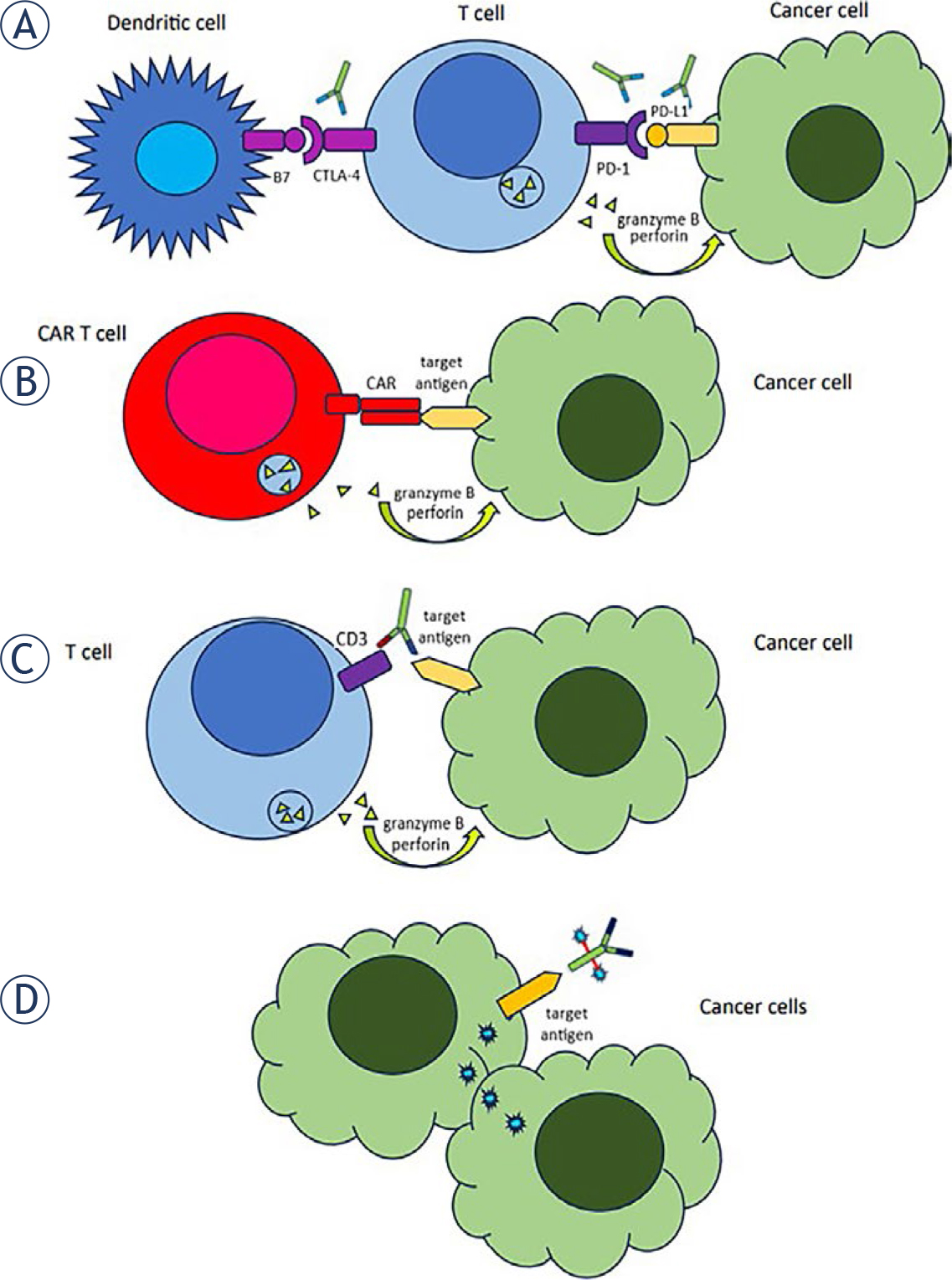
FIGURE 1.
Mechanisms of action of new anticancer therapies. (A) Immune checkpoint inhibitor; (B) CAR T-cell; (C) Bispecific T-cell engager and (D) Antibody drug conjugate.
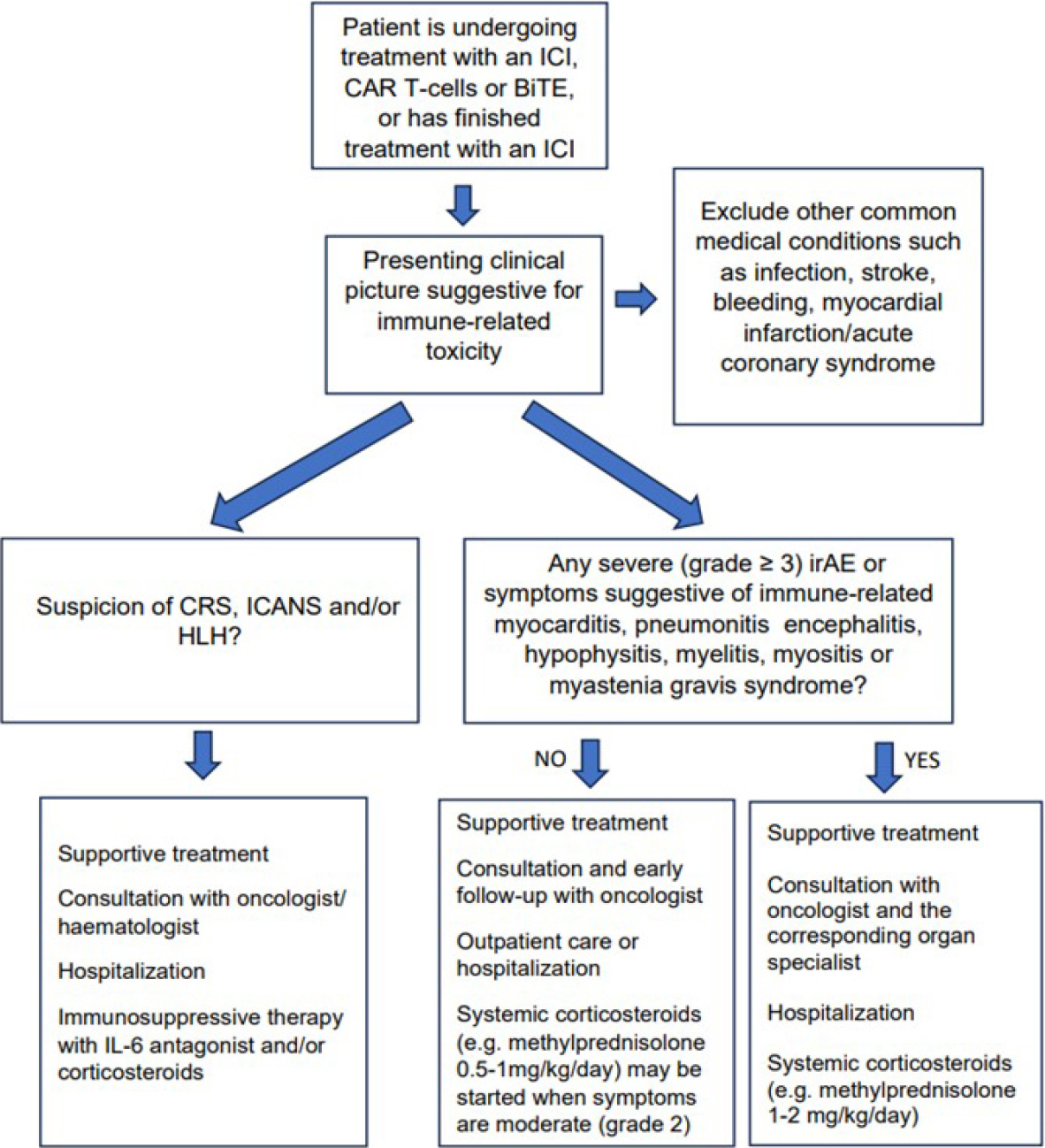
FIGURE 2.
Management of toxicities of immunotherapy.
BiTE = bispecific T-cell engager; CAR = chimeric antigen receptor; CRS = cytokine release syndrome; HLH = haemophagocytic lymphohistiocytosis; ICANS = immune effector-cell associated neurotoxicity syndrome; ICI = immune checkpoint inhibitor; irAE = immune-related adverse events
TABLE 2.
Approved CAR T cell therapies and bispecific T cell engagers in the European Union
| Agent | Type of therapy | Target | Indications |
|---|---|---|---|
| Tisagenlecleucel (Kymriah) | CAR T | CD19 | B-cell acute lymphoblastic leukaemia, Diffuse large B-cell lymphoma, Follicular lymphoma |
| Axicabtagene ciloleucel (Yescarta) | CAR T | CD19 | Primary mediastinal large B-cell lymphoma, Diffuse large B-cell lymphoma, High grade B-cell lymphoma, Follicular lymphoma |
| Brexucabtagene autoleucel (Tecartus) | CAR T | CD19 | Mantle-cell lymphoma, B-cell acute lymphoblastic leukaemia |
| Lisocabtagene maraleucel (Breyanzi) | CAR T | CD19 | Follicular lymphoma grade 3B, Primary mediastinal large B-cell lymphoma, Diffuse large B-cell lymphoma |
| Idecabtagene vicleucel (Abecma) | CAR T | BCMA | Multiple myeloma |
| Ciltacabtagene autoleucel (Carvykti) | CAR T | BCMA | Multiple myeloma |
| Talquetamab (Talvey) | BiTE | GPRC5D/CD3 | Multiple myeloma |
| Teclistamab (Tecvayli) | BiTE | BCMA/CD3 | Multiple myeloma |
| Glofitamab (Columvi) | BiTE | CD20/CD3 | Diffuse large B-cell lymphoma |
| Mosunetuzumab (Lunsumio) | BiTE | CD20/CD3 | Follicular lymphoma |
| Tebentafusp (Kimmtrak) | BiTE | Gp100/CD3 | Uveal melanoma |
| Teclistamab (Tecvayli) | BiTE | BCMA/CD3 | Multiple myeloma |
[i] BCMA = B-cell maturation antigen; BiTE = bispecific T cell engager; CAR T = chimeric antigen receptor T-cells; CD3 = cluster of differentiation 3; CD19 = cluster of differentiation 19; CD20 = cluster of differentiation 20; GP100 = G protein 100; GPRC5D = G protein-coupled receptor, class C, group 5, member D
TABLE 3.
Grades 2 and 3 of the selected immune-related adverse events (irAEs)
| irAE | Grade 2 | Grade 3 |
|---|---|---|
| Maculo-papular rash | Papules and/or pustules covering 10−30% BSA, which may or may not be associated with symptoms of pruritus or tenderness; associated with psychosocial impact; limiting instrumental ADL; papules and/or pustules covering > 30% BSA with or without mild symptoms | Papules and/or pustules covering > 30% BSA with moderate or severe symptoms; limiting self-care ADL; associated with local superinfection with oral antibiotics indicated |
| Diarrhoea/enterocolitis | Increase of 4−6 stools/day over baseline | Increase of ≥ 7 stools/day over baseline |
| ILD/Pneumonitis | Symptomatic (presence of new or worsening symptoms: dyspnoea, cough), medical intervention indicated, limiting instrumental ADL | Severe symptoms, oxygen indicated, limiting self-care ADL |
| Rheumatologic toxicity | Moderate pain, stiffness and/or weakness limiting instrumental ADL | Severe pain, stiffness and/or weakness limiting self-care ADL |
| Neuro-muscular toxicity | Moderate pain associated with weakness, limiting instrumental ADL | Pain associated with severe weakness, limiting self-care ADL |
| Hepatotoxicity | ALT or AST 3−5 × ULN | ALT > 5 × or AST < 20 × ULN |
| Renal toxicity | Serum creatinine >1.5−3 × above the baseline or the UNL, KDIGO stage 2: increase in serum creatinine 2−2.9 × above the baseline | Serum creatinine > 3 × above the baseline or > 3−6 × ULN, KDIGO stage 3: increase in serum creatinine > 3 × or to > 4.0 mg/dl or initiation of dialysis |
[i] ALT = alanine transaminase; ADL = activities of daily living; AST = aspartate aminotransferase; BSA = body surface area; ILD = interstitial lung disease; KDIGO = kidney disease improving global outcomes; ULN = upper limit normal
TABLE 4.
Grades of the cytokine release syndrome (CRS) and the immune cell-associated neurologic syndrome ICANS
| Toxicity | Grade 1 | Grade 2 | Grade 3 | Grade 4 |
|---|---|---|---|---|
| CRS | Fever: ≥ 38°C Hypotension: none Hypoxia: none | Fever: ≥ 38°C AND Hypotension: not requiring vasopressor AND/OR Hypoxia | Fever: ≥ 38°C AND Hypotension: requiring vasopressor AND/OR Hypoxia | Fever: ≥ 38°C AND Hypotension requiring multiple vasopressors AND/OR Hypoxia requiring positive pressure |
| ICANS | ICE score: 7−9 No depressed level of consciousness | ICE score: 3−6 AND/OR Mild somnolence awaking to voice | ICE score: 0−2 AND/OR Depressed level of consciousness awakening only to tactile stimulus AND/OR clinical seizure focal or generalized that resolve with intervention AND/OR Focal or local oedema on neuroimaging | ICE sore: 0 AND/OR Stupor or coma AND/OR Life-threatening prolonged seizure AND/OR Diffuse cerebral oedema on neuroimaging, decerebrate or decorticate posturing or papilledema, cranial nerve VI palsy, or Cushing’s triad |
[i] Immune effector cell-associated encephalopathy (ICE) assessment tool: (A) Orientation: orientation to year, month, city, and hospital: 4 points. (B) Naming: ability to name three objects: 3 points. (C) Following commands: ability to follow simple commands: 1 point. (D) Writing: ability to write a standard sentence: 1 point. (E) Attention: ability to count backward from 100 by 10: 1 point
TABLE 5.
Approved antibody drug conjugates in the European union and their potentially fatal toxicities
| Antibody drug conjugate | Target/cytotoxic agent | Indication | Potentially fatal complications |
|---|---|---|---|
| Belantamab mafodotin (Blenrep) | BCMA/mcMMAF | Multiple myeloma | Pneumonitis Thrombocytopenic bleeding |
| Brentuximab vedotin (Adcetris) | CD30/MMAE | Hodgkin and non-Hodgkin lymphoma | Progressive multifocal encephalopathy (reactivation of JCV) Pancreatitis ILD/Pneumonitis/ARDS Serious infections/Opportunistic infections Severe skin reactions (SJS, TEN) Liver failure Tumor lysis syndrome |
| Gemtuzumab ozogamicin (Mylotarg) | CD33/ ozogamicin | AML | Liver failure (VOD/SOS) Myelosuppression Tumour lysis syndrome |
| Inotuzumab ozogamicin (Besponsa) | CD22/ ozogamicin | B-cell ALL | Liver failure (VOD/SOS) Myelosuppression Tumor lysis syndrome |
| Loncastuximab tesirine (Zynlonta) | CD19/ PBD | DLCBCL | Opportunistic infections Oedema and effusions |
| Polatuzumab vedotin (Polivy) | CD79b/ MMAE | DLCBCL | Neutropenic infection Opportunistic infection Progressive multifocal encephalopathy Tumor lysis syndrome |
| Enfortumab vedotin (Padcev) | Nectin-4/ MMAE | Advanced urothelial carcinoma | Severe skin reactions (SJS, TEN) ILD/Pneumonitis Hyperglycaemia/Diabetic ketoacidosis |
| Trastuzumab deruxtecan (Enhertu) | HER-2/ Dxd | Advanced breast, non-small cell lung and gastric cancer | Pneumonitis/ILD Neutropenic infection |
| Trastuzumab emtansine (Kadcyla) | HER-2/ Emtansine | Early and advanced breast cancer | Liver failure Haemorrhagic events ILD/Pneumonitis |
| Sacituzumab govitecan (Trodelvy) | Trop-2/ SN-38 | Advanced breast cancer | Neutropenic infection Severe diarrhoea |
[i] ALL = acute lymphoblastic leukaemia; AML = acute myeloid leukaemia; ARDS = adult respiratory distress syndrome; BCMA = B-cell maturation antigen; CD = cluster of differentiation; DLCBCL = diffuse large cell B-cell lymphoma; Dxd = an exatecan derivative and a topoisomerase I inhibitor; HER-2 = human epidermal growth factor receptor 2; ILD = interstitial lung disease; JCV = John Cunningham virus; mcMMAF = maleimidocaproyl monomethyl auristatin F; MMAE = monomethyl auristatin E; PBD = pyrrolobenzodiazepine; SN-38 = 7-ethyl-10 hydroxycamptothecin; SJS = Steven-Johnson syndrome; TEN = toxic epidermal necrolysis; Trop-2 = trophoblast cell surface antigen 2; VOD/SOS = hepatic veno-occlusive disease/sinusoidal obstruction syndrome