
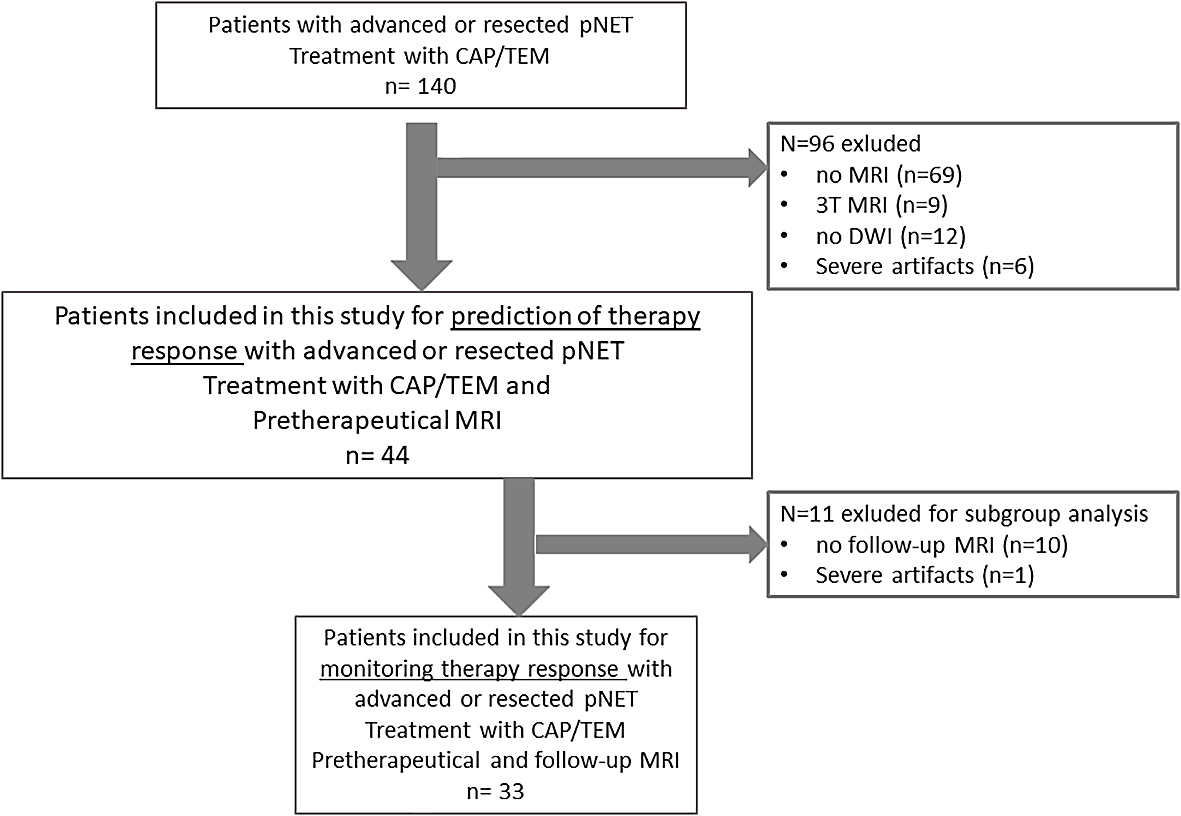
FIGURE 1.
Flow-chart of including process of patients.
CAP/TEM = capecitabine and temozolomide; DWI = diffusion-weighted imaging
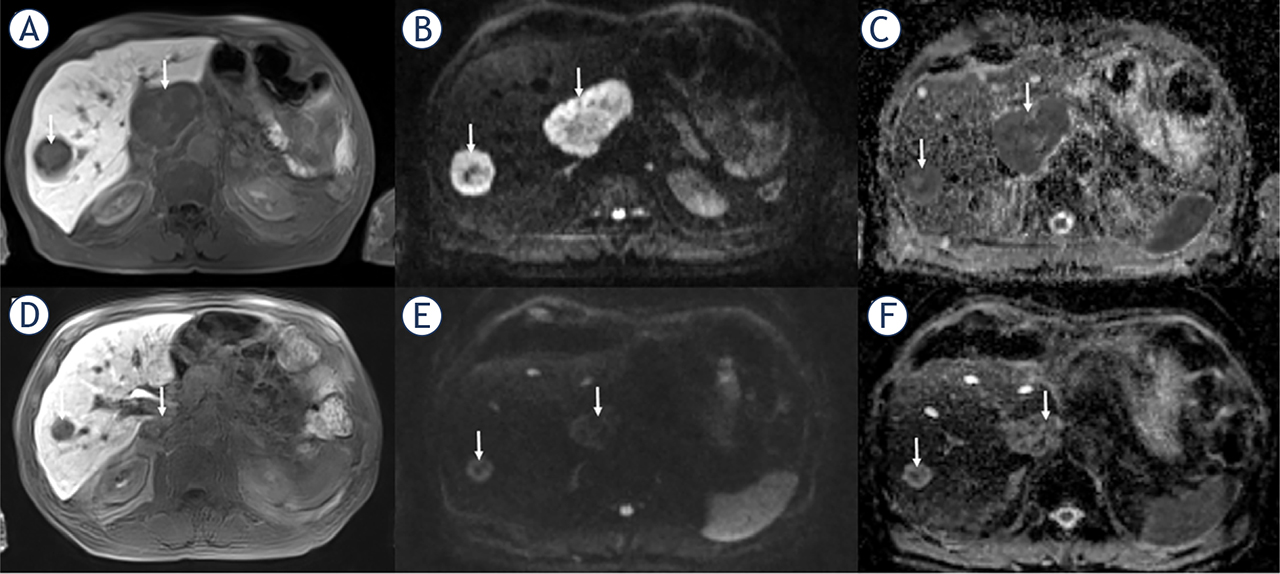
FIGURE 2.
A 72-year-old man with liver metastasis of pancreatic NET classified as responder with a PFS of 38 months. The baseline axial contrast-enhanced T1- weighted image (hepatobiliary phase) (A) shows hypointense lesions (arrows) in segment 8 and exophytic in segment 1. The metastases show (B) restricted diffusion (arrows) with high signal on axial DW-MR image b = 800 s/mm2 and dark signal (arrows) on ADC map (C). After initiation of CAPTEM, the metastases (arrows) exhibited a decrease in size (D) On the axial DW-MR image b = 800 s/mm2, the metastasis (arrow) (E) demonstrated less hyperintense signal to liver and predominantly hyperintense signal (circle) on the ADC map (F) indicating less restricted diffusion compared to the preinterventional image.
ADC = apparent diffusion coefficient; CAPTEM = capecitabine and temozolomide; DW-MR = diffusion-weighted magnetic resonance; NET = neuroendocrine tumor; PFS = progression-free survival; PR =partial remission; TARE = transarterial radioembolization
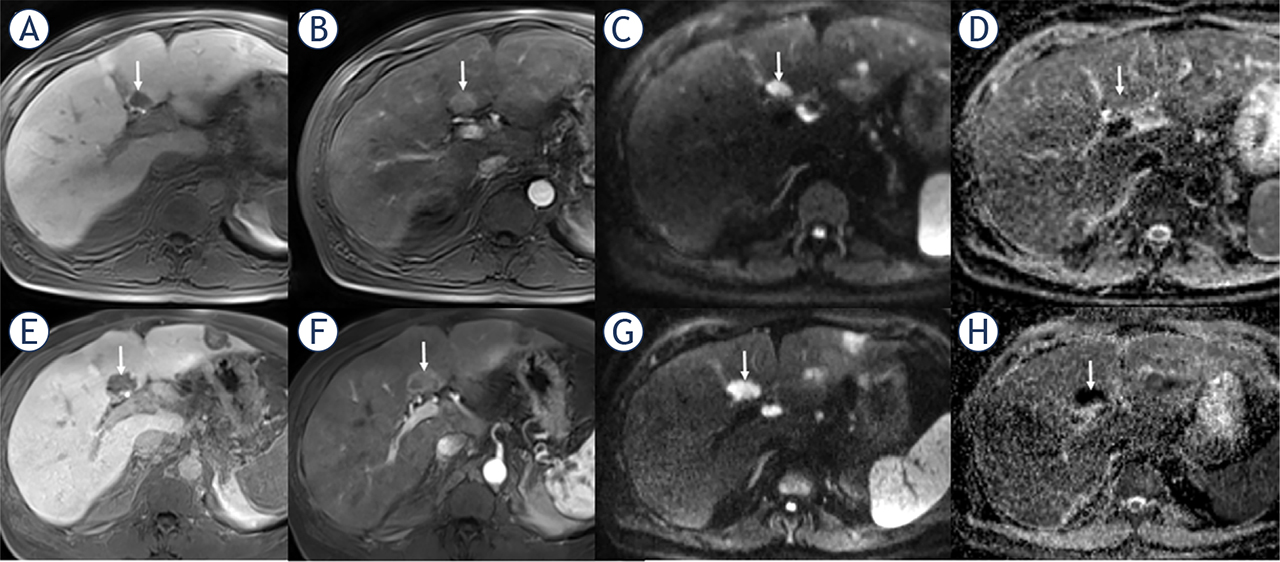
FIGURE 3.
A 56-year-old man with liver metastasis of pancreatic NET classified as nonresponder with a PFS of 3 months. The baseline axial contrast-enhanced T1- weighted image (hepatobiliary phase) (A) shows a hypointense lesion (arrow) in segment 4A. The metastasis shows a strong artrerial enhancement (B) and restricted diffusion (arrow) with high signal on axial DW-MR image b = 800 s/mm2 (C) and dark signal (arrow) on ADC map (D). After 3 months under CAPTEM, the metastasis (arrow) (E) exhibited an increase in size; however, it shows less arterial enhancement (F). On the axial DW-MR image b = 800 s/mm2, the metastasis (arrow) demonstrated hyperintense signal to liver and increasing hypointense signal on the ADC map indicating increasing restricted diffusion compared to the baseline image ADC, apparent diffusion coefficient.
ADC = apparent diffusion coefficient; CAPTEM = capecitabine and temozolomide; DW-MR = diffusion-weighted magnetic resonance; NET = neuroendocrine tumor; PFS = progression-free survival
TABLE 1.
Patients characteristics
| Baseline N = 44 | Follow-Up N = 33 | |
|---|---|---|
| Age (years) | 60.4 (50.5; 70.2) | |
| Males | 33 (75.0%) | |
| Time initial diagnosis – therapy start | 685 (199; 1230) | |
| Clinical parameter | ||
| Hepatic tumor burden (%) | 10 (5 ;40) | |
| CgA (ng/ml) | 610 (119; 2093) | 647 (261; 2357) |
| Bilirubin (mg/dl) | 0.6 (0.4; 0.8) | 0.7 (0.6; 0.9) |
| Grading | ||
| 1 | 1 (2.4%) | |
| 2 | 32 (76.2%) | |
| 3 | 6 (14.3%) | |
| NEC = 4 | 3 (7.1%) | |
| Ki-67 primary tumor (%) | 15 (8;20) | |
| Localization primary tumor | ||
| Pancreas | 37 (84.1%) | |
| Lung | 7 (15.9%) | |
| MRI parameter | ||
| NELM | ||
| Size (mm) | 28 (19;36) | 24.5 (18;38.5) |
| T1 non-contrast/T1 liver | 0.62 (0.53;0.68) | 0.68 (0.56;0.75) |
| T2/T2 liver | 1.63 (1.16;2.07) | 1.66 (1.21;2.17) |
| ADCmin | 448.5 (242.5;628.5) | 549 (341;848) |
| ADCmean | 903 (708.5;1069.5) | 969 (764;1250) |
| ADCmin/ADCmin liver | 0.80 (0.60;0.93) | 0.85 (0.51;1.32) |
| ADCmean/ADCmean liver | 0.82 (0.74;0.96) | 0.99 (0.65;1.32) |
| % arterial vascularization | 42.5 (15;80) | 22.5 (5;74.5)** |
| PNET | ||
| Size (mm) | 43 (32;70) | 43 (29.5;52) |
| T1 non-contrast /T1 pancreas | 0.63 (0.59;0.76) | 0.68 (0.61;0.84) |
| T2/T2 pancreas | 1.38 (0.85;1.67) | 1.08 (0.83;1.34) |
| ADCmin | 604.5 (237;648) | 628 (499.5;758.5) |
| ADCmean | 985 (810;1150) | 1042.5 (939;1167) |
| ADCmin/ADCmin pancreas | 0.69 (0.41;1.11) | 0.73 (0.58;0.85) |
| ADCmean/ADCmean pancreas | 1.01 (0.78;1.19) | 0.89 (0.72;0.97) |
| % arterial vascularization | 15 (10;80) | 7 (5;45) |
Data are given as median (25th and 75th percentile) or number (percentage);
ADC = apparent diffusion coefficient; CgA = chromogranin A; d = days; NEC = neuroendocrine cancer; NELM = neuroendocrine liver metastasis; PNET = pancreatic neuroendocrine tumor
TABLE 2.
Differences in baseline clinical and imaging tumor parameters between responder and non-responder
| Non-responder (< 6 months PFS) N = 23 | Responder (≥ 6 months PFS) N = 21 | p-value | |
|---|---|---|---|
| Age | 57.8 (44.1;71.1) | 61.7 (55.8;68.8) | 0.953 |
| Males | 16 (69.6%) | 17 (81.0%) | 0.494 |
| Time ID – Therapy start (d) | 851 (426;1552) | 396 (153;1004) | 0.115 |
| Clinical parameter | |||
| Hepatic tumor burden (%) | 5 (5;20) | 20 (10;40) | 0.007 |
| CgA | 592 (116;2031) | 616 (156.5;2745) | 0.706 |
| Bilirubin | 0.6 (0.4;0.8) | 0.6 (0.3;0.9) | 0.859 |
| Grading | 0.234 | ||
| 1 | 0 (0%) | 1 (5%) | |
| 2 | 15 (68.2%) | 17 (85%) | |
| 3 | 4 (18.2%) | 2 (10%) | |
| NEC = 4 | 3 (13.6%) | 0 (0%) | |
| Ki-67 primary tumor (%) | 16.5 (10;30) | 10.0 (5;15) | 0.013 |
| Localization primary tumor | 0.232 | ||
| Pancreas | 21 (91.3%) | 16 (76.2%) | |
| Lung | 2 (8.7%) | 5 (23.8%) | |
| MRI parameter | |||
| NELM | |||
| Size (mm) | 25.5 (17;33.5) | 29.8 (21.8;37.5) | 0.348 |
| T1 non-contrast/T1 liver | 0.60 (0.53;0.68) | 0.64 (0.54;0.74) | 0.263 |
| T2/T2 liver | 1.62 (1.2;2.07) | 1.69 (1.12;2.06) | 0.903 |
| ADCmin | 506 (228;639) | 424 (243;606) | 0.827 |
| ADCmean | 852.5 (674;1059) | 911 (790.5;1082.5) | 0.495 |
| ADCmin/ADCmin liver | 0.80 (0.63;0.93) | 0.74 (0.51;1.03) | 0.846 |
| ADCmean/ADCmean liver | 0.82 (0.68;0.93) | 0.86 (0.78;1.02) | 0.342 |
| % arterial vascularization | 45 (15;85) | 36.3 (15;72.5) | 0.494 |
| PNET | |||
| Size (mm) | 38 (30;44) | 75.5 (65;85.5) | 0.024 |
| T1 non-contrast /T1 pancreas | 0.60 (0.58;0.71) | 0.71 (0.63;0.8) | 0.258 |
| T2/T2 pancreas | 1.38 (0.84;1.67) | 1.38 (1.11;1.5) | 0.777 |
| ADCmin | 604.5 (237;648) | 527 (316.5;698) | 1.000 |
| ADCmean | 893 (789;1055) | 1084 (996.5;1256) | 0.157 |
| ADCmin/ADCmin pancreas | 0.79 (0.41;1.18) | 0.63 (0.44;0.8) | 0.480 |
| ADCmean/ADCmean pancreas | 1.09 (0.66;1.31) | 0.97 (0.96;1.1) | 0.888 |
| % arterial vascularization | 10 (5;70) | 65 (30;85) | 0.130 |
[i] Data are given as median (25th and 75th percentile); p-values are from Wilcoxon rank-sum (Mann-Whitney) test or Fisher’s exact test; ADC = apparent diffusion coefficient; CgA = chromogranin A; NELM = neuroendocrine liver metastasis; PFS = progression-free survival; PNET = pancreatic neuroendocrine tumor
TABLE 3.
Differences in change of clinical and imaging tumor parameters between responder and non-responder
| Change between baseline and follow-up (%) | Non-responder (< 6 months PFS) N = 17 | Responder (≥ 6 months PFS) N = 16 | p-value |
|---|---|---|---|
| Clinical parameter | |||
| CgA | 61.2 (−8.3;251.9) | −1.5 (−69.3;19) | 0.036 |
| Bilirubin | 0 (−20;40) | 8.3 (−15.3;133.3) | 0.312 |
| MRI parameter | |||
| NELM | |||
| Size (mm) | 20 (−4.7;50) | −8.0 (−20.1;2.2) | 0.038 |
| T1 non-contrast/T1 liver | 5.4 (−3.8;32.6) | −6.8 (−13.6;11.2) | 0.078 |
| T2/T2 liver | 1.6 (−9.2;24.1) | −5.7 (−26.2;32.8) | 0.589 |
| ADCmin | −22.8 (−41.1;40.2) | 49.7 (−6.7;146.4) | 0.037 |
| ADCmean | −3.5 (−18.4;14.1) | 11.7 (−3.4;75.4) | 0.056 |
| ADCmin/ADCmin liver | −32.3 (−46.2;70.8) | 47.5 (12.7;251.7) | 0.113 |
| ADCmean/ADCmean liver | −16.3 (−30.6;6.9) | 30.0 (6.9;90.4) | 0.011 |
| % arterial vascularization | −16.7 (−75; −5.9) | −16.7 (−50.0;11.8) | 0.298 |
| PNET | |||
| Size (mm) | 2.3 (−5.4;20) | −55 (−60; −17.8) | 0.013 |
| T1 non-contrast /T1 pancreas | 7.4 (−3.8;36.7) | −5 (−19.7;1.9) | 0.116 |
| T2/T2 pancreas | −16.6 (−22;1.2) | −36.1 (−40.3; −10.1) | 0.229 |
| ADCmin | 14.4 (−13.7;260.8) | 18.7 (−33.2;48.9) | 0.782 |
| ADCmean | 8.3 (−4.5;29.3) | 4.0 (−26.3;4.6) | 0.405 |
| ADCmin/ADCmin pancreas | −3.6 (−29;76.6) | 53 (−18.4;80.9) | 0.518 |
| ADCmean/ADCmean pancreas | −23.2 (−35.5;4.5) | −5.7 (−14.3;0.2) | 0.518 |
| % arterial vascularization | −50 (−80;0) | −50 (−80;0) | 0.851 |
[i] Data are given as median (25th and 75th percentile); p-values are from Wilcoxon rank-sum (Mann-Whitney) test; ADC = apparent diffusion coefficient; CgA = chromogranin A; NELM = neuroendocrine liver metastasis; PFS = progression-free survival; PNET = pancreatic neuroendocrine tumor
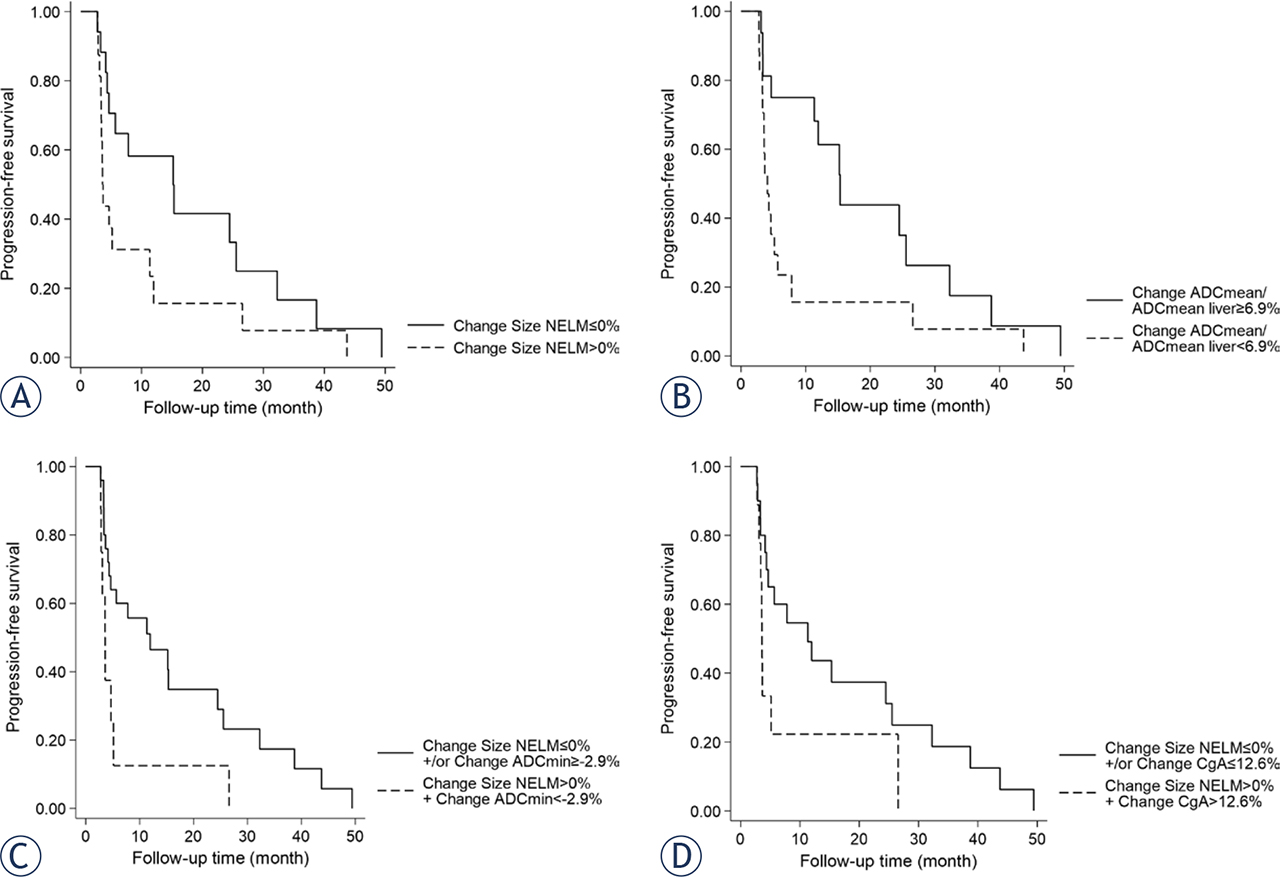
FIGURE 4.
(A) Survival analysis for ∆ size of NELM with a cut-off of ≤ 0% for responder. This cut-off revealed a slightly longer median PFS time of 12.2 vs. 3.6 month (p = 0.062). (B) The median cut-off for ∆ ADCmean/ADCmean liver showed a significantly longer median PFS time of 15.3 compared to 4.1 month (p = 0.024). Both the combination of ∆ size of NELM > 0% and ∆ ADCmin < − 2.9% and the combination of ∆ size of NELM > 0% and ∆ CgA > 12.6% could differentiate patients with a longer median PFS time. Median PFS of the group with ∆ size of NELM > 0% and ∆ ADCmin < −2.9% was 3.6 m compared to 12 months (p = 0.021) in the group not fulfilling these criteria or a maximum of one criterion. Median PFS of the group with ∆ size of NELM > 0% and ∆ CgA > 12.6% was 3.6 m compared to 11.3 months (p = 0.072) in the group not fulfilling these criteria or a maximum of one criterium.
ADC = apparent diffusion coefficient; CgA = chromogranin A; NELM = neuroendocrine liver metastasis; PFS = progression-free survival
TABLE 4.
ROC analysis of the previously selected imaging and clinical parameters
| AUC | Cut-off (Median) | Sensitivity (%) | Specificity (%) | Youden-Index | |
|---|---|---|---|---|---|
| Ki-67% | 0.72 | > 15 | 69 | 59 | 0.28 |
| Hepatic tumor burden | 0.73 | < 10 | 84 | 72 | 0.56 |
| ∆ CgA | 0.73 | > 12.6 | 67 | 64 | 0.31 |
| ∆Size NELM | 0.71 | > 0 | 69 | 65 | 0.34 |
| ∆ Size PNET | - | > −2.7 | 100 | 50 | 0.50 |
| ∆ ADCmin | 0.71 | < −2.9 | 65 | 63 | 0.28 |
| ∆ ADCmean/ADCmean liver | 0.76 | < 6.9 | 76 | 75 | 0.51 |
| ∆ Size NELM+ ∆ CgA | 0.79 | > 0/> 12.6 | 78 | 60 | 0.38 |
| ∆ Size NELM+ ∆ ADCmin | 0.70 | > 0/< −2.9 | 88 | 60 | 0.48 |
| ∆ Size NELM+ ∆ ADCmean/ ADCmean liver | 0.77 | > 0/< 6.9 | 78 | 58 | 0.36 |
[i] All p > 0.05; ADC = apparent diffusion coefficient; AUC = area under the curve; CgA = chromogranin A; NELM = neuroendocrine liver metastasis; PNET = pancreatic neuroendocrine tumor