
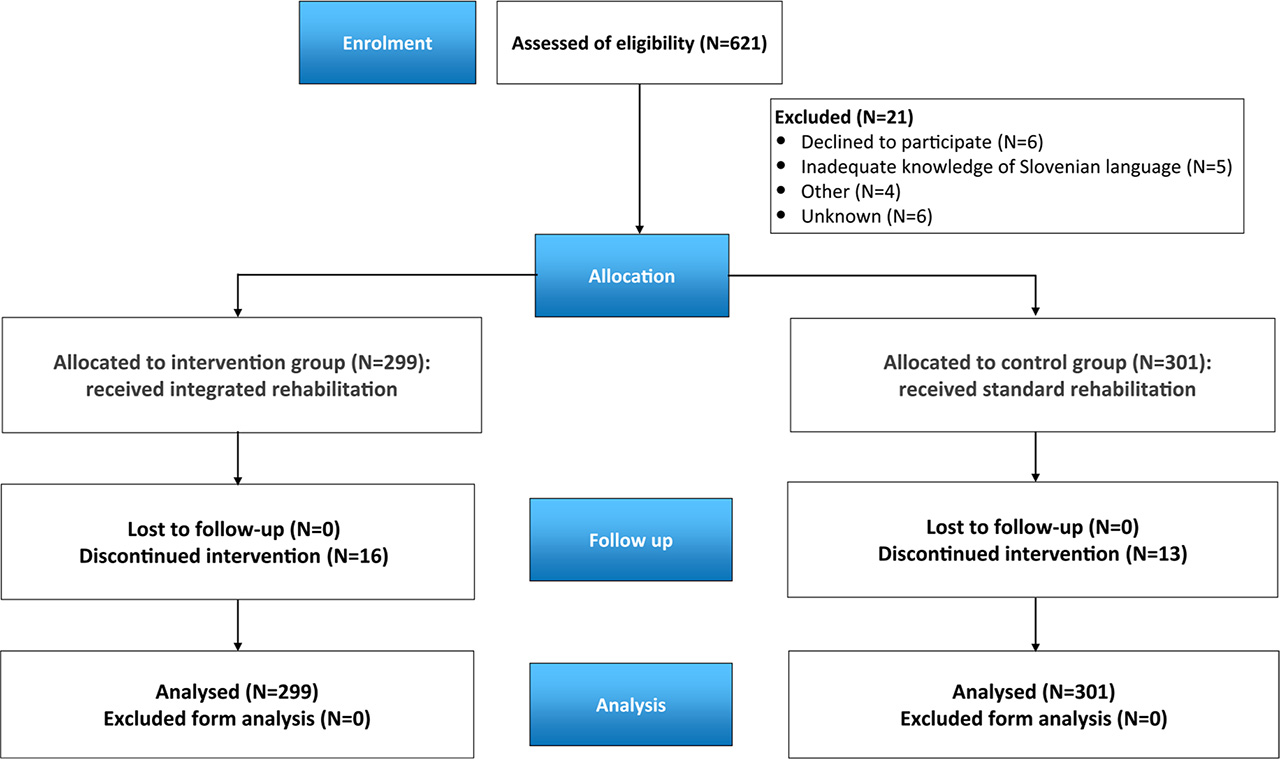
FIGURE 1.
A flowchart of patients’ inclusion in our study.
TABLE 1.
Demographic and clinical characteristics of patients, pathological characteristics of tumors and treatment. P-value refers to difference between control and intervention group; it is calculated by t-test in case of comparing means and by chi-squared test in case of counts
| Factor | Subgroup | All patients (N = 600) | Control group (N = 301) | Intervention group (N = 299) | P-value |
|---|---|---|---|---|---|
| Mean age of patients (years) | 50.78 | 50.59 | 50.97 | 0.601 | |
| Living areas | Urban | 287 | 125 | 162 | 0.003 |
| Suburban | 105 | 53 | 52 | ||
| Rural | 208 | 123 | 85 | ||
| Education (N = 599) | Primary school | 66 | 39 | 27 | 0.290 |
| Secondary school | 242 | 117 | 125 | ||
| Higher | 291 | 144 | 147 | ||
| Socioeconomic status | Low | 71 | 36 | 35 | 0.940 |
| Middle | 432 | 217 | 215 | ||
| Higher | 95 | 46 | 49 | ||
| With whom they live (N = 597) | Alone | 58 | 24 | 34 | 0.600 |
| With partner only | 145 | 71 | 74 | ||
| Partner and children | 289 | 147 | 142 | ||
| With children only | 42 | 22 | 20 | ||
| Other | 63 | 35 | 28 | ||
| Employment (N = 581) | Unemployed | 54 | 35 | 19 | 0.067 |
| Employed | 433 | 209 | 224 | ||
| Retired | 94 | 45 | 49 | ||
| Mean primary tumor size (mm) | 26.3 | 25.5 | 27.2 | 0.285 | |
| Tumor stage | In situ | 10 | 5 | 5 | 0.152 |
| I | 260 | 133 | 127 | ||
| II | 214 | 97 | 117 | ||
| III | 81 | 50 | 31 | ||
| IV | 35 | 16 | 19 | ||
| Concomitant diseases | No | 301 | 154 | 147 | 0.624 |
| Yes | 299 | 147 | 152 | ||
| Neoadjuvant chemotherapy and/or anti-HER-2 therapy | No | 465 | 227 | 237 | 0.241 |
| Yes | 135 | 74 | 61 | ||
| Breast surgery | Mastectomy | 252 | 135 | 117 | 0.357 |
| Tumorectomy | 326 | 156 | 170 | ||
| No surgery | 22 | 10 | 12 | ||
| Lymph node surgery | Lymphadenectomy | 151 | 83 | 86 | 0.337 |
| Sentinel node biopsy | 417 | 204 | 213 | ||
| No surgery | 32 | 14 | 18 | ||
| Breast reconstruction | No | 431 | 214 | 217 | 0.402 |
| Tissue expander | 127 | 69 | 58 | ||
| Free-flap | 42 | 18 | 24 | ||
| Breast external beam radiotherapy | No | 149 | 83 | 66 | 0.131 |
| Yes | 451 | 218 | 233 | ||
| Chemotherapy | No | 280 | 137 | 143 | 0.623 |
| Yes | 320 | 164 | 156 | ||
| Anti-HER2 therapy | No | 522 | 264 | 258 | 0.629 |
| Yes | 78 | 37 | 41 | ||
| Hormone therapy | No | 132 | 69 | 63 | 0.623 |
| Yes | 468 | 232 | 236 |
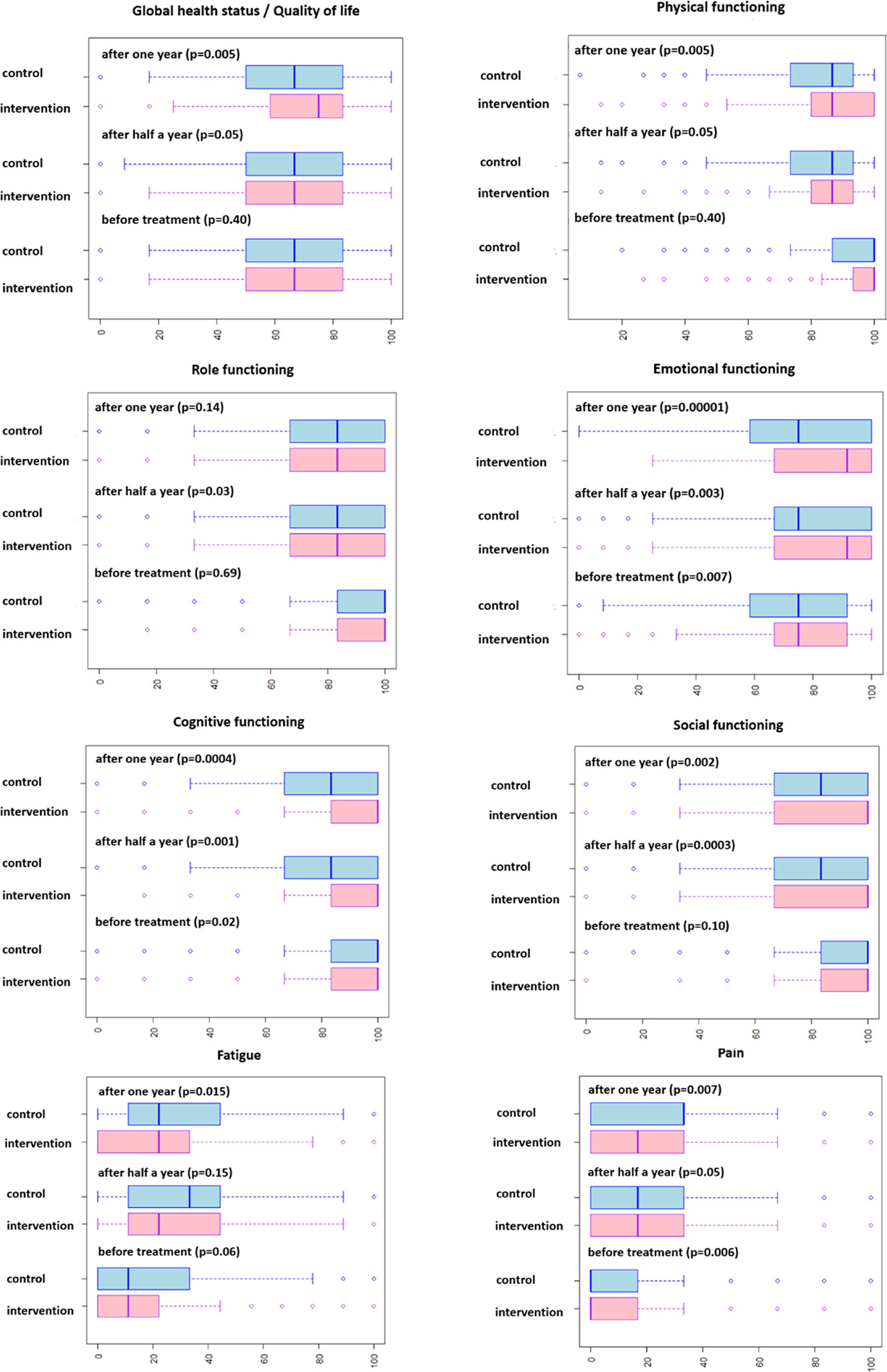
FIGURE 2.
Data and statistical analysis from EORTC C30 questionnaires about the global health quality of life scale, physical, role, emotional, cognitive, and social function scale, symptom scales about fatigue, pain and insomnia in the intervention and control group of patients before treatment, half a year, and a year after the beginning of treatment.
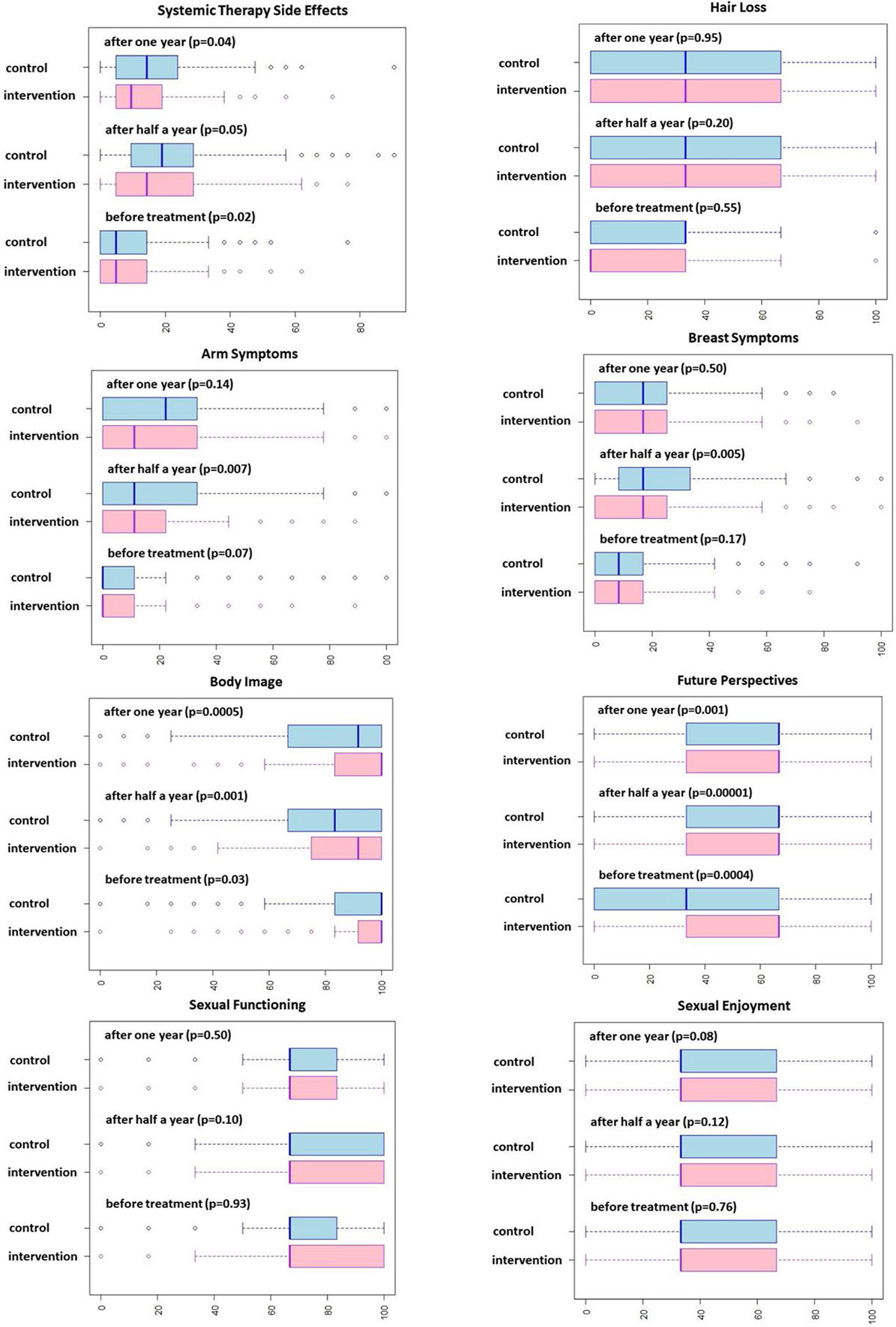
FIGURE 3.
Data and statistical analysis from EORTC BR23 questionnaires.
TABLE 2.
Mean values of psychological factors and pain reported by patients before, half a year and one year after the beginning of treatment
| Factor | Time of assessment | Group | Mean value | Standard deviation | p-value |
|---|---|---|---|---|---|
| Depression level | Before therapy | Control | 4.2 | 2.8 | 0.013 |
| Intervention | 3.6 | 2.5 | |||
| After half year | Control | 3.0 | 2.4 | < 0.001 | |
| Intervention | 2.2 | 1.7 | |||
| After one year | Control | 3.2 | 2.4 | < 0.001 | |
| Intervention | 2.3 | 1.9 | |||
| Anxiety level | Before treatment | Control | 4.2 | 2.7 | 0.041 |
| Intervention | 3.8 | 2.6 | |||
| After half year | Control | 3.2 | 2.5 | < 0.001 | |
| Intervention | 2.4 | 1.8 | |||
| After one year | Control | 3.5 | 2.6 | < 0.001 | |
| Intervention | 2.6 | 2.0 | |||
| Level of difficulty concentrating | Before treatment | Control | 3.2 | 2.5 | 0.96 |
| Intervention | 3.1 | 2.3 | |||
| After half year | Control | 3.2 | 2.4 | 0.02 | |
| Intervention | 2.8 | 2.1 | |||
| After one year | Control | 3.6 | 2.4 | < 0.001 | |
| Intervention | 2.7 | 2.1 | |||
| Constant fatigue | Before treatment | Control | 3.2 | 2.4 | 0.59 |
| Intervention | 3.1 | 2.2 | |||
| After half year | Control | 3.8 | 2.6 | 0.018 | |
| Intervention | 3.3 | 2.4 | |||
| After one year | Control | 4.0 | 2.7 | 0.001 | |
| Intervention | 3.3 | 2.3 | |||
| Disturbing fatigue | Before treatment | Control | 2.8 | 2.3 | 0.50 |
| Intervention | 2.9 | 2.2 | |||
| After half year | Control | 3.9 | 2.5 | 0.003 | |
| Intervention | 3.3 | 2.3 | |||
| After one year | Control | 3.8 | 2.5 | < 0.001 | |
| Intervention | 3.2 | 2.2 | |||
| Insomnia | Before treatment | Control | 4.2 | 3.0 | 0.22 |
| Intervention | 3.9 | 2.8 | |||
| After half year | Control | 4.8 | 3.0 | 0.002 | |
| Intervention | 4.0 | 2.7 | |||
| After one year | Control | 4.8 | 3.0 | < 0.001 | |
| Intervention | 3.9 | 2.9 | |||
| Pain | Before treatment | Control | 2.8 | 2.4 | 0.005 |
| Intervention | 2.3 | 2.0 | |||
| After half year | Control | 3.4 | 2.4 | 0.006 | |
| Intervention | 2.9 | 2.1 | |||
| After one year | Control | 3.7 | 2.5 | < 0.001 | |
| Intervention | 2.7 | 1.8 |
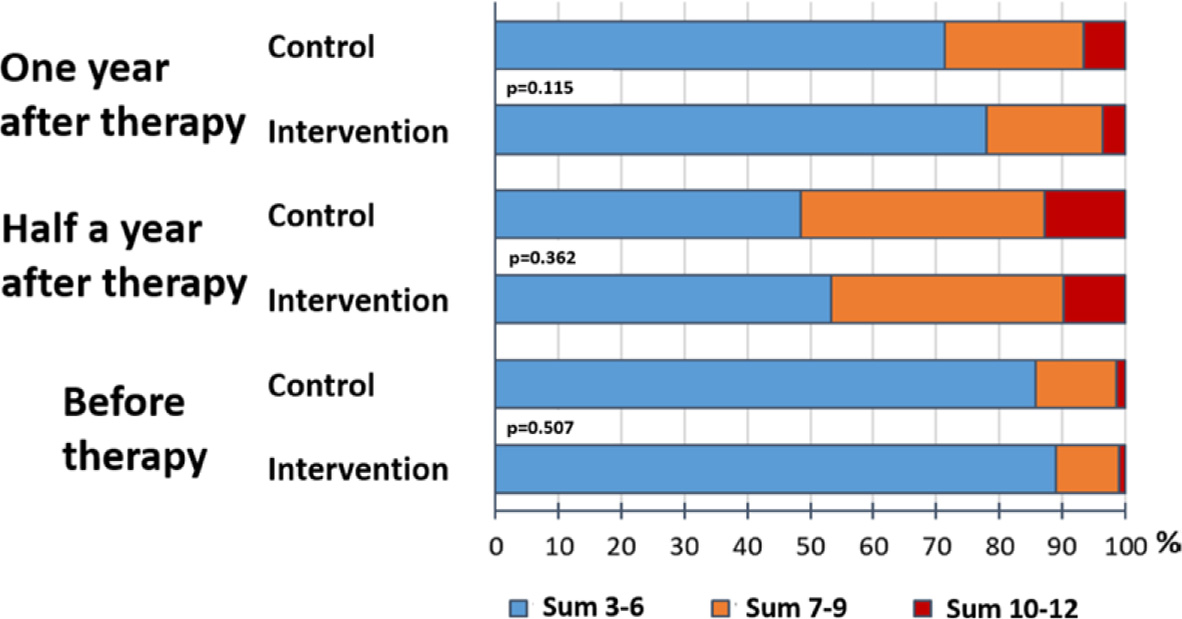
FIGURE 4.
The sum of responses to EORTC questions 10, 12 and 18 in the intervention and control groups before, half a year, and a year after treatment.
TABLE 3.
The influence of each individual variable on fatigue (univariate models) by individual logistic regressions before treatment, half a year and one year after the beginning of treatment. OR – odds ratio; CI – confidence interval
| Before treatment | OR | 95% CI | p-value |
| Control group | 1.3 | 0.8–2.2 | 0.245 |
| Half a year after the beginning of treatment | OR | 95% CI | p-value |
| Control group | 1.3 | 0.9–1.9 | 0.114 |
| Age group 45–54 years | 1.0 | 0.7–1.6 | 0.855 |
| Age group 55–64 years | 0.9 | 0.6–1.5 | 0.803 |
| Chemotherapy – yes | 1.3 | 0.9–1.9 | 0.135 |
| Hormonal therapy – yes | 0.9 | 0.6–1.4 | 0.689 |
| Radiotherapy – yes | 0.8 | 0.5–1.3 | 0.364 |
| Neoadjuvant chemotherapy and/or anti-HER2 therapy | 1.3 | 0.9–1.9 | 0.227 |
| Surgery – not done | 1.7 | 0.6–4.4 | 0.308 |
| Surgery – Tumorectomy – yes | 1.3 | 0.9–1.8 | 0.208 |
| Axillary lymphadenectomy – yes | 0.7 | 0.5–1.1 | 0.162 |
| Breast reconstruction – yes | 0.8 | 0.5–1.2 | 0.256 |
| Presence of distant metastases | 1.4 | 0.7–2.8 | 0.403 |
| A year after the beginning of treatment | OR | 95% CI | p-value |
| Control group | 1.5 | 1.0–2.2 | 0.046 |
| Age group 45–54 years | 1.2 | 0.8–2.0 | 0.387 |
| Age group 55–64 years | 0.6 | 0.4–1.0 | 0.064 |
| Chemotherapy – yes | 1.4 | 0.8–1.7 | 0.493 |
| Hormonal therapy – yes | 1.3 | 0.8–2.2 | 0.246 |
| Radiotherapy – yes | 0.7 | 0.5–1.2 | 0.191 |
| Neoadjuvant chemotherapy and/or anti-HER2 therapy | 1.2 | 0.8–1.9 | 0.347 |
| Surgery – not done | 1.7 | 0.5–5.2 | 0.371 |
| Surgery – Tumorectomy – yes | 1.1 | 0.7–1.6 | 0.961 |
| Axillary lymphadenectomy – yes | 0.7 | 0.5–1.1 | 0.161 |
| Breast reconstruction – yes | 0.9 | 0.6–1.3 | 0.454 |
| Presence of distant metastases | 1.8 | 0.8–4.0 | 0.130 |
TABLE 4.
The influence of all included variables simultaneously on fatigue half a year and a year after the beginning of treatment
| Half a year after treatment | One year after treatment | |||||
|---|---|---|---|---|---|---|
| OR | 95% CI | p-value | OR | 95% CI | p-value | |
| Control group | 1.4 | 0.9–2.0 | 0.100 | 1.5 | 1.0–2.2 | 0.044 |
| Age group 45–54 years | 1.1 | 0.7–1.7 | 0.822 | 1.1 | 0.7–1.9 | 0.617 |
| Age group 55–64 years | 1.0 | 0.6–1.6 | 0.931 | 0.6 | 0.3–1.0 | 0.052 |
| Chemotherapy – yes | 1.6 | 1.1–2.5 | 0.025 | 1.3 | 0.9–2.1 | 0.206 |
| Hormonal therapy – yes | 1.1 | 0.7–1.8 | 0.616 | 1.6 | 0.9–2.6 | 0.088 |
| Radiotherapy – yes | 0.7 | 0.4–1.2 | 0.196 | 0.7 | 0.4–1.3 | 0.277 |
| Surgery – not done | 1.2 | 0.3–4.4 | 0.745 | 0.9 | 0.2–3.9 | 0.879 |
| Surgery – Tumorectomy – yes | 1.6 | 0.9–2.6 | 0.080 | 1.4 | 0.8–2.4 | 0.256 |
| Axillary lymphadenectomy – yes | 0.7 | 0.4–1.2 | 0.232 | 0.7 | 0.4–1.2 | 0.148 |
| Presence of distant metastases | 1.4 | 0.5–3.7 | 0.491 | 2.1 | 0.8–5.9 | 0.145 |
[i] OR = odds ratio; CI = confidence interval