
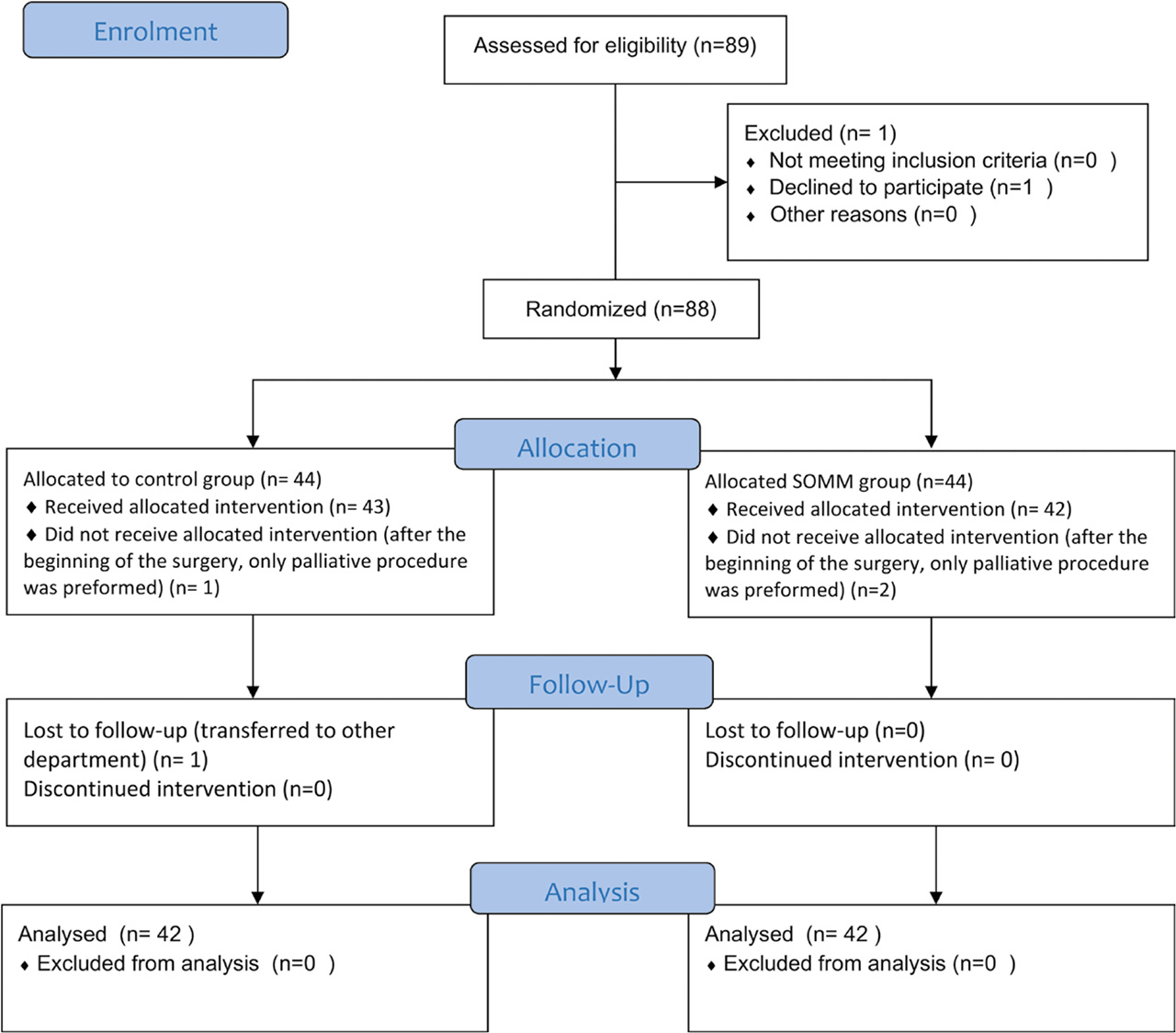
FIGURE 1.
Consort diagram of the study.
TABLE 1.
Intraoperative fluid management
| Control group Median (interquartile range) ml | Protocol group Median (interquartile range) ml | P-value (Mann – Whitney U test) | |
|---|---|---|---|
| Intraoperative blood loss | 300 (425) | 500 (500) | 0.182 |
| RBC transfusion | 0 (0) | 0 (0) | 0.185 |
| FFP transfusion | 0 (0) | 0 (0) | 1 |
| Platelet transfusion | 0 (0) | 0 (0) | 0.317 |
| Intraoperative fluid balance | +375 (438) | +1300 (1063) | 0.0001 |
| Intraoperative urinary output | 205 (100) | 300 (200) | 0.078 |
[i] 1 = shows statistically significant difference; FFP = fresh frozen plasma; RBC = red blood cell
TABLE 2.
Intraoperative observations and interventions
| Control group (Number of patients out of 42 with a certain observation/intervention) | Protocol group (Number of patients out of 42 with a certain observation/intervention) | P-value | |
|---|---|---|---|
| Bolus of phenylephrine during procedure | 31 | 38 | 0.0431,2 |
| Vasoactive support with norepinephrine | 1 | 2 | 0.5003 |
| Mean arterial pressure less than 70mmHg at any time during the procedure | 31 | 36 | 0.2262 |
| Mean arterial pressure less than 50mmHg at any time during the procedure | 7 | 8 | 0.3532 |
TABLE 3.
Comparison of length of stay
| Control group Median (Interquartile range) days | Protocol group Median (Interquartile range) days | P-value (Mann – Whitney U test) | |
|---|---|---|---|
| Longest stay in the hospital | 9 (8) | 9 (5.5) | 0.851 |
| Duration of stay in the HDU | 4 (3) | 3 (1.3) | 0.122 |
[i] HDU = high-depense unit
TABLE 4.
List of postoperative complications in the first three days after the procedure in both groups
| Postoperative complication/intervention | Control group (Number of patients out of 42 with a certain observation/intervention) | Protocol group (Number of patients out of 42 with a certain observation/intervention) | Value P* |
|---|---|---|---|
| Readmission to the HDU | 5 | 1 | 0.1361 |
| Admission to the ICU | 2 | 0 | 0.2472 |
| Revision surgery | 6 | 0 | 0.0261 |
| The patient has died before discharge | 1 | 0 | 0.5002 |
| Complications related to the operative procedure (dehiscence, inflammation) first day after the procedure | 0 | 2 | 0.4942 |
| Complications related to the operative procedure (dehiscence, inflammation) third day after the procedure | 3 | 2 | 12 |
| RBC transfusion needed on the first day after the procedure | 2 | 0 | 0.5132 |
| RBC transfusion required the second or third day after the procedure. | 1 | 2 | 0.5002 |
| Acute kidney disease | 3 | 4 | 0,5002 |
| Troponin leak | 0 | 3 | 0,2412 |
| Median level of C-reactive protein (difference between highest postoperative level in 3 days and preoperative level) Laboratory reference range (0–5 mcg/L) | 125 (118) | 115 (122) | 0.1063 |
| Median level of procalcitonin (highest postoperative value in the first 3 days) Laboratory reference range (0–0.50 mcg/L) | 0.75 (3.19) | 0.3 (0.88) | 0.0013 |
Due to multiple comparisons, the significance of the p-value was adjusted accordingly to the Bonferroni correction (significant p value for the variables in the table was < 0.001);
HDU = high-depence unit; ICU = intensive care unit; RBC = red blood cell