
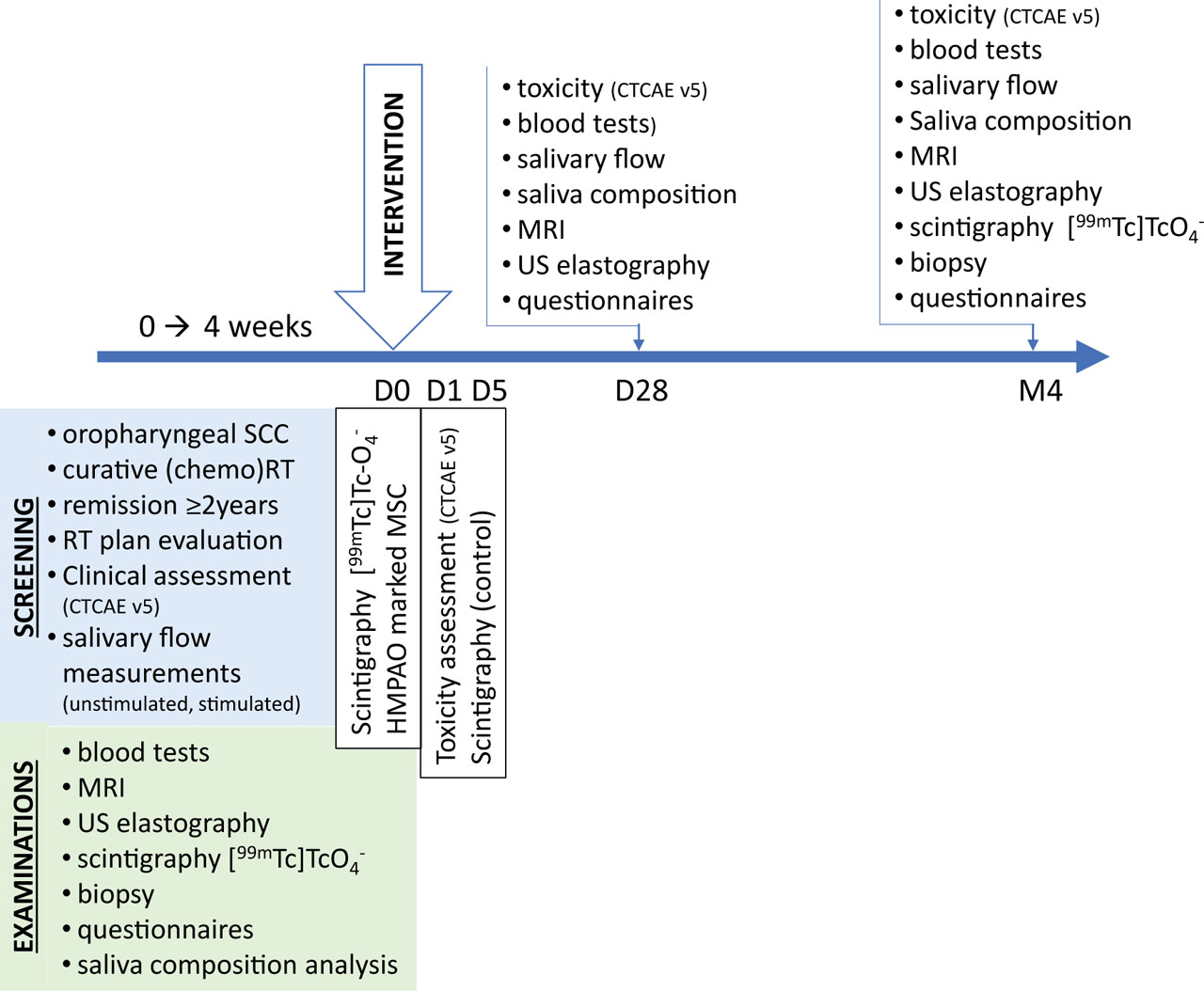
FIGURE 1.
Design of the clinical trial.
CTCAE v5 = Common Terminology Criteria for Adverse Events version 5.0; MRI = magnetic resonance imaging; MSC = allogeneic mesenchymal stromal stem cells; RT = radiotherapy; SCC = squamous cell carcinoma; US = ultrasound; [99mTc]HMPAO = Technetium 99m-hexamethylpropyleneamine oxime; [99mTc]TcO4 = Technetium 99m-pertechnetate
TABLE 1.
Primary and secondary objectives of the study
| Objective | Definition of objective | Time of evaluation |
|---|---|---|
| Primary | ||
| Evaluation of the safety of administration of allogeneic MSCs | Adverse event assessment (CTCAE v.5 criteria): pain at application site, mouth sensation, infection | From the start of therapy to the last follow-up (days 1, 5, 28, and 120) |
| Secondary | ||
| Efficacy of the procedure | Measurement of unstimulated/stimulated salivary flow and saliva composition | During recruitment, day 28 and 120 post-procedure |
| Assessment of subjective degree of xerostomia (questionnaires) | During recruitment, days 28 and 120 after the procedure | |
| Immediately after the procedure (day 0) | ||
| Scintigraphic evaluation of grafting, retention, and migration of allogeneic MSCs | During recruitment, on days 28 and 120 after the procedure | |
| Assessment of patients’ quality of life | ||
| Radiological changes of the salivary tissue | Magnetic resonance imaging (MRI): volume, signal, and diffusivity changes | During recruitment, on days 28 and 120 after procedure |
| Ultrasonography (US): consistency (firmness) | ||
| Functional changes of the salivary tissue | Scintigraphy with ([99mTc]TcO4− (pertechnetate): uptake of radioisotope in parenchyma, ejection fraction | During recruitment, on days 28 and 120 after procedure |
| Morphological changes of the salivary tissue | Core needle biopsy specimens: composition, inflammatory infiltrate, metaplasia, reactive changes | During recruitment, on day 120 after the procedure |
[i] CTCAE v.5 = Common Terminology Criteria for Adverse Events version 5.0; MSCs = allogeneic mesenchymal stromal stem cells
TABLE 2.
Inclusion and exclusion criteria
| Inclusion criteria | Exclusion criteria |
|---|---|
| Squamous cell carcinoma of the oropharynx, UICC TNM (8th ed.) stage cT1–2N+ or cT3–4cN0–3 M0, treated with curative intent RT (TD 66–70 Gy, bilateral neck irradiation) with or without concurrent chemotherapy | Newly diagnosed malignant tumor anywhere in the body within the last two years |
| Two years or more after treatment with no evidence of locoregional recurrence or systemic metastasis | Active smoker |
| Nonsmoker or former smoker (quit smoking ≥ 2 years ago) | Use of xerogenic medications (e.g., tricyclic antidepressants, antipsychotics, decongestants, bronchodilators, antihypertensive agents such as beta blockers and diuretics, antihistamines, hypnotic sedatives, opioids, and muscle relaxants) |
| Mean radiation dose > 26 Gy to each of the parotid glands and > 35 Gy to each of the submandibular glands | Other salivary gland disorders (e.g., Sjoegren's syndrome, scleroderma, sialolithiasis, etc.) |
| Grade 2 or 3 xerostomia as assessed by the CTCAE v5.0 scale | Patients receiving anticoagulant therapy that cannot be discontinued during the procedure |
| Clinically decreased salivation and hyposalivation (unstimulated total salivary flow of 0.05–0.20 ml/min) | Pregnancy or planned pregnancy within the next two years |
| Age between 18–75 years | Breastfeeding |
| Both sexes | Active, uncontrolled infection |
| Signed “Informed Consent Form” to participate in the study | Other medical (including psychiatric) conditions that, in the opinion of the investigators, preclude safe administration of the planned therapy and completion of follow-up visits |
| Known substance abuse or alcoholism |
[i] CTCAE v.5 = Common Terminology Criteria for Adverse Events version 5.0; RT = radiotherapy: TD = tumor doses; UICC = Union for International Cancer Control
TABLE 3.
Procedures of the study
| Procedures | Inclusion | Intervention | Follow-up examinations | |||
|---|---|---|---|---|---|---|
| W4→0 | D0 | D1 | D5 | D28 | D120 | |
| Patient screening with clinical and objective evaluation of xerostomia1 | X | |||||
| Complete blood count, biochemistry | X | X | X | |||
| Coagulation profile | X | |||||
| Measurement of unstimulated and stimulated salivary flow rate | X | X | X | |||
| Determination of salivary composition | X | X | X | |||
| Magnetic resonance imaging | X | X | X | |||
| US elastography | X | X | X | |||
| Scintigraphy with [99mTc]Tc-HMPAO labeled MSCs | X | |||||
| Scintigraphy with ([99mTc]TcO4−) | X | X | ||||
| Core needle biopsy of the gland2 | X | X | ||||
| Visual Analog Scale questionnaire | X | X | X | |||
| Xerostomia Questionnaire | X | X | X | |||
| EORTC QLQ-H&N35 | X | X | X | |||
| Toxicity assessment, CTCAE v.5 | X | X | X | X | X | |
CTCAE v.5 = Common Terminology Criteria for Adverse Events version 5.0; D = day; EORTC QLQ-H&N35 = European Organisation for Research and Treatment of Cancer Quality of Life Questionnaire Head and Neck Module; MSCs = allogeneic mesenchymal stromal stem cells; US = ultrasound; W = week; [99mTc]HMPAO = Technetium 99m-hexamethylpropyleneamine oxime; [99mTc]TcO4− = Technetium 99m-pertechnetate
1 Inclusion criteria, see Table 2.