
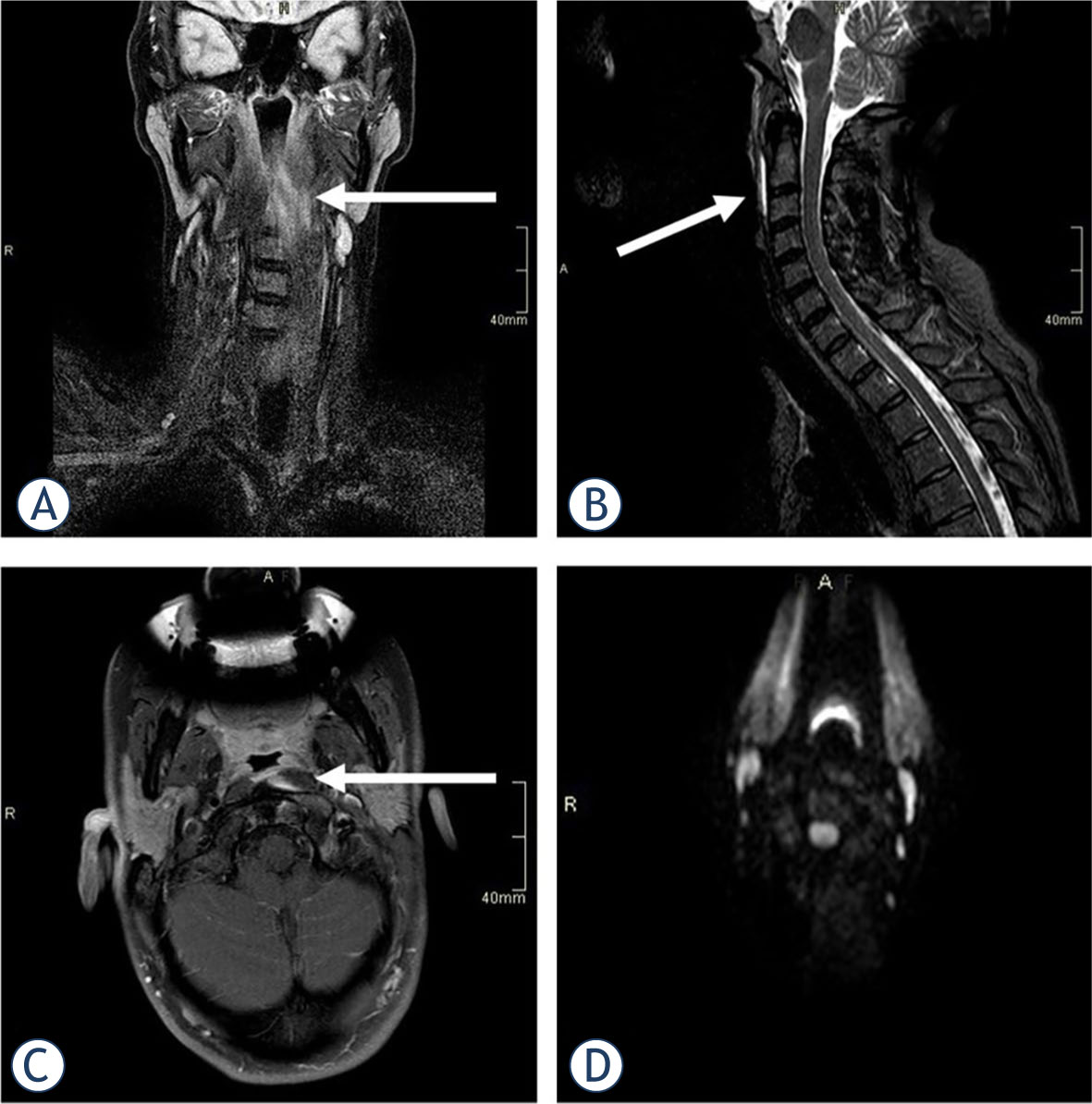
FIGURE 1.
MRI in a 40-year-old female showed short tau inversion recovery sequence (STIR) hyperintensity in the upper part of her left Longus colli muscle, suggesting an oedema (A), with thin prevertebral effusion on sagittal images (B). After intravenous gadolinium contrast injection, a small area of enhancement was observed in the medial aspect of the muscle (C), but no peripherally enhancing collection to suggest an abscess was present. Diffusion-weighted imaging was normal, excluding the presence of pus (D).
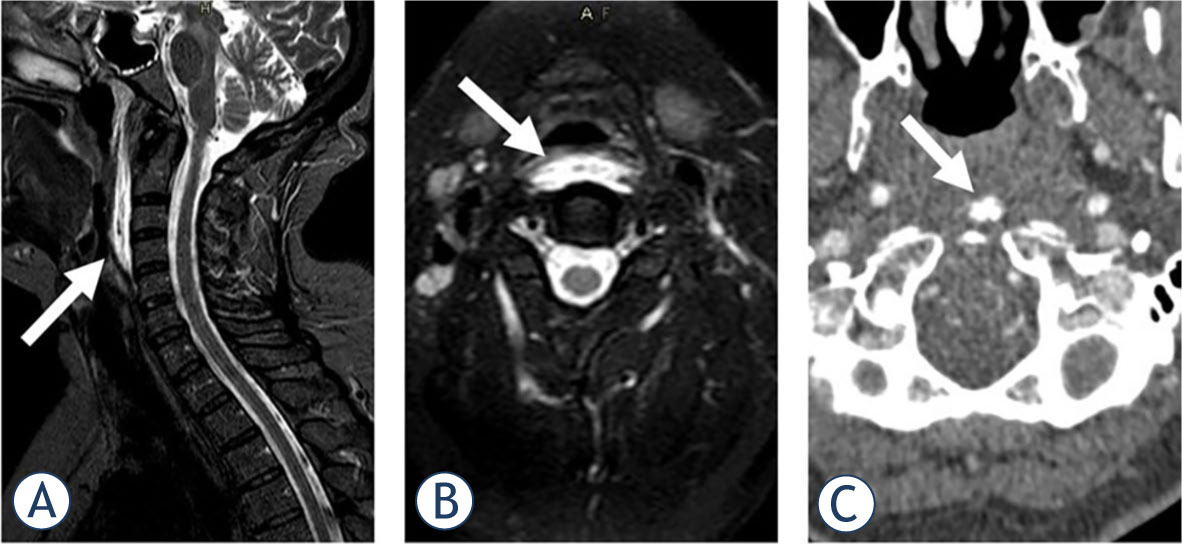
FIGURE 2.
STIR (short tau inversion recovery) imaging in sagittal (A) and axial (B) plane demonstrated prevertebral soft tissue swelling and oedema in a 51-year-old female, suggesting retropharyngeal calcific tendinitis as the underlying cause. Calcifications in the medial aspect of the longus colli muscle in front of the C1 arc were noted on computed tomography angiography (CTA) (C), confirming the diagnosis.
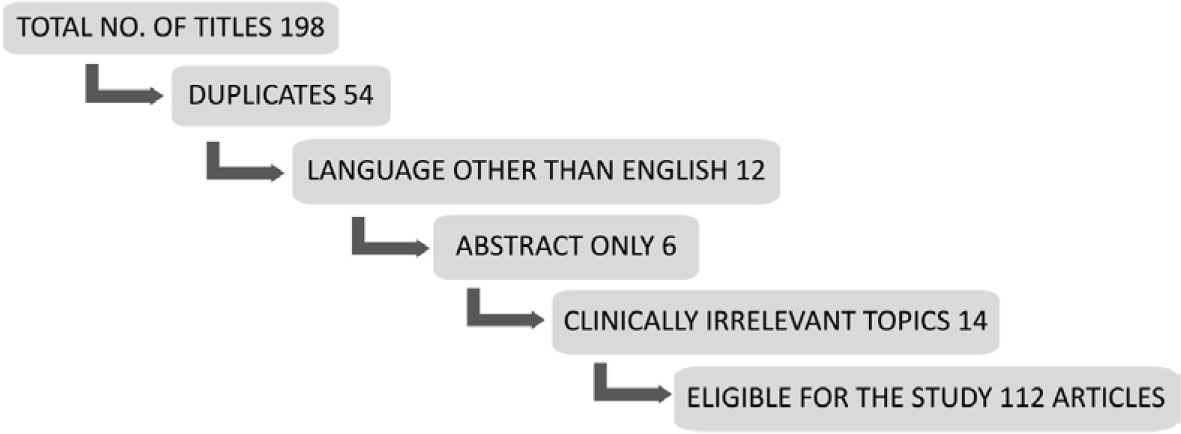
FIGURE 3.
Flowchart of article selection.
TABLE 1.
Results from literature analysis
| N | % | |
|---|---|---|
| SPECIALITY REPORTS | 112 | 100 |
| Otorhinolaryngology (ENT) | 32 | 28.6 |
| Emergency medicine | 26 | 23.2 |
| Orthopaedic surgery | 24 | 21.4 |
| Other | 19 | 17 |
| Neurology | 11 | 9.8 |
| PATIENTS TOTAL | 231 | 100 |
| Sex: women:men | 121:110 | 52.4:47.6 |
| Age (years) | 22–78 | 46.7 |
| Median | ||
| No comorbidities | 224 | 96 |
| Acute onset (24–72 hours) | 208 | 91 |
| LEADING SYMPTOMS | ||
| Neck pain | 231 | 100 |
| Neck immobility | 222 | 96 |
| Odynophagia | 210 | 91 |
| Trismus | 35 | 15 |
| Torticollis | 11 | 5 |
| Stridor | 1 | 0.4 |
| Dysarthria | 1 | 0.4 |
| Vertigo | 1 | 0.4 |
| DIAGNOSTIC WORKUP | ||
| Mild to moderate increase in CRP and/or total leucocyte count | 216 | 93 |
| CT | 111 | 43 |
| CT + MR | 120 | 47 |
| Aspiration biopsy | 7 | 3 |
| DIFFERENTIAL DIAGNOSIS | ||
| Retropharyngeal abscess | 134 | 58 |
| Spondylodiscitis | 28 | 12 |
| Meningitis | 25 | 11 |
| Neck artery dissection | 4 | 1,7 |
| COURSE | ||
| Marked improvement within 2 weeks | 221 | 95 |
TABLE 2.
Differential diagnosis of the Retropharyngeal calcific tendinitis (RCT)
| Feature | RCT | Meningitis | Abscess | Discitis | Dissection | GON,CH |
|---|---|---|---|---|---|---|
| Neck pain | +++ | ++ | +++ | +++ | ++ | ++ |
| Fever | − | + | + | + | − | − |
| Photophobia | − | + | − | − | − | − |
| Nausea | − | + | − | − | −/+ | − |
| Decreased ROM | +++ | + (flexion) | ++ | ++ | − | −/+ |
| Odynophagia | ++/+ | − | ++ | −/+ | − | − |
| Long tract signs | − | − | − | −/+ | + | − |
[i] CH = cervicogenic headache; GON = greater occipital nerve neuralgia; ROM = range of movement
TABLE 3.
Radiological clues for differential diagnosis
| Differential diagnosis | |||
|---|---|---|---|
| Modality | RCT | ABSCESS | TUMOUR |
| X-RAY | May show calcifications | Prevertebral swelling | − Prevertebral swelling |
| CT | Calcifications LCM oedema |
|
|
| MR | May suggest calcifications LCM oedema | +Diffusion restriction (pus) | (Superior contrast resolution) |
[i] LCM = longus colli muscle