
TABLE 1.
International Society for the Study of Vascular Anomalies (ISSVA) classification for vascular anomalies 2018
| VASCULAR TUMORS | VASCULAR MALFORMATIONS | |||
|---|---|---|---|---|
| Benign | Locally aggressive | Malignant | Simple | Combined |
| Infantile hemangioma | Kaposiform hemangioendothelioma | Capillary malformation (CM) | CVM, CLM | |
| Congenital hemangioma | Retiform hemangioendothelioma | Lymphatic malformation (LM) | LVM. CLVM | |
| Tufted hemangioma | PILA. Dabska tumor | Epithelioid hemangioendothelioma | Venous malformation (VM) | CAVM |
| Spindle-cell hemangioma | Composite hemangioendothelioma | Angiosarcoma | Arteriovenous malformation (AVM) | |
| Epithelioid hemangioma | Kaposi sarcoma | Arteriovenous fistula | CLAVM | |
| Pyogenic granuloma | ||||
[i] AVM = arteriovenous malformation; CAVM = capillary arteriovenous malformation; CLAVM = capillary lymphatic arteriovenous malformation; CLM = capillary lymphatic malformations; CLVM = capillary lymphatic venous malformation; CM = capillary malformation; CVM = capillary venous malformations; LM = lymphatic malformation; LVM = lymphatic venous malformation; PILA – papillary intralymphatic angioendothelioma; VM - venous malformation
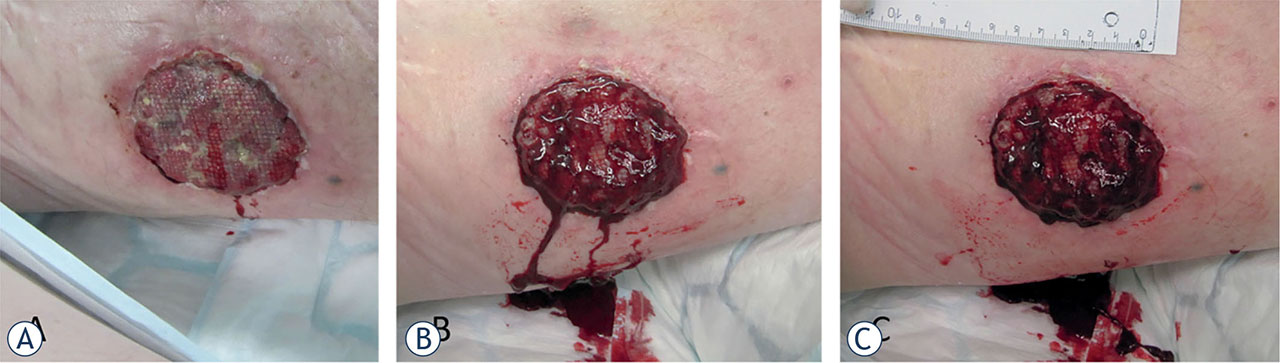
FIGURE 1.
Treatment of vascularized melanoma metastasis by electrochemotherapy. (A) Highly vascularized tumor before treatment. (B) Bleeding due to electrode insertion after application of electric pulses to the tumor. (C) Bleeding stopped immediately after electric pulse application.
TABLE 2.
| Reference | Type of malformation | N of pts | Bleomycin dose and concentration | Electrodes used | N of pulse applications | Response | Comment | |
|---|---|---|---|---|---|---|---|---|
| McMorrow et al., Br J Oral and Maxillofacial Surg 201744 | Venous malformation | 1 | Reduced dose: 1/3 of the standard dose | Not reported | Not reported | Considerable improvement after 6 unsuccessful sessions with bleomycin | Case report with poor respiratory function | |
| Horbach et al., Dermatologic Surgery 202045 | Hypertrophic capillary malformations | 5 pts. (out of 20 planned) | 0.25 mg or units/cm3 | Plate & needle | Not reported | 7–8 weeks DEROI (changes in colorimetry) Flux in ROI (in Perfusion Units) | Randomized controlled pilot trial | |
| Dalmady et al., Pediatrics 202043 | Lymphatic malformation | 1 | 0.5 mg/kg (5.4 mg) | Needle | 1st session: 68 applications 2nd session: 74 applications | 63% growth-corrected volume decrease. No recurrence at 18 months Follow up | Case report | |
| Wohlgemuth et al., Journal of Vascular Surgery 202140 | Venous malformations | 17 pts. (20 lesions) | Calculated based on the size of the lesion. C = 0.25 mg/mL Intralesional injection (25% concentration of standard bleomycin sclerotherapy) | Needle & finger | Not reported | 3-month post-therapy Changes in volume MRI: Volume reduction,%: | ||
| > 90% | 9 lesions | Retrospective observational case study | ||||||
| > 70% in < 90% | 6 lesions | |||||||
| > 50% in < 70% | 2 lesions | |||||||
| < 35% | 2 lesions | |||||||
| No response | 1 lesion | |||||||
| Kostusiak et al., Dermatologic Surgery 202242 | Various vascular malformations | 30 pts. VM: 17 AVM: 3 CVM LM: 2 Mixed: 2 | Calculated based on the size of the lesion. Bleomycin mixed with 1 mL plain 1% lidocaine Dose not reported | Needle & finger | Not reported | 17 Complete Response 7: significant improvement 1: moderate improvement 1: minor response 1: no response 3: active follow up | Prospective observational case study Electrosclerotherapy offered to non-responding patients to standard bleomycin | |
| Krt et al., Front Oncol 202241 | Arteriovenous malformation | 1 | 750 IU BLM intralesional | Plate | 15 | CR 18 months after BEST | Case report | |
[i] AVM = arteriovenous malformation; BLM = bleomycin; CVM = capillary venous malformations; VM - venous malformation; LM = lymphatic malformation;
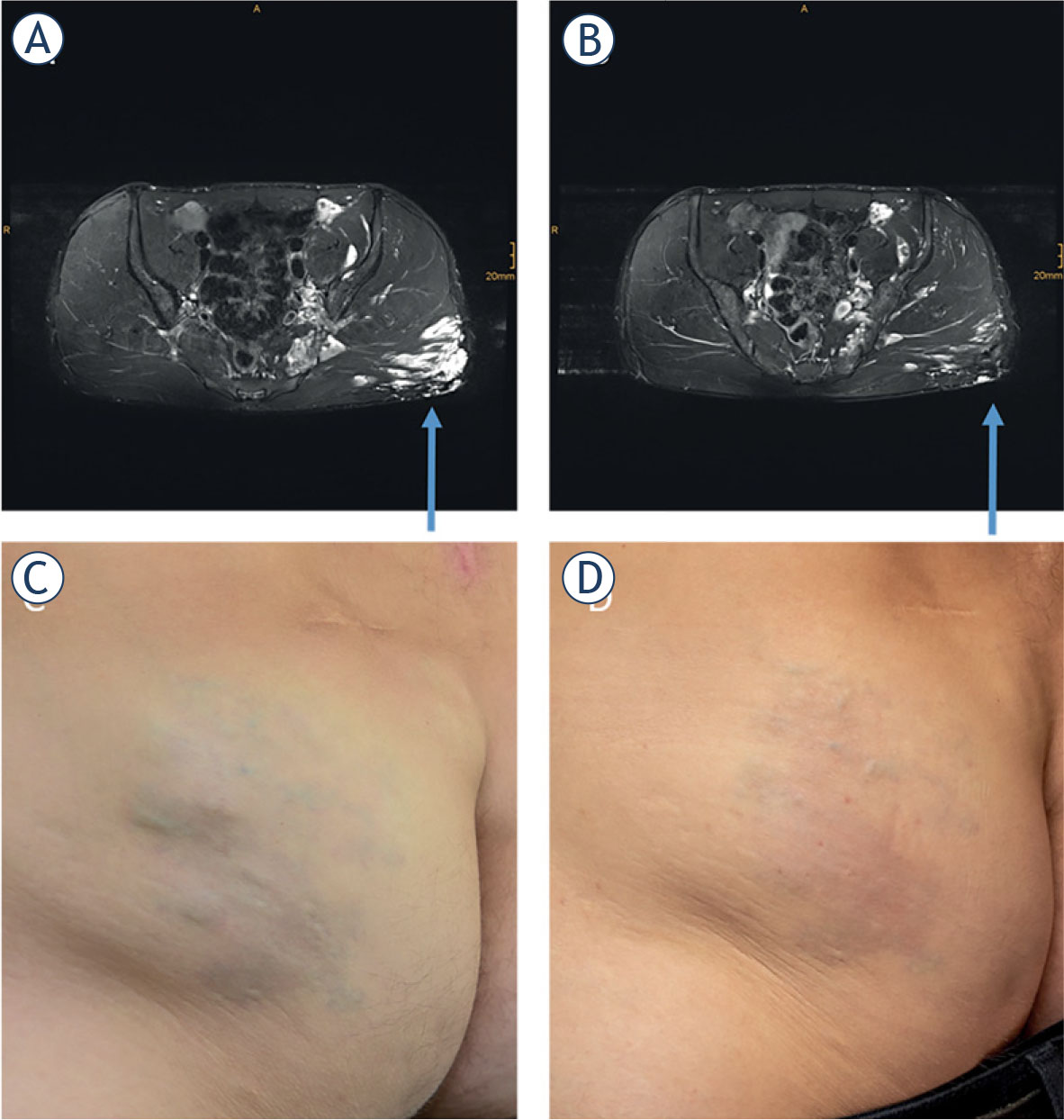
FIGURE 2.
Patient treated by BEST. Axial T2-weighted, fat-saturated MRI with hyperintense (arrow) gluteal venous malformation before treatment (A). Axial T2-weighted, fat-saturated MRI of the same region 4 months after treatment. The main part of the venous malformation is occluded (B). Photography before (C) and after the treatment (D).